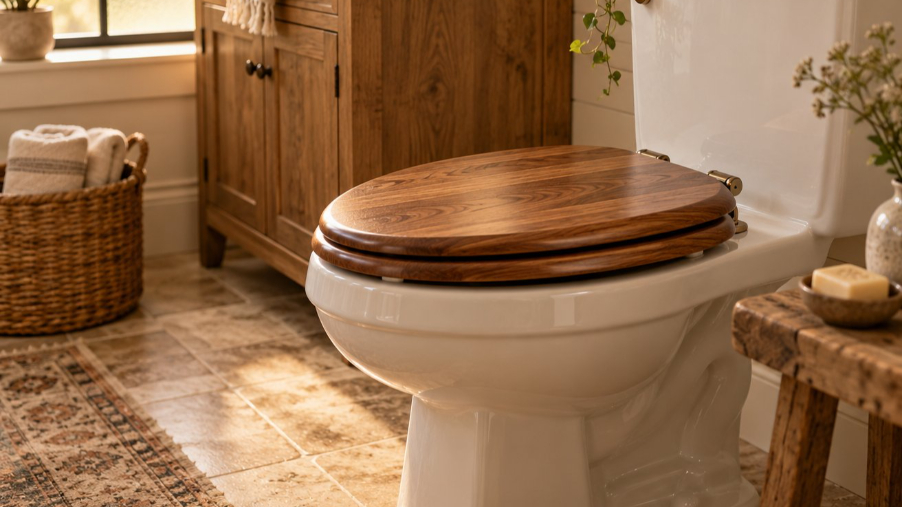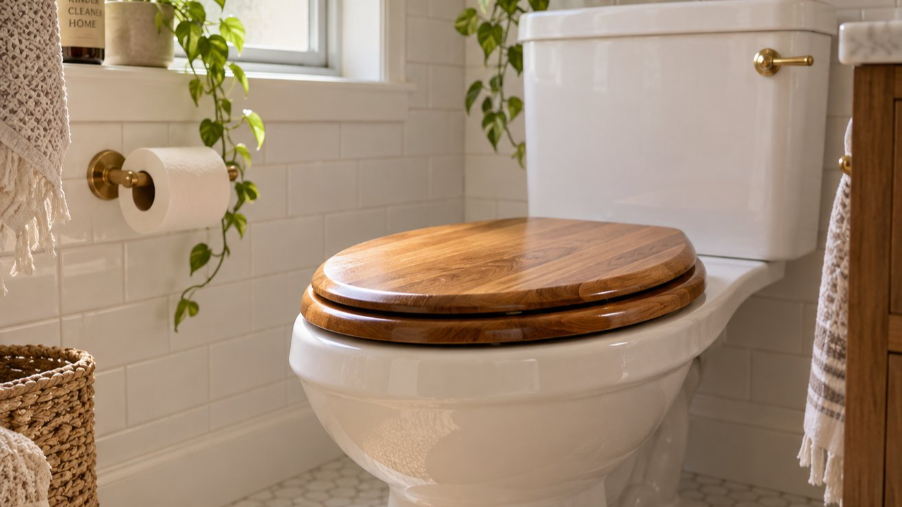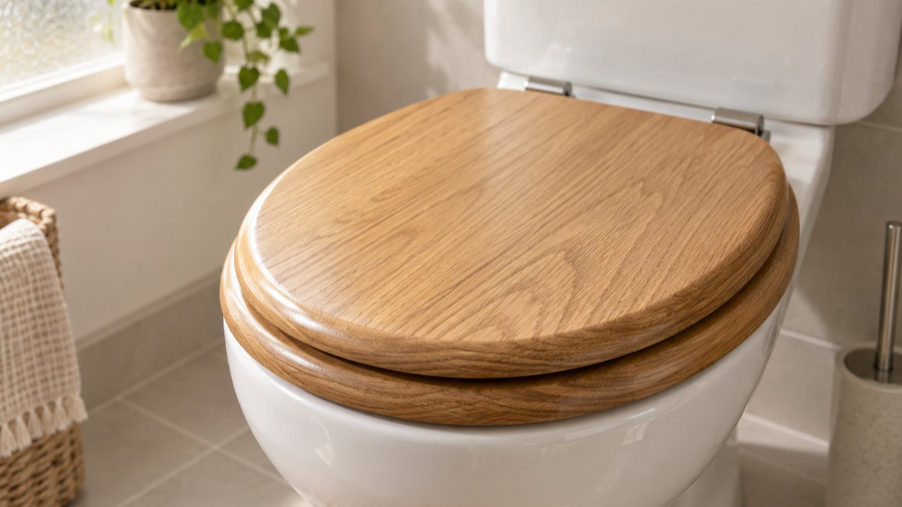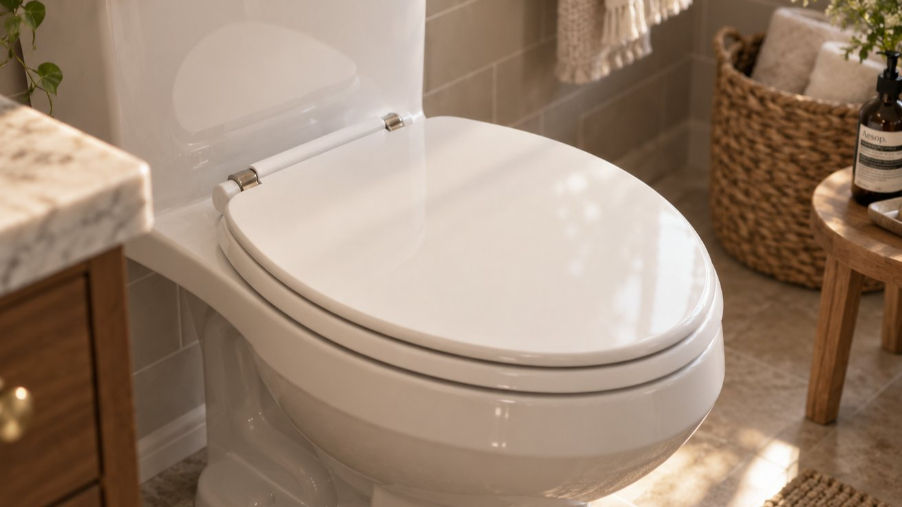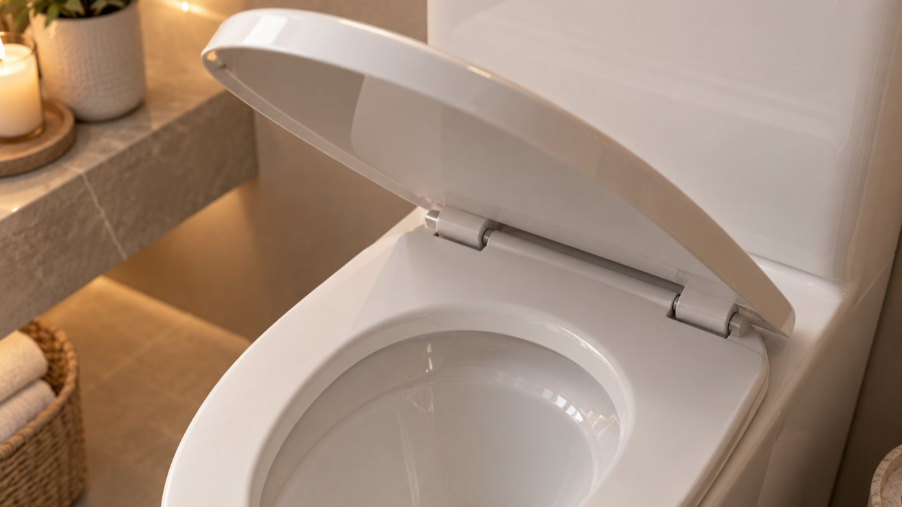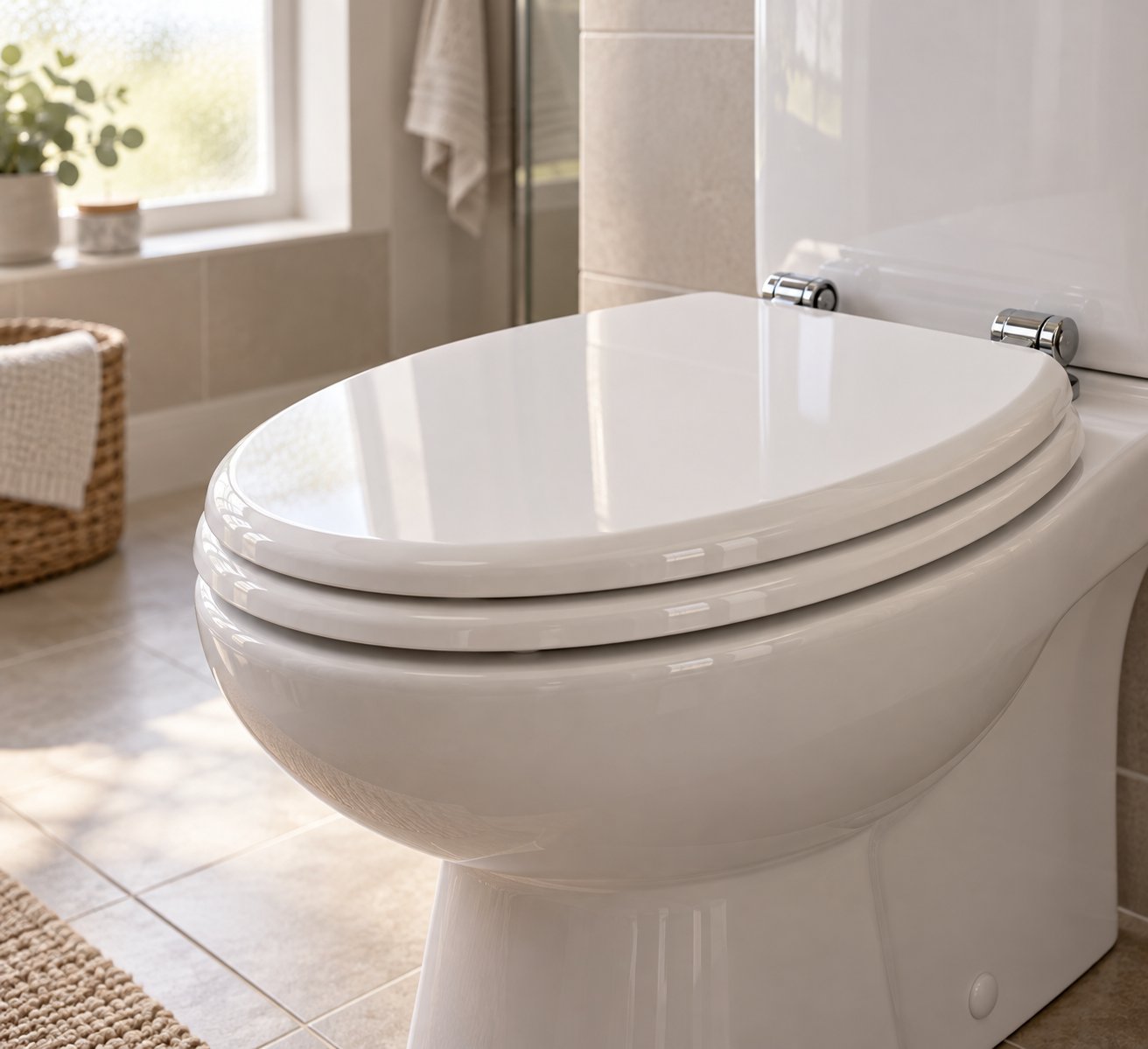
What a Moulded Wood Toilet Seat Actually Is
You're browsing for a new wood toilet seat, and the product descriptions throw around terms like "moulded wood," "molded wood," "compressed wood," and "wood effect" as if they all mean the same thing. They don't. And that confusion costs shoppers real money when the seat they receive looks or feels nothing like what they expected.
So let's clear it up right from the start.
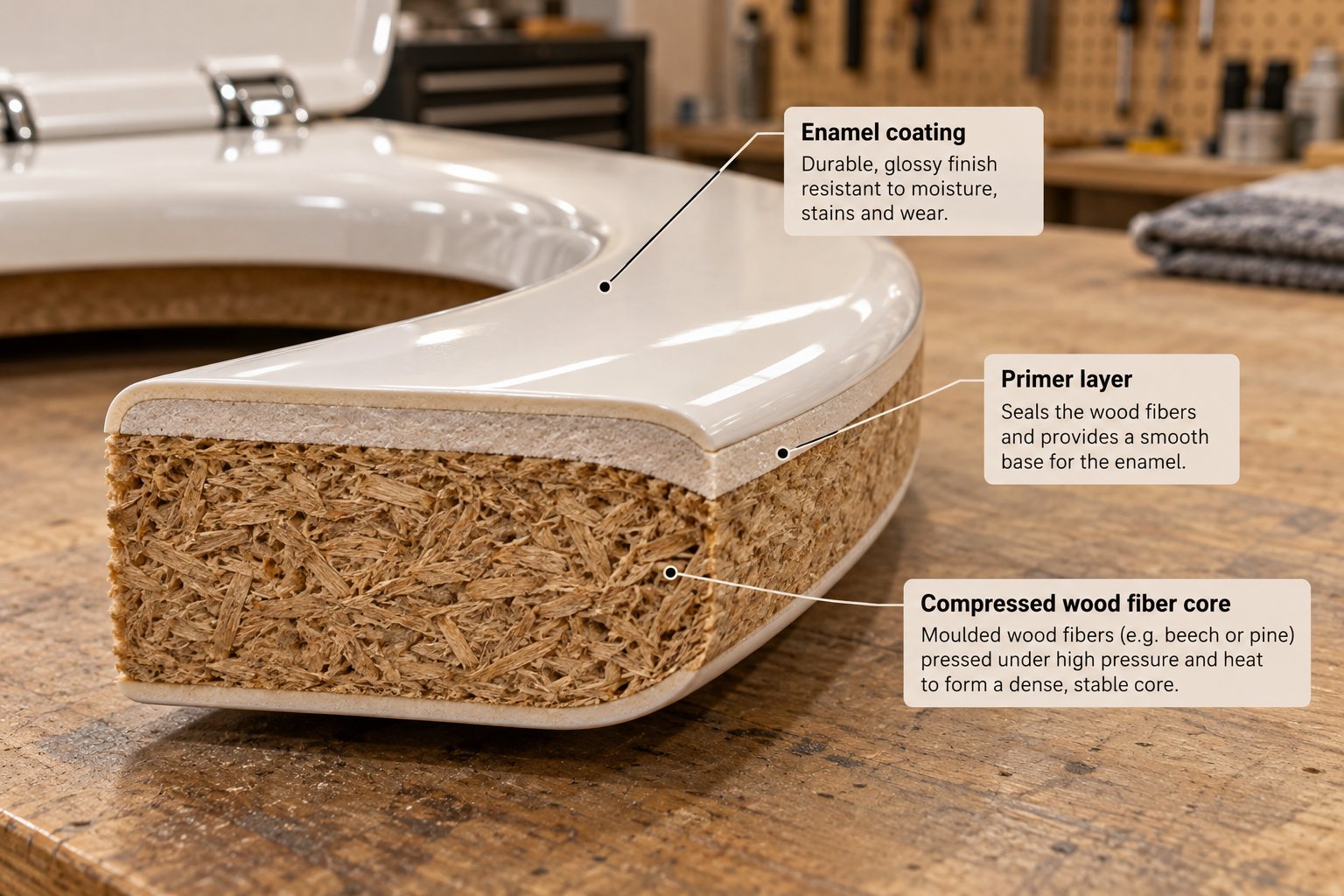
A moulded wood toilet seat is made from real wood fibers — typically collected from sawmill byproducts — that are bonded with synthetic resin, compressed under high heat and pressure into a dense, uniform shape, and then coated with multiple layers of enamel paint or lacquer to create a smooth, water-resistant bathroom fixture.
That single definition separates this product from every lookalike on the shelf. The key word is real wood fibers. The seat starts its life as actual timber, not as a petroleum-based polymer molded to resemble grain.
Compressed Wood Fibers, Resin, and Coating Explained
Imagine taking fine wood particles, mixing them with a binding resin, and then squeezing that mixture under enormous pressure while applying heat. The result is a blank that's denser and more uniform than natural timber — free from knots, grain splits, and the moisture pockets that cause solid wood to warp. Once machined into a seat and lid profile, the piece is sanded smooth and sealed with primer followed by several coats of enamel or lacquer. This outer shell is what gives the seat its glossy appearance and, more importantly, its ability to repel water in a high-humidity environment like a bathroom.
You'll notice these seats feel noticeably heavier than plastic alternatives. That weight comes directly from the compressed fiber core, and many homeowners actually prefer it — a wooden WC seat with some heft feels more substantial and secure on the bowl.
Why Moulded Wood Is Not the Same as Wood-Effect Plastic
Here's where the marketplace gets tricky. "Wood effect" or "wood-look" seats are made entirely from thermoplastic polymers like polypropylene. They feature a printed or textured surface designed to mimic timber grain, but there's zero actual wood inside. They're lighter, often cheaper, and behave like any other plastic seat — which means they can flex under load, feel cold to the touch, and lack the solid, premium character of genuine wooden lavatory seats.
A moulded wood toilet seat, by contrast, shares thermal properties with real timber. It feels warmer when you sit down on a cold morning, and it doesn't creak or flex the way thinner plastic can. Material comparisons from Bubblegum Bathrooms confirm that this warm, natural feel is one of the primary reasons buyers choose wood-based seats over polypropylene or even duroplast options.
Where Moulded Wood Fits in the Toilet Seat Market
The global toilet seat market was valued at USD 6.41 billion in 2025 and is projected to reach USD 11.69 billion by 2034. Within that landscape, ordinary (non-smart) seats still account for roughly 56% of sales, and moulded wood occupies a sweet spot inside that segment — positioned above budget polypropylene and below premium solid timber or high-tech smart seats.
For buyers who want a wooden seat toilet that looks and feels premium without the maintenance demands of raw oak or mahogany, compressed wood delivers exactly that balance. It suits traditional bathrooms, period properties, and anyone who simply prefers the tactile warmth of a wood-based product over cold plastic.
Understanding what's actually inside that glossy shell matters, though — because the manufacturing process directly shapes how the seat performs, how long it lasts, and what kind of care it needs over the years.
How Moulded Wood Toilet Seats Are Made
That glossy, weighty seat you pick up at the hardware store doesn't start out looking anything like a wooden toilet seat. It begins as a pile of fine wood particles — sawdust and shavings that would otherwise be discarded at the mill. The journey from loose fiber to finished product involves heat, pressure, chemistry, and precision machining, and each step directly influences how the seat performs once it's bolted to your bowl.
From Wood Fiber to Compressed Blank
Picture a sawmill floor at the end of a shift. Wood particles, shavings, and fine dust are swept up — byproducts of cutting lumber for furniture, flooring, and construction. Rather than going to waste, these fibers become the raw ingredient for moulded wood toilet seats.
Manufacturers collect and dry these wood fibers to a controlled moisture content, then blend them thoroughly with a synthetic binding resin. The resin acts as the glue that will hold everything together under stress. This mixture is poured into a steel mold shaped roughly like a seat-and-lid blank, and then comes the critical transformation.
A hydraulic press applies intense pressure — often several hundred tons — while simultaneously heating the mold. The combination of force and temperature causes the resin to cure and the wood fibers to fuse into a single, rock-solid panel. The result is a dense, uniform blank with no knots, no grain direction, and none of the internal voids that make natural timber unpredictable. As Bofan Seats explains, this compression-molding approach produces a highly consistent internal structure that resists the warping and cracking common in solid wood alternatives.
Shaping, Machining, and Surface Coating
A raw compressed blank doesn't look much like a wooden toilet yet. It needs to be machined into the familiar oval profile — seat ring, lid, and hinge mounting points — using CNC routers and cutting equipment that carve smooth, dimensionally accurate shapes from the dense material.
Here's the full production sequence from raw fiber to finished product:
- Fiber collection and drying — Wood particles from sawmill byproducts are gathered and dried to a uniform moisture level.
- Resin blending — Dried fibers are mixed with a synthetic binding resin to create a consistent, moldable compound.
- Compression molding — The blended material is loaded into steel molds and compressed under high heat and pressure, fusing into a solid blank.
- CNC machining — The blank is cut, routed, and drilled into precise seat and lid profiles, including bolt-hole locations.
- Sanding and priming — Machined surfaces are sanded smooth and coated with a primer layer that seals the wood fiber core.
- Multi-layer enamel or lacquer coating — Several coats of enamel paint or lacquer are applied and cured, building up the glossy, water-resistant shell that defines the seat's finished appearance.
Each coating layer matters. The primer bonds to the porous fiber core, and the enamel or lacquer on top provides the moisture barrier that keeps bathroom humidity from reaching the wood inside. Skip a layer or apply it too thin, and you'll eventually see bubbling or peeling — a quality difference that separates a well-made seat from a bargain-bin one.
How the Process Affects Durability and Weight
This manufacturing method produces two characteristics you'll notice immediately: weight and rigidity. A moulded wood toilet seat is noticeably heavier than a comparably sized plastic seat — typically around 2 to 3 kilograms versus under 1 kilogram for standard polypropylene. That heft comes from the compressed fiber density, and it's one reason these seats feel so much more solid and secure when placed on the bowl.
Rigidity is the other defining trait. Unlike thermoplastic seats that flex slightly under body weight, compressed wood doesn't give. It holds its shape over years of daily use, and the uniform internal structure means there are no weak spots where stress could concentrate — something you can't guarantee with natural timber that has variable grain patterns running through it.
The trade-off? That same rigidity means an elongated molded wood toilet seat won't absorb impact the way a flexible plastic lid might. Drop it hard enough and it can crack rather than bounce. It's a limitation worth knowing, and it directly shapes how you should handle installation, cleaning, and everyday use — topics that become especially important when you start comparing this material against its main market rivals.
Moulded Wood Compared to Solid Wood and Plastic
Knowing how a toilet seat molded wood is manufactured only tells half the story. The real question most buyers wrestle with is simpler: how does it stack up against the alternatives sitting right next to it on the shelf? Solid timber, various plastics, and MDF-core seats all compete for the same spot on your bowl — and each brings a different mix of strengths and compromises to the bathroom.
Rather than declaring one material the automatic winner, let's lay the facts out honestly so you can match the right seat to your actual priorities.
| Criteria | Moulded Wood | Solid Wood | Plastic (Thermoset / Thermoplastic) | MDF-Core |
|---|---|---|---|---|
| Weight | Medium-heavy (2–3 kg) | Heavy (2.5–4 kg) | Light (0.5–1.5 kg) | Medium (1.5–2.5 kg) |
| Moisture Resistance | Good — relies on intact enamel coating | Moderate — needs regular sealing | Excellent — non-porous material | Fair — vulnerable if coating is breached |
| Warmth to Touch | Warm | Warm | Cold initially | Warm |
| Price Range | $20–$60 | $40–$120+ | $15–$75 | $20–$50 |
| Durability | High — rigid, stable structure | High — but prone to warping in humidity | Moderate to high — flexes under load | Moderate — lower density than moulded wood |
| Finish Options | Wide — painted enamel, lacquer, custom colors | Limited — natural grain, stains, clear coats | Wide — molded colors, printed patterns | Moderate — painted or laminated |
| Environmental Considerations | Uses sawmill waste; resin binders add chemical processing | Natural material; requires harvested timber | Petroleum-based; long decomposition time | Uses wood fiber; resin and adhesive content varies |
That table gives you the overview, but the real nuances emerge when you compare these materials head to head.
Moulded Wood vs Solid Wood Seats
Imagine running your hand across a beautifully finished mahogany toilet seat — the visible grain, the richness of the natural color. Solid wood seats deliver an aesthetic that no factory process can fully replicate. Oak, pine, bamboo, and exotic hardwoods each bring unique grain patterns and a sense of craftsmanship that appeals to decorators designing rustic, heritage, or luxury bathrooms.
The problem is the bathroom itself. It's one of the most humid rooms in any home, and solid timber reacts to moisture. Over time, even a well-sealed wooden seat toilet can absorb humidity through micro-cracks in its finish, leading to warping, expansion, or surface cracking. Industry data from Bofan Seats confirms that solid wood seats are more sensitive to humidity and temperature fluctuations, which can cause expansion, contraction, and eventual structural issues that compressed alternatives largely avoid.
Moulded wood sidesteps these vulnerabilities because its compressed fiber core has no grain direction and no natural moisture pathways. The dense, uniform structure doesn't expand or contract the way natural timber does. You sacrifice the exposed wood-grain beauty, but you gain a stable, crack-resistant seat that holds its shape in a steamy bathroom year after year.
Price is another clear divider. Solid wood seats typically range from $40 to $120 or more, driven by raw material costs and labor-intensive production. Moulded wood seats, produced efficiently through compression molding, usually land between $20 and $60 — delivering much of the tactile warmth of real timber at roughly half the cost.
Moulded Wood vs Plastic and Thermoset Alternatives
Plastic dominates the global toilet seat market for obvious reasons: it's cheap, lightweight, and nearly immune to moisture. Polypropylene (thermoplastic) seats can cost as little as $15, and thermoset options like urea-formaldehyde or duroplast offer harder, more scratch-resistant surfaces at a slightly higher price point.
So why would anyone choose a heavier, more expensive enameled wood toilet seat over plastic? The answer usually comes down to feel. Plastic seats are cold to the touch on winter mornings, and thinner thermoplastic models can flex noticeably under body weight. That flex doesn't mean they'll break, but it creates a less secure, less premium sensation. User satisfaction surveys compiled by Horow consistently rank wood-based seats higher for comfort while noting that plastic scores better for long-term hygiene confidence, thanks to its non-porous surface.
Thermoset plastics — particularly urea-formaldehyde resin — deserve a separate mention. These seats are harder than standard polypropylene, resist scratches well, and can mimic a glossy, almost porcelain-like finish. They're a genuine competitor to moulded wood in the mid-range bracket. The trade-off is still warmth: thermoset plastic doesn't retain body heat the way a wood-fiber core does.
Durability comparisons depend on the type of stress involved. Plastic seats flex and absorb impact; drop a polypropylene lid onto the bowl and it bounces. Drop a moulded wood lid with the same force and you risk a crack, because its rigid structure doesn't give. On the other hand, plastic seats can scratch, thin out at stress points, and eventually loosen on the hinge bolts more quickly due to their lighter weight. Laboratory testing data from Horow suggests wooden seats can last 10 to 20 years with medium maintenance, while plastic typically falls in the 5-to-10-year range.
Weight, Warmth, and Environmental Trade-Offs
Weight is a double-edged characteristic. A heavier seat feels solid and stays put on the bowl, reducing the wobble that plagues lightweight plastic alternatives. But that extra mass also means soft-close hinges need to work harder — the damping mechanism must control a heavier lid, which affects hinge selection and longevity. If you're upgrading from a flimsy plastic seat, the difference in heft is immediately noticeable and, for most people, reassuring.
Warmth matters more than many shoppers realize until they experience both options. Because the compressed wood-fiber core shares thermal properties with natural timber, a moulded wood seat doesn't shock you with cold contact the way polypropylene or ceramic does. In cooler climates or unheated bathrooms, that warmth alone can justify the price difference.
Environmental impact is where honesty gets uncomfortable. Moulded wood seats do use sawmill byproducts — particles and dust that would otherwise be landfilled or burned — so there's a genuine waste-reduction benefit. However, the synthetic resin binders (often urea-formaldehyde or phenol-formaldehyde) and multiple coats of enamel or lacquer introduce chemical processing that solid timber seats avoid. Plastic seats carry their own environmental burden: petroleum-derived raw materials and extremely slow decomposition in landfills. MDF-core seats occupy a middle ground, using wood fibers at a lower compression density, which can mean less resin per unit but also less durability in wet conditions.
No single material wins on every count. The honest takeaway? If you value a warm, rigid, premium-feeling seat at a moderate price and you're willing to handle it with reasonable care, moulded wood earns its place. If budget and pure moisture immunity are your top priorities, plastic makes sense. And if nothing but the natural grain beauty of real oak or mahogany will do, solid wood rewards your investment — as long as you commit to the upkeep.
Material choice sets the foundation, but it doesn't guarantee a good fit on your specific toilet. Getting the shape and dimensions right is the next critical step — and one that trips up more buyers than you'd expect.
Round and Elongated Shapes and How to Measure
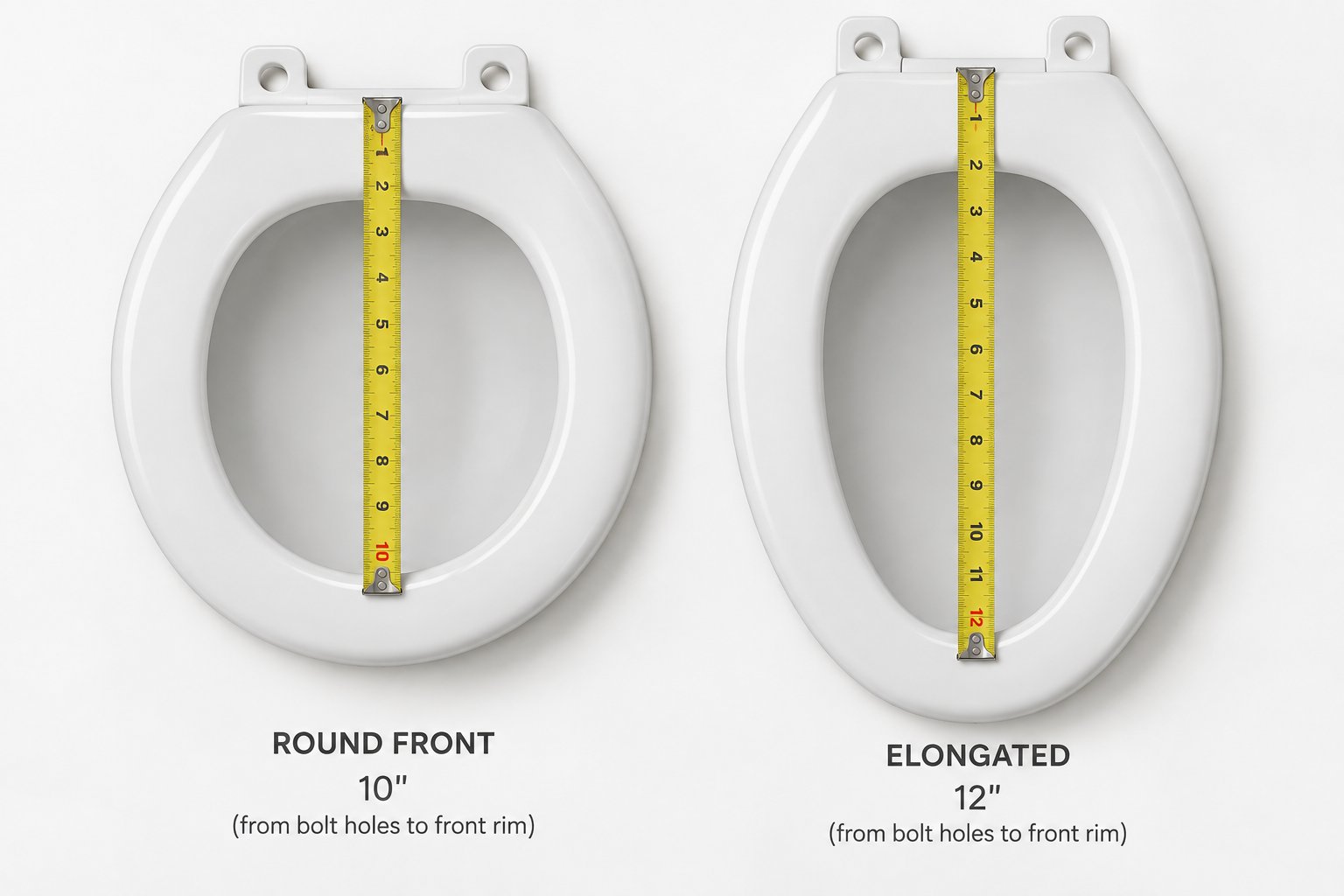
A perfectly built wood seat means nothing if it doesn't match your bowl. And yet, ordering the wrong shape is one of the most common — and most easily preventable — mistakes buyers make. Toilet bowls come in two standard profiles in the North American market: round front and elongated. Each requires a different seat footprint, and moulded wood manufacturers produce dedicated molds for both. Grab the wrong one and you'll end up with an awkward overhang at the front or, worse, a seat that falls short of the rim, leaving an exposed gap that looks sloppy and feels uncomfortable.
The good news? You can figure out which shape you need in under two minutes with tools you already own.
How to Measure Your Toilet Bowl in Three Steps
Before you start, gather these basic items:
- Tape measure — a flexible one works, but a rigid steel tape is easier to hold steady.
- Pencil — to mark the center point between your mounting bolt holes if they're covered by caps.
- Straightedge — a ruler or level laid across the bolt holes helps pinpoint the exact center line.
Here's the process:
- Locate the mounting bolt holes. These are the two holes at the back of the bowl where the seat hinges attach. If plastic caps cover them, pop those off.
- Find the center point. Lay your straightedge across the two bolt holes and mark the midpoint with your pencil. This is your measurement origin.
- Measure to the front rim. Extend your tape measure from that center mark straight forward to the very front edge of the bowl rim. Read the distance.
That single number tells you nearly everything you need to know. Approximately 16.5 inches means you have a round front bowl. Approximately 18.5 inches means you have an elongated bowl. Simple as that.
Round Front vs Elongated Seat Dimensions
The two-inch difference between round and elongated shapes might sound minor, but it changes the entire seating profile. Round bowls are more compact — common in smaller bathrooms, powder rooms, and older homes where space is tight. Elongated bowls extend further forward, offering a larger seating area that many people find more comfortable for everyday use. Most wood toilets sold in new construction today feature elongated bowls, though round models remain popular for half-baths and apartment renovations.
Here's a side-by-side comparison of the key dimensions:
| Dimension | Round Front | Elongated |
|---|---|---|
| Bolt holes to front rim | ~16.5 inches (42 cm) | ~18.5 inches (47 cm) |
| Overall seat width | ~14–14.5 inches | ~14–14.5 inches |
| Bolt-hole spacing (center to center) | 5.5 inches (14 cm) | 5.5 inches (14 cm) |
| Typical use | Small bathrooms, powder rooms, older homes | Master baths, new construction, ADA compliance |
Notice that the width and bolt-hole spacing stay the same across both shapes. The only real variable is the front-to-back length. That consistency is actually helpful — it means the hinge hardware is interchangeable between round and elongated seats from the same manufacturer, so if you accidentally buy the wrong shape, you can swap the wood seat itself without needing new mounting bolts.
Bolt-Hole Spacing and Compatibility Checks
Nearly all residential toilets in the United States and Canada use a standardized bolt-hole spacing of 5.5 inches, measured from the center of one hole to the center of the other. This has been the industry norm for decades, so a moulded wood toilet seat from virtually any manufacturer will align with your existing bowl.
That said, a quick verification never hurts — especially if you own an imported toilet, a vintage model, or a wall-hung unit with non-standard geometry. Measure the center-to-center distance between your bolt holes before ordering. If it deviates significantly from 5.5 inches, you may need a seat with adjustable hinge brackets or one designed specifically for your toilet brand.
Also pay attention to the bolt-hole diameter. Most wood toliet seat mounting hardware uses bolts that fit through holes roughly 3/8 inch in diameter, but some European-designed bowls feature slightly different sizing. A few seconds with your tape measure at the bolt holes can save you a frustrating return trip to the store.
Getting the right shape and confirming bolt-hole compatibility ensures the seat sits flush, looks clean, and feels stable from day one. But shape alone doesn't determine long-term satisfaction — the hinge system connecting that seat to the bowl plays an equally critical role in how the seat performs every single day.
Hinge Types and Soft-Close Mechanisms That Matter
You've picked the right shape, confirmed the bolt-hole spacing, and chosen a beautifully finished white wood toilet seat that matches your bathroom decor. Everything should be perfect — and yet, six months later, the seat wobbles, the lid slams, or the hinges leave rust marks on the porcelain. What went wrong?
Almost always, it's the hinges. The seat material gets all the attention on product packaging, but the hinge system quietly determines whether your daily experience is smooth and silent or annoying and short-lived. A premium compressed-wood seat paired with flimsy hinges will disappoint you faster than a basic seat mounted on well-engineered hardware.
Understanding the different hinge categories — and especially how soft-close damping actually works — puts you in a much stronger position to choose a wood toilet lid that performs as well as it looks.
Standard, Quick-Release, and Bottom-Fix Hinges
Hinges do more than hold the seat on the bowl. They dictate how the lid opens and closes, how easy the seat is to remove for cleaning, and how securely everything stays aligned over years of use. Here are the main types you'll encounter when shopping for solid wood toilet seats or moulded wood models:
- Standard top-mount hinges — The most common design. Bolts insert from the top of the bowl through the hinge brackets and are secured with wing nuts or hex nuts underneath. Simple, affordable, and compatible with nearly every residential toilet. The drawback? Removing the seat for deep cleaning requires unscrewing the bolts entirely, which can be tedious — especially if corrosion has set in.
- Bottom-fix hinges — Instead of bolting from above, these fasten from underneath the bowl rim using expanding rubber or plastic anchors. You'll find them more often on European-style toilets and certain concealed-cistern designs. They create a cleaner top surface with no visible bolt heads, but installation and removal take a bit more effort.
- Quick-release hinges — A game-changer for hygiene. These allow you to detach the entire seat and lid from the mounting brackets with a simple push-button or lever mechanism — no tools required. The brackets stay bolted to the bowl, and the seat lifts straight off. This makes it easy to clean around the bolt area, the back of the bowl rim, and the underside of the seat where grime loves to hide. If you've ever struggled to scrub around fixed hinges, you'll appreciate this design immediately.
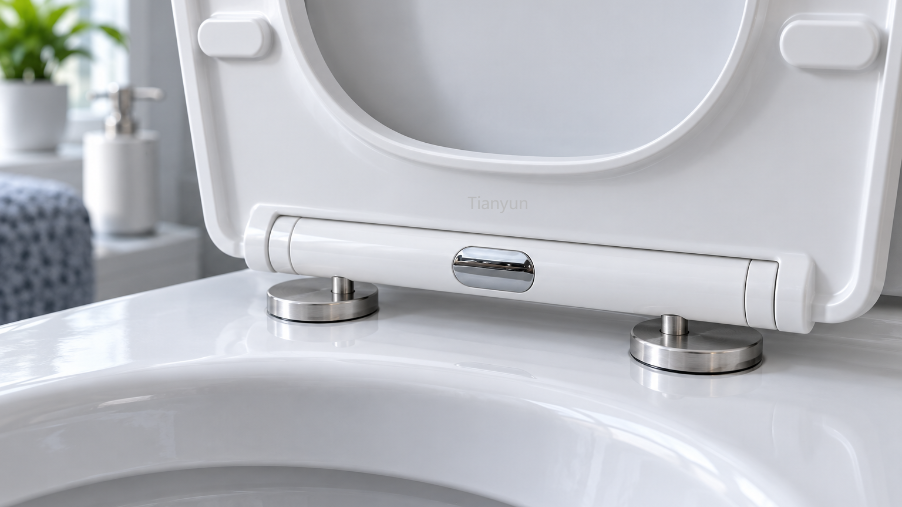
- Soft-close (slow-close) hinges — These integrate a damping mechanism that controls the speed at which the lid and seat descend. Instead of slamming shut, the lid glides down gently and silently. Many modern elongated toilet seat wood models come with soft-close hinges as standard, and for good reason — they protect the seat finish, reduce noise, and prevent small fingers from getting caught.
Some manufacturers combine these features. You can find quick-release hinges with built-in soft-close damping, giving you the convenience of easy removal and the comfort of a silent close in one package. These combination hinges tend to cost a few dollars more, but for most households, the convenience is well worth it.
How Soft-Close Dampers Work Inside the Hinge
Ever wondered what's actually happening inside a soft-close hinge when the lid drifts down in that controlled, almost theatrical slow motion? The secret is a small component called a rotary damper — a precision-engineered device tucked inside the hinge body where you can't see it.
Here's how it works. A rotary damper contains a sealed chamber filled with a viscous silicone-based fluid. When you release the toilet lid, gravity pulls it downward, which rotates the hinge spindle. That rotation forces the internal fluid through precisely sized channels or past vanes inside the damper. The resistance created by pushing thick fluid through narrow passages is what slows the lid's descent. The heavier the lid — and a moulded wood seat is heavier than plastic, remember — the more carefully the damper's torque must be calibrated to achieve a smooth, consistent closing speed.
Three engineering variables define how well a soft-close hinge performs:
- Torque setting — The amount of rotational resistance the damper produces. Too little torque and a heavy wood seat still closes too fast. Too much and the lid barely moves, frustrating the user.
- Closing speed — A well-tuned damper brings the lid from fully open to fully closed in roughly 5 to 7 seconds. This range feels natural — fast enough to be convenient, slow enough to be silent.
- Lifespan — Quality dampers are rated for tens of thousands of open-close cycles. Over time, however, the sealing components and damping fluid can degrade, especially in cheaper units. When a soft-close hinge starts slamming after a year or two, it's usually the internal damper that has worn out rather than the hinge structure itself.
This is why hinge engineering matters so much at the component level. Toilet seat manufacturers developing wood, MDF, resin, or metal seat assemblies need dampers that match the specific weight and dimensions of their product. Tianyun's MDF and metal toilet seat damper solutions illustrate how this works in practice — their platform offers configurable hinge dimensions, torque settings, and mounting designs tailored to different seat materials. It's a component solutions resource rather than a finished seat retailer, but if you're curious about how soft-close damping systems are engineered at the manufacturing level, it provides a useful deeper dive into the technology behind the hinges.
For the everyday buyer, the practical takeaway is straightforward: not all soft-close hinges are equal. A quality damper matched to the weight of a compressed-wood seat will deliver years of quiet, consistent performance. A cheap damper will lose its resistance within months, leaving you with a heavy lid that slams just like the old seat you replaced.
Choosing a Hinge Finish That Matches Your Bathroom
Hinges aren't just mechanical — they're visible. On most toilet seats, the hinge caps or brackets sit right at the back of the bowl where they catch the eye every time you enter the room. The finish you choose contributes to the overall look of your bathroom, especially if you've already coordinated your faucets, towel bars, and cabinet hardware in a matching metallic tone.
The most common hinge finish options include:
- Chrome-plated — Bright, mirror-like, and by far the most popular choice. Chrome pairs well with modern and transitional bathroom designs and matches the majority of faucet finishes on the market. It's also the easiest to clean — a quick wipe removes water spots and fingerprints.
- Brushed nickel — A softer, muted metallic tone with a slightly textured appearance. Brushed nickel suits contemporary bathrooms and coordinates well with stainless steel fixtures. It hides fingerprints and minor scratches better than polished chrome.
- Oil-rubbed bronze or antique finishes — Darker, warmer metallic tones that complement traditional, rustic, or heritage-style bathrooms. If you've installed an antique wooden toilet seat or a period-appropriate fixture, bronze-toned hinges reinforce that aesthetic cohesion.
- White or color-matched plastic caps — Many moulded wood seats ship with plastic hinge covers that match the seat color. These are unobtrusive and work in any bathroom, though they lack the premium look of exposed metal hardware.
When evaluating hinge finishes, think about what else is visible in the room. Mismatched metals — say, chrome hinges next to brushed-gold faucets — create a subtle visual clash that can undermine an otherwise polished bathroom design. If your bathroom hardware is all one tone, matching the hinge finish takes about ten seconds of thought and makes a surprisingly big difference in the finished look.
Quality hinges keep the seat stable, the lid quiet, and the aesthetics coordinated. But even the best hardware won't help if the seat isn't installed correctly — and a moulded wood seat's extra weight introduces a few installation nuances that plastic seats simply don't have.
Step-by-Step Installation Without a Plumber
A moulded wood toilet seat arrives in the box with all the mounting hardware you need — bolts, nuts, washers, and hinge brackets. You don't need a plumber. You don't even need much experience. What you do need is a bit of patience and the right approach, because the extra weight of a compressed-wood seat introduces a couple of wrinkles that lightweight plastic models never present.
Before you tear open the packaging, gather these items and lay them within arm's reach:
- Adjustable wrench — for gripping nuts underneath the bowl rim.
- Penetrating oil (such as WD-40 or PB Blaster) — essential if your old bolts are corroded or frozen in place.
- Pliers — a backup gripping tool for stubborn hardware or tight spaces.
- Flathead or Phillips screwdriver — to hold or turn the bolt head from above.
- Towel or soft cloth — to protect the porcelain rim from scratches during the swap.
Everything on that list is probably already in your toolbox. With it all ready, the entire job takes about 15 minutes.
Removing Your Old Toilet Seat Safely
Start by giving the old seat and the bowl rim a quick wipe-down — you'll be working close to these surfaces, and a clean workspace is more pleasant and more hygienic.
- Expose the bolt heads. Look at the back of the seat where the hinges meet the bowl. Most loo seats wooden or plastic have small plastic caps covering the bolt heads. Pop these open with a flathead screwdriver or your fingernail.
- Attempt to loosen the nuts by hand. Reach underneath the bowl rim and feel for the wing nuts or hex nuts that secure each bolt. Try turning them counterclockwise. If they spin free, great — remove the nuts and washers and pull the bolts straight up.
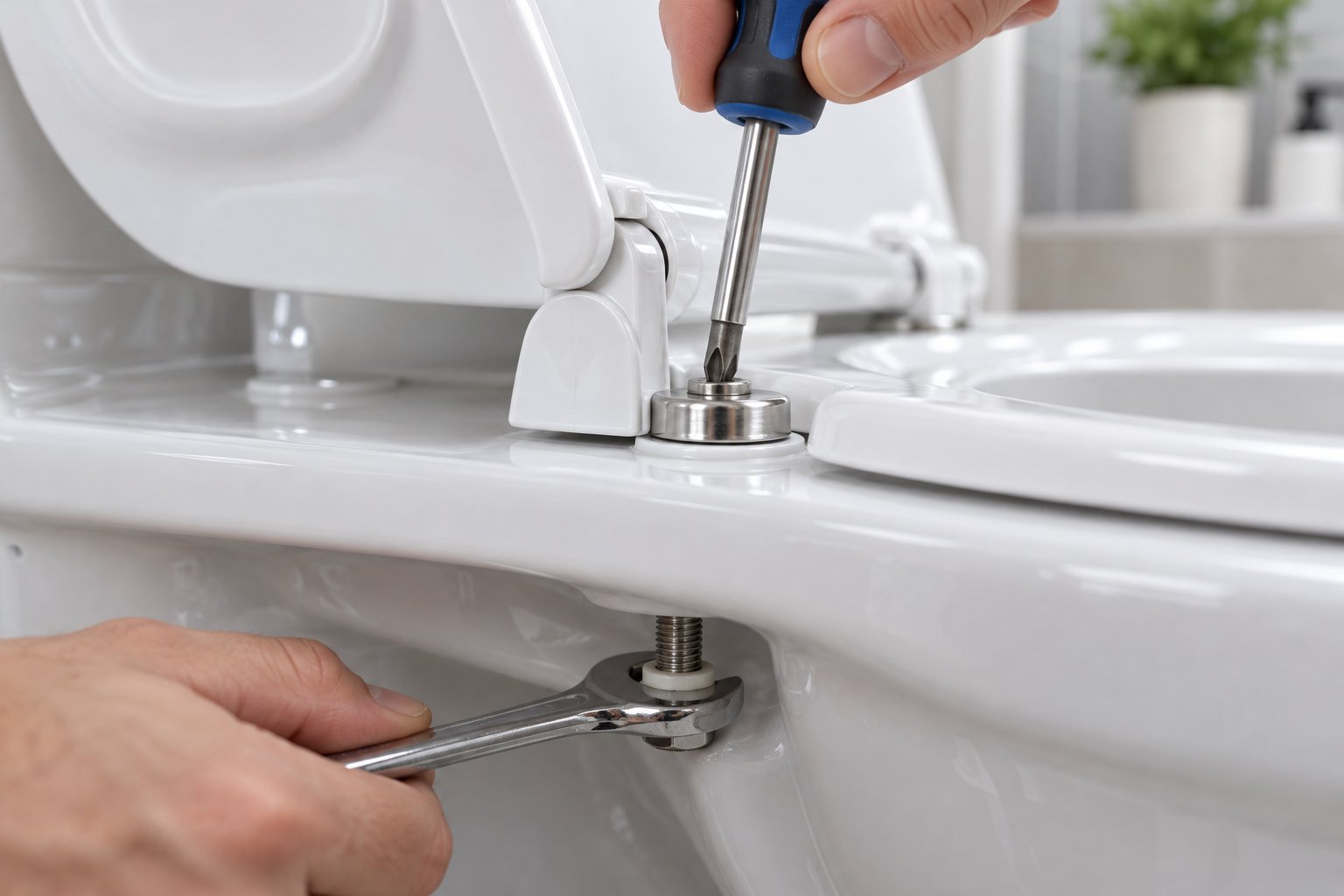
- Tackle corroded bolts. If the nuts won't budge — and on older seats, they often won't — spray the bolt threads and nut with penetrating oil and wait five to ten minutes. Then grip the nut from below with your adjustable wrench while holding the bolt head steady from above with a screwdriver. Turn the wrench counterclockwise. In extreme cases where rust has welded the hardware together, a small hacksaw can cut through the bolt shank just above the nut — a trick plumbers use routinely.
- Lift off the old seat. Once both bolts are free, lift the old seat and hinges straight up and off the wooden toilet bowl. Set them aside for recycling or disposal.
With the old seat removed, take a moment to clean the bolt-hole area on the bowl rim. Grime, mineral deposits, and old washer residue accumulate here for years, and this is the easiest access you'll ever have to that spot.
Positioning and Securing the New Moulded Wood Seat
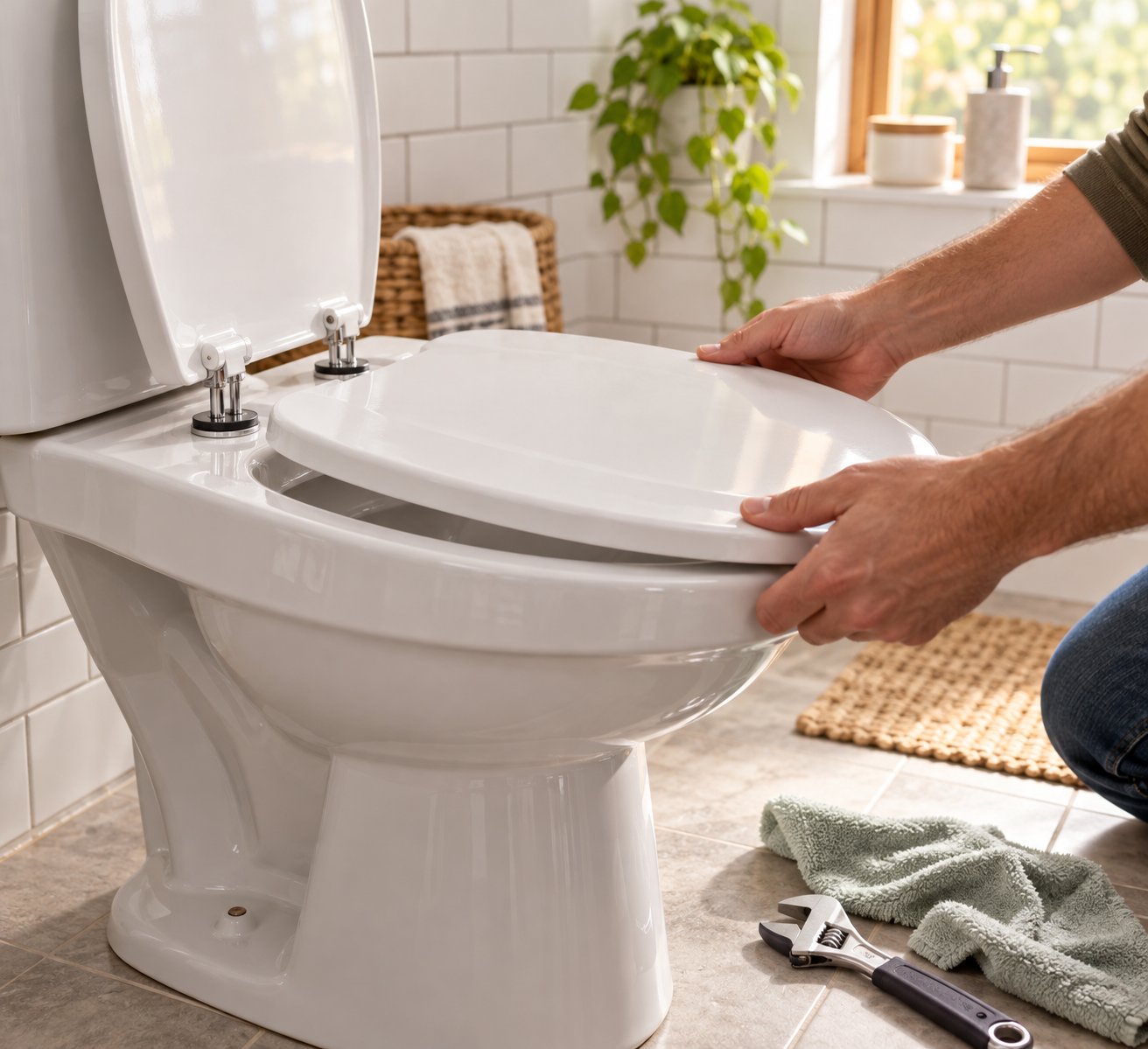
Here's where the weight difference matters. A plastic seat weighs under a kilogram — you can hold it in place with one hand while threading bolts with the other. A moulded wood seat weighs two to three times that, which makes a clumsy one-handed grip a recipe for scratching the porcelain or misaligning the bolt holes.
Drape your towel or soft cloth over the back edge of the bowl rim before positioning the new seat. This creates a buffer that protects the glazed surface if the heavier seat shifts during alignment.
- Unpack and inspect. Remove the seat from its packaging and confirm all mounting hardware is included — typically two bolts, two nuts, and a set of washers. If your seat features a wood grain toilet seat finish or specialty coating, check for any shipping damage on the painted surface before installing.
- Set the seat on the bowl. Lower the seat gently onto the rim, aligning the hinge bolt holes with the mounting holes in the porcelain. Support the seat's weight with both hands during this step to prevent it from sliding forward and scratching the bowl.
- Insert the bolts. Feed each bolt down through the hinge bracket hole and through the corresponding hole in the bowl. The bolt head should sit on top; the threaded end hangs below the rim.
- Hand-tighten the nuts. Reach underneath and thread a washer (if included) onto each bolt, followed by the nut. Turn the nuts clockwise by hand until they feel snug against the underside of the bowl rim. Do not reach for the wrench yet.
- Check alignment. Open and close the lid. Shift your weight gently on the seat. Is it centered? Does the front edge sit evenly on the bowl rim without favoring one side? If the seat is slightly off-center, loosen the nuts a quarter-turn, reposition, and hand-tighten again.
- Final tightening. Once the seat is perfectly aligned, use your adjustable wrench to snug each nut an additional quarter-turn beyond hand-tight. Hold the bolt head from above with a screwdriver to prevent it from spinning. Alternate between the two sides — a half-turn on the left, then a half-turn on the right — so the seat draws down evenly.
- Snap hinge covers into place. If your hinges include plastic caps, press them down over the bolt heads for a clean, finished look.
Give the seat one last jiggle test. It should feel rock-solid with zero lateral movement. Open and close the lid a few times to confirm the soft-close mechanism (if equipped) operates smoothly and the seat doesn't shift during use.
Avoiding Over-Tightening and Common Installation Mistakes
The single most damaging mistake during installation isn't a loose bolt — it's a bolt cranked too tight. Porcelain is strong under compression but brittle under point stress. An over-tightened mounting bolt can crack the ceramic around the bolt hole, turning a 15-minute job into a full toilet replacement. The compressed-wood seat itself can also fracture at the hinge point if the bolt pulls the material past its limit.
Follow this simple rule: tighten until the seat doesn't wobble, then add one final quarter-turn. Stop there. If the seat still shifts after that, the problem isn't insufficient torque — it's likely a washer missing, a bolt that's too short, or a mounting hole that's slightly oversized and needs a rubber bushing to fill the gap.
A few more pitfalls worth knowing:
- Skipping the washer. Washers distribute clamping pressure across a wider area. Without them, the nut bears directly on the porcelain — increasing the risk of a stress crack and allowing the nut to loosen faster from vibration.
- Ignoring the towel step. That protective cloth takes three seconds to place and saves you from scratches you can never buff out of a glazed bowl. Moulded wood seats are heavy enough that even a small slip during positioning can leave a mark.
- Forgetting to test soft-close operation before final tightening. If the lid binds, catches, or doesn't close smoothly, the hinges may need minor repositioning. It's far easier to adjust alignment while the nuts are still hand-tight than after you've locked everything down with a wrench.
With the seat securely mounted and the lid closing quietly, your installation is complete. The real test, though, is how the seat holds up over months and years of daily use — and that depends almost entirely on how you clean and maintain the lacquered finish that keeps moisture from reaching the wood-fiber core inside.
Cleaning and Maintaining a White Wooden Toilet Seat Over Time
That glossy lacquered shell isn't just decoration — it's the single barrier standing between your bathroom's humidity and the compressed wood fibers inside. Every cleaning decision you make either preserves that barrier or slowly erodes it. And here's what most product labels fail to mention: the same aggressive bathroom cleaners you trust on porcelain and tile can quietly destroy a moulded wood toilet seat's finish within months.
Treat the coating right, and you'll get years of service from a seat that still looks showroom-fresh. Treat it carelessly, and you'll notice dullness, discoloration, and eventually peeling that exposes the vulnerable core beneath.
Safe Cleaning Products for Coated Wood Surfaces
The golden rule is simple: gentle products, soft materials, minimal moisture. You're cleaning a painted and lacquered surface, not raw porcelain, so the approach needs to be different from how you scrub the rest of the toilet.
Here's what works safely on white wooden toilet seats and other coated finishes:
- Mild liquid dish soap diluted in warm water — a few drops in a bowl of water creates a solution strong enough to cut through everyday grime without attacking the enamel.
- Non-abrasive bathroom spray cleaners — look for formulas labeled "gentle" or "for delicate surfaces." Many multi-surface sprays fall into this category.
- White vinegar solution (diluted) — a 50/50 mix of white vinegar and water handles light mineral deposits and soap scum. Spray it on, wipe it off promptly, and rinse with a damp cloth.
- Soft microfiber cloths or cotton rags — these won't scratch the lacquer the way rougher materials can.
Apply your chosen cleaner to the cloth first rather than spraying it directly onto the seat. This gives you control over how much liquid contacts the surface and prevents excess moisture from pooling around the hinge points or along the seat's edges — two areas where the coating is thinnest and most vulnerable to penetration.
Equally important is knowing what to keep away from the finish. These products cause the most damage to white wooden toilet seats and coated surfaces in general:
- Bleach-based cleaners — sodium hypochlorite is highly effective on porcelain but attacks painted and lacquered coatings. Prolonged or repeated contact strips the surface gloss, causes micro-cracking, and accelerates yellowing on white finishes.
- Abrasive scrubbing pads and steel wool — these scratch through the enamel layer, exposing the primer or raw wood fiber underneath. Once that happens, moisture seeps in and the damage compounds rapidly.
- Harsh chemical sprays containing ammonia or strong oxidizers — these degrade the resin bonds in the lacquer, dulling the finish and weakening its moisture-blocking ability.
- Toilet bowl cleaners applied to the seat — products designed to sit inside the bowl (tablets, gel clips, thick pour-on formulas) contain concentrated acids or chlorine that should never contact the seat surface.
Sounds restrictive? It's really not. A soft cloth, a squirt of dish soap, and thirty seconds of wiping is all most cleaning sessions require. The seat isn't a high-scrub surface like a shower floor — light, frequent cleaning beats occasional heavy-duty attacks every time.
Preventing Yellowing on White Moulded Wood Seats
If you've ever seen an older white wooden toilet seat that has turned a dingy cream or pale yellow, you've witnessed what happens when the lacquer's chemistry breaks down over time. Yellowing is the number-one cosmetic complaint among owners of white-finished moulded wood seats, and it has three primary triggers.
First, chemical exposure. Cleaning products containing strong oxidizing agents — chlorine bleach being the biggest offender — react with the compounds in enamel and lacquer coatings. Each exposure might seem harmless, but the cumulative effect over dozens of cleanings gradually shifts the surface color from bright white toward yellow. The fix is straightforward: stop using bleach on the seat entirely.
Second, residual moisture. Wiping the seat with a damp cloth and then closing the lid traps moisture between the seat and the bowl rim. That warm, humid pocket accelerates chemical changes in the finish. After every cleaning session, dry the seat thoroughly with a clean towel — top, bottom, and especially the edges where water loves to linger.
Third, poor bathroom ventilation. A bathroom that stays steamy long after showers creates a persistently humid environment that stresses any lacquered surface. Running an exhaust fan during and for ten to fifteen minutes after showering reduces ambient moisture levels significantly. If your bathroom lacks a fan, cracking a window achieves the same effect. Good airflow benefits every surface in the room, but the painted finish of a moulded wood seat is particularly sensitive to sustained humidity.
Can yellowing be reversed once it sets in? Unfortunately, mild surface yellowing is usually permanent — the discoloration occurs within the lacquer itself, not on top of it. Some owners have had limited success applying a thin coat of automotive polishing compound to restore slight brightness, but deep yellowing typically means the seat has reached the end of its cosmetic life even if it remains structurally sound.
When to Inspect the Underside Coating
Most people never flip their toilet seat over to look at the bottom — and that's exactly why problems develop unnoticed. The underside of the seat and the inner face of the lid sit closest to the bowl water and bear the brunt of splash, condensation, and humidity. If the coating on these hidden surfaces chips or wears thin, moisture creeps into the compressed wood core and starts softening it from within.
Make a habit of checking the underside every few months. Lift the seat, flip it gently, and look for these warning signs:
- Small chips or flaking paint — especially near the hinge attachment points and along the inner rim edge where the seat contacts the bowl.
- Soft or spongy spots — press firmly with your thumb in a few areas. A healthy moulded wood surface feels uniformly hard. Any give suggests moisture has penetrated the core.
- Bubbling or lifting of the coating — tiny blisters in the enamel indicate trapped moisture underneath, a sign that the protective layer has been breached.
- Discoloration or dark staining — water absorption often shows as darkened patches on the underside long before any damage is visible from above.
Catching a small chip early gives you the option of sealing it with a dab of waterproof enamel or clear nail polish — a quick field repair that can extend the seat's life by months or even years. Ignoring it lets humidity work its way deeper into the fiber core, eventually leading to swelling, cracking, or structural weakening that no touch-up can fix.
Consistent, gentle cleaning and a quick underside check a few times a year keep the finish intact and the wood fibers protected. But what happens when something does go wrong — a wobble develops, the finish chips, or the surface cracks? Those situations call for targeted fixes, and knowing the right response for each problem saves you from replacing a seat that might still have plenty of life left.
Common Molded Wood Toilet Seat Problems and How to Fix Them
Your seat is installed, the finish looks great, and the soft-close lid drifts shut without a sound. Fast-forward six months or a year, and reality introduces itself. A slight wobble. A yellowish tinge on that once-bright white surface. A hairline crack you swear wasn't there last week. These aren't signs of a defective product — they're the predictable wear patterns of a molded wood toilet seat that every owner eventually encounters but almost no product listing bothers to explain.
The good news? Each of these issues has a clear cause and a practical fix. Knowing what to look for — and how to respond — can extend your seat's useful life by years and save you from replacing something that just needs a bit of attention.
Here's a quick-reference overview before we dig into the details:
| Problem | Likely Cause | Recommended Fix |
|---|---|---|
| Wobbly or shifting seat | Mounting bolts have loosened from repeated use; washers may be worn or missing | Retighten bolts with a screwdriver and wrench; add rubber washers for extra grip; replace hardware if threads are stripped |
| Yellowing or discoloration | Exposure to bleach-based cleaners, UV light, or sustained humidity degrading the lacquer | Switch to mild, non-bleach cleaners; improve ventilation; replace the seat if yellowing is deep and irreversible |
| Cracking from impact or weight | Dropping the lid forcefully or standing/sitting on the closed lid — compressed wood is rigid and does not flex like plastic | For minor cracks, apply wood glue, clamp, and let cure overnight; for structural fractures, replace the seat entirely |
| Paint chipping or peeling | Friction at hinge contact points, abrasive cleaners, or moisture penetrating a weak spot in the coating | Seal small chips with waterproof enamel or clear nail polish; avoid abrasive pads; replace the seat if peeling is widespread |
Each of these problems deserves a closer look, because the right intervention at the right time makes all the difference.
Fixing a Wobbly or Shifting Seat
A molded toilet seat that slides sideways or rocks when you sit down is more than annoying — it puts uneven stress on the mounting hardware and the porcelain around the bolt holes. Left unchecked, that constant movement can widen the holes, strip bolt threads, and eventually make a secure fit impossible without replacing the hardware entirely.
The fix usually takes less than five minutes. Pop open the hinge caps, hold the bolt head from above with a screwdriver, and tighten the nut underneath with an adjustable wrench. Turn clockwise, alternating between both sides to keep the seat centered. As noted in Horow's toilet seat tightening guide, the target is snug-plus-a-quarter-turn — firm enough to eliminate movement, but not so forceful that you risk cracking the porcelain.
If the seat keeps loosening every few weeks, the underlying hardware is the culprit, not your technique. Plastic wing nuts wear down over time, and metal nuts can corrode in a humid bathroom. Adding a rubber washer between the nut and the underside of the bowl rim introduces friction that resists loosening. If the bolt threads are visibly stripped or the nut spins freely without gripping, pick up a universal toilet seat mounting kit from any hardware store — they're inexpensive and include fresh bolts, nuts, and anti-slip washers that restore a rock-solid connection.
Dealing With Yellowed or Chipped Finishes
Yellowing is the cosmetic issue that frustrates wooden toilet cover owners the most, especially those who chose a bright white finish to match their bathroom suite. You clean the seat regularly, yet somehow it gradually shifts from crisp white to a dull, creamy yellow. What gives?
The primary driver, as discoloration research from RoomFix explains, is chemical interaction between the lacquer coating and strong cleaning agents — particularly bleach. Chlorine-based cleaners react with the compounds in enamel, and each cleaning session deposits a tiny amount of chemical change that accumulates over months. UV exposure from bathroom windows and persistent humidity compound the effect.
Can you reverse it? Mild surface yellowing sometimes responds to a paste of baking soda and water gently buffed across the surface with a soft cloth. Some owners report slight improvement from a light application of automotive polishing compound. But if the discoloration has penetrated into the lacquer itself — and it usually has by the time it's clearly visible — no amount of surface treatment will restore the original white. At that stage, replacement is the most practical path forward.
Paint chipping is a related but distinct problem. It tends to appear first at the hinge contact points, where the seat and lid meet the brackets during every open-close cycle. Friction gradually wears through the enamel at these high-contact edges. You'll also see chipping along the front rim if the seat gets bumped regularly against the bowl or tank. Small chips can be sealed with a dab of waterproof enamel touch-up paint or even clear nail polish — the goal is to block moisture from reaching the exposed wood fiber underneath. If large sections of coating are peeling or flaking, the protective barrier is fundamentally compromised, and the seat should be replaced before moisture infiltrates the core.
Preventing Cracks From Impact and Weight
Here's the trade-off most shoppers don't anticipate. A molded wood toilet seat feels premium precisely because it's rigid — it doesn't flex, creak, or bow under normal use. But that rigidity also means it can't absorb sudden impact the way a thermoplastic seat can. Drop a polypropylene lid from full height and it bounces. Drop a compressed-wood lid with the same force and there's a real chance it fractures.
Cracking typically happens in two scenarios. The first is a lid that slams shut — either because the soft-close damper has worn out or because the seat never had one. The repeated shock of hard landings stresses the material at the hinge attachment points, where the seat is thinnest and most vulnerable. The second scenario is standing or kneeling on the closed lid — reaching for a high shelf, changing a light bulb, or a child climbing up. Compressed wood can support standard seated body weight without issue, but concentrated loads on a closed lid exceed its designed stress tolerance.
For minor surface cracks that haven't split the seat in two, a targeted repair with wood glue can work. Remove the seat from the bowl, gently pry the crack open slightly, inject wood glue into the gap using a nozzle-tipped dispenser, wipe away any excess immediately, and clamp the crack closed. Leave the clamp on overnight to allow the glue to cure fully, then reinstall. This buys you additional months or even years of service.
For deep structural fractures — cracks that run through the full thickness or cause the seat to feel unstable — replacement is the only safe option. A cracked seat can pinch skin, collapse under load, or shed sharp fragments of coated wood fiber.
Prevention is far simpler than repair:
- Use soft-close hinges — they eliminate slamming, the single biggest cause of impact damage on a molded wood toilet seat.
- Never stand or kneel on the closed lid — use a step stool instead.
- Teach children not to drop the lid — soft-close mechanisms help here, but awareness matters too.
- Support the seat's weight during installation and removal — avoid letting it drop or bang against the porcelain rim.
Most of these problems are avoidable with basic awareness and a few minutes of periodic maintenance. But knowing that certain issues exist — and recognizing them early — is exactly what separates an owner who gets a decade of service from their seat and one who replaces it every couple of years. The real question left is whether this material suits your household in the first place, because the best troubleshooting strategy of all is choosing the right seat for your specific situation from the start.
Who Should Choose a Moulded Wood Toilet Seat
You've seen how these seats are built, what can go wrong, and how to maintain the finish. The material itself is sound — but that doesn't automatically make it the right pick for every bathroom or every household. A seat that's perfect for a couple renovating a period cottage might be completely wrong for a landlord furnishing twenty rental units on a tight budget. The smartest buying decision starts with an honest look at your own priorities.
Let's match the material to the person.
Best Scenarios for Choosing Moulded Wood
Certain situations play directly to the strengths of compressed wood construction — that combination of warmth, rigidity, moderate cost, and finish versatility. If any of the following profiles sound like you, this material deserves serious consideration:
- Budget-conscious buyers who still want a premium feel — Moulded wood seats typically fall in the $20 to $60 range, placing them well below solid timber options that can run $40 to $120 or more. Yet they deliver a weight, warmth, and solidity that cheap polypropylene can't match. If you want your bathroom to feel a notch above builder-grade without spending accordingly, this is the sweet spot.
- Aesthetics-focused decorators coordinating a bathroom design — Because the compressed-wood core accepts multiple coats of enamel, lacquer, or decorative paint, manufacturers offer these seats in classic white, matte finishes, glossy options, and even custom colors. Hunting for an antique wooden toilet seat vibe to complement a Victorian-style bathroom? Moulded wood provides a stable, warp-resistant substrate for heritage-inspired decorative coatings — ornate painted patterns, aged-look finishes, and period-appropriate color palettes that solid timber or plastic can't replicate as convincingly. Think of it as a blank canvas that holds any aesthetic you throw at it.
- Families with children — A heavier seat stays put on the bowl and resists the constant shifting that lighter plastic seats suffer under active use. The rigid construction handles everyday wear better than thin thermoplastic, and the enamel surface wipes clean easily after the inevitable mess. One strong recommendation here: pair the seat with a wooden soft close toilet seat hinge system. The damped closing mechanism protects small fingers from getting caught in a slamming lid — a genuine safety concern that emergency rooms see more often than you'd expect.
- Renters looking for a quick, reversible upgrade — Swapping a toilet seat takes about fifteen minutes and requires no permanent changes to the apartment. If the existing seat is a scratched, yellowed eyesore, replacing it with a clean moulded wood model instantly elevates the bathroom's appearance. When you move out, you simply unbolt your seat, reinstall the original, and take the upgrade with you to the next place. It's one of the highest-impact, lowest-commitment bathroom improvements a renter can make.
- Hotel and rental property owners — Industry sources note that moulded wood seats are widely used in hotels, rental apartments, and commercial spaces because they balance durability, consistent quality from batch to batch, and a price point that makes large-volume purchasing practical. The uniform manufacturing process means unit 500 looks and performs identically to unit one — something handcrafted solid wood can't guarantee.
When a Different Material Might Serve You Better
Honesty matters more than a sale. There are situations where moulded wood isn't the ideal choice, and pretending otherwise wastes your money.
- You need the lightest possible seat — If physical limitations make lifting a heavier lid uncomfortable, or you're outfitting an accessible bathroom where ease of use is paramount, a lightweight polypropylene or thermoset plastic seat at under one kilogram is the better call. Compressed wood seats weigh two to three times that, and no amount of hinge engineering fully offsets the difference in lid weight.
- You want visible, natural wood grain — The entire surface of a moulded wood seat is painted or lacquered. You'll never see the timber fibers underneath. If exposed oak grain, the rich tones of a mahogany toilet seat, or the natural warmth of bamboo is what draws you, only a genuine solid wood seat delivers that experience. Yes, it costs more and demands more maintenance — but for some homeowners, the aesthetic payoff justifies both.
- Maximum moisture immunity is the priority — Bathrooms with poor ventilation, high foot traffic, or frequent splashing (think shared family baths with young children) push any coated surface to its limits. Plastic seats are inherently non-porous — moisture can't penetrate even if the surface is scratched. An enamel potty seat or any painted wood product, by contrast, depends on its coating remaining intact. If you know your bathroom environment is especially harsh, plastic removes that vulnerability entirely.
- You want a high-tech smart seat — Bidet seats, heated seats, and other electronic toilet seat platforms are built on plastic or resin shells designed to house wiring and plumbing components. Moulded wood isn't used in this segment. If smart features are on your wish list, you're shopping in a completely different product category.
Matching Seat Style to Your Bathroom Design
Beyond the practical checklist, there's a design dimension worth thinking through. A moulded wood toilet seat is one of the most visible fixtures in the room — you see it every time you walk in. Getting the style right ties the whole space together; getting it wrong creates a subtle but persistent visual mismatch.
For modern, minimalist bathrooms with clean lines and white ceramics, a glossy white moulded wood seat blends seamlessly. The smooth enamel surface echoes the porcelain of the bowl, creating a unified, streamlined look. For traditional or cottage-style bathrooms, specialty finishes — a painted wood-grain pattern, a soft cream tone, or a heritage color — give the seat character without the maintenance burden of raw timber. And for eclectic or vintage-inspired spaces, the ability to pair a decoratively coated seat with coordinating metal hinge finishes (brushed nickel for industrial tones, oil-rubbed bronze for period authenticity) allows a level of customization that plastic simply doesn't support as convincingly.
Ultimately, the right toilet seat is the one that matches three things at once: your bathroom's dimensions, your household's daily demands, and your aesthetic vision for the space. A moulded wood toilet seat won't win every comparison on every criterion — no material does. But for the majority of homeowners looking for a seat that feels solid, looks polished, cleans easily, and lasts for years without demanding constant attention, it remains one of the most sensible choices on the market.
Frequently Asked Questions About Moulded Wood Toilet Seats
1. What is a moulded wood toilet seat made of?
A moulded wood toilet seat is constructed from real wood fibers — typically sawmill byproducts like sawdust and shavings — bonded together with synthetic resin under high heat and pressure. The resulting dense, uniform blank is then machined into a seat shape, sanded, primed, and coated with multiple layers of enamel paint or lacquer. This layered coating creates the water-resistant shell that protects the compressed wood core from bathroom humidity, giving the seat a glossy finish and a noticeably heavier, more substantial feel compared to standard plastic alternatives.
2. How long does a moulded wood toilet seat last?
With proper care, a moulded wood toilet seat can last 10 to 20 years. Longevity depends heavily on maintaining the protective enamel or lacquer coating that seals the compressed wood core. Using mild, non-bleach cleaners, drying the seat after cleaning, ensuring good bathroom ventilation, and periodically inspecting the underside for chips or soft spots all help extend its lifespan. Pairing the seat with quality soft-close hinges also prevents impact damage from slamming, which is one of the leading causes of premature cracking.
3. Is a moulded wood toilet seat better than plastic?
It depends on your priorities. Moulded wood feels warmer to the touch, carries a solid and premium weight, and resists flexing under body weight — qualities that many homeowners prefer over plastic. However, plastic seats are lighter, fully non-porous (meaning moisture cannot penetrate even if scratched), and generally cheaper. For buyers who value comfort and a substantial feel at a mid-range price, moulded wood is often the better choice. For those prioritizing the lightest weight or maximum moisture immunity in a high-humidity bathroom, plastic may be more practical.
4. Why is my white moulded wood toilet seat turning yellow?
Yellowing on white moulded wood seats is primarily caused by repeated exposure to bleach-based or strong oxidizing cleaners that chemically react with the lacquer coating over time. Persistent bathroom humidity and UV light from windows can accelerate the discoloration. To slow or prevent yellowing, switch to mild soap-and-water cleaning, dry the seat thoroughly after each wipe-down, and improve bathroom ventilation with an exhaust fan. Unfortunately, once yellowing penetrates into the lacquer itself, it is usually irreversible, and seat replacement becomes the most effective solution.
5. How do soft-close hinges work on a moulded wood toilet seat?
Soft-close hinges contain a small internal rotary damper filled with viscous silicone fluid. When you release the lid, gravity pulls it downward, rotating the hinge spindle and forcing the fluid through narrow channels inside the damper. This resistance slows the lid's descent to a gentle, silent close over roughly 5 to 7 seconds. Because moulded wood seats are heavier than plastic, the damper's torque must be carefully calibrated to match the lid's weight. Manufacturers like Tianyun offer configurable damper solutions with adjustable torque settings and mounting designs for wood, MDF, resin, and metal seat assemblies.
Apply This Insight to Your Project
Tell us what you are building and how the topic “Moulded Wood Toilet Seat: What Nobody Tells You Before Buying” relates to your application. Our engineering team can help evaluate the next step.