

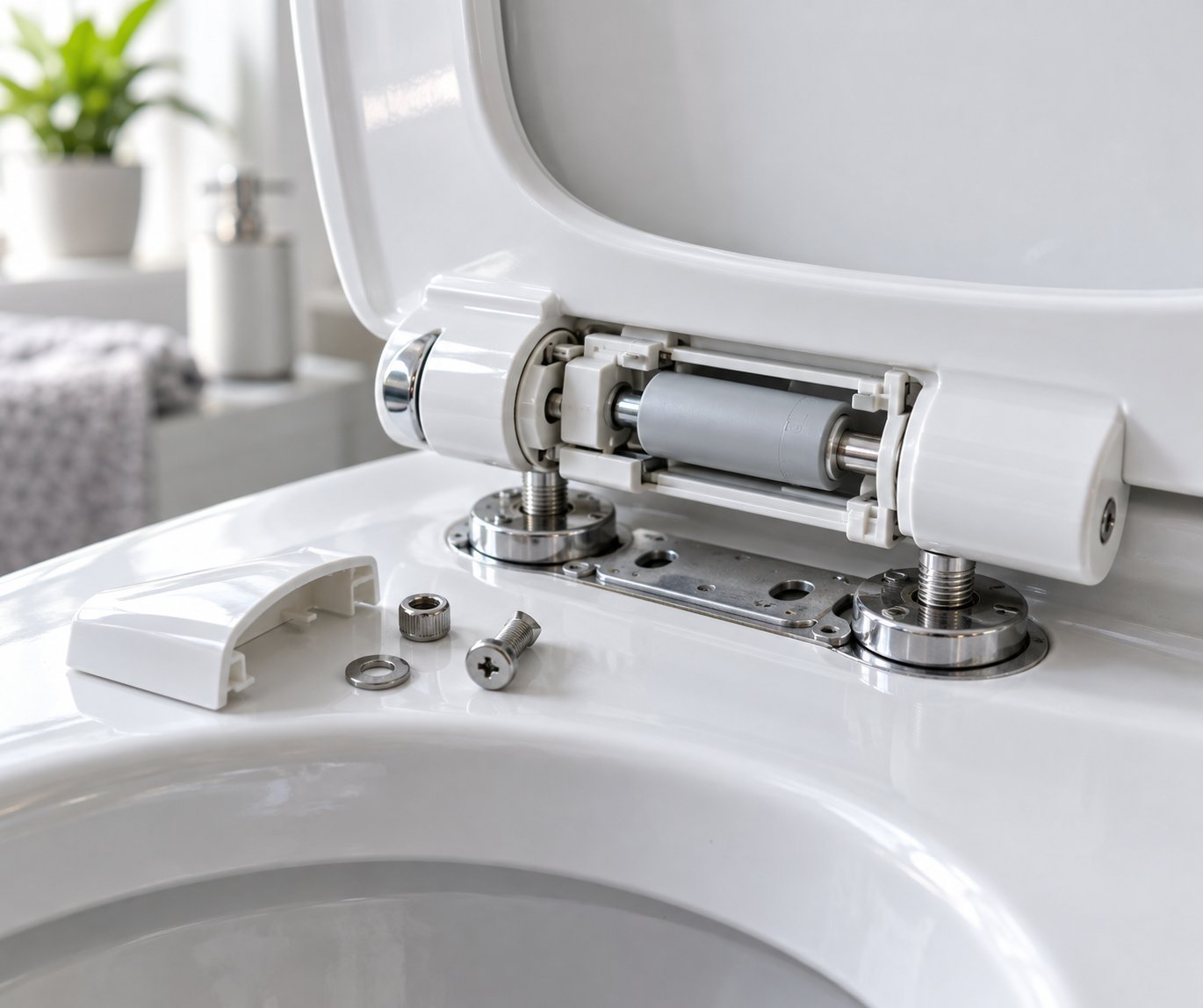
 What a Soft Close Toilet Seat Hinge Actually Does
Your toilet seat lid drifts down slowly, lands without a sound, and you never think twice about it — until the day it slams. That jarring bang sends most homeowners straight to a search bar, hunting for answers. But before you order a replacement part or grab a wrench, you need to understand what you're actually dealing with.
A soft close toilet seat hinge is a specialized hinge assembly with a built-in damping mechanism that controls the descent of the toilet seat lid, allowing it to close slowly, quietly, and without slamming. It combines a standard mounting hinge with an internal damper — typically hydraulic or spring-loaded — to absorb the kinetic energy of the falling lid.
What Is a Soft Close Toilet Seat Hinge
Found on most modern toilet seats, this component does more than just connect the seat to the bowl. A standard toilet seat hinge simply pivots. Soft close toilet seat hinges go a step further by integrating a damper — a small device filled with fluid or calibrated with internal tension — directly into the hinge body. That damper is what transforms an abrupt drop into a gentle, controlled glide. Whether you call them toilet seat hinges or commode seat hinges, the core function remains the same: absorb energy and slow the closing motion so the lid never free-falls.
Why Understanding Your Hinge Matters
Here's the problem most people run into: they assume any closing issue means the hinge is broken. In reality, the culprit could be a worn damper, loose mounting hardware, or even a seat that doesn't fit the bowl correctly. Each of these problems looks similar on the surface but requires a completely different fix. Misdiagnosing the issue wastes time, money, and often leads to buying parts you don't need.
This guide takes a diagnostic-first approach. You'll learn how the damping mechanism works on the inside, what causes soft close toilet seat hinges to fail, how to rule out fitment problems, and how to troubleshoot by symptom across major brands. Think of it as the full lifecycle — from selection through daily maintenance to eventual replacement — so you can pinpoint the real issue and solve it the first time.
How the Damping Mechanism Works Inside the Hinge
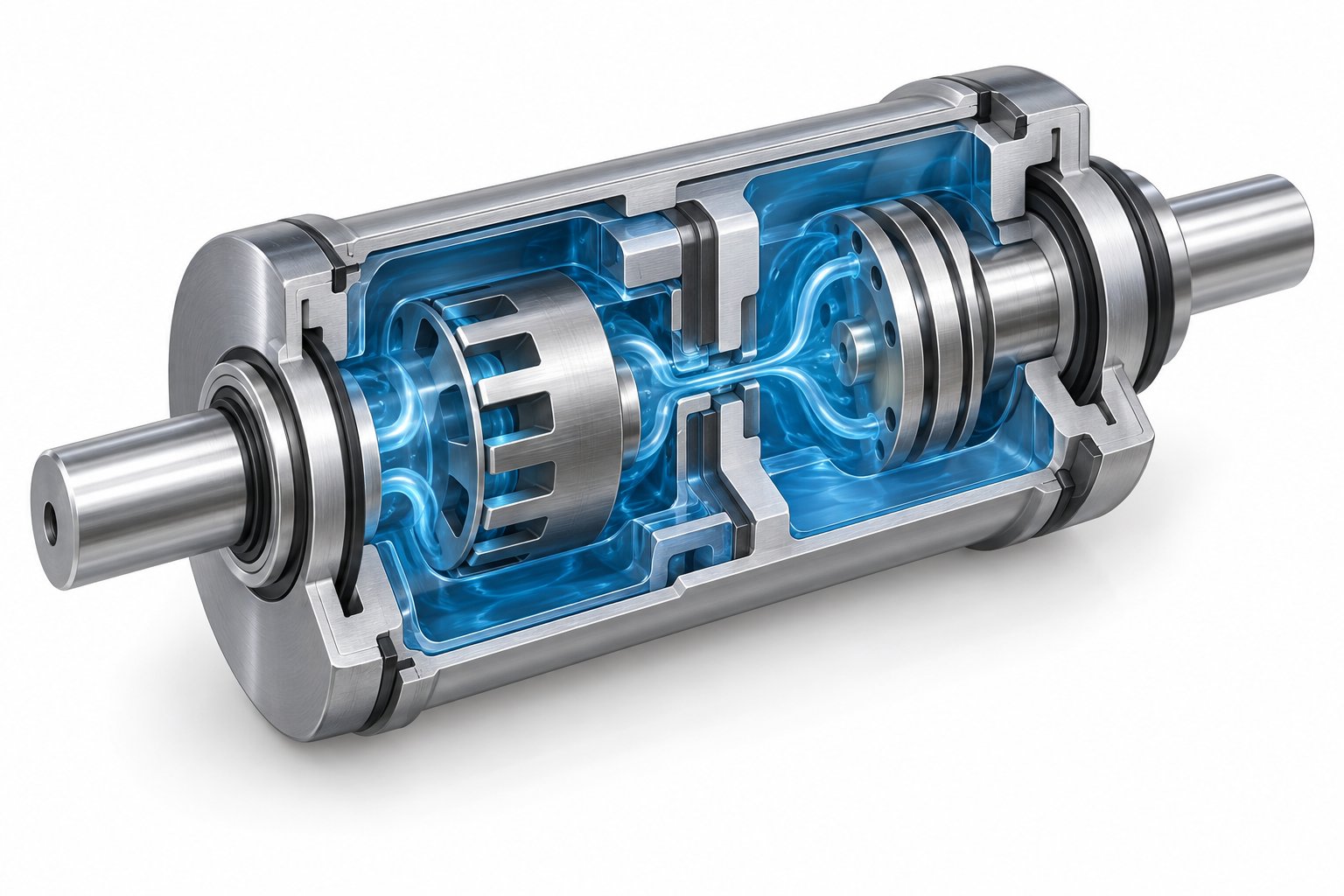
Imagine tilting a jar of honey upside down. The honey doesn't rush out — it flows slowly because the thick fluid resists movement. That same principle is at work inside every slow close toilet seat hinge, just on a much smaller and more precisely engineered scale. The "magic" behind the gentle closing motion isn't magic at all. It's physics, contained in a compact cartridge you'll never see unless something goes wrong.
Two fundamentally different damping technologies power the hinges soft close toilet seat manufacturers rely on today. Understanding which one lives inside your hinge tells you a lot about how it behaves, why it might be misbehaving, and what you can realistically do about it.
Hydraulic Damper Systems Explained
The most common type of toilet seat damper uses a hydraulic, fluid-based design. Inside the hinge cartridge sits a small sealed chamber filled with silicone oil. When you release the toilet lid, the hinge rotates and a precision-machined rotor forces that silicone oil through a narrow internal channel. The fluid can't rush through the gap all at once — it squeezes through gradually, and that resistance is what slows the lid's descent into a smooth, controlled glide.
You'll notice this system delivers remarkably consistent motion. The closing speed stays even from the moment the lid begins to drop until it touches the bowl rim. That consistency comes from the rotary damper's ability to convert kinetic energy into heat through fluid friction — a reliable, repeatable process every single cycle.
There's one quirk worth knowing, though. Silicone oil viscosity changes with temperature. In a warm bathroom after a hot shower, the fluid thins slightly and the lid may close a touch faster. In a cold guest bathroom during winter, the fluid thickens and the descent slows noticeably. This isn't a defect — it's inherent to how hydraulic toilet seat dampers work.
Spring-Loaded and Friction-Based Systems
The alternative approach skips fluid entirely. Spring-loaded and friction-based dampers rely on mechanical tension to resist the lid's downward rotation. A calibrated spring or a friction disc inside the hinge body presses against a contact surface, creating drag that slows the closing motion.
These systems have a distinct advantage: temperature barely affects them. Whether your bathroom is steamy or freezing, the closing speed stays roughly the same. They're also simpler to manufacture, which typically makes them more affordable.
The tradeoff? Motion quality. Where hydraulic dampers deliver a silky, even glide, spring-loaded systems often produce a slightly jerky or stepped descent — especially as the spring ages and loses tension. You might hear a faint clicking or feel the lid hesitate at certain points in its arc. Friction-based designs can also wear unevenly, leading to one side of the hinge losing resistance faster than the other.
| Attribute | Hydraulic (Fluid-Based) Damper | Spring-Loaded / Friction-Based |
|---|---|---|
| Closing Speed Consistency | Very consistent — smooth, even descent | Moderate — may feel stepped or jerky |
| Typical Lifespan | 50,000+ cycles with quality seals | 20,000–40,000 cycles before noticeable wear |
| Temperature Sensitivity | Noticeable — fluid thins in heat, thickens in cold | Minimal — mechanical tension is largely unaffected |
| Noise Level | Near-silent operation | Low to moderate — occasional clicking or friction sounds |
| Relative Cost | Higher | Lower |
Why Damping Mechanisms Degrade Over Time
Every damper — hydraulic or mechanical — has a finite service life. Understanding the specific failure modes helps you diagnose whether your hinge is actually broken or simply worn in a predictable, fixable way.
- Seal wear and fluid leakage: Hydraulic dampers rely on tight internal seals to keep silicone oil contained. After tens of thousands of open-close cycles, those seals can degrade. Once fluid escapes, the damper loses resistance and the lid begins to drop faster — or slams entirely.
- Fluid viscosity breakdown: Even without a leak, the silicone oil itself changes over years of use. Repeated shearing through the narrow channel gradually reduces the fluid's ability to create resistance, producing a slow but steady decline in damping performance.
- Mineral and moisture buildup: Bathrooms are humid environments. Mineral deposits from water vapor can infiltrate the damper housing or accumulate on pivot points, adding friction where you don't want it and potentially compromising seals.
- Spring fatigue and friction surface wear: In mechanical systems, springs lose tension over thousands of compression cycles — a process engineers call fatigue. Friction discs wear down in much the same way brake pads do, gradually reducing the drag that controls the lid's speed.
The key takeaway? A hinge that worked perfectly for three years and now closes a little too quickly isn't necessarily "broken." It may simply be experiencing normal degradation in its damping medium — a distinction that matters when deciding between a quick adjustment and a full replacement.
Types of Soft Close Hinges and Damper Designs
Knowing how dampers degrade is useful — but it only tells half the story. The type of hinge assembly on your toilet seat determines everything from how smoothly the lid closes on day one to how easily you can fix or replace the mechanism years later. Not all soft close hinges are created equal, and the differences go well beyond brand labels.
The market offers several distinct hinge categories, each with its own mounting approach, material construction, and damping integration. The table below breaks down the most common designs side by side so you can quickly identify what's on your toilet — and what might work better.
| Hinge Type | Mounting Style | Material | Best Use Case | Durability | Compatibility |
|---|---|---|---|---|---|
| Two-Piece Integrated Damper | Top-fix or bottom-fix | Reinforced plastic with precision damper cartridge | Factory-built PP and UF toilet seats | High — damper calibrated to seat weight | Matched to specific seat geometry during production |
| Single-Piece Integrated Hinge | Top-fix or bottom-fix | Plastic or metal body with built-in damper | Mid-range to premium residential seats | Moderate to high | Brand-specific in most cases |
| Retrofit Add-On Damper Kit | Adapts to existing mounting | Plastic housing with universal fittings | Upgrading a non-soft-close seat | Lower — generic damper not tuned to seat | Universal, but fit varies |
| Metal Hinge with Damper Cartridge | Bottom-fix (most common) | Stainless steel, zinc alloy, or brass | Heavy-duty and commercial applications | Very high | Requires matching bolt hole spacing |
| Quick-Release Soft Close Hinge | Top-fix with release button | Plastic or metal | Easy-clean residential installations | Moderate | Brand-specific release mechanisms |
Integrated vs. Retrofit Add-On Dampers
This is the single biggest distinction that affects long-term performance, and it's one most shoppers overlook entirely.
Integrated hinges have the damper built directly into the hinge assembly during manufacturing. The damper cartridge is selected and calibrated to match the specific seat's weight, material, and pivot geometry. When a manufacturer designs a polypropylene (PP) or urea-formaldehyde (UF) toilet seat, the damper's resistance is tuned so the lid descends at exactly the right speed — not too fast, not agonizingly slow — for that particular seat.
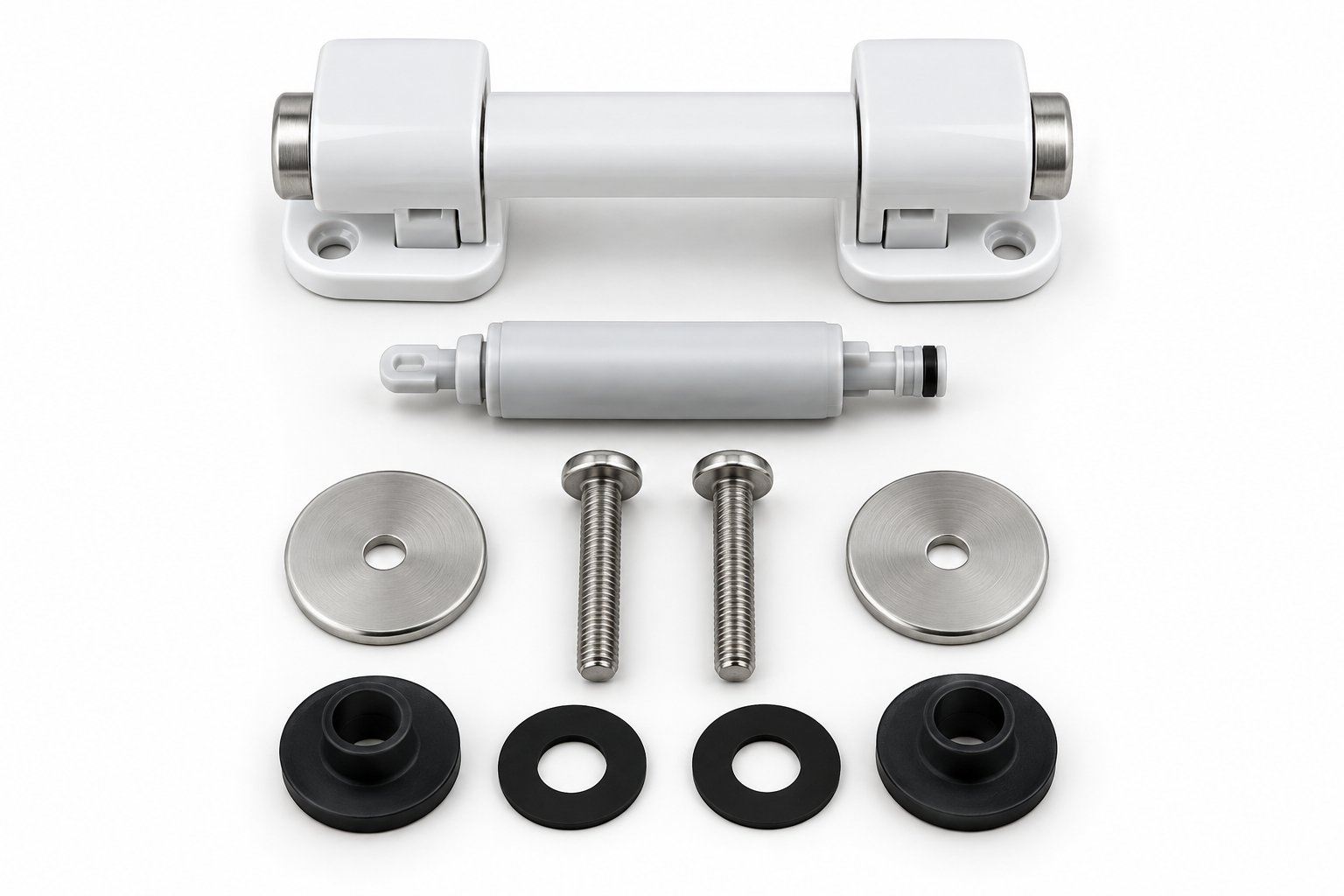
Tianyun's two-piece soft close dampers illustrate this approach well. Designed specifically for toilet seat manufacturers building PP and UF seats, these damper components integrate into the hinge assembly during production. Because the damping is purpose-built for the seat's exact weight and geometry, the result is smoother, quieter, and more reliable closing than what aftermarket solutions can achieve. It's the difference between a tailored suit and one pulled off a rack — both cover the basics, but the fit tells the whole story.
Retrofit add-on damper kits, on the other hand, are designed to bolt onto existing non-soft-close seats. They use generic damping cartridges with "one-size-fits-most" resistance values. Sometimes they work well enough. Other times, the damper is too weak for a heavy UF seat (leading to a semi-controlled thud) or too strong for a lightweight plastic lid (causing the seat to hover annoyingly at a 20-degree angle before finally settling). If your retrofit kit feels inconsistent, it's likely not defective — it's simply mismatched to your seat's characteristics.
Top-Fix vs. Bottom-Fix Mounting Configurations
Imagine you're looking down at your toilet bowl with the seat removed. You'll see two bolt holes near the back rim. How your hinge connects through those holes defines whether it's a top-fix or bottom-fix design — and this distinction matters more than most people realize.
Top-fix hinges tighten from above the bowl rim. You'll typically secure them using wing nuts, expanding rubber bolts, or a twist cap toilet seat hinge mechanism that locks into place with a simple quarter-turn. This design is especially common on back-to-wall and wall-hung toilets where there's no access underneath the bowl. Installation is straightforward — you can do it without contorting yourself around the base of the toilet.
Bottom-fix hinges drop bolts through the mounting holes from the top, then require tightening with nuts from underneath the bowl rim. This older configuration is common on open-back close-coupled and traditional toilets. Bottom-fix systems often provide slightly more stability and room for adjustment, but they're trickier to install in tight spaces.
Here's the practical takeaway: before ordering any replacement hinge, check which mounting configuration your toilet requires. A top-fix hinge won't work on a toilet designed for bottom-fix installation, and forcing the wrong type leads to wobble, misalignment, and premature damper failure — problems that mimic a broken hinge but have nothing to do with the damping mechanism itself.
Metal vs. Plastic Hinge Construction
The material your hinge is made from affects durability, corrosion resistance, weight, and cost. Both metal toilet seat hinges and plastic toilet seat hinges have legitimate strengths — the right choice depends on your specific situation.
Pros of Metal Hinges (Stainless Steel, Brass, Zinc Alloy)
- Superior structural strength — metal resists cracking under stress, making it ideal for heavy lids and high-traffic bathrooms
- Longer mechanical lifespan — pivot pins and bolt threads hold up better over tens of thousands of cycles
- Premium feel — brass toilet seat hinges and stainless steel options add a polished, high-end look to the installation
- Better for commercial settings — public restrooms and rental properties benefit from the added durability metal provides
Cons of Metal Hinges
- Corrosion risk — even stainless steel can develop surface rust in persistently damp environments, and lower-grade metals corrode faster
- Higher cost — brass toilet seat hinges and stainless steel assemblies typically cost two to four times more than their plastic equivalents
- Heavier weight — adds load to the damper, which must be rated accordingly
Pros of Plastic Hinges
- Completely corrosion-proof — no rust, no oxidation, no matter how humid the bathroom gets
- Lightweight — reduces stress on mounting points and the damper mechanism
- More affordable — makes replacement more economical, especially for standard residential use
- Gentler on ceramic — less likely to scratch or chip the toilet bowl surface during installation
Cons of Plastic Hinges
- Susceptible to cracking — especially when overtightened or exposed to years of UV light near a bathroom window
- Shorter mechanical life — bolt threads and pivot points wear faster under repeated stress
- Less rigid — can flex under heavy loads, contributing to seat wobble over time
For most residential bathrooms, a quality reinforced plastic hinge with an integrated damper handles daily use without issue. Heavy-duty applications — think commercial buildings, bariatric-rated seats, or households with young children who test every object's structural limits — lean toward metal construction for the added peace of mind.
Choosing the right hinge type is only half the equation, though. Even a perfectly matched hinge can underperform if something else in the system is going wrong — and that "something else" often has nothing to do with the hinge hardware at all.
Why Soft Close Hinges Fail Over Time
A perfectly matched hinge, installed correctly, with the right damper calibrated to your seat — it should last for years. And it usually does. But "years" is not "forever," and every soft close toilet seat hinge operates in one of the harshest micro-environments in your home: a small, humid room with constant temperature swings, chemical exposure, and repeated mechanical stress. When something eventually goes wrong, the cause almost always falls into one of two categories — the environment did it, or the user did.
Pinpointing which category your problem belongs to isn't just academic. It's the difference between a five-minute cleaning fix and a trip to the hardware store for a completely new seat. Here's what actually causes these hinges to fail.
Mechanical and Environmental Causes of Failure
Your bathroom works against your hinge hardware every single day, even when nobody is using the toilet. Moisture hangs in the air, temperatures rise and fall, and minerals in your water supply leave invisible deposits on every surface. Over thousands of open-close cycles, these forces take a measurable toll.
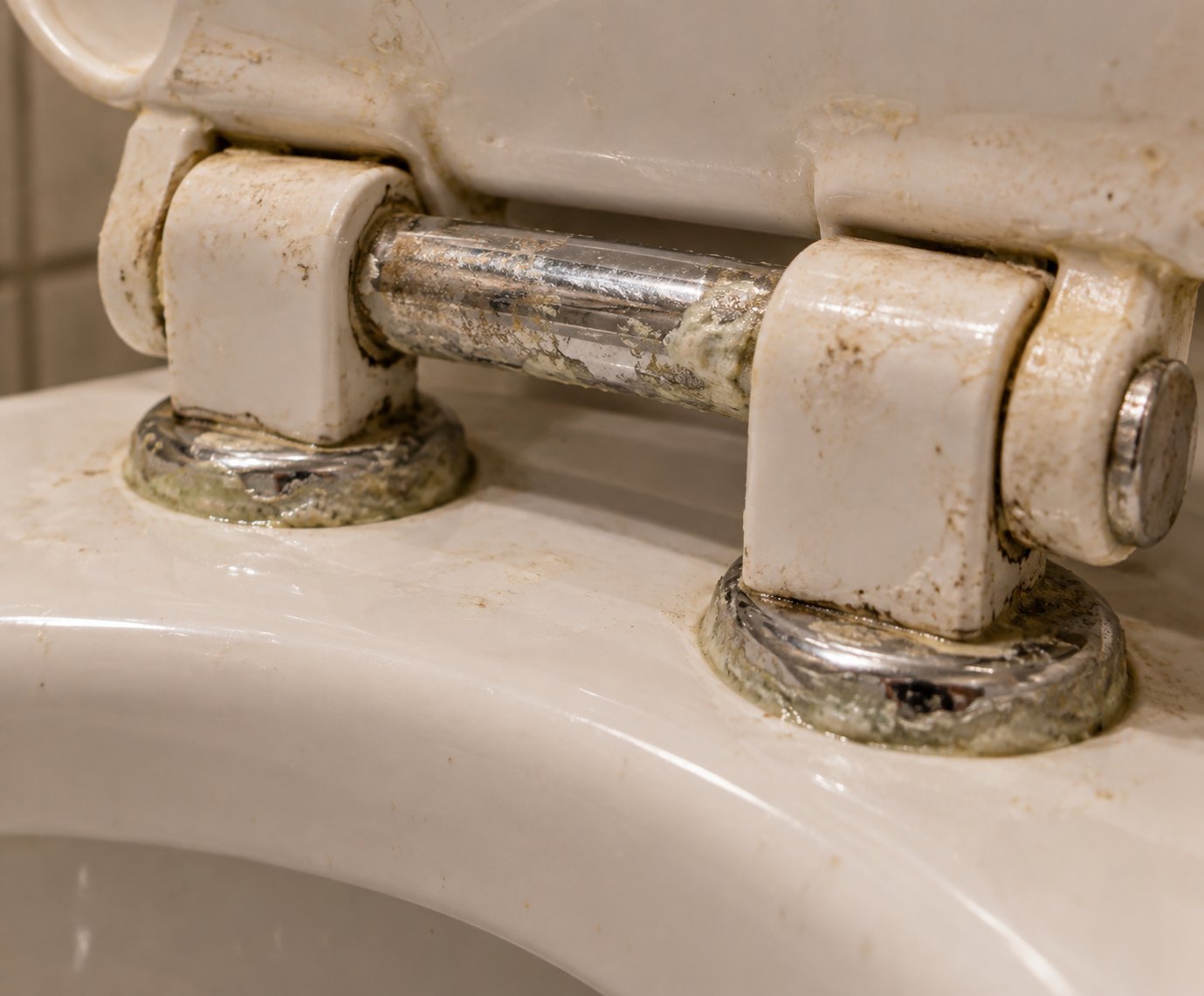
- Mineral and limescale buildup: Bathroom humidity doesn't just fog your mirror — it carries dissolved minerals that settle on and around hinge components. Over time, limescale infiltrates the damper housing, gums up pivot points, and creates gritty resistance where the mechanism needs smooth rotation. You'll notice the lid catching or hesitating at odd angles, and it often gets misread as a broken toilet seat hinge when it's really just a dirty one.
- Temperature effects on hydraulic fluid: As covered earlier, silicone oil inside hydraulic dampers thins in heat and thickens in cold. Bathrooms that experience wide temperature swings — think an unheated guest bath in winter versus a steam-filled master bath after a shower — put the fluid through repeated viscosity changes. Over years, this cycling accelerates fluid breakdown and makes closing speed increasingly inconsistent.
- Internal seal degradation: The rubber or silicone seals that keep damping fluid contained inside the cartridge are under constant low-level stress. Every rotation flexes them slightly. After tens of thousands of cycles, micro-cracks develop and fluid begins to seep out. Once enough fluid escapes, the damper can no longer generate sufficient resistance, and the lid drops with a thud instead of a glide.
- Overtightening during installation: This one happens on day one and causes problems for months or years afterward. Cranking mounting bolts too tight can crack plastic hinge housings, distort a metal toilet seat hinge body, or crush rubber gaskets meant to absorb vibration. The damage may not be visible immediately, but the compromised component fails much sooner than it should.
- Age-related fatigue: Springs lose tension. Friction surfaces wear smooth. Fluid shears down. Even the best-engineered hinge has a rated cycle life — typically 50,000 to 80,000 open-close cycles for quality hydraulic dampers. In a household bathroom used by four people, that translates roughly to five to eight years of daily use before performance noticeably declines.
- Corrosion on metal components: Hinge pins, mounting bolts, and bracket hardware made from lower-grade metals are vulnerable to rust and oxidation in damp conditions. Corroded pins bind instead of rotating freely, and rusted bolts can seize in place — making the hinge difficult to adjust or remove. Even stainless steel components can develop surface corrosion if the protective passivation layer is scratched during installation. Toilet seat hinge covers can help shield exposed metal from direct moisture contact, but they don't eliminate the risk entirely.
User-Caused Damage and Misuse
Here's the uncomfortable truth: many hinge failures aren't caused by age or environment. They're caused by how the seat gets used — or misused — on a daily basis.
Slamming the lid despite the soft close feature. It sounds counterintuitive, but it happens constantly. Someone gives the lid a hard push downward instead of releasing it gently and letting the damper do its job. That sudden force overwhelms the damper's designed resistance range, stressing seals, bending internal components, and accelerating fluid degradation. Over hundreds of forced slams, you're essentially fast-forwarding the hinge through years of normal wear in a matter of months.
Forcing the seat past its natural range of motion. Every hinge has a designed arc — typically around 95 to 110 degrees from closed to fully open. Pushing the lid back beyond that range, especially aggressively, bends pivot pins, cracks mounting brackets, and can pop damper cartridges out of alignment. If the lid suddenly feels loose or wobbly at a certain angle, this kind of overextension is a likely cause.
Using harsh chemical cleaners. Bleach-based sprays, ammonia, and abrasive bathroom cleaners don't just clean — they attack rubber seals, degrade plastic housings, and strip protective coatings off metal components. Frequent use of these products around the hinge area accelerates seal failure in hydraulic dampers and weakens plastic pivot points. Mild soap, diluted white vinegar, or pH-neutral bathroom cleaners are far safer options for the area around hinges.
Sitting or standing on the seat lid. Toilet seat lids are not designed to bear body weight. When someone stands on the lid to reach a high shelf or sits on a closed lid while drying off, the downward force concentrates at the hinge points. Plastic housings crack, metal brackets bend, and damper cartridges can be crushed internally — all damage that shows up as sudden and complete hinge failure rather than gradual decline.
The pattern here matters. Environmental and mechanical failures tend to show up gradually — the lid closes a little faster each month, a faint squeak develops, or one side starts lagging behind the other. User-caused damage is often sudden and dramatic — the hinge was fine yesterday, and today it's clearly broken.
Recognizing that distinction is crucial, because it shapes what you do next. A gradual decline might call for cleaning, lubrication, or a damper cartridge swap. A sudden break usually means something structural gave way and needs replacement. But before you reach for a wrench or a credit card, there's one more possibility worth ruling out — one that has nothing to do with the hinge itself.
Ruling Out Fitment Issues Before Blaming the Hinge
That wobble you feel when you press down on the seat. The uneven closing where the left side touches down a full second before the right. The damper that seems to "fight" the lid instead of guiding it smoothly. These symptoms scream hinge failure — except in a surprising number of cases, the hinge is perfectly fine. The real problem? The toilet seat with hinges attached doesn't actually fit the bowl it's sitting on.
This is the misdiagnosis that wastes more time and money than any other. Homeowners order replacement hinges, swap damper cartridges, and tighten bolts until the plastic cracks — all because nobody stopped to check whether the seat and bowl were ever a proper match in the first place.
How Seat-to-Bowl Mismatch Mimics a Hinge Problem
Picture a round toilet seat mounted on an elongated bowl. The seat is roughly two inches shorter than the bowl's front rim, so the lid's center of gravity shifts backward toward the toilet bowl hinges. That rearward weight bias puts uneven load on the dampers — one side bears more force than the other, causing the lid to descend crookedly. It looks exactly like a failing damper, but no amount of hinge replacement will fix a geometry problem.
The reverse scenario creates different symptoms. An elongated seat overhanging a round bowl leaves the front unsupported, which makes the entire hinge seat toilet assembly feel unstable. The lid wobbles laterally because the mounting bolts can't anchor a seat that extends past the ceramic rim. Users feel that wobble and assume the bolts are stripped or the hinge brackets are worn — when the seat simply doesn't belong on that bowl.
Bolt hole spacing introduces another layer of confusion. The standard distance between mounting hole centers is 5-1/2 inches for most residential toilets, but specialty and European models sometimes deviate. When bolt holes don't align cleanly, installers tend to angle the bolts or force them through at a slight diagonal. That misalignment prevents the hinge plate from sitting flush against the ceramic rim, which introduces lateral play. Every time the lid closes, it shifts sideways by a millimeter or two — enough to make the damper work against resistance it wasn't designed for, accelerating wear and producing uneven closing that mimics internal damper failure.
A Quick Fitment Check Before You Touch the Hinge
Before you order a single replacement part, run through this four-step diagnostic. It takes less than two minutes and can save you an unnecessary repair entirely.
- Measure bowl length from mounting holes to front rim. Lift the seat and lid. Locate the two bolt holes at the back of the bowl. Measure from the center point between those holes straight to the front edge of the bowl rim. Round bowls measure approximately 16-1/2 inches; elongated bowls measure approximately 18-1/2 inches. If your seat style doesn't match the measurement, you've found your problem.
- Check that the seat sits centered and level. Close the lid and look at the gap between the seat edge and the bowl rim on all sides. The overhang should be roughly even — no significant gap on one side and tight contact on the other. An off-center seat loads the hinges unevenly, creating the "one side closes faster" symptom that gets blamed on the damper.
- Verify bolt holes align without forcing. Remove the seat and look straight down through the hinge plate holes. The bowl's mounting holes should be fully visible through each one, with no need to flex the hinge bracket or angle the bolts. If you had to muscle the bolts into position during installation, the hinge plate is under constant tension — a stress that degrades both the bracket and the damper over time.
- Confirm the seat does not rock side to side. Place both hands on the closed seat, one on each side, and press down alternately. A properly fitted seat should feel stable and planted. Any rocking or lateral shift means the seat's footprint doesn't match the bowl's contour, or the mounting hardware isn't creating a secure connection.
If any of these checks fail, the fix isn't a new hinge — it's a correctly sized seat. Matching your bowl shape (round vs. elongated), confirming standard bolt hole spacing of 5-1/2 inches, and verifying width compatibility eliminates the vast majority of phantom "hinge problems" that are really fitment problems in disguise.
Only once you've confirmed the seat genuinely fits the bowl does it make sense to start diagnosing the hinge mechanism itself. And when that diagnosis is warranted, the fastest path to a solution is matching your specific symptom to its most likely cause — rather than guessing your way through a generic checklist.
How to Fix Soft Close Toilet Seat Hinges by Symptom
You've confirmed the seat fits the bowl. The mounting holes line up. There's no rocking or lateral play. That means the problem lives inside or around the hinge mechanism itself — and the fastest way to solve it is to start with what you're actually experiencing. Forget generic "Step 1, Step 2" instructions that assume every hinge fails the same way. Real troubleshooting works backward from the symptom, because each one points to a different root cause and a different fix.
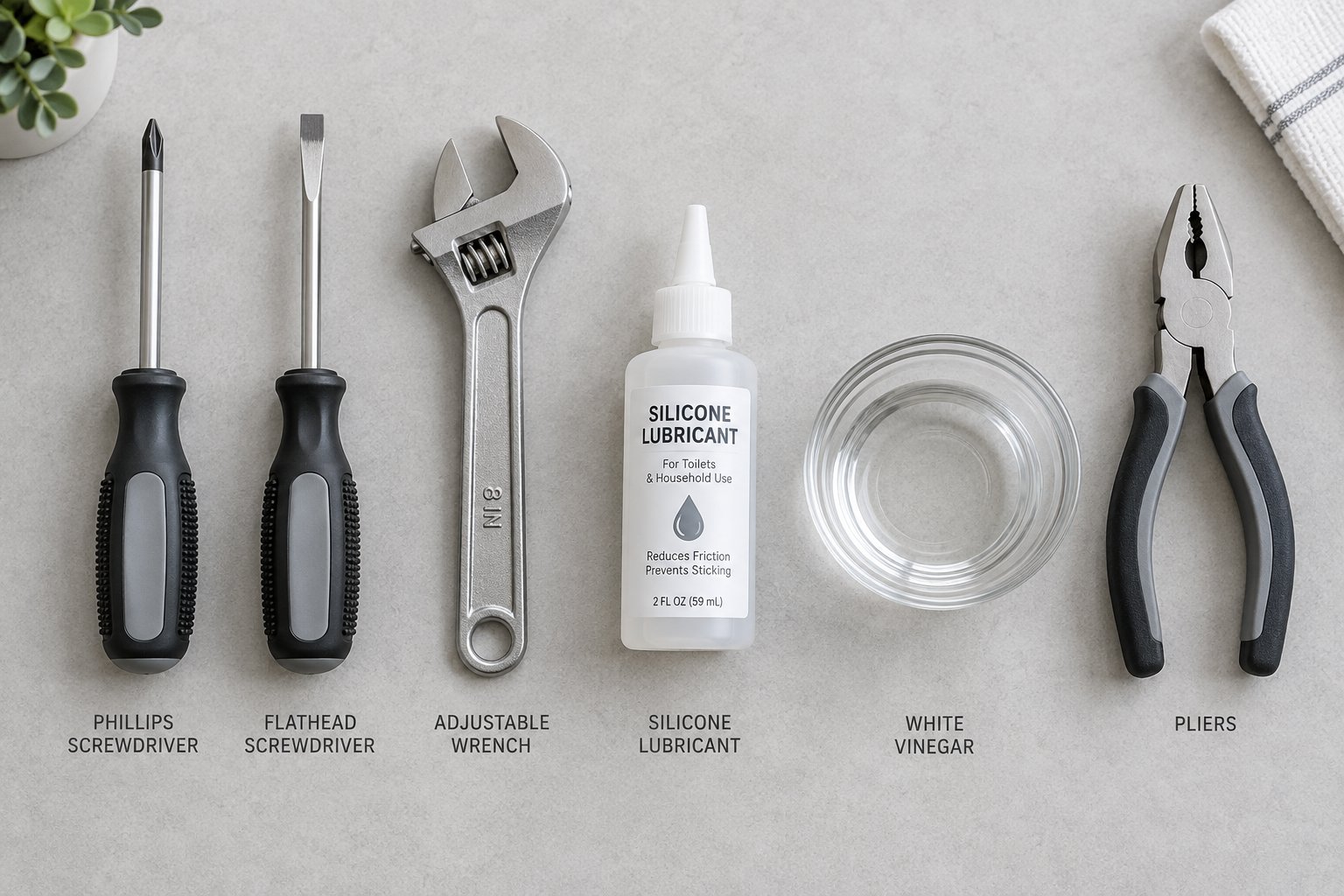
Grab these tools before you start — you'll likely need at least a few of them regardless of the symptom: a flathead screwdriver, a Phillips screwdriver, an adjustable wrench, pliers, white vinegar, and silicone-based lubricant. Having everything within reach means you won't have to stop mid-repair to rummage through a drawer.
Seat Slams Shut Despite the Soft Close Feature
This is the symptom that sends most people searching for how to fix toilet seat hinge problems — and it has three distinct causes, each requiring a different response.
Depleted damper fluid. If the lid used to close smoothly and has been gradually slamming harder over weeks or months, the hydraulic damper's silicone oil has likely leaked or degraded. Check for any oily residue around the hinge cartridge. Unfortunately, most residential damper cartridges are sealed units and can't be refilled. If fluid loss is the issue, you'll need a replacement cartridge or a complete toilet seat soft close fittings swap.
Failed internal seals. Closely related to fluid loss, but sometimes seals fail suddenly rather than gradually. The lid worked fine yesterday and slams today. Look for a small wet spot or discoloration near the hinge pivot. Same fix — cartridge or hinge replacement.
Incorrect bolt tension. Here's one that surprises people: both overtightened and undertightened mounting bolts can cause slamming. Overtightened bolts compress the hinge housing and restrict the damper's ability to rotate freely through its designed arc. Undertightened bolts allow the seat to shift, changing the angle at which force hits the damper. Try loosening the bolts a quarter-turn, then retightening to finger-tight plus a half-turn with a wrench. Test the closing motion after each adjustment.
One Side Closes Faster Than the Other
Uneven closing is one of the most common — and most misdiagnosed — soft close hinge complaints. You release the lid, and it descends at an angle, with one side touching down noticeably before the other.
Three usual culprits are at work here:
- One damper failing while the other still works. Most seats have independent dampers on each side. When one wears out faster (or leaks), that side loses resistance while the other still brakes normally. The fix is replacing the failed damper cartridge — or both, since the surviving one likely isn't far behind.
- Uneven bolt tension left vs. right. If the left mounting bolt is torqued tighter than the right, it creates different friction profiles on each side. Use a wrench to equalize tension: loosen both bolts completely, then retighten each one to the same snugness, alternating sides like you'd tighten lug nuts on a wheel.
- Debris lodged in one hinge. A small piece of mineral scale, a hair, or even dried cleaning product residue jammed into one pivot point adds enough drag to throw off the symmetry. Remove the seat, inspect both hinge assemblies, and clean each pivot with a cotton swab dipped in white vinegar. Rinse, dry, and reassemble.
Clicking, Grinding, or Squeaking Noises During Closing
A soft close hinge is supposed to be nearly silent. When it starts announcing itself with clicks, grinds, or squeaks, the sound itself tells you where to look.
Clicking usually signals mineral buildup on the pivot points. Dissolved minerals from bathroom humidity crystallize on metal pins and inside plastic bushings, creating tiny hard spots the hinge "clicks" over during rotation. Remove the seat, soak the hinge ends in a white vinegar solution for 15 to 20 minutes, then scrub the pivot area gently with an old toothbrush. Reattach and test. Regular cleaning — as simple as wiping around the hinge area during routine bathroom cleaning — prevents this buildup from returning.
Grinding points to dry or corroded hinge pins. The metal-on-metal (or metal-on-plastic) contact has lost its lubrication and is wearing surfaces down with each cycle. Apply a thin film of silicone-based lubricant directly to the pivot pins. Avoid petroleum-based products like WD-40 — they can swell rubber seals inside the damper and accelerate failure.
Squeaking often comes from a cracked internal damper housing. As the crack opens and closes slightly with each rotation, it produces a high-pitched protest. Inspect the damper cartridge visually for hairline fractures. If you spot one, the cartridge needs replacement — no amount of lubricant quiets a structural crack.
Seat Wobbles or Shifts Side to Side
Lateral movement in a toilet seat almost never means the damper is bad. Instead, it points to the connection between the hinge and the bowl — the mounting hardware layer that holds everything together.
The most common causes and their targeted fixes:
- Retighten mounting bolts. This is the first and simplest step. Bolts loosen naturally over months of use as vibration and thermal cycling work them free. Snug them down firmly — but not aggressively — and check again in a week.
- Replace rubber bushings or gaskets. The soft rubber pieces sandwiched between the hinge plate and the ceramic rim compress and flatten over time. Once they lose their cushioning, the hinge plate can slide laterally on the hard porcelain surface. New bushings cost a few dollars and restore a tight, non-slip fit.
- Add stabilizing washers. If the bolt holes in the ceramic are slightly oversized — common on older toilets — standard bolts can't clamp tightly enough. Adding a wider washer on top of and beneath the bowl rim distributes the clamping force over a larger area and eliminates play.
- Replace the entire mounting kit. When bolts are corroded, threads are stripped, or gaskets have disintegrated beyond replacement, swapping the full hardware set is the cleanest solution. Most soft close toilet seat hinge replacement kits include bolts, nuts, washers, and gaskets designed to work as a system.
Each of these symptom-fix pairs assumes you've already ruled out fitment issues from the previous section. When fitment is confirmed and the right symptom leads you to the right repair, most soft close hinge problems resolve in under 30 minutes with basic hand tools.
The trickier question comes after the diagnosis: is the repair actually worth doing, or has the hinge reached the point where replacement — of the hinge assembly or the entire seat — makes more financial and practical sense?
Repair or Replace
You've identified the symptom, traced it to a cause, and now you're staring at the hinge assembly wondering: do I fix this, or do I just buy a new one? It's the question nobody seems to answer clearly — most guides stop at "tighten the bolts" and leave you on your own from there. The truth is, sometimes a ten-minute repair extends your seat's life by years. Other times, sinking money into a soft close toilet seat hinge kit for a seat that's already on its last legs is like putting premium tires on a car headed to the junkyard.
The right call depends on a handful of concrete factors — not gut feeling. This decision matrix maps common problem types against seat age, parts availability, and effort level so you can make a clear-headed choice.
| Problem Type | Seat Age | Part Availability | Estimated Effort | Recommended Action |
|---|---|---|---|---|
| Loose or rattling mounting bolts | Any age | Universal hardware widely available | 5–10 minutes | Repair — retighten or replace bolts and gaskets |
| Mineral buildup on pivot points | Any age | No parts needed (vinegar + lubricant) | 15–20 minutes | Repair — clean and lubricate |
| One damper failing, other works fine | Under 3 years | Brand-specific cartridge available | 20–30 minutes | Repair — replace the failed damper cartridge |
| Both dampers weakening gradually | 3–5 years | Check manufacturer's parts catalog | 30–45 minutes | Repair if parts are affordable; replace seat if cost is comparable |
| Damper fluid leaked, cartridge sealed | Any age | Often not user-replaceable | N/A — no DIY fix | Replace hinge assembly or full seat |
| Cracked plastic hinge body | Any age | Brand-specific; often discontinued | N/A — structural failure | Replace hinge assembly or full seat |
| Multiple simultaneous issues | Over 5 years | May require several separate kits | 60+ minutes combined | Replace the entire seat |
| Seat model discontinued, no parts | Any age | Unavailable | N/A | Replace the entire seat |
When Repair Makes Sense
Repair is the smart move when the underlying structure is still sound and you're dealing with a single, isolated issue rather than cascading failures. Think of it this way — if the seat itself is in good shape and the ceramic mounting points on the bowl are undamaged, there's no reason to throw out a functional seat over one worn component.
Specifically, repair tends to be cost-effective when:
- The seat is less than two to three years old. A relatively new seat with one failing damper or loose hardware almost certainly has life left in it. The damper on the working side probably has years of service remaining, and a single cartridge swap restores balanced performance.
- The issue is loose mounting hardware or mineral buildup. These are maintenance problems, not mechanical failures. Retightening bolts, replacing rubber bushings, or soaking pivot points in vinegar solves the symptom without touching the damper at all.
- A soft close toilet seat hinge kit is available for your specific brand and model. Major manufacturers like Bemis, Kohler, and American Standard sell replacement hinge kits that include matched damper cartridges, bolts, and gaskets. When the right kit exists, a targeted repair is straightforward and far cheaper than a full seat.
- The toilet bowl's ceramic mounting points are intact. If the porcelain around the bolt holes isn't chipped, cracked, or worn oversized, the new hardware will anchor just as securely as the original installation. Damaged ceramic, on the other hand, can't grip any hinge reliably — and that's a bowl problem, not a hinge problem.
Common repairable issues — loose bolts, degraded gaskets, mineral-fouled pivots, a single spent damper cartridge — share a pattern. They're isolated, they affect one component at a time, and parts are either universal or readily sourced. When your situation fits that profile, a targeted fix is almost always the right call.
When Full Replacement Is the Better Path
Repair stops making sense when the fix costs nearly as much as a new seat, or when one repaired component just exposes the next failure waiting behind it. Imagine replacing both damper cartridges only to discover the plastic hinge body cracks two months later — you've paid twice for a problem that a single seat purchase would have solved outright.
Replacement is the smarter choice in these situations:
The damper fluid has leaked and the cartridge isn't user-replaceable. Many budget and mid-range seats use permanently sealed damper units. Once the fluid escapes, there's no refill port and no way to restore function. The damper is effectively dead, and on sealed designs, that means the entire hinge assembly — or the seat — goes with it.
Plastic hinge bodies have cracked. Structural fractures in the hinge housing can't be reliably glued or clamped. The forces involved during every open-close cycle are too repetitive and too concentrated at the break point. Epoxy might hold for a week; it won't hold for a year.
The seat model is discontinued and soft close toilet seat hinge replacements aren't available. This is more common than you'd expect. Toilet seat models cycle through production runs, and once a model is retired, its proprietary hinge hardware dries up in supply chains within a year or two. Universal options sometimes bridge the gap, but they rarely match the fit and performance of the original parts.
The seat is more than five years old and showing multiple symptoms. A five-year-old seat with both dampers weakening, bolt holes elongating, and plastic yellowing from age isn't worth a piecemeal rebuild. At that point, every component is approaching end-of-life simultaneously. Replacing one just shifts the failure to the next weakest link.
Here's the number that seals the decision for most homeowners: a branded toilet seat hinge replacement kit typically costs between $15 and $40, depending on the brand and material. A quality replacement toilet seat with integrated soft close hinges runs $30 to $80 for most standard models. When the parts alone cost half the price of a brand-new seat — one that comes with fresh dampers, new hardware, and a clean warranty — the math tilts decisively toward replacement.
Cost Considerations and Parts Availability
Before you commit either way, a quick pricing reality check prevents buyer's remorse. Brand-specific hinge kits and damper cartridges tend to cost more than universal alternatives, but they offer substantially better fit and more consistent damping performance. A genuine replacement cartridge designed for your exact seat model drops in without modification. A universal kit might require shimming, adapting, or accepting a slightly different closing speed.
General price ranges to expect:
- Universal mounting bolt kits: $5–$12
- Brand-specific hinge replacement kits: $15–$40
- Universal soft close damper retrofit kits: $10–$25
- Complete replacement toilet seat (standard soft close): $30–$80
- Premium replacement seat (heavy-duty or feature-rich): $80–$150+
One practical step saves a lot of frustration: before purchasing any replacement part, visit the manufacturer's website and look for a parts diagram or exploded view of your specific seat model. These diagrams show every individual component with its part number, making it easy to confirm whether the hinge assembly, damper cartridge, or mounting hardware is sold separately. If you can't find your model listed — or the parts page shows everything as "discontinued" — that's your answer. Skip the repair and start shopping for a new seat.
Whichever direction the decision framework points you, there's one more variable that can complicate the process: brand-specific hinge designs. Not every manufacturer uses the same mounting configuration, damper style, or bolt pattern, and a replacement hinge that fits one brand perfectly may be completely incompatible with another.
Brand-Specific Hinge Systems and Compatibility Factors
A hinge kit labeled "universal" sitting next to one labeled "Bemis Model 7300" on the same shelf — they look similar, they cost roughly the same, and they both claim to restore soft close function. So what's the difference? In a word: fit. Every major toilet seat manufacturer engineers its hinge system around proprietary mounting geometry, damper specifications, and fastening mechanisms. Grabbing the wrong one doesn't just mean a frustrating return trip — it can introduce the exact wobble, uneven closing, and premature wear you were trying to fix.
Bemis and Mayfair Hinge Systems
Bemis manufactures both the Bemis and Mayfair seat lines, so if you own a Mayfair seat, you're shopping for Bemis toilet seat hinges replacement parts whether you realize it or not. The two brands share core hinge platforms, though individual model numbers determine exactly which replacement kit you need.
Many Bemis models use a proprietary top-tightening system built around either a twist-cap or wing-nut design. You'll recognize it instantly — instead of reaching underneath the bowl to wrangle a corroded nut, you tighten the entire assembly from above with a quarter-turn cap or a hand-tightened wing nut. It's a cleaner installation experience, but it also means standard aftermarket bolts won't work. The twist-cap mechanism requires Bemis-specific hardware sized to engage the proprietary locking channel.
Bemis also offers its STA-TITE fastening system on select models. STA-TITE uses a different bolt configuration than standard hinges — the bolts incorporate an internal expanding mechanism that grips the underside of the bowl rim without needing a separate nut. It's designed to stay tight indefinitely, which is a genuine advantage. The tradeoff? A Bemis toilet seat hinge replacement on a STA-TITE model requires the matching STA-TITE hardware. Standard bolts won't engage the same way, and universal kits almost never include this expanding bolt design. Always match replacements to the specific seat model number printed on the underside of the seat or inside the hinge cover — Bemis maintains a parts lookup on their website that cross-references model numbers to compatible hinge kits.
For mayfair toilet seat hinges replacement, the same rule applies: find the model number first, then source parts through Bemis's catalog. The branding differs, but the engineering is shared.
American Standard Hinge Configurations
American Standard takes a different design approach. Many of their soft close seats use a concealed hinge system where the damper cartridge clips directly into the hinge body rather than being permanently molded in. This modular design means that on some models, you can pop out a spent slow-close cartridge and snap in a fresh one without removing the entire hinge assembly from the bowl — a significant advantage when the mounting hardware is still in good condition.
The catch is that American Standard toilet seat hinges come in both top-mount and bottom-mount configurations, and the two are not interchangeable. Their top-mount models typically feature a cover cap that conceals the bolt head for a cleaner look, while bottom-mount versions use a more traditional bolt-and-nut arrangement accessible from beneath the rim. An American Standard toilet seat hinge replacement must match not just the seat model but also the specific mounting orientation. Ordering a top-mount kit for a bottom-mount seat leaves you with hardware that physically cannot attach.
If you're unsure which configuration your American Standard seat uses, flip the hinge cover open. Top-mount models reveal the bolt head or adjustment mechanism from above. Bottom-mount models show a smooth hinge plate on top with no visible fastener access — everything tightens from below.
Universal Hinges and Cross-Brand Compatibility
Universal hinges exist precisely because brand-specific parts can be hard to find, expensive, or discontinued entirely. A "universal" soft close hinge typically features standard bolt hole spacing (the widely adopted 5.5-inch center-to-center measurement), adjustable-width mounting brackets that accommodate slight dimensional variations between toilet brands, and generic damper cartridges rated for a middle-of-the-road seat weight.
They solve a real problem — and for older or discontinued seats, they may be the only option. But "universal" doesn't mean "fits everything perfectly." The damper resistance is calibrated to an average seat weight, so a particularly heavy urea-formaldehyde lid may close too quickly while a lightweight polypropylene seat may hover awkwardly. The adjustable brackets add flexibility but can also introduce slight lateral play that brand-matched hardware avoids. It's a reasonable compromise, not a perfect substitute.
Before purchasing any replacement hinge — universal or OEM — verify these compatibility factors:
- Bolt hole center-to-center distance: Measure between the centers of your toilet's two mounting holes. The standard is 5.5 inches, but deviations exist on European imports and designer models. A mismatch here means the hinge simply won't mount.
- Mounting style (top-fix vs. bottom-fix): Confirm whether your toilet requires fastening from above or below the rim. As covered earlier, the wrong configuration won't attach — no amount of improvising changes this.
- Seat material compatibility: Heavy UF seats need dampers rated for higher weight; lighter PP seats need gentler resistance. A mismatched damper strength produces either slamming or an annoyingly slow descent.
- Damper strength rating relative to seat weight: Some manufacturers list the damper's rated load range in grams or kilograms. Cross-reference this against your seat's weight — especially important when going the universal route, where the damper wasn't designed for your specific seat.
Getting these four factors right eliminates the most common compatibility failures. Get even one wrong, and you're back to square one — a hinge that technically mounts but doesn't perform the way it should. The difference between a hinge that fits and a hinge that works correctly often comes down to these details, which is why knowing what to look for in a quality replacement matters just as much as knowing which brand you're working with.
How to Choose a Quality Replacement Soft Close Hinge
Compatibility gets the hinge onto the bowl. Quality determines whether it still works smoothly a year from now — or three years, or five. Two hinges can share the same bolt spacing, the same mounting style, and the same seat material rating, yet perform worlds apart over their lifespan. The gap comes down to engineering details that most shoppers never think to check.
Key Quality Indicators in Soft Close Hinge Hardware
When you're evaluating replacement loo seat hinges or shopping for a new seat with upgraded hardware, these are the specifications that separate reliable products from disposable ones:
- Damper consistency across temperature ranges: A quality hydraulic damper maintains smooth, predictable closing whether your bathroom is 60°F or 85°F. Cheap dampers that work fine in a heated showroom can slam in a cold guest bath or crawl in a steamy master suite. Ask whether the damper has been tested across a realistic temperature band.
- Material grade throughout the assembly: Look for stainless steel hinge pins that resist corrosion, reinforced nylon or engineering-grade plastic bodies that won't crack under repetitive stress, and brass bolts that hold threads without stripping. A heavy duty toilet seat with metal hinges built from quality alloys outlasts budget alternatives by years — especially in commercial or high-traffic residential settings.
- Rated cycle life: Premium dampers are tested to 50,000 cycles or more, which translates to roughly five to eight years of normal household use. Budget components rarely publish cycle ratings at all — and that silence speaks volumes. If the manufacturer doesn't test it, you're the test.
- User-replaceable damper cartridge: The damper is the first component to wear out. Hinges designed with a removable, snap-in cartridge let you swap just the worn element instead of replacing the entire assembly. This extends the useful life of your toilet seat metal hinges and mounting hardware significantly.
The pattern here is clear: a hinge is only as good as its damping mechanism. Sturdy bolts and corrosion-resistant pins matter, but the damper does the actual work of controlling the lid's descent. Every other component exists to support that one critical function.
Why Integrated Damper Design Outperforms Aftermarket Kits
Imagine buying running shoes where the sole is glued on after the fact versus a pair where the sole is molded as part of the shoe's original structure. Both technically function, but the integrated design distributes force exactly where it needs to go. The same principle applies to soft close hinges.
Hinges with factory-integrated dampers are calibrated during production to match a specific seat's weight, material density, and pivot geometry. The damper's resistance curve — how much braking force it applies at each point in the lid's arc — is tuned so the descent feels smooth and consistent from the first degree of travel to the last. This calibration is especially important for toilet seat with metal hinges assemblies, where the heavier hardware shifts the weight distribution the damper must manage.
Tianyun's two-piece soft close dampers exemplify this integrated approach. Purpose-engineered for toilet seat manufacturers building PP and UF seats, these damper components are matched to each seat's exact weight and geometry during production. The result is smooth, quiet, and reliable closing performance that holds up across thousands of daily cycles — because the damping wasn't bolted on as an afterthought. It was designed into the seat from the start.
For consumers, the practical takeaway is straightforward: when choosing a replacement seat, prioritize models built with quality integrated damper systems rather than planning to add soft-close capability after purchase. A retrofit kit might seem like a budget-friendly shortcut, but the mismatched damping resistance, inconsistent closing speeds, and shorter service life often make it a false economy. You end up spending more — in money and frustration — chasing a performance level that integrated designs deliver out of the box.
Making Your Final Selection
Every section of this guide feeds into the decision you're making right now. Rather than starting from scratch, use this checklist to pull the right details from each stage of your diagnosis and research:
- Confirm your mounting configuration. Is your toilet top-fix or bottom-fix? Does it use a proprietary system like Bemis STA-TITE or a standard bolt-and-nut arrangement? The brand-specific guidance from earlier in this article tells you exactly what to look for.
- Match material to your durability needs. Standard residential use? Reinforced plastic handles it well. High-traffic household, commercial restroom, or bariatric application? Metal hinges for toilet seat assemblies — stainless steel or brass — provide the structural strength that plastic can't match long-term.
- Verify the damper type suits your climate and bathroom conditions. Hydraulic dampers deliver the smoothest motion but are sensitive to temperature extremes. Spring-loaded systems trade some smoothness for thermal stability. If your bathroom swings between very cold and very warm, factor that into your choice.
- Check brand compatibility. Bolt hole spacing, fastening mechanism, and damper cartridge dimensions must align with your specific toilet. When in doubt, pull the model number from your existing seat and cross-reference it with the manufacturer's parts catalog before ordering.
- Prioritize seats with integrated damper systems for longest-lasting performance. Whether you're replacing just the hinge or the entire seat, an integrated damper calibrated to the seat's weight and material outperforms any universal retrofit over the long haul.
A soft close toilet seat hinge is a small component that has an outsized effect on your daily comfort. When it works, you never notice it. When it fails, you hear it — and everyone else in the house does too. The good news? Armed with the diagnostic process, troubleshooting logic, and selection criteria covered throughout this guide, you're no longer guessing. You know what's actually wrong, you know whether to fix it or replace it, and you know exactly what to look for in the replacement that finally solves the problem for good.
Frequently Asked Questions About Soft Close Toilet Seat Hinges
1. Why does my soft close toilet seat slam shut suddenly?
A sudden slamming issue usually stems from depleted silicone oil inside the hydraulic damper cartridge, failed internal seals, or incorrect mounting bolt tension. If the problem developed gradually over weeks, the damper fluid has likely leaked or degraded beyond its ability to create resistance. If it happened overnight, a seal may have ruptured. Before replacing the hinge, try loosening the mounting bolts a quarter-turn and retightening to finger-tight plus a half-turn — incorrect bolt tension is a surprisingly common cause that mimics damper failure.
2. How long do soft close toilet seat hinges typically last?
Quality hydraulic damper hinges are rated for 50,000 to 80,000 open-close cycles, which translates to roughly five to eight years of normal daily use in a typical household. Spring-loaded and friction-based systems tend to have shorter lifespans of 20,000 to 40,000 cycles. Factors like bathroom humidity, temperature swings, harsh chemical cleaners, and misuse — such as forcing the lid shut — can significantly shorten this lifespan. Seats built with purpose-engineered integrated dampers, like those using Tianyun's two-piece soft close damper components, generally deliver more consistent performance over their full rated cycle life.
3. Can I replace just the hinge without buying a whole new toilet seat?
Yes, in many cases you can replace only the hinge assembly or damper cartridge. Major brands like Bemis and American Standard sell model-specific replacement hinge kits ranging from $15 to $40. However, replacement only makes sense when the seat itself is in good condition, the model's parts are still available, and the repair cost is well below the price of a new seat. If your seat is over five years old, the model is discontinued, or multiple components are failing simultaneously, a full seat replacement at $30 to $80 is usually the more economical choice.
4. What is the difference between a hydraulic and spring-loaded soft close hinge?
Hydraulic dampers use silicone oil forced through a narrow internal channel to slow the lid's descent, producing a very smooth, near-silent, and consistent closing motion. Their downside is temperature sensitivity — the oil thins in warm bathrooms and thickens in cold ones, slightly altering closing speed. Spring-loaded and friction-based systems rely on mechanical tension instead of fluid, making them largely unaffected by temperature changes. However, they tend to produce a slightly jerky descent, wear out faster (20,000-40,000 cycles vs. 50,000+), and may develop clicking sounds as components age.
5. How do I know if my toilet seat hinge problem is actually a fitment issue?
A surprising number of hinge complaints are actually caused by a seat that doesn't fit the bowl. Run a quick four-step check: measure from the mounting holes to the front rim (round bowls are approximately 16.5 inches, elongated bowls approximately 18.5 inches), verify the seat sits centered with even gaps on all sides, confirm bolt holes align without forcing, and press down on alternating sides to check for rocking. If any check fails, the solution is a correctly sized seat — not a hinge repair. Mismatched seats create uneven weight distribution that causes lopsided closing, wobble, and accelerated damper wear.
Apply This Insight to Your Project
Tell us what you are building and how the topic “Your Soft Close Toilet Seat Hinge Isn't Broken-It's Misdiagnosed” relates to your application. Our engineering team can help evaluate the next step.


