What a White Toilet Seat Cover Actually Means and Why Terminology Matters
Search for "toilet seat cover" and you'll land on everything from flimsy paper liners to heavy-duty replacement seats to decorative fabric toppers. The problem? These are fundamentally different products, yet retailers, search engines, and even manufacturers lump them under the same phrase. If you've ever ordered a seat cover for toilet use at home only to receive a box of disposable tissue sheets, you already know how costly that confusion can be. Before spending a dollar, you need to know exactly which category you're shopping in.
Disposable Covers vs. Replacement Seat Covers Explained
The term "toilet seat covers" actually spans three distinct product types, and mixing them up is the single fastest way to waste money or time:
- Disposable paper liners - Thin, single-use tissue sheets designed for public restrooms. You pull one from a wall-mounted dispenser, lay it over the bowl rim, and discard it after use. They offer a hygiene barrier in shared facilities but have zero relevance to home bathroom upgrades.
- Hard-shell replacement seats - A complete toilet seat cover made from plastic, wood, or composite material that bolts directly onto your toilet bowl. This is the product most homeowners actually need when they search online, and it's the primary focus of this guide.
- Decorative aftermarket covers - Fabric or padded toppers that slip over an existing toilet lid for aesthetic or comfort purposes. They don't replace anything structurally and serve a purely cosmetic role.
When you're dealing with a cracked, yellowed, or wobbly seat, a hard-shell replacement toilet seat cover is what solves the problem. Disposable liners belong in airport restrooms, and decorative covers belong in a different shopping aisle entirely.
What Makes a White Toilet Seat Cover Different from Other Types
White dominates the residential and commercial toilet market by a wide margin. Walk through any home improvement store and you'll notice that white replacement seats occupy more shelf space than every other color combined. That popularity, however, creates a unique set of challenges most buyers never anticipate.
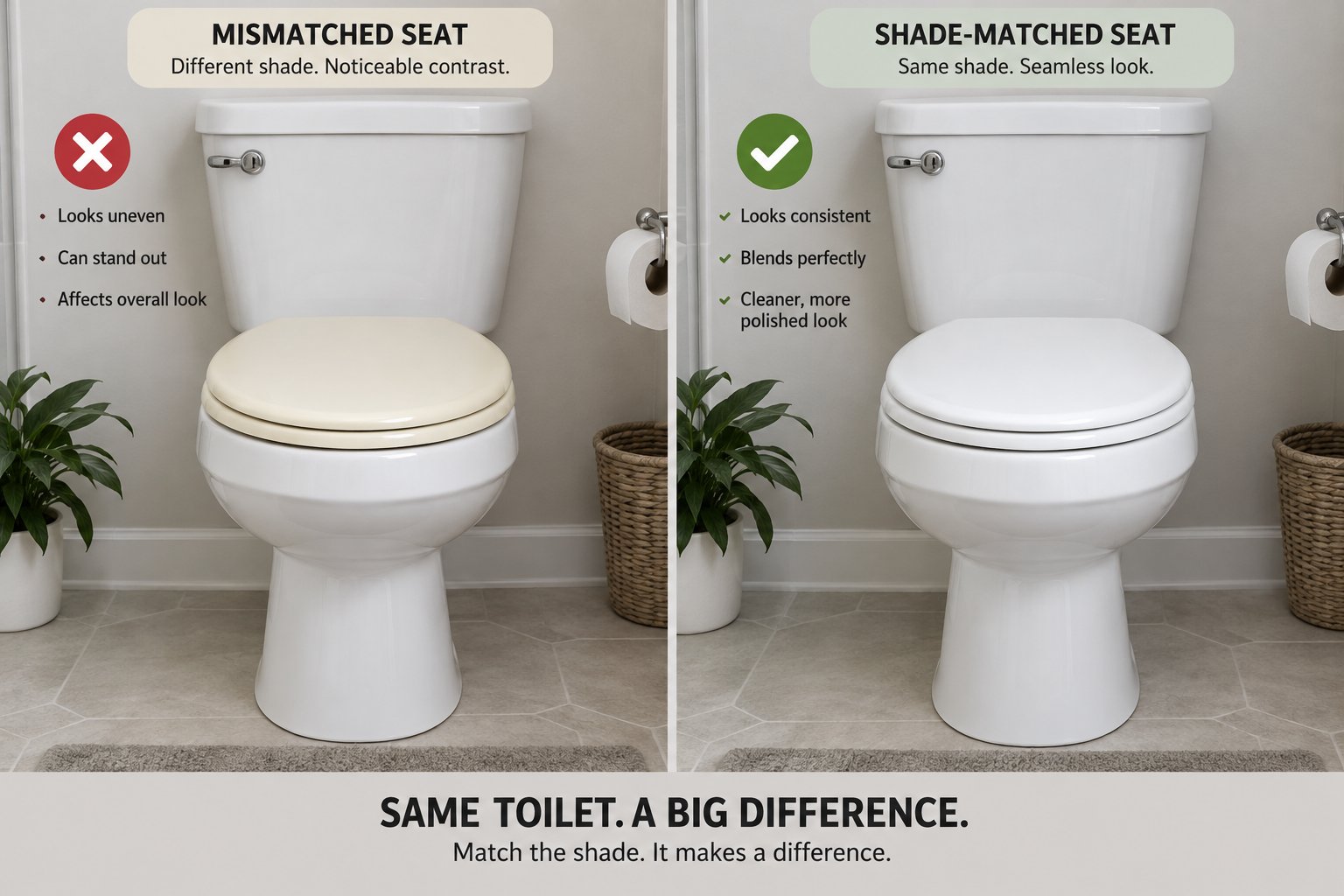
Shade matching is the first hurdle. "White" isn't a single color - it's a spectrum that includes bright white, cotton white, bone, biscuit, and more. Installing a bright white seat on a bone-colored toilet creates an immediate visual mismatch that looks dingy even when both pieces are brand new. Beyond shade, white surfaces reveal every mineral stain, cleaning streak, and scratch far more aggressively than darker alternatives. The material a white seat is made from also determines how quickly it yellows under UV light or chemical exposure.
White is the default choice for nearly every bathroom, yet it's the most unforgiving color when it comes to shade accuracy, stain visibility, and long-term color stability.
These challenges - yellowing, cracking, slamming, shade mismatches - are exactly why a white toilet seat cover deserves its own dedicated guide. The color you assume is simplest actually demands the most careful decision-making, starting with understanding the shape of your toilet bowl.
Why White Is the Most Popular Toilet Seat Cover Color
Walk into any bathroom showroom, scroll through walmart toilet seat listings, or browse the plumbing aisle at your local hardware store, and one color dominates the display: white. That's not a coincidence. It's the result of decades of design standards, manufacturing economics, and consumer preference converging on a single shade family. But "popular" doesn't mean "simple." In fact, white is the color that trips up more buyers than any other - and the reason comes down to variations most people never realize exist.
Why White Remains the Universal Standard for Toilet Seats
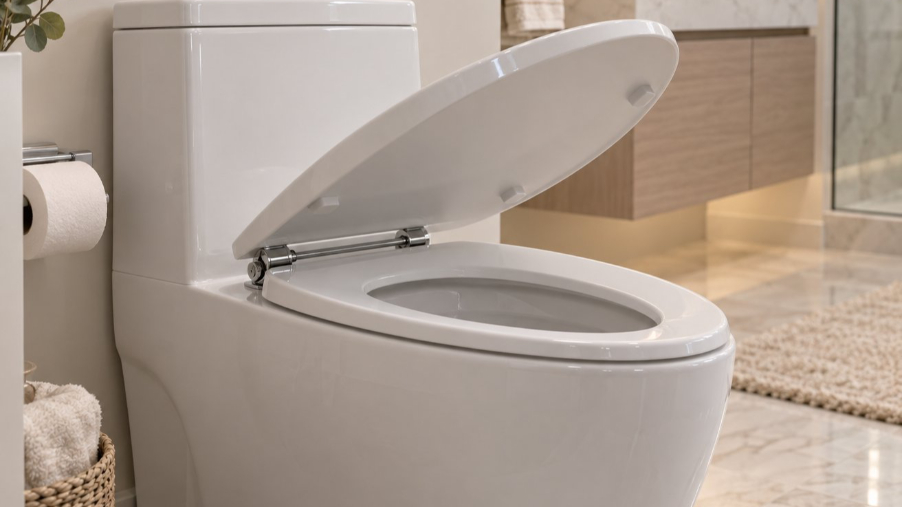
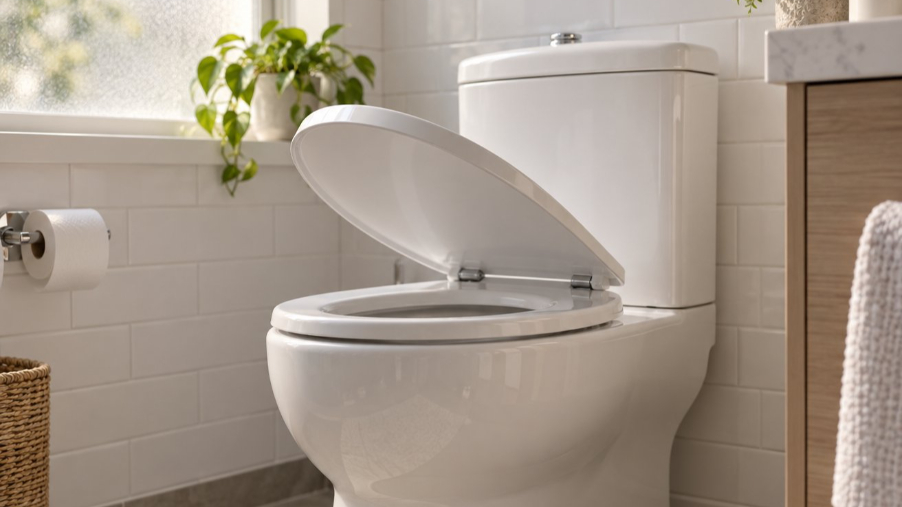
White earned its status as the bathroom default for practical reasons, not just aesthetic ones. A white toilet seat cover pairs with virtually any wall color, tile pattern, or vanity finish. It reads as clean and neutral in minimalist, traditional, and modern bathroom designs alike. That universal compatibility is why builders, contractors, and hotel chains overwhelmingly specify white fixtures - and why manufacturers produce white seats in every material, shape, and price bracket available.
Availability compounds the effect. Because demand for white is so high, retailers stock it in the widest variety of round, elongated, and specialty shapes. If you need a plastic toilet lid in an uncommon size, your best odds of finding one are in white. The same holds true for walmart toilet seats and other mass-market options - white selections outnumber colored alternatives by a significant margin. Whether you're shopping for a budget polypropylene seat or a premium thermoset model, the broadest feature and price range will always be in white.
For commercial settings - offices, restaurants, healthcare facilities - white also signals hygiene. It shows dirt clearly, which counterintuitively works in favor of facilities that maintain rigorous cleaning schedules. A spotless white seat communicates cleanliness in a way that darker colors simply can't replicate.
Understanding White Shade Variations Across Manufacturers
Here's where most buyers run into trouble. You'd assume that "white" means one thing, but toilet manufacturers each define it differently. Order a seat labeled "white" from one brand and hold it against a toilet bowl from another, and you'll often see a noticeable mismatch - one appears slightly blue-toned while the other leans warm or creamy. The result looks worse than a completely different color because it registers as "off" rather than intentionally contrasting.
The industry uses several distinct shade names, and they are not interchangeable. A guide from Bath Royale emphasizes that you should never try to match colors through your screen because all displays cast colors differently - instead, confirm your toilet's brand and specific color name before ordering.
| Shade Name | Visual Characteristic | Common Toilet Brands Using This Shade |
|---|---|---|
| Bright White / White | Cool-toned, crisp, blue-white undertone | TOTO, Kohler (White), American Standard (White) |
| Cotton White | Slightly softer than bright white, minimal warmth | TOTO (Cotton White) |
| Biscuit / Linen | Warm cream tone, noticeably off-white | Kohler (Biscuit), American Standard (Linen) |
| Bone | Light beige with a yellow-warm undertone | Kohler (Almond), American Standard (Bone) |
| Almond | Warmer than bone, distinct tan cast | Kohler (Almond), various economy brands |
Imagine placing a bright white seat on a biscuit-toned toilet. Even though both pieces are technically in the "white family," the contrast is immediately visible - the seat looks stark and cold against the warmer bowl, making the entire fixture appear mismatched and cheap. This is why checking your toilet manufacturer's documentation matters more than any product listing photo. If you can't find the original spec sheet, bring a snapshot of your bowl taken in natural daylight to the store, or order a sample chip if the manufacturer offers one.
Toilet seat liners and disposable covers avoid this problem entirely because they're temporary. But a permanent replacement seat lives on your toilet for years, so getting the shade right at purchase is essential.
Stain Visibility and Yellowing Challenges Unique to White
The same brightness that makes white look clean when it's new also makes every imperfection impossible to ignore over time. White surfaces act like a blank canvas - mineral deposits from hard water leave chalky rings, cleaning product residue creates dull streaks, and even body oils gradually build up a yellowish film in high-contact areas.
UV exposure adds another layer of challenge. As plumbing professionals note, constant exposure to sunlight through a bathroom window can shift a white seat's color toward yellow over time. Certain cleaning chemicals - particularly bleach applied to specific plastics - can actually accelerate discoloration rather than prevent it. And harsh or abrasive scrubbers create micro-scratches in the surface that trap stains permanently, making the seat look dirty even right after cleaning.
These aren't reasons to avoid white. They're reasons to choose the right material for a white seat, because not all plastics, composites, and finishes respond to UV light, chemicals, and wear in the same way. The material your seat is made from determines whether it stays bright for a decade or starts yellowing within a year - a distinction that matters far less with darker-colored seats where discoloration simply doesn't show.
Shape Compatibility Guide for Round, Elongated, and D-Shape Toilets
Getting the shade right is only half the equation. A perfectly color-matched white toilet cover seat still ends up as a return if it doesn't fit the shape of your bowl. And mismatched shapes are the single most common reason people send toilet seats back - or worse, discover the problem after installation when the packaging is torn and a return is no longer an option. The fix is simple: identify your bowl's shape before you shop. You don't need a tape measure, a level, or any special tools. You just need to know what to look for.
Round vs. Elongated vs. D-Shape Toilet Bowls
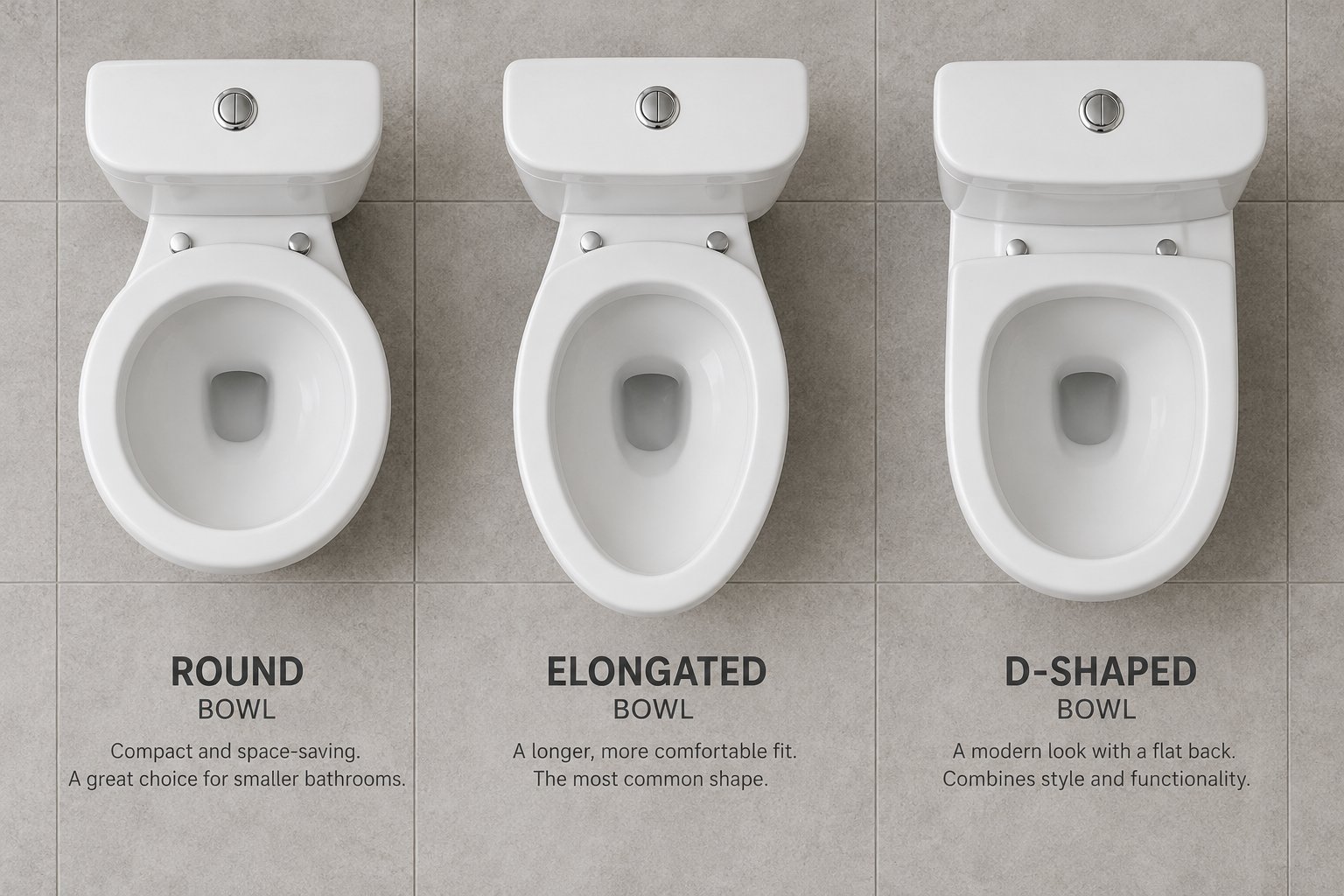
Every residential and commercial toilet bowl falls into one of three basic shape categories. Recognizing yours takes about five seconds once you know the visual cues.
- Round bowls - Stand above your toilet and look straight down. If the bowl opening appears nearly circular - roughly as wide as it is long - you have a round bowl. These are compact, typically found in smaller bathrooms, powder rooms, and older homes. The front of the bowl curves evenly without a pronounced point or extension. A toilet shape guide from Horow notes that the bowl length on round models typically runs about 16 to 16.5 inches from the seat mounting holes to the front rim.
- Elongated bowls - These look distinctly oval from above, stretching about two inches farther forward than a round bowl. The front of the rim comes to a softer, more pointed curve rather than a uniform circle. Elongated bowls measure roughly 18 to 18.5 inches from the mounting holes to the front rim. They're the most popular shape in primary bathrooms and newer construction because they offer more seating surface and a more comfortable posture for most adults.
- D-shape bowls - Imagine the letter "D" viewed from above. The back of the bowl is flat where it meets the tank or the wall, while the front curves outward in a smooth arc. D-shape designs are common in European-influenced and contemporary bathrooms, often paired with wall-hung toilets or sleek one-piece models. Bowl length varies more dramatically here - anywhere from about 14 to 16 inches depending on the specific design - because manufacturers prioritize the aesthetic line over standardized dimensions.
The key takeaway? Round and elongated bowls follow predictable sizing conventions. D-shape bowls don't. That difference in standardization directly affects how easy it is to find a toilet seat cover replacement in white for each shape.
How to Confirm Your Toilet Shape Without Measuring
Not everyone has a tape measure handy, and you shouldn't need one just to figure out what shape seat to buy. Here are three practical ways to identify your bowl type using nothing but your eyes:
- The overhead glance - Stand directly above the open bowl and look down. A circle means round. An oval with a visibly narrower, pointed front means elongated. A flat back edge paired with a curved front means D-shape. This takes three seconds and eliminates most guesswork immediately.
- The front profile check - Look at the toilet from the front at eye level. If the bowl rim traces a gentle, uniform curve, it's round. If the rim extends forward into a more egg-like or tapered profile, it's elongated. A flat rear transition into a curved front confirms a D-shape.
- The sit test - Sit down normally. On a round bowl, the seat feels compact and the front rim sits close. On an elongated bowl, you'll notice additional room in front of you - your thighs are more fully supported and the rim doesn't feel like it's crowding your legs. This isn't precise, but it builds useful instinct for when you're reading product descriptions online.
One extra tip that saves headaches: take a photo of your bowl from directly above before you start shopping online. Hold your phone parallel to the floor, center the bowl in the frame, and snap the shot in natural daylight. When you're comparing cover seat toilet options on a retailer's website, you can pull up that photo on your phone and visually match it against the product images. It's a surprisingly effective way to catch shape mismatches before checkout.
Which White Seat Cover Shapes Are Most Widely Available
Availability matters just as much as compatibility. You might correctly identify your bowl shape only to discover that finding a white replacement in that exact profile is harder than expected. Here's how the three shapes rank in terms of retail availability and ease of sourcing a toilet seat cover replacement:
- Elongated - The widest selection by far. Because elongated bowls dominate newer residential construction and commercial installations, manufacturers produce the greatest variety of white elongated seats across every material and price point. You'll find dozens of options on any major retailer's shelf or website.
- Round - A close second. Round white seats are widely stocked because millions of older homes and smaller bathrooms still use round bowls. Selection is excellent, though slightly narrower than elongated in premium feature categories like soft-close and quick-release models.
- D-shape - Significantly harder to source through mass-market channels. Many D-shape seats are model-specific, meaning they're designed to fit one particular toilet line rather than serving as a universal replacement. You'll often need to order directly from the toilet manufacturer or a specialty supplier, which limits your color-matching options and can extend lead times.
This ranking has a practical consequence that catches many buyers off guard: purchasing the wrong shape is often non-returnable once installed. Most retailers will not accept a toilet seat back after mounting hardware has been used, bolt holes have been tightened, or packaging has been discarded. A round seat wobbles and overhangs on an elongated bowl. An elongated seat on a round bowl juts past the front rim and looks awkward. Either scenario means you've bought a seat you can't use and can't return.
Confirming your bowl shape before ordering costs zero dollars and takes less than a minute. Skipping that step can cost you the full price of a seat you'll never use.
Shape and shade together form the foundation of a smart purchase - but they only tell you whether a seat will fit your toilet. What determines whether it stays white, resists scratches, and feels solid under daily use is the material it's made from, and that's where the real differences between budget and premium white seats begin to emerge.
Material Comparison for White Toilet Seat Covers
A white seat that fits your toilet's shape and shade can still disappoint within months if the material isn't right. Imagine installing a perfectly matched bright-white seat only to notice fine scratches dulling the surface after a few weeks of regular cleaning, or a yellowish tint creeping in after one summer of sunlight streaming through the bathroom window. The culprit isn't your cleaning routine or your bathroom's orientation - it's the material the seat was molded from. And because white reveals every flaw that darker colors can hide, material selection carries more weight here than with any other toilet seat color.
Plastic, Polypropylene, and Thermoset Material Differences
Most white toilet seats and covers on the market today fall into one of five material categories. Two of them - polypropylene (PP) and urea-formaldehyde (UF) - are engineered plastics that dominate modern production, while the remaining three serve niche roles. Here's what each one actually brings to the table.
Polypropylene (PP) is a thermoplastic polymer - meaning it's shaped by melting and injection molding. PP seats are lightweight, flexible enough to absorb impact without cracking, and inherently resistant to most chemical bathroom cleaners. They're manufactured at high volume with consistent color output, which makes them a staple in both residential bathrooms and commercial settings. If you've browsed toilet seat covers walmart carries in the budget-to-midrange aisle, you've likely held a PP seat without realizing it. The trade-off? PP's softer surface is more prone to micro-scratches over time, and its thermoplastic nature makes it slightly more susceptible to surface wear compared to harder alternatives.
Urea-formaldehyde (UF), often marketed as Duroplast, is a thermosetting plastic. Unlike PP, UF is compressed and cured under high heat and pressure during manufacturing. Once hardened, the material doesn't soften again - ever. The result is a rigid, dense seat with exceptional scratch resistance and a glossy, ceramic-like finish that closely resembles the porcelain it sits on. UF seats feel heavier and more substantial in your hand, which many users associate with premium quality. Their non-porous surface resists bacterial buildup and staining, making them popular in healthcare facilities and upscale hospitality projects. The downside is cost - UF seats carry a higher price tag due to the more complex manufacturing process.
Beyond PP and UF, you'll encounter three other material categories, each with distinct characteristics:
- Thermoset (general category) - A broader family that includes UF. Thermoset seats share the same color-through construction, meaning the pigment runs throughout the entire material rather than sitting as a surface layer. A scratch on a thermoset seat reveals the same color underneath, which is a significant advantage for white wc seat cover options that endure heavy daily use.
- Solid wood - Often finished with enamel paint or lacquer. Wood seats offer a warm, traditional feel and noticeable heft, but they're the most vulnerable to moisture damage, paint chipping, and yellowing. A scratch on a painted white wood seat exposes the bare wood grain underneath - an immediate and irreversible cosmetic problem.
- Molded wood composite (MDF) - Compressed wood fibers coated with a painted or laminated finish. Lighter than solid wood and less expensive, but prone to swelling if moisture penetrates the surface coating through chips or cracks. Once the seal breaks, the composite core absorbs water and begins to degrade.
The following table puts all five materials side by side across the attributes that matter most for a white seat:
| Attribute | PP (Polypropylene) | UF (Urea-Formaldehyde / Duroplast) | Thermoset (General) | Solid Wood | Molded Wood Composite |
|---|---|---|---|---|---|
| Weight | Lightweight | Medium-heavy | Medium-heavy | Heavy | Medium |
| Scratch Resistance | Moderate | Very high | High | Low (paint chips) | Low-moderate |
| Yellowing Resistance | Moderate (UV-sensitive) | High | High | Low (paint yellows) | Low-moderate |
| Price Range | Budget to mid-range | Mid-range to premium | Mid-range to premium | Mid-range to high | Budget to mid-range |
| Color Consistency | Good (surface color) | Excellent (color-through) | Excellent (color-through) | Depends on paint quality | Depends on coating |
| Feel / Comfort | Slightly warm, flexible | Cool, rigid, ceramic-like | Cool, solid | Warm, natural | Neutral, slightly warm |
You'll notice PP and UF sitting at the top of this comparison for a reason: they account for the vast majority of white toilet seats sold today, both in retail and in commercial supply chains. Wood-based options still have their advocates - particularly fans of the traditional bathroom aesthetic - but engineered plastics have largely overtaken them on durability, hygiene, and long-term color stability.
Why Material Choice Matters More for White Seats
Here's the reality that most product listings never address: a scratch on a black or navy seat is practically invisible. The same scratch on a white seat? It catches light, traps grime, and creates a visible line that no amount of cleaning can erase. White acts as a magnifying glass for every material weakness.
Consider three scenarios that play out differently depending on material:
- Scratches on painted wood reveal a brown or tan substrate beneath the white finish. The contrast is stark and immediate - one accidental scrape from a belt buckle or a dropped object, and the damage is permanently visible.
- UV yellowing is most aggressive on white surfaces because the color shift from pure white to yellowish-cream is easy for the human eye to detect. A UF or thermoset seat with color-through construction resists this shift far longer than a PP seat, which is why you'll often see PP seats in bathrooms without direct sunlight holding their color well, while the same material in a sun-exposed room begins to turn within a year or two.
- Chemical cleaner damage leaves bleach spots, dull patches, or hazy residue that disappears into darker colors but stands out immediately on white. PP seats tolerate most household cleaners but react poorly to concentrated bleach. UF's non-porous surface shrugs off chemical exposure more effectively.
The bottom line is straightforward: material choice has a bigger visual impact on white seats than on any other color. A budget material in charcoal gray might look fine for years because its flaws stay hidden. That same budget material in bright white starts showing its age within months. If longevity and appearance matter to you - and with white, they inevitably do - the material is where your money should go.
PP and UF Seat Covers for OEM and Brand Programs
For individual homeowners, the PP-versus-UF decision comes down to budget and bathroom conditions. But the same comparison plays out at a much larger scale in the manufacturing world. Sanitaryware brands, hotel chains, and commercial developers don't just buy seats one at a time - they source thousands of units in coordinated programs where the seat material, hinge type, damper mechanism, and fixing hardware all need to work together seamlessly.
PP and UF have become the industry-standard materials for these production-ready programs because they offer predictable quality, consistent white-shade output across large batches, and compatibility with modern hinge and damper systems. A brand launching a new toilet line needs seat covers that match the bowl's shade precisely across every unit, hold up under commercial-grade use, and integrate with soft-close or quick-release mechanisms without aftermarket modification.
Manufacturers like Tianyun have built their programs specifically around this need, offering PP and UF seat cover options that pair directly with compatible dampers, hinges, and fixing systems. For brands evaluating production-ready seat cover solutions at scale, this kind of integrated approach eliminates the guesswork of sourcing individual components from separate suppliers and ensures that every seat in a production run delivers the same fit, finish, and functional performance.
Whether you're a homeowner replacing a single yellowed seat or a brand manager specifying materials for a 10,000-unit hotel project, the underlying principle is identical: the material you choose determines how long your white seat stays white. PP delivers reliable performance at an accessible price point. UF delivers premium durability and a finish that resists the scratches, stains, and yellowing that white surfaces are uniquely prone to revealing. Either way, the material decision is the single most consequential choice you'll make - more than shape, more than brand, and certainly more than price alone.
Of course, even the best material can't prevent a seat from slamming shut dozens of times a day. That repeated impact stress is one of the leading causes of cracking and hinge failure, which is exactly why the hinge mechanism deserves just as much attention as the material itself.
Slow-Close vs. Standard Hinges and What They Mean for Your Seat
You've probably seen "slow close" or "soft close" stamped across dozens of product titles while browsing toilet seats at walmart or any online retailer. It sounds like a nice feature - but what does it actually do inside the hinge? How is it different from a standard hinge, and is it worth paying extra for? Most listings treat these terms as self-explanatory selling points without ever explaining the mechanism, the durability trade-offs, or how hinge quality varies wildly between a fifteen-dollar toilets seat cover and a sixty-dollar one. That gap leaves buyers guessing, so let's close it.
How Slow-Close Hinges Work and Why They Matter
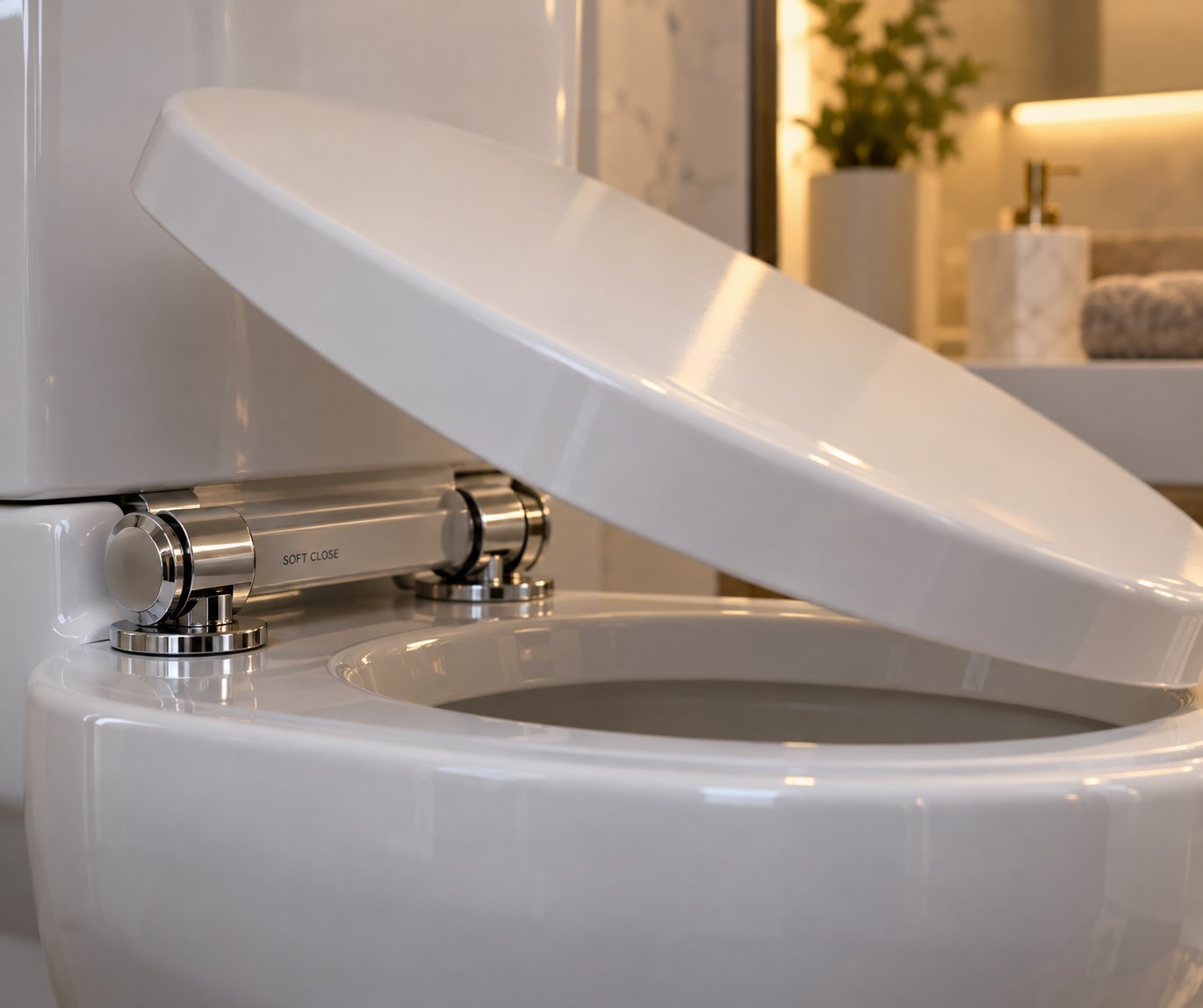
A slow-close hinge - also called a soft-close hinge - contains a small internal component called a rotary damper. Picture a tiny sealed cylinder filled with viscous silicone fluid. When you release the seat or lid, gravity pulls it downward, but the damper forces that motion through the fluid, absorbing the kinetic energy and converting a free-fall slam into a controlled, silent descent. The entire closing cycle typically takes four to eight seconds, depending on the damper's calibration.
The practical benefits show up immediately in daily life:
- Noise elimination - No more jarring bang echoing through the house at 2 a.m. This matters enormously in shared housing, apartments with thin walls, and any bathroom adjacent to a bedroom.
- Extended seat life - Every slam sends a shockwave through the seat material and the porcelain rim beneath it. Over hundreds of impacts, that repeated stress causes cracks, loosened hinges, and even chips in the bowl itself. A slow-close mechanism removes that impact entirely, so both the seat and the toilet last longer.
- Child safety - A toilet lid falling under its own weight generates enough force to pinch small fingers painfully. Soft-close hinges eliminate that risk completely, making them a practical upgrade for any household with toddlers or young children.
Here's the detail most shoppers miss, though: damper quality varies dramatically. A cheaply manufactured damper may feel smooth for the first few months, then begin to lose resistance as the internal fluid degrades or the seals wear. At that point, the "soft close" turns into a slightly-less-loud slam. High-quality dampers use precision-engineered fluid chambers and durable seals rated for tens of thousands of cycles - often lasting the full lifespan of the seat itself, which can mean five to ten years of reliable, silent closing.
Standard Hinges vs. Soft-Close vs. Quick-Release Mechanisms
Hinge types are often described interchangeably in product listings, which creates unnecessary confusion. In reality, three distinct hinge categories exist, and two of them - soft-close and quick-release - are independent features that can appear separately or together on the same toilet bowl cover.
- Standard hinges - The simplest design. A fixed or adjustable pivot point connects the seat to the bowl with bolts and nuts. You lift the seat manually and lower it manually. If you let go, gravity takes over and the seat drops freely. Standard hinges cost the least, have no moving internal parts to wear out, and are the easiest to replace. They're a reliable choice for guest bathrooms, rental units, or any setting where budget outweighs convenience.
- Soft-close hinges - Same bolt-and-mount connection, but with the internal rotary damper described above. You can still lift the seat freely - the damping only engages during the downward closing motion. Mid-range cost. The damper mechanism requires compatible mounting geometry, so you can't always retrofit a soft-close hinge onto every seat. Many modern toilet seat covera products come with soft-close hinges pre-installed as a standard feature rather than an upgrade.
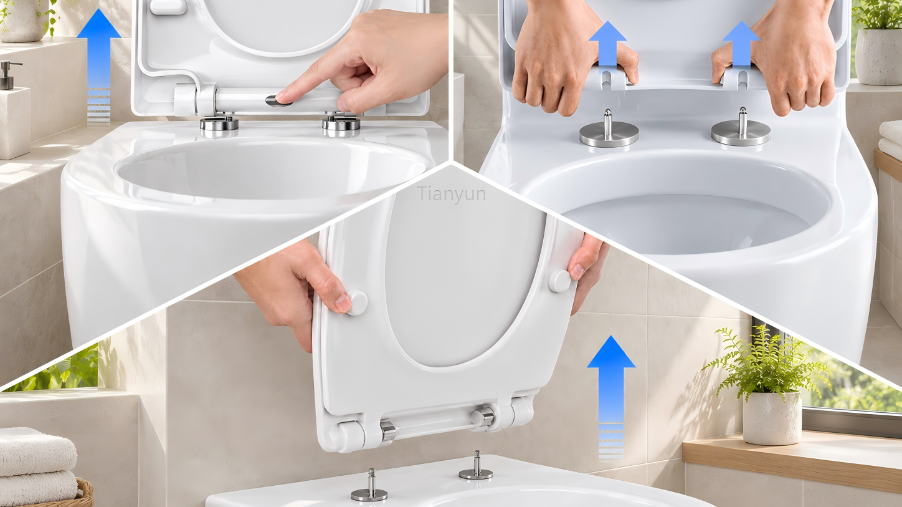
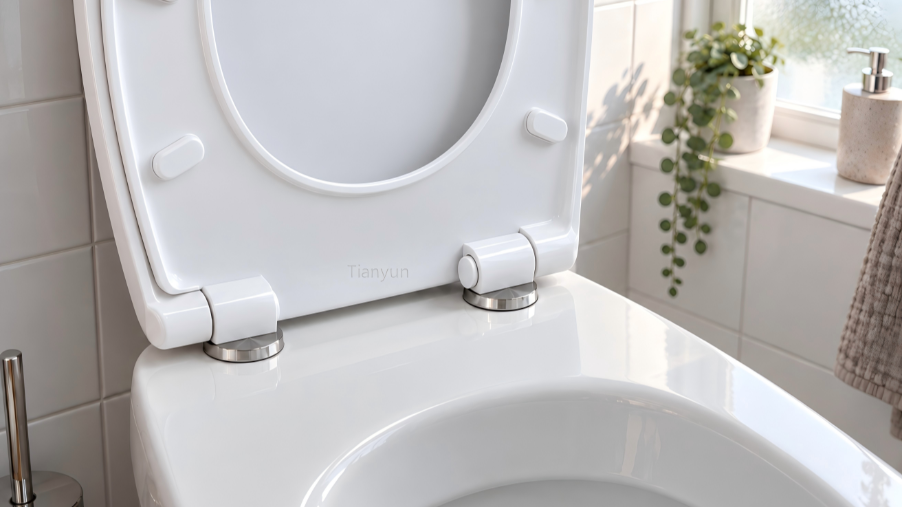
- Quick-release hinges - A mechanism that allows you to detach the entire seat from the bowl without tools, usually by pressing a button or flipping a lever at the hinge plate. This makes deep cleaning around the mounting area dramatically easier - that hard-to-reach zone where the seat bolts meet the porcelain collects grime that's nearly impossible to scrub with the seat in place. Quick-release can exist on its own with standard closing, or it can be combined with soft-close for a seat that both detaches easily and closes silently.
That last point is worth emphasizing: quick-release and soft-close solve two completely different problems. Soft-close addresses noise and impact. Quick-release addresses hygiene and cleaning access. The best toilet bowl cover options combine both features, but you'll also find seats with one and not the other. Knowing they're independent helps you evaluate listings more accurately instead of assuming that a "soft-close" seat automatically includes quick-release functionality - it often doesn't.
What to Look for When Upgrading Hinges on a White Seat
On darker-colored seats, hinge hardware blends into the background. On a white surface, every hinge component is on full display. The contrast between a bright white seat and a tarnished chrome bracket or a yellowed plastic hinge cap creates a visual mismatch that undermines an otherwise clean look. When you're shopping for a white seat - or upgrading the hinges on one you already own - keep these details in mind:
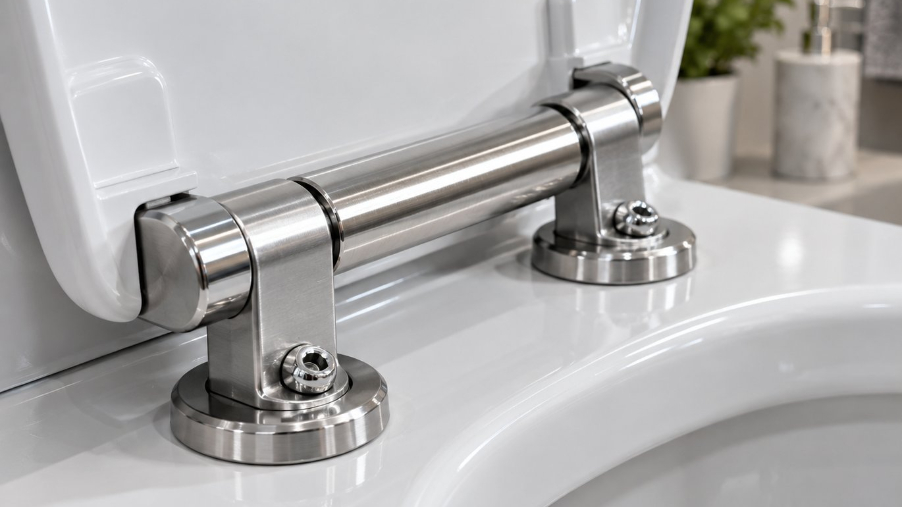
- Hinge material and finish - Common options include white plastic, polished chrome, brushed stainless steel, and brass. White plastic hinges disappear against a white seat for a seamless appearance. Chrome and stainless steel add a subtle accent that works well in modern bathrooms. Brass hinges suit traditional decor but tend to develop patina over time, which may clash with a crisp white seat.
- Hinge visibility - Some designs conceal the hinge mechanism beneath a cover plate, while others leave the bolt heads and pivot hardware exposed. On white seats, concealed hinges deliver a cleaner look.
- Replacement without full seat swap - Certain seat models allow you to replace worn or failed hinges independently, without discarding the entire seat. This is a genuine money-saver, especially for premium UF or thermoset seats where the seat body itself may be in perfect condition even after the original damper wears out. Check whether your seat's manufacturer sells replacement hinge kits before committing to a full replacement.
A high-quality hinge paired with a durable material is the combination that keeps a white seat looking and functioning like new - one prevents yellowing and scratches, the other prevents slamming and loosening.
Hinges control how your seat moves. But the features built into the seat itself - antimicrobial coatings, integrated child seats, hygiene-focused design elements - determine how well it serves your household's specific needs beyond just opening and closing.
Special Features That Upgrade a Basic White Toilet Seat Cover
Browse any page of plastic toilet seat covers at a major retailer and you'll spot a parade of buzzwords: "antimicrobial protection," "built-in child seat," "no-slam technology," "quick-release for easy cleaning." Each one adds a few dollars - sometimes quite a few - to the sticker price. But here's the problem: almost no listing actually explains what these features do, how they work, or whether they'll make a meaningful difference in your bathroom. That leaves you guessing which upgrades are genuine improvements and which are marketing fluff designed to justify a higher price tag. Let's break each one down so you can decide with real information, not assumptions.
Antimicrobial Coatings and Hygiene Features Explained
An antimicrobial toilet seat uses a chemical agent - most commonly silver-ion technology or zinc pyrithione - to inhibit the growth of bacteria, mold, and mildew on the seat surface between cleanings. The key word there is "inhibit." These treatments slow microbial reproduction rather than eliminating organisms entirely. Think of it as an extra layer of defense that keeps bacterial populations from multiplying as rapidly on the seat surface during the hours between your regular cleaning sessions.
How the treatment gets into the seat matters, too. Two approaches dominate the market:
- Integrated antimicrobial agents - The active compound is mixed directly into the raw material during manufacturing, so it's distributed throughout the entire seat body. This approach lasts the full life of the seat because the agent isn't just on the surface - it's embedded in the material itself. Even minor surface scratches expose fresh antimicrobial-treated material underneath.
- Surface-applied coatings - The antimicrobial agent is applied as a topcoat after the seat is molded. This is less expensive to produce but can wear away over time through repeated cleaning, abrasion, or chemical exposure. Once the coating degrades, the antimicrobial benefit diminishes.
Who benefits most? Households with young children who touch bathroom surfaces frequently, shared or commercial restrooms where multiple users cycle through daily, and individuals with compromised immune systems all see the greatest value from antimicrobial features. For a single-adult household with a consistent cleaning schedule, the benefit is real but less dramatic.
One critical clarification: antimicrobial does not mean self-cleaning. These coatings reduce bacterial growth between cleanings, but they don't eliminate the need to wipe down your seat regularly. Visible grime, mineral deposits, and soap scum still accumulate just as they would on any other surface. If a product listing implies you can skip cleaning altogether because of antimicrobial protection, that's misleading.
Quick-Release and Built-In Child Seat Features
If you've ever tried to scrub the narrow gap where a toilet seat's hinge plate meets the porcelain bowl, you already know the frustration. That crevice collects a stubborn mix of dust, moisture, and bathroom grime that a sponge or brush simply can't reach while the seat is mounted. Quick-release mechanisms solve this problem elegantly - press a button or flip a small lever at the back of the hinge, and the entire seat lifts straight off the mounting bolts without any tools. You clean the exposed porcelain thoroughly, then snap the seat back into place in seconds.
Built-in child seats take a different approach to convenience. Instead of buying a separate toddler adapter ring that sits on top of the adult seat - easy to misplace, prone to sliding, and one more item to store - some white seats integrate a smaller child-sized ring directly into the lid. The child seat folds down when a toddler needs it and tucks away magnetically or with a latch when adults are using the bathroom. No separate accessories, no storage hassles, and no wrestling with an adapter at 6 a.m. while a preschooler waits impatiently.
Here's a quick summary to help you match each feature to the right user profile:
- Quick-release mechanism - Primary benefit: thorough, tool-free cleaning access around the hinge zone. Ideal for: anyone who prioritizes hygiene, households that clean frequently, and commercial restrooms where sanitation standards are high.
- Built-in child seat - Primary benefit: eliminates the need for a separate toddler adapter ring. Ideal for: families with children roughly ages one through five who are potty-training or transitioning to adult-sized fixtures.
- Antimicrobial coating (integrated) - Primary benefit: slows bacterial growth on the seat surface between cleanings. Ideal for: shared bathrooms, commercial settings, households with immunocompromised members.
- Antimicrobial coating (surface-applied) - Primary benefit: same bacterial inhibition at a lower price point. Ideal for: budget-conscious buyers who still want added hygiene assurance, understanding it may diminish over time.
Which Features Are Worth Paying More For
Not every upgrade delivers the same return on investment, and honest evaluation depends entirely on how your bathroom is used - not on how much the seat costs.
Soft-close hinges and quick-release mechanisms deliver quality-of-life improvements you'll notice every single day. The silence of a controlled close, the ease of lifting a seat off for deep cleaning - these are benefits that compound over hundreds of uses per month. They also protect your investment: less slamming means less cracking, and easier cleaning means the white surface stays brighter longer. If your budget allows only one upgrade, these two features offer the most consistent daily value.
Antimicrobial coatings provide genuine peace of mind, particularly in high-traffic or shared bathrooms. But they should complement your cleaning routine, never replace it. A toilet cover walmart stocks at a premium price because of an antimicrobial label still needs regular wiping. The coating works between cleanings, not instead of them.
Built-in child seats are a high-value feature for a very specific window of time. If you have a toddler, this single feature can eliminate months of wrestling with loose adapter rings. If your children have outgrown that stage - or you don't have young kids at all - the integrated child seat adds cost and complexity with no benefit. Toilet seats walmart carries with this feature tend to occupy the upper end of the price spectrum, so buying one "just in case" is rarely a smart investment.
The best feature set for your bathroom depends on who uses it and how often - not on the price tag. A family with toddlers needs different upgrades than a couple in an empty nest, and a guest bathroom demands different priorities than a primary suite used twice daily.
Features like these enhance how a seat performs over its lifespan. But none of them matter if you can't get the seat installed properly in the first place - and installation is where a surprising number of white seat upgrades go wrong before they ever get used.
How to Remove and Install a White Toilet Seat Cover
A yellowed, cracked, or wobbly white seat is one of the most common reasons homeowners start searching for toliet seat covers in the first place. The good news? Replacing one is genuinely one of the simplest bathroom projects you'll ever tackle. No plumber required, no specialized training, and no expensive tools. Most people finish in fifteen to thirty minutes, including cleanup. The entire process comes down to loosening two bolts, lifting off the old seat, and securing the new one in place. Yet a handful of avoidable mistakes - especially overtightening and misalignment - turn this quick swap into a frustrating ordeal. Here's how to get it right on the first try.
Tools You Need and How to Remove an Old Toilet Seat
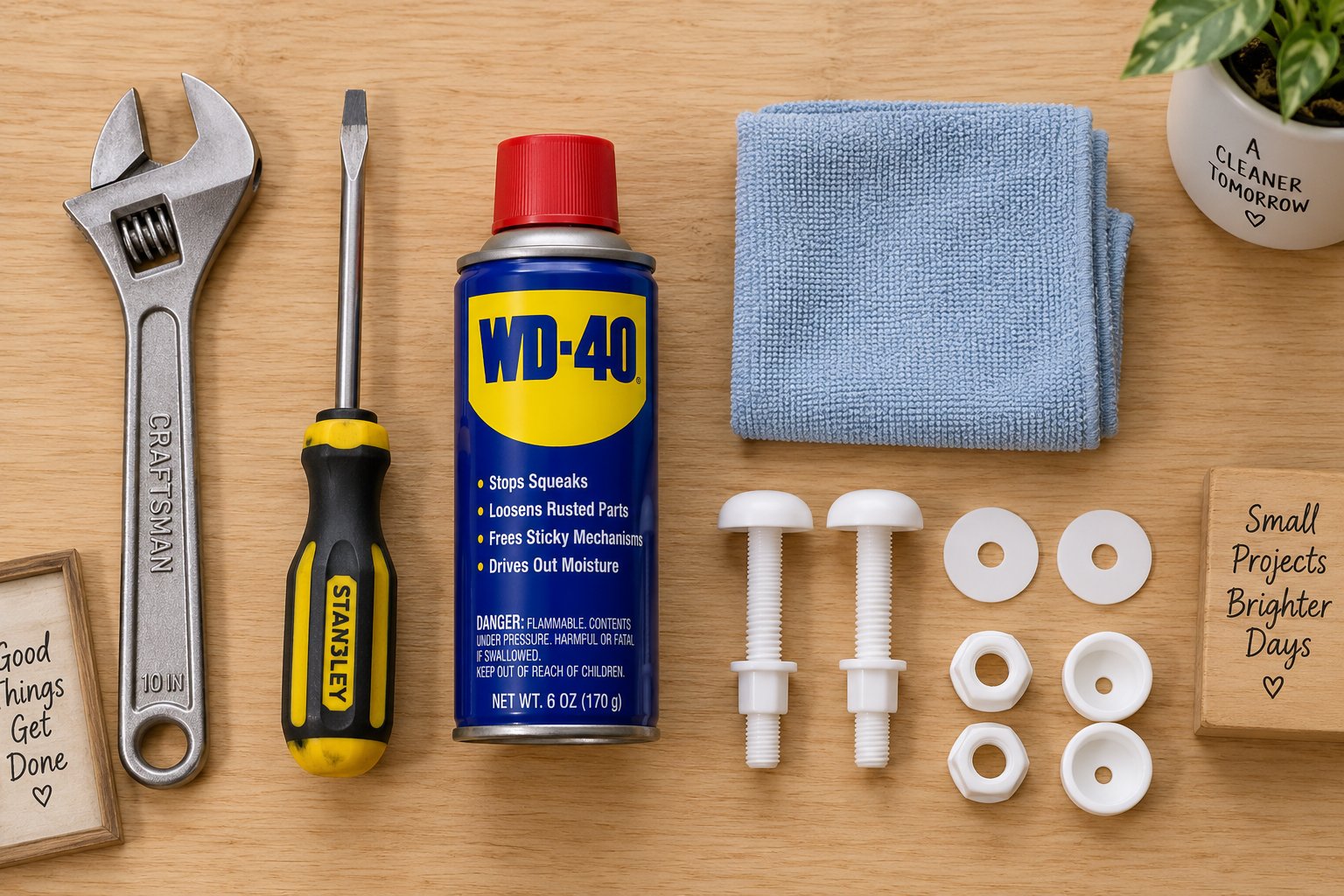
Before you touch anything, gather a small toolkit. You likely already own everything on this list:
- Adjustable wrench or pliers - For gripping nuts underneath the bowl rim while you turn the bolt on top.
- Flathead screwdriver - For popping open plastic bolt caps that conceal the mounting hardware on many seats.
- Penetrating oil (like WD-40 or PB Blaster) - Essential if your existing bolts are corroded. Spray it on, wait ten to fifteen minutes, and let chemistry do the hard work before you apply force.
- A soft cloth or old towel - Lay this over the porcelain behind the seat to protect the tank and bowl from accidental scratches if a wrench slips.
With your tools ready, removal follows a straightforward sequence. Look at the back of your current seat where it connects to the bowl. You'll see two mounting points - one on each side - sitting in oval or round holes in the porcelain rim. Many restroom seat covers and residential models hide these mounting bolts beneath small plastic caps that snap or flip open. Pop those caps to expose the bolt heads.
Here's the key move: hold the nut underneath the bowl rim with your pliers or wrench while you turn the bolt on top with a screwdriver or a second wrench. Turning the bolt alone often just spins the nut along with it, accomplishing nothing. You need to stabilize one side while rotating the other. Once both bolts are free, lift the old seat straight up and off the bowl.
Sounds simple, right? It is - unless the bolts are corroded. Rust-seized hardware is the single most common frustration in toilet seat removal, particularly in humid bathrooms where metal bolts have sat in moisture for years. If the bolts won't budge after applying penetrating oil and waiting, try tapping the bolt head gently with a hammer to break the rust bond. As a last resort, a mini hacksaw or oscillating multi-tool can cut through a stubborn bolt in about thirty seconds. Just protect the porcelain with your cloth and cut carefully. Royal Bathrooms notes that even stuck-bolt situations rarely push the total job past thirty minutes.
Step-by-Step Installation of a New White Seat Cover
With the old seat removed, you're looking at a bare porcelain rim with two open mounting holes. Before you unbox the new seat, take sixty seconds for one critical step that most people skip: clean the mounting area thoroughly. Grime, mineral buildup, and old rubber gasket residue collect around those bolt holes and underneath the hinge zone. A damp cloth with mild bathroom cleaner clears it quickly. Starting with a clean surface ensures your new seat sits flush against the porcelain without any debris creating an uneven gap.
From here, follow this sequence:
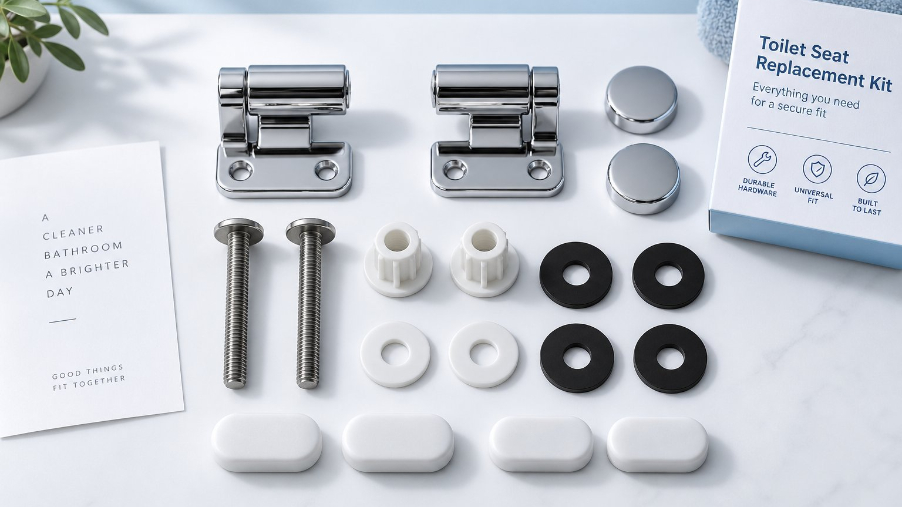
- Unpack the new seat and verify all hardware is included. Most walmart toilet seat covers and other retail options include mounting bolts, nuts, washers, and any specialty gaskets in a small hardware bag. Confirm nothing is missing before you start.
- Align the new seat's hinge bolts with the existing mounting holes. Set the seat on the bowl without fastening anything first. Check that the bolt holes on the hinge plate line up naturally with the holes in the porcelain rim. If you need to adjust, most hinges allow slight lateral sliding.
- Insert the bolts from above. Drop each bolt through the hinge plate and down through the porcelain hole. Some seats include rubber or plastic washers that sit between the hinge plate and the porcelain - install these now to create a cushion that prevents the hardware from scratching the bowl.
- Hand-tighten the nuts from below. Reach under the bowl rim and thread each nut onto its bolt. Turn them finger-tight only at this stage. You want enough grip to hold the seat in position but enough play to make adjustments.
- Center the seat on the bowl and adjust. Close the lid and look at the seat from directly above. The seat should sit centered on the bowl rim with even overhang on both sides. If it's shifted left or right, nudge it while the bolts are still hand-tight. Many modern hinge plates have elongated slots rather than fixed holes, giving you a centimeter or two of adjustment range.
- Tighten the bolts firmly - but do not overtighten. Use your wrench to snug each nut down in quarter-turn increments, alternating between the left and right bolt to apply even pressure. Stop as soon as the seat feels solid and doesn't shift when you press down on it. The seat should be secure, not strangled.
One modern design worth noting: many newer seats - particularly soft-close models - use top-fixing systems that don't require access underneath the bowl at all. Instead of a bolt-and-nut arrangement, these systems use expanding anchors or tightening screws that you install entirely from above. You insert the fixing into the porcelain hole, tighten a top-accessible screw that expands the anchor against the underside of the rim, and the seat locks into place. If your new seat includes this type of hardware, the manufacturer's instructions will walk you through the specific mechanism. Top-fixing systems are especially convenient for close-coupled and wall-hung toilets where reaching underneath the bowl is physically awkward.
Avoiding the Most Common Installation Mistakes
Three errors account for nearly every installation problem, and all three are preventable with a little awareness:
| Mistake | What Happens | How to Prevent It |
|---|---|---|
| Overtightening the mounting bolts | Cracks the porcelain rim, cracks the seat's hinge plate, or strips the bolt threads - any of which can mean replacing the toilet itself, not just the seat | Tighten in quarter-turn increments and stop the moment the seat feels stable; if it doesn't wobble when you press on it, it's tight enough |
| Undertightening the mounting bolts | The seat slides and shifts during use, creating an annoying rocking motion and accelerated wear on the bolt holes | After hand-tightening, apply just enough wrench force to eliminate all lateral movement; test by pressing firmly on the front and sides of the seat |
| Misaligning the seat before final tightening | The seat sits off-center on the bowl, with more overhang on one side than the other - visually obvious on a white seat against white porcelain and impossible to fix without loosening and repositioning | Always close the lid and visually check centering from above before applying final torque to the bolts |
One more subtle mistake deserves a mention: discarding the old mounting hardware before confirming that the new seat's bolts fit your toilet's hole spacing. Most toilets use a standard bolt-hole distance of roughly 5.5 inches center to center, but variations exist - especially on older or imported models. If your new hardware doesn't align, you'll need adapter plates or a different seat entirely. Keep the old bolts nearby until the new seat is fully installed and confirmed secure.
The entire replacement process - removal, cleaning, installation, and adjustment - typically takes fifteen to twenty minutes. Rushing the alignment and tightening steps to save two minutes is how a simple project turns into a cracked bowl or a wobbly seat.
A properly installed white seat should feel rock-solid from day one, with no shifting, no wobble, and no visible gaps between the hinge plate and the porcelain. Keeping it looking that good over the following months and years, however, depends entirely on how you clean and maintain a surface that shows every mark - and white demands a specific care approach that darker colors simply don't require.
Cleaning and Maintaining White Toilet Seat Covers to Prevent Yellowing
White porcelain gleams when it's clean - and broadcasts every speck, streak, and stain when it's not. Your bathroom toilet seat cover operates under the same unforgiving rules. A dark-colored seat can go a week between deep cleans without looking noticeably worse. A white seat? You'll spot a dried water droplet or a faint cleaning residue streak within a day. That visibility isn't a flaw - it's actually useful feedback that tells you exactly when your seat needs attention. The trick is knowing which cleaning methods preserve that bright finish and which ones quietly accelerate the yellowing, scratching, and dulling you're trying to prevent.
Daily and Weekly Cleaning Best Practices for White Seats
Your daily routine doesn't need to be elaborate. A quick wipe-down with mild soap and warm water - or a non-abrasive bathroom cleaner sprayed onto a soft cloth - handles surface-level grime before it has a chance to set. The emphasis here is on "non-abrasive." Scouring powders, rough sponge pads, and stiff-bristled brushes create micro-scratches in the seat's surface that are invisible at first but gradually accumulate into a dull haze. Those tiny grooves also trap dirt and body oils, creating permanent discoloration that no amount of scrubbing can reverse.
For a weekly deep clean, a baking soda paste works remarkably well on stubborn marks without damaging the finish. Mix a few tablespoons of baking soda with just enough water to form a thick, spreadable consistency. Apply the paste directly to stained areas using a microfibre cloth or an old soft-bristled toothbrush for tight spots around the hinges. Let it sit for fifteen to twenty minutes, then gently scrub and wipe away. Good Housekeeping recommends repeating this process if marks remain - they should fade noticeably with each application.
Here's the step most people skip: rinsing and drying after every cleaning session. White surfaces show residue streaks from cleaning products just as easily as they show dirt. A damp cloth wipe followed by a dry towel pass eliminates those hazy film marks that make a freshly cleaned seat look almost as dull as a dirty one. It takes thirty seconds and makes a visible difference.
One quick note on wood and wood-composite bathroom seat covers: skip the baking soda paste entirely. Stick to warm, soapy water and gentle wiping. Abrasive pastes can damage lacquer finishes and expose the wood substrate beneath, which creates moisture entry points that lead to swelling and permanent discoloration.
How to Prevent and Treat Yellowing on White Toilet Seat Covers
Yellowing is the number-one cosmetic complaint about white seats, and it frustrates homeowners because it often appears gradually - so slowly that you don't notice until a visitor points it out or you hold a new white towel next to the seat and realize the color no longer matches. Understanding what causes the discoloration is the first step toward preventing it.
Three culprits account for virtually all yellowing on white seats:
- UV exposure from bathroom windows - Sunlight contains ultraviolet radiation that breaks down the chemical bonds in many plastics, particularly polypropylene. This photodegradation shifts the surface color from bright white toward a yellowish or cream tone. Bathrooms with large windows, skylights, or south-facing exposure are the most vulnerable. The yellowing is cumulative and irreversible once it sets in - no cleaner can undo UV-induced molecular changes.
- Chemical reactions from harsh cleaners - Bleach is the biggest offender. While it seems logical to use bleach on a white surface for maximum whitening power, concentrated bleach actually reacts with certain plastics - especially PP - to accelerate yellowing rather than prevent it. The chlorine in bleach oxidizes the polymer surface, creating the exact discoloration you were trying to avoid. Other harsh chemicals, including some toilet bowl cleaners that splash onto the seat, produce similar reactions.
- Body oil absorption over time - Skin oils, sweat, and lotions transfer to the seat surface during every use. On porous or micro-scratched surfaces, these oils seep below the top layer and create a yellowish buildup that standard surface cleaning can't reach. The effect is most pronounced on high-contact areas - the front and sides of the seat ring where thighs make direct contact.
Prevention is far more effective than treatment once yellowing starts. Here are the strategies that make the biggest difference:
- Choose UV-resistant materials from the start - UF (Duroplast) and thermoset seats resist UV-driven color changes far better than standard PP. If your bathroom gets direct sunlight, this material choice alone can add years of bright-white appearance.
- Avoid bleach-based cleaners on plastic seats - Use hydrogen peroxide-based alternatives or simple soap-and-water solutions instead. If you must disinfect, look for cleaners specifically labeled safe for plastic surfaces.
- Clean regularly to prevent oil buildup - A weekly wipe with mild soap prevents body oils from accumulating to the point where they penetrate the surface. Consistency matters more than intensity here - gentle, frequent cleaning outperforms occasional aggressive scrubbing every time.
- Consider window treatments for sun-facing bathrooms - A simple window film, blind, or sheer curtain that blocks UV rays protects every white surface in the room, not just the seat. This is an especially smart move if you've invested in a premium white seat and want to preserve its finish for the long haul.
Already noticing yellowing? The baking soda paste method described above can improve mild surface discoloration. For more advanced yellowing, a paste made with hydrogen peroxide and baking soda - applied for thirty minutes and gently scrubbed - sometimes produces noticeable lightening. But be realistic: deep, material-level yellowing caused by years of UV exposure or chemical damage is permanent. No topical treatment reverses molecular-level degradation.
When to Replace Rather Than Clean a White Seat Cover
There's a point where cleaning stops being productive and replacement becomes the smarter investment. Recognizing that threshold saves you from spending hours scrubbing a seat that's past its useful life. Most toilet seats last roughly five to seven years depending on material quality and usage intensity, but visible condition tells you more than any calendar date.
Consider a toilet seat lid replacement when you notice any of these signs:
- Permanent discoloration that cleaning cannot resolve - If the baking soda paste, hydrogen peroxide treatment, and every other method you've tried leaves the seat looking dingy, the yellowing has penetrated beyond the cleanable surface layer. No product will restore the original color.
- Visible cracks or chips - Beyond being cosmetically unappealing, cracks in a seat surface create crevices where bacteria thrive in moisture - a genuine hygiene risk that cleaning alone cannot mitigate. Chipped edges can also scratch skin.
- Loose hinges that cannot be retightened - If the bolt holes in the seat have worn or stripped to the point where the mounting hardware no longer holds securely, no amount of tightening will restore stability. The seat will continue to shift and wobble, accelerating wear on both the seat and the porcelain beneath it.
- Shade mismatch from aging - Over years of use, a white seat ages differently than the porcelain bowl it sits on. The seat may yellow while the bowl stays bright, or vice versa. When the two whites no longer match, the entire fixture looks older and dingier than either piece would appear on its own.
A yellowed or cracked white seat undermines your entire bathroom's appearance more than any other single element - it's the first thing visitors notice and the last thing they forget.
Replacement doesn't have to be complicated or expensive. As the installation section of this guide showed, swapping a seat takes about fifteen minutes. And armed with the material, shape, and shade knowledge from earlier chapters, you can choose a replacement that resists the same yellowing and damage that shortened your old seat's life. The goal isn't just to replace what failed - it's to avoid repeating the same mistakes that caused the failure in the first place.
Common Mistakes to Avoid When Buying a White Toilet Seat Cover
Every section of this guide has flagged a potential pitfall - wrong shape, wrong shade, wrong material, wrong hinge tension. Scattered across separate chapters, those warnings are easy to absorb in context but hard to remember all at once when you're standing in a store aisle or hovering over a checkout button. This section pulls every major mistake into one place so you can scan it like a preflight checklist before committing your money. Think of it as the quick-reference page you wish existed the last time you bought a toilet seat and cover that ended up back in the box.
Buying Mistakes That Lead to Returns and Frustration
The most expensive errors happen before installation ever begins - at the point of purchase. Four mistakes account for the overwhelming majority of returns, negative reviews, and that sinking feeling when you hold a new seat against your toilet bowl and realize it's wrong.
- Buying a round seat for an elongated bowl (or the reverse) - A round toilet bowl seat cover on an elongated toilet doesn't just look odd - it wobbles because the bolt spacing may align but the body doesn't follow the bowl's contour. The front of the seat falls short of the rim, leaving exposed porcelain. An elongated seat on a round bowl juts past the front edge, creating a lip that catches clothing and looks visually awkward. Either mismatch makes the seat feel unstable during use, and most retailers refuse returns once mounting hardware has been opened.
- Assuming all "white" shades are identical across brands - A bright white seat on a cotton white or bone toilet creates a contrast that reads as "dirty" even when both pieces are brand new. The mismatch is subtle enough that you might not catch it under fluorescent store lighting, but natural daylight in your bathroom exposes it immediately. Always verify your toilet manufacturer's specific shade name before selecting a seat - "white" is never just white.
- Choosing the cheapest option without evaluating hinge quality - Budget seats frequently ship with stamped-metal or thin plastic hinges and bottom-tier dampers. The seat body itself might look acceptable, but hinges that loosen within weeks or dampers that fail within months leave you shopping again far sooner than expected. Price matters, but the hinge mechanism is where cutting corners costs you the most in long-term satisfaction.
- Ignoring material type entirely - Many buyers focus on shape, features, and price while treating material as an afterthought. On a white surface, material determines everything visible: scratch resistance, yellowing timeline, color-through consistency, and how the seat feels under daily use. A painted wood composite in bright white may photograph identically to a UF seat online, but their durability trajectories diverge dramatically within the first year.
Installation and Maintenance Errors to Watch For
Even the right seat can underperform if installation or ongoing care goes sideways. Some of these errors cause immediate damage. Others create slow, cumulative problems that surface months later - often after the return window has closed.
On the installation side, three pitfalls stand out. Overtightening mounting bolts ranks first because the consequences are the most severe: cracked porcelain, split hinge plates, or stripped threads that leave the seat impossible to secure. Not cleaning the mounting surface before installing a new seat traps old grime, mineral deposits, and gasket residue beneath the hinge plate, creating an uneven seat and a hidden reservoir for bacterial growth. And discarding old mounting hardware before confirming the new seat's bolts fit leaves you without a fallback if the replacement hardware doesn't match your toilet's hole spacing.
Maintenance mistakes are subtler but equally damaging over time. Using abrasive scrubbers - the rough green side of a kitchen sponge, scouring pads, or stiff-bristled brushes - scratches white surfaces in ways that are initially invisible but progressively dull the finish and create micro-grooves where stains lodge permanently. Bathroom cleaning experts consistently warn against abrasive tools on delicate surfaces; as Good Housekeeping notes, even well-intentioned scrubbing with the wrong tool can leave irreparable marks. Applying bleach to polypropylene seats is the other major maintenance error - the chlorine oxidizes the polymer surface and accelerates the very yellowing you're trying to prevent.
| Mistake | Consequence |
|---|---|
| Overtightening mounting bolts | Cracks porcelain rim or seat hinge plate; may require full toilet replacement |
| Skipping mounting-surface cleaning before installation | Uneven seat contact, trapped grime, accelerated bacterial growth under hinge plate |
| Discarding old hardware before confirming new bolt fit | No fallback if replacement bolts don't match your toilet's hole spacing |
| Using abrasive scrubbers on white surfaces | Micro-scratches that dull the finish and permanently trap stains in surface grooves |
| Applying bleach to polypropylene (PP) seats | Chemical oxidation that accelerates yellowing instead of preventing it |
| Undertightening mounting bolts | Seat shifts and rocks during use, wearing down bolt holes and creating persistent instability |
| Misaligning the seat before final tightening | Off-center positioning that's visually obvious on white-on-white and requires full re-loosening to correct |
Overlooking Disposable vs. Permanent Seat Cover Needs
This one circles all the way back to the terminology confusion from the opening of this guide - and it still catches people. The phrase "toilet sear covers" or "toilet seat covers" returns a jumbled mix of results that blends disposable paper liners with permanent hard-shell replacement seats. Clicking quickly and buying without reading the product category leads to a surprisingly common mismatch: a homeowner receives a box of flimsy paper liners when they needed a bolted-on replacement, or a facilities manager orders a rigid PP seat when the restroom actually needs a wall-mounted dispenser of disposable liners.
The distinction is simple once you pause to confirm it. Commercial and public restroom settings - offices, restaurants, airports, medical facilities - almost always require disposable toilet seat liners. These are single-use paper or tissue sheets that provide a hygiene barrier for transient users and are discarded after each use. Residential searches, on the other hand, almost universally indicate a permanent replacement seat: a hard-shell toilet bowl seat cover in PP, UF, thermoset, or wood that mounts to your toilet with bolts and stays in place for years.
Before you add anything to your cart, ask one clarifying question: Am I replacing a physical seat that bolts onto a toilet, or am I stocking a dispenser with disposable liners for a shared restroom? The answer determines not just which product category to shop in, but which aisle, which website filter, and which price range is relevant. Getting this wrong wastes money, wastes time, and - if you've already discarded the packaging - may waste the product entirely since many retailers won't accept returns on opened hygiene items.
Every mistake on this list is preventable with a few minutes of preparation. The cost of getting it right is a little patience before checkout. The cost of getting it wrong is a seat you can't use, can't return, or can't keep looking clean.
Avoiding these pitfalls puts you in a stronger position than most buyers, but knowledge alone isn't the finish line. The final step is assembling everything - shape, shade, material, features, and error awareness - into a clear decision framework that turns research into a confident purchase.
How to Choose the Right White Toilet Seat Cover for Your Bathroom
You've absorbed a lot of detail across this guide - material chemistry, shade nuances, hinge mechanisms, cleaning protocols, and a full catalog of avoidable mistakes. That's valuable knowledge, but knowledge scattered across nine sections isn't the same as a decision you can act on in five minutes. This final section distills everything into a streamlined framework you can use whether you're a homeowner replacing a single seat, a property manager outfitting twenty rental units, or a sanitaryware brand sourcing seat covers at production scale. Same principles, different quantities.
Your White Toilet Seat Cover Decision Checklist
Before you browse a single product listing - at a home improvement store, on a toilet seat cover walmart page, or through a wholesale supplier - walk through these six steps in order. Each one eliminates an entire category of purchasing errors, and skipping any of them is how returns happen.
- Identify your bowl shape. Stand directly above the toilet and look down. Circular opening means round. Oval with a tapered front means elongated. Flat back edge with a curved front means D-shape. This three-second visual check prevents the single most common buying mistake.
- Match your toilet's specific white shade. Find your toilet manufacturer's name (usually stamped near the base or inside the tank lid) and look up the exact shade designation - bright white, cotton white, bone, biscuit, or almond. Never assume "white" is universal. A photo of your bowl taken in natural daylight serves as a reliable reference when shopping.
- Choose your material based on durability and yellowing-resistance priorities. PP (polypropylene) delivers solid performance at a budget-friendly price and resists most chemical cleaners. UF (urea-formaldehyde / Duroplast) offers superior scratch resistance, color-through construction, and significantly better UV yellowing resistance - worth the premium if your bathroom gets direct sunlight or heavy daily use.
- Decide on must-have features. Soft-close hinges eliminate slamming noise and extend seat life. Quick-release mechanisms allow tool-free removal for thorough cleaning around the hinge zone. Antimicrobial coatings slow bacterial growth between cleanings. Built-in child seats serve families with toddlers. Rank these by your household's actual daily needs rather than by how impressive they sound in a product description.
- Set a realistic budget that accounts for hinge quality. A fifteen-dollar seat with flimsy hinges costs more in the long run than a forty-dollar seat with precision dampers that last five years. The seat body is only half the product - the hinge mechanism determines how long the whole assembly performs without loosening, slamming, or failing.
- Verify mounting-hole spacing compatibility. Most toilets use a standard bolt-hole distance of roughly 5.5 inches center to center, but variations exist on older, imported, or specialty models. Confirm this measurement before ordering, especially if you're replacing a seat on a toilet you didn't originally install.
Run through this checklist once, and you've eliminated roughly ninety percent of the frustration that drives negative reviews and product returns. It takes five minutes of preparation to save hours of hassle - and potentially the cost of a seat you can't send back.
Where to Find Quality White Seat Covers for Every Need
Your sourcing path depends entirely on scale and context. A homeowner replacing one seat and a brand manager specifying thousands of units face the same technical decisions - shape, shade, material, features - but navigate very different supply channels to get there.
For residential buyers, major home improvement retailers and online marketplaces stock a broad range of white covers in both PP and thermoset materials across round and elongated shapes. Seat covers bathrooms in most homes need are readily available at multiple price points, from basic standard-hinge models under twenty dollars to feature-rich soft-close and quick-release options in the forty-to-eighty-dollar range. When shopping in person, bring your shade reference photo and confirm the shape designation on the packaging matches your bowl. When shopping online, filter by shape first, then material, then features - this order mirrors the checklist above and prevents you from falling in love with a feature set that doesn't fit your toilet.
For sanitaryware brands and OEM manufacturers developing their own toilet seat product lines, the sourcing equation involves more variables: consistent shade output across large production runs, material performance certification, and integration with specific hinge, damper, and fixing hardware. PP and UF remain the industry-standard materials for these programs because they deliver predictable quality at scale. Tianyun's PP/UF Seat Cover program is built specifically for this tier of buyer - their seat covers can be paired with matching dampers, hinges, and fixing systems to create complete, production-ready programs across various white shades and shapes. For brands that need every component to work together out of the box without sourcing individual parts from multiple suppliers, that kind of integrated program eliminates compatibility risk and streamlines time-to-market.
Making the Final Decision with Confidence
Choosing a toilet seat cover white enough to match your bowl, durable enough to resist yellowing, and engineered well enough to close silently for years shouldn't require guesswork. And after working through this guide, it doesn't. You understand the difference between PP and UF at a molecular level. You know that "white" spans at least five distinct shades that are never interchangeable. You can identify your bowl shape in three seconds without a tape measure. You recognize which features deliver daily value and which ones serve a narrow use case. And you know exactly which cleaning and installation mistakes will shorten any seat's lifespan regardless of how much you paid for it.
That knowledge changes how you evaluate every product listing you encounter. A vague description that says "white, fits most toilets" no longer passes your filter - you want the specific shade name, the exact shape designation, the material type, and the hinge specification. A premium price tag doesn't automatically earn your trust, and a budget option doesn't automatically lose it. You're evaluating substance, not marketing language.
The global toilet seat market is projected to grow from USD 7.32 billion in 2026 to USD 12.65 billion by 2034, driven largely by consumers who increasingly prioritize hygiene, comfort, and material quality over price alone. That trend works in your favor. Manufacturers are investing more heavily in UV-resistant materials, precision dampers, and antimicrobial technologies because informed buyers - buyers like you - demand products that perform, not just products that ship.
The best toilet seat purchase isn't the cheapest one or the most expensive one. It's the one made by someone who knows exactly what they need before they start shopping - and that's the position you're in right now.
Whether you're clicking "add to cart" on a single replacement seat for your guest bathroom or specifying materials for a commercial project spanning hundreds of units, the fundamentals hold. Match the shape. Confirm the shade. Choose the material that fits your environment. Prioritize the features your household actually uses. Install it correctly. Clean it gently. And when the day comes - years from now - that even the best-maintained seat finally shows its age, you'll know exactly how to replace it with something better.
Frequently Asked Questions About White Toilet Seat Covers
1. How do I know which white shade matches my toilet?
Toilet manufacturers use distinct shade names like bright white, cotton white, bone, biscuit, and almond - and they are not interchangeable. A bright white seat on a bone toilet creates a visible mismatch that looks dingy even when new. To find the right shade, check the brand name stamped near your toilet's base or inside the tank lid, then look up the manufacturer's specific color designation. Taking a photo of your bowl in natural daylight and bringing it to the store is a reliable way to avoid mismatches when shopping in person or online.
2. Why is my white toilet seat turning yellow, and can I fix it?
Three main factors cause yellowing on white seats: UV exposure from bathroom windows that breaks down plastic polymers, chemical reactions from bleach-based cleaners that oxidize the surface, and gradual body oil absorption during daily use. Mild surface yellowing can sometimes be improved with a hydrogen peroxide and baking soda paste applied for thirty minutes. However, deep yellowing caused by long-term UV damage involves molecular-level changes that no topical cleaner can reverse. Prevention is far more effective - choose UV-resistant materials like UF (Duroplast), avoid bleach on plastic seats, clean weekly to prevent oil buildup, and consider UV-blocking window treatments in sun-facing bathrooms.
3. What is the difference between PP and UF toilet seat materials?
PP (polypropylene) is a lightweight thermoplastic that is affordable, resistant to most household cleaners, and widely available at every price point. Its softer surface, however, is more prone to micro-scratches and UV-driven yellowing over time. UF (urea-formaldehyde), often branded as Duroplast, is a thermosetting plastic that is denser, heavier, and exceptionally scratch-resistant with a glossy ceramic-like finish. UF uses color-through construction, meaning scratches reveal the same white underneath rather than exposing a different substrate. For white seats specifically, UF holds its color significantly longer under sunlight and heavy use, making it the preferred choice for sun-exposed or high-traffic bathrooms. Manufacturers like Tianyun offer both PP and UF seat cover programs paired with compatible dampers, hinges, and fixing systems for brands needing production-ready solutions.
4. Can I install a toilet seat cover myself without a plumber?
Yes, toilet seat replacement is one of the simplest bathroom projects and typically takes fifteen to thirty minutes. You need only basic tools: an adjustable wrench or pliers, a flathead screwdriver, and penetrating oil for corroded bolts. The process involves removing two mounting bolts from the old seat, cleaning the porcelain mounting area, aligning the new seat's hinge bolts with the existing holes, and tightening the nuts in quarter-turn increments. The most important rule is to avoid overtightening, which can crack the porcelain rim or the seat's hinge plate. Many modern seats also feature top-fixing systems that require no access underneath the bowl at all.
5. Is a soft-close toilet seat worth the extra cost?
For most households, yes. Soft-close hinges use an internal rotary damper filled with silicone fluid to convert a free-fall slam into a controlled, silent descent lasting four to eight seconds. The daily benefits include eliminated slamming noise - especially valuable at night or in shared housing - reduced impact stress that extends both the seat's and the toilet bowl's lifespan, and improved child safety by preventing finger-pinching. The key consideration is damper quality: cheap dampers can fail within months, while precision-engineered dampers last the full life of the seat. A soft-close seat in the forty-to-sixty-dollar range with quality dampers typically outperforms a fifteen-dollar standard seat replaced multiple times over the same period.
Apply This Insight to Your Project
Tell us what you are building and how the topic “Toilet Seat Cover White Picks That Won't Yellow, Slam, or Crack” relates to your application. Our engineering team can help evaluate the next step.