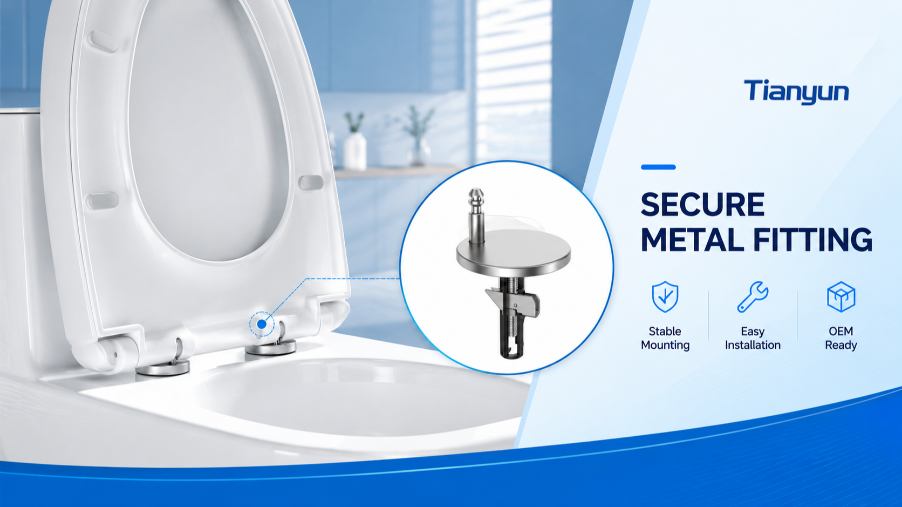
What Metal Toilet Seat Hinges Are and Why They Matter
Imagine sitting down and feeling the toilet seat shift beneath you. That wobble, that unsettling sideways slide, almost always traces back to one overlooked component: the hinges. Specifically, the small pieces of hardware that anchor the seat and lid to the bowl. When those hinges are made from cheap plastic, failure is not a question of "if" but "when." That is exactly where metal toilet seat hinges come in.
What Are Metal Toilet Seat Hinges
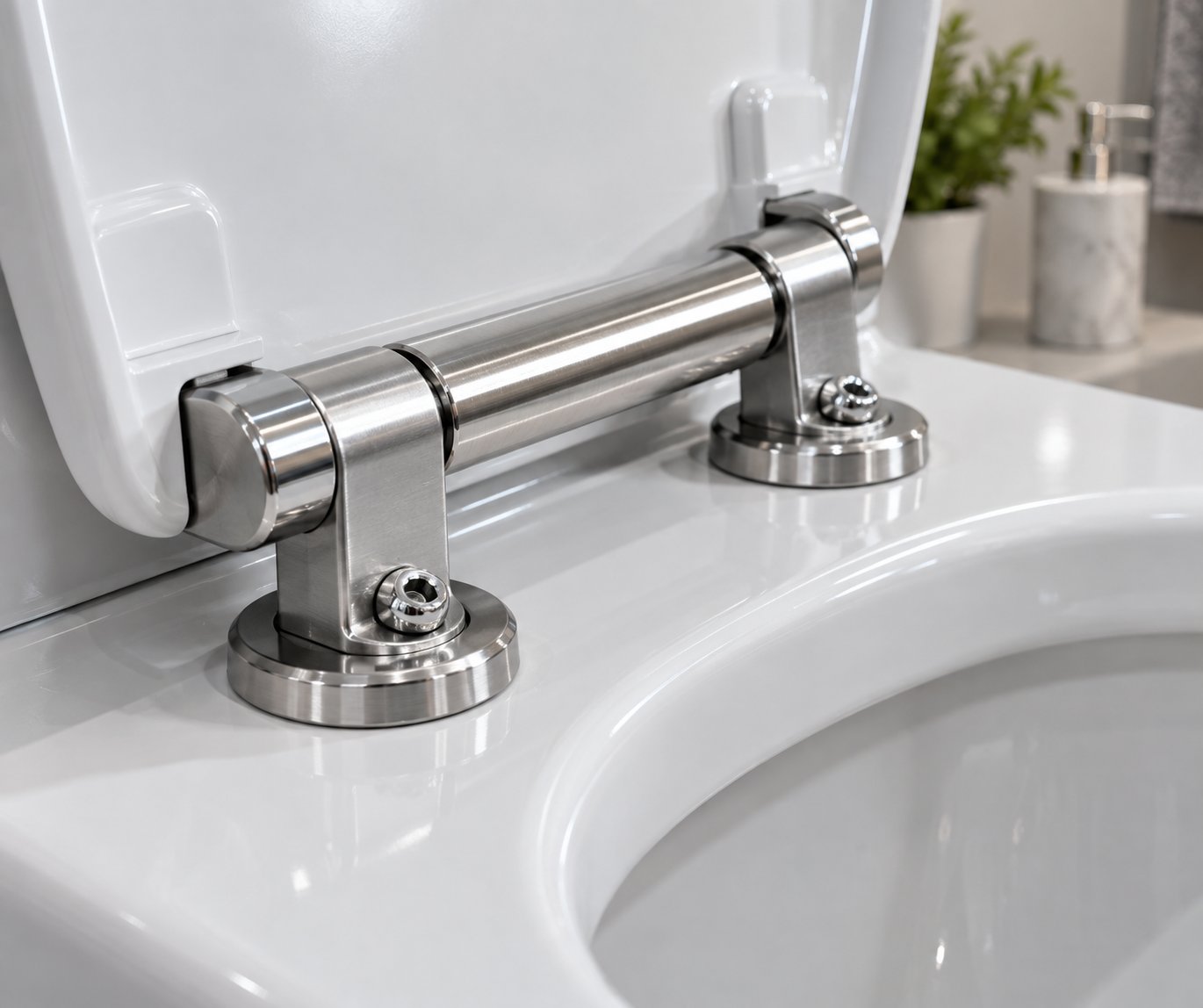
Metal toilet seat hinges are the mechanical mounting hardware that connects a toilet seat and lid to the porcelain bowl. Unlike their plastic counterparts, these hinges are constructed from metals such as stainless steel, brass, zinc alloy, or chrome-plated brass. They serve a deceptively simple purpose: hold the seat firmly in place, allow it to pivot open and closed, and endure thousands of cycles without cracking or loosening.
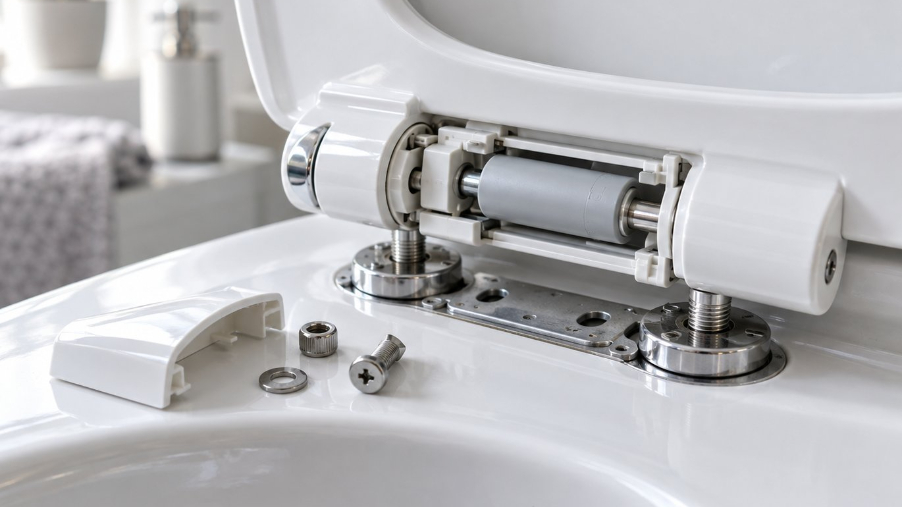
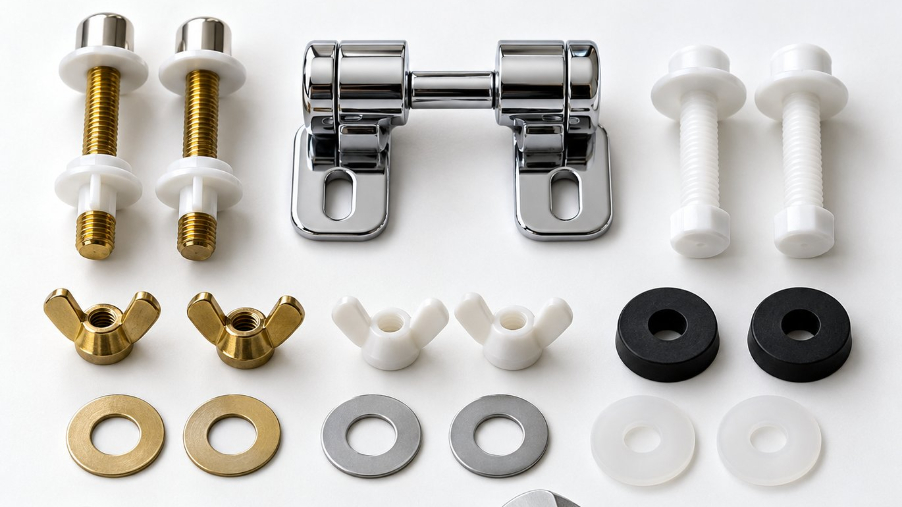
Every toilet seat hinge, whether for a standard commode or a wall-hung WC, shares the same basic anatomy. Here are the core components you will find in a typical metal hinge assembly:
- Hinge pins: The cylindrical rods around which the seat and lid rotate. Metal pins resist bending and wear far better than plastic ones.
- Mounting bolts: Threaded fasteners that pass through the holes at the back of the toilet bowl and secure the hinge to the porcelain.
- Brackets and plates: Flat or shaped metal pieces that sit on the bowl rim and distribute clamping force evenly across the mounting area.
- Pivot mechanism: The joint assembly that allows the seat and lid to swing open independently, often incorporating bushings or washers to reduce friction.
- Nuts and washers: Fastening hardware, typically including rubber or nylon washers, that locks everything in place without scratching the bowl surface.
Understanding these parts matters because when a toilet seat hinge fails, the culprit is usually one specific component rather than the entire assembly. Knowing the anatomy helps you diagnose problems and find the right replacement.
Why Metal Hinges Exist
So why choose metal over plastic in the first place? The reasons are practical, not just cosmetic. Metal hinges offer greater load-bearing strength, which means they handle heavier users and more aggressive daily use without flexing or snapping. They also deliver a significantly longer service life. While a plastic hinge might crack after a year or two of regular use, a quality stainless steel or brass hinge can last for the entire lifespan of the toilet seat itself.
Resistance to cracking and snapping is another major factor. Plastic becomes brittle over time, especially in bathrooms where temperature swings and humidity accelerate material degradation. Metal, by contrast, maintains its structural integrity across a much wider range of conditions. There is also the matter of feel: WC seat hinges made from solid metal simply provide a more stable, premium experience every time you raise or lower the lid.
Manufacturers recognize these advantages too. Many mid-range and premium commode seat hinges now ship with metal hardware as standard because the durability gains translate directly into fewer warranty claims and higher customer satisfaction.
This guide covers everything you need to know about these hinges in one place, from material differences and mechanism types to compatibility checks, step-by-step replacement, and long-term maintenance. Whether you are shopping for an upgrade or troubleshooting a wobbly seat, the sections ahead break it all down. The first decision most buyers face is a fundamental one: metal or plastic?
Metal vs. Plastic Toilet Seat Hinges Compared
You have probably lived through it: one day the seat feels rock-solid, and a few months later it slides, clicks, or snaps right at the hinge point. That frustrating progression is overwhelmingly a plastic hinge problem. But does that automatically make metal the right call for every bathroom? Let's break the comparison down honestly.
Strength and Durability Differences
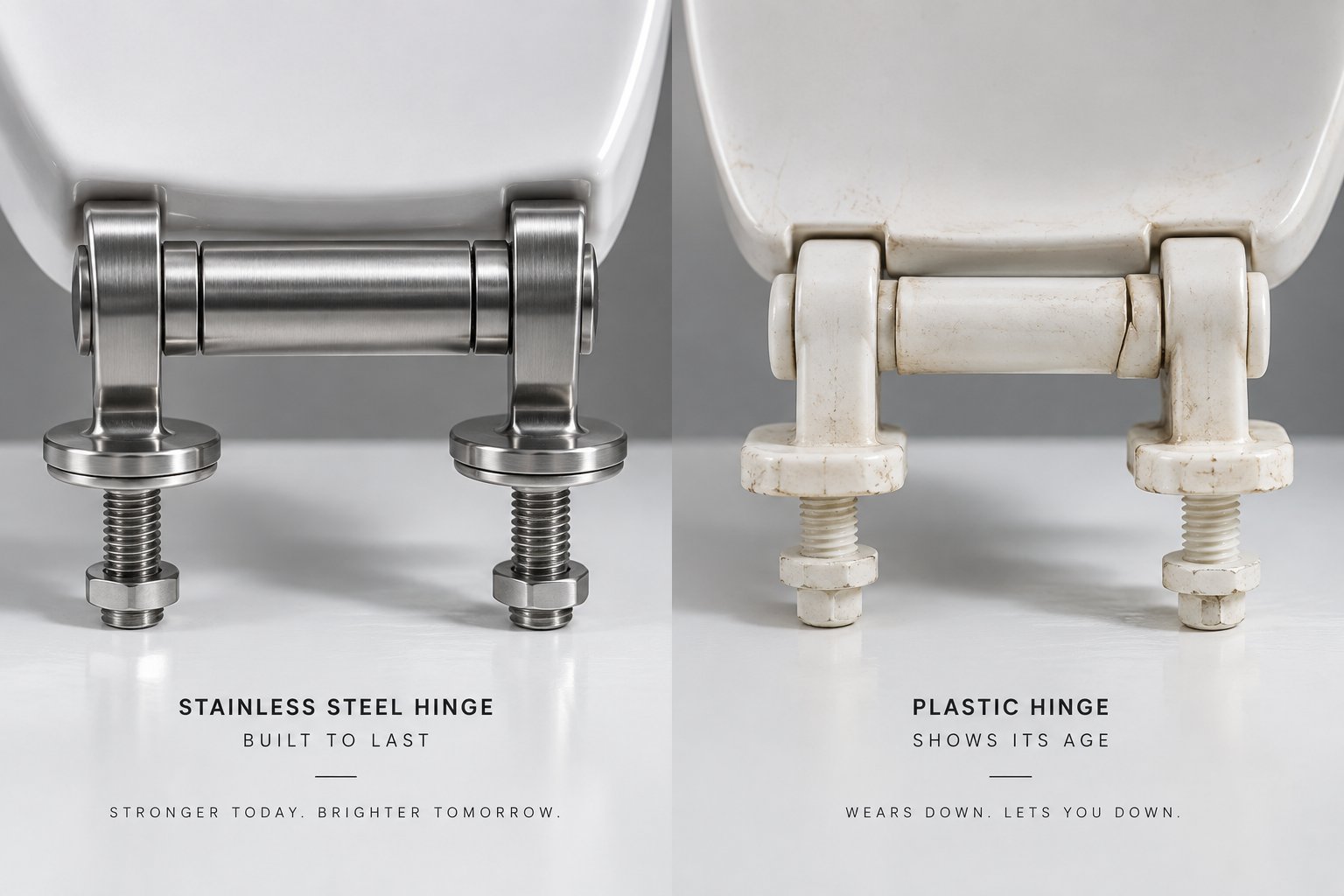
Plastic toilet seat hinges carry an inherent weakness: they lose structural integrity under repeated stress. Every time someone sits down, stands up, or drops the lid, the hinge absorbs force at the pivot point and around the bolt holes. Plastic gradually fatigues, develops hairline fractures, and eventually cracks. This happens faster in households with heavier users or where the lid gets slammed regularly. As Fly Plumbing notes, cracks commonly form around the hinge area and can worsen with daily use, compromising both safety and hygiene.
A toilet seat with metal hinges handles the same forces very differently. Metals like stainless steel and brass distribute stress more evenly across the hinge body, resisting the fatigue cycle that destroys plastic. They also maintain dimensional stability in humid bathroom conditions where temperature swings make plastic brittle over time. The result? Toilet seat metal hinges hold their clamping force, stay aligned, and keep the seat wobble-free for years instead of months.
Pros and Cons at a Glance
The table below puts the key differences side by side so you can weigh what matters most for your situation:
| Factor | Metal Hinges | Plastic Hinges |
|---|---|---|
| Durability | Excellent — resists cracking, bending, and fatigue over thousands of use cycles | Moderate — prone to cracking and snapping under repeated stress |
| Corrosion Risk | Low to moderate (depends on metal type; stainless steel resists rust, chrome plating can wear) | Virtually none — plastic does not corrode |
| Weight | Heavier, which adds a solid, stable feel | Lightweight, easier to handle during installation |
| Ease of Installation | Comparable to plastic; may require more careful torque to avoid over-tightening | Simple and forgiving — less risk of cracking porcelain from over-torque |
| Cost | Higher upfront, but lower long-term replacement costs | Lower upfront, but more frequent replacements add up |
| Aesthetic Appeal | Premium look — polished chrome, brushed steel, or brass finishes elevate the bathroom | Utilitarian appearance; limited finish options |
| Typical Lifespan | Several years to a decade or more with proper care | One to three years under regular household use |
When Plastic Hinges Make Sense
Fairness matters here. Toilet seats with plastic hinges are not universally bad — they serve a purpose in the right context. If you are furnishing a rental property where tenants handle their own replacements, an inexpensive plastic hinge keeps costs low and avoids over-investment in a unit you do not control. The same logic applies to a seldom-used guest bathroom where the hinges may see only a few cycles per week. Budget-driven quick replacements also favor plastic: when you need a working seat today and plan a full bathroom renovation next year, spending extra on metal hardware adds little value.
The real trouble starts when plastic hinges land on a primary household toilet that sees heavy daily traffic. That is the scenario where they crack, loosen, and wobble — and where upgrading to metal pays for itself many times over in avoided frustration and repeat purchases.
Material choice, however, is only half the equation. Not all metals perform equally in the damp, chemically exposed environment of a bathroom, and picking the wrong alloy can introduce corrosion problems that plastic never faces. The differences between stainless steel, brass, and zinc alloy hinges deserve a closer look.
Metal Hinge Materials Compared From Steel to Brass
Knowing that metal outperforms plastic is a good start, but "metal" is not a single material. The stainless steel hinge on a high-end soft-close seat and the zinc alloy hinge bundled with a budget toilet seat live in entirely different performance categories. Picking the wrong alloy can mean trading one set of problems — cracked plastic — for another, like corroded bolts or a green patina spreading across the mounting hardware. Here is what each common material actually brings to the table.
Stainless Steel Hinges
If you want the closest thing to a "set it and forget it" hinge material, stainless steel toilet seat hinges are the premium choice. Stainless steel is an alloy of iron, chromium, and nickel, and that chromium content is the key: it forms a self-repairing oxide layer on the surface that resists rust without needing any additional plating or coating. In a high-humidity bathroom where condensation collects on every surface, that built-in corrosion defense is a major advantage.
Beyond rust resistance, a stainless steel toilet seat hinge delivers excellent tensile strength, meaning it can handle significant load-bearing stress at the pivot point and bolt holes cycle after cycle. You will also notice that stainless steel maintains tight dimensional tolerances over time. It does not warp, swell, or creep the way softer metals can under sustained clamping pressure. For households with heavier users or toilets that see frequent daily traffic, this stability translates directly into a seat that stays firmly aligned for years.
The trade-off? Cost. Stainless steel hinges sit at the top of the price range for toilet seat hardware. They are also slightly harder to machine, which means the bolts and threads may feel stiffer during installation compared to brass. Still, for a primary bathroom where longevity is the priority, the upfront investment pays for itself by eliminating repeat replacements.
Chrome-Plated Brass Hinges
Chrome plated brass toilet seat hinges occupy a popular middle ground — strong enough for everyday residential use, with a polished finish that looks right at home in most bathrooms. Brass itself is an alloy of roughly 85% copper and 15% zinc, giving it solid structural strength and natural resistance to many forms of corrosion. The chrome plating adds a thin layer of chromium oxide on top, providing that familiar silver-toned shine while creating an additional barrier against moisture.
Here is the important nuance: brass toilet seat hinges can corrode over time, particularly in consistently damp conditions. The corrosion appears as a greenish patina caused by the copper content reacting with moisture and air. Chrome plating delays this process significantly, but the layer is thin. Years of cleaning, chemical exposure, or simple mechanical wear can gradually erode the chrome, exposing the brass beneath. Once that happens, corrosion can begin at the exposed spots.
Does that make chrome-plated brass a bad choice? Not at all. For most residential bathrooms with reasonable ventilation, these hinges perform reliably for many years. They also tend to be easier to find as replacements. If you are searching for a chrome plated brass replacement toilet seat hinge, you will find options from both brand-specific and universal aftermarket suppliers. The key is understanding that the chrome finish is a protective layer with a finite life — not a permanent guarantee.
Zinc Alloy and Other Metal Options
Zinc alloy hinges represent the budget-friendly end of the metal spectrum. Zinc alloys are composed primarily of zinc combined with small amounts of aluminum, copper, and magnesium to improve strength and castability. These alloys have a relatively low melting point and excellent fluidity, making them cheap to cast into complex hinge shapes. You will find zinc alloy hardware bundled with many mid-range toilet seats as a step up from plastic without a significant price increase.
The performance trade-offs, however, are real. Zinc alloys are heavier than you might expect for their strength class, yet they do not match the load-bearing capacity or fatigue resistance of stainless steel or brass. Corrosion susceptibility is also a concern. While zinc itself forms a protective oxide layer in dry conditions, bathroom humidity and acidic cleaning products can accelerate degradation. Industry comparisons for bathroom hardware place zinc alloy lifespan at roughly 3 to 10 years, significantly shorter than the 15-to-20-year range typical of brass and stainless steel in similar applications.
Other metals occasionally appear in hinge hardware, including nickel-plated steel and die-cast aluminum, though these are far less common. Nickel plating offers a slightly warmer tone than chrome and decent corrosion resistance, while aluminum is lightweight but prone to galvanic corrosion when in contact with dissimilar metals — a real risk in a bolted assembly sitting on a porcelain bowl.
The comparison below puts all three primary materials side by side across the factors that matter most when choosing replacement hardware or evaluating what came with your toilet seat:
| Property | Stainless Steel | Chrome-Plated Brass | Zinc Alloy |
|---|---|---|---|
| Corrosion Resistance | Excellent — self-repairing oxide layer; no plating needed | Good — chrome layer protects well, but can wear over time exposing brass | Moderate — adequate in dry conditions, vulnerable to humidity and acidic cleaners |
| Weight-Bearing Capacity | High — excellent tensile strength and fatigue resistance | High — brass core provides strong structural support | Moderate — sufficient for standard use, less reliable under heavy or repeated stress |
| Typical Price Range | High | Mid | Low to Mid |
| Appearance | Brushed or polished silver finish; modern aesthetic | Bright chrome shine; classic look that complements most bathroom fixtures | Chrome or nickel plated finish; can appear similar to brass hinges when new |
| Expected Lifespan | 15–20+ years | 10–20 years (depends on chrome integrity and ventilation) | 3–10 years |
| Best Use Cases | Primary bathrooms, heavy-use households, humid climates, commercial restrooms | Residential bathrooms with standard use; chrome plated brass replacement toilet seat hinge availability makes it easy to source | Budget replacements, light-use guest bathrooms, temporary setups |
Choosing the right material is one piece of the puzzle, but even the strongest stainless steel hinge will not perform properly if the mechanism type does not match your toilet setup. Top-fix versus bottom-fix, quick-release versus fixed, soft-close versus standard — these mechanism differences determine how the hinge actually functions day to day.
Understanding Hinge Mechanism Types and How They Differ
You have found the perfect material — stainless steel, brass, or zinc alloy — and you are ready to buy. Then the product listing hits you with a wall of terms: "top-fix," "bottom-fix," "quick-release," "soft-close," maybe even "twist cap." None of these phrases get explained on the page. You pick what sounds right, the package arrives, and the hinge either does not install the way you expected or lacks a feature you assumed was included. This is one of the most common reasons toilet seat hinge purchases go wrong, and it is entirely avoidable once you understand what each mechanism type actually does.
Top-Fix vs. Bottom-Fix Installation
Every metal hinge has to attach to the toilet bowl somehow, and the two main approaches are top-fix and bottom-fix. The difference comes down to where you tighten the fasteners.
Top-fix hinges (sometimes called top-mount) use expanding bolts or anchoring mechanisms that you tighten entirely from above the bowl rim. You feed the bolt down through the mounting hole, then turn a screw or nut from the top that causes the bolt's lower section to expand and grip the underside of the porcelain. There is no reaching around the back of the toilet, no awkward blind fumbling with a wrench underneath. This makes top-fix designs especially practical for wall-hung and back-to-wall toilets where physical access beneath the bowl is limited or impossible.
Bottom-fix hinges take the more traditional route. Bolts pass down through the bowl's mounting holes from above, and you secure them with wing nuts or hex nuts from underneath. This creates a mechanically straightforward clamp — the bolt head or bracket sits on top of the rim, the nut tightens from below, and the porcelain is sandwiched between them. Bottom-fix installations are common on open-back and close-coupled toilets where the underside of the bowl is easy to reach.
Which type does your toilet need? Drench's toilet seat guide offers a simple test: reach underneath the pan near the hinge holes. If you can feel an existing bolt and nut, you have a bottom-fix toilet. If there is nothing there, it is top-fix. One practical note — top-fix seats generally also work on bottom-fix toilets, but the reverse is not true, so confirming your toilet's configuration before ordering saves a return trip to the store.
Quick-Release Mechanisms Explained
Anyone who has tried to scrub around fixed hinge posts knows the frustration. Grime collects in the narrow gap between the hinge and the bowl rim — exactly where a cloth or sponge cannot reach. Quick-release mechanisms solve this by allowing you to detach the entire seat and lid from the bowl in seconds, without tools.
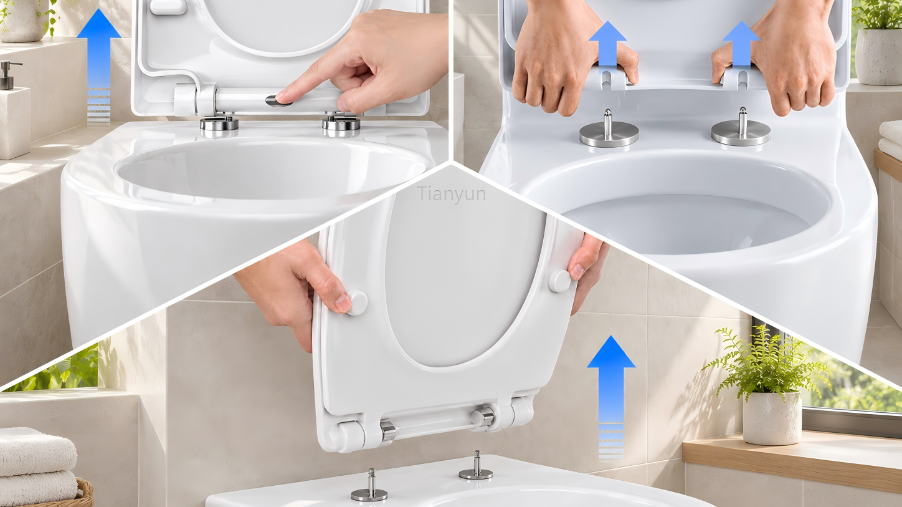
The design varies by manufacturer, but the concept is consistent. The hinge base stays bolted to the bowl permanently. The seat assembly clicks or slides onto that base via a locking mechanism — usually a push-button or a small lever on each hinge. Press the button, lift the seat straight up, and the entire unit comes free. Cleaning the bowl rim, the underside of the seat, and the hinge area becomes dramatically easier.
This feature has become increasingly popular because it addresses a genuine hygiene pain point. Bacteria and mineral deposits thrive in the hard-to-reach zones around fixed hinges, and no amount of careful wiping fully eliminates buildup without removing the seat. Quick-release hinges also simplify periodic hinge inspection. You can pop the seat off, check mounting bolts for corrosion or looseness, and reattach in under a minute. Many modern soft close toilet seat hinges now include quick-release as a standard feature rather than a premium add-on, reflecting how central it has become to the user experience.
A related design you may encounter in product listings is the twist cap toilet seat hinge. Instead of a push-button, these use decorative caps that twist to lock or unlock the seat from the mounting posts. The function is the same — tool-free seat removal — but the twist cap style tends to sit lower and look cleaner on the bowl rim.
Standard vs. Soft-Close Hinge Mechanisms
This is the mechanism choice that affects your daily experience the most. A standard hinge is a simple pivot: lift the lid, let it go, and gravity slams it down. A soft close toilet seat hinge adds a built-in dampening system that catches the lid partway through its descent and lowers it slowly and quietly to the closed position.
The dampening action relies on a rotary damper integrated inside the hinge body. This small component uses internal fluid resistance to absorb the kinetic energy of the falling lid, converting a free-fall slam into a controlled, gentle close. You will sometimes see these described as hydraulic hinges, slow-close hinges, or dampened hinges — they all refer to the same core technology.
Soft-close mechanisms have surged in popularity for good reason. They eliminate the jarring noise of a slamming lid, reduce the risk of pinched fingers (a real concern in homes with young children), and significantly decrease the impact stress that damages both the seat and the porcelain rim over time. As Bofan's comparison points out, the gentle closing also reduces wear on the hinges themselves, improving overall durability and extending the product's service life.
Here is a quick breakdown of how the main mechanism types compare across the factors that matter most when choosing your hinges types of toilet seat fixings:
- Standard hinge: Simple pivot with no dampening. Lowest cost and zero maintenance complexity. Free-falling closure produces noise and impact wear. Best suited for budget setups or situations where slamming is not a concern.
- Soft-close hinge: Integrated rotary damper controls closing speed. Quiet operation, improved safety, and reduced wear on the seat and bowl. Slightly higher cost. The damper mechanism can eventually wear out after years of use, potentially requiring hinge replacement. Ideal for primary bathrooms, family homes, and anyone who values a quieter routine.
- Quick-release hinge (compatible with either standard or soft-close): Adds tool-free seat removal for easy cleaning. No impact on closing behavior — the release mechanism is separate from the pivot or damper. Marginally increases cost but significantly improves hygiene maintenance.
- Twist cap hinge (a quick-release subtype): Uses a decorative twist cap instead of a push-button for seat removal. Functionally identical to button-release. Offers a lower-profile, more streamlined aesthetic on the bowl rim.
Most buyers shopping for toilet seat soft close fittings find that the combination of soft-close dampening and quick-release removal covers the broadest set of everyday needs. If you are outfitting a guest bathroom on a tight budget, a standard bottom-fix hinge works perfectly well. But for a primary toilet that sees daily family use, the comfort and durability gains from a soft-close quick-release mechanism justify the modest price difference.
The soft-close mechanism, in particular, deserves a deeper look. Its dampening performance depends heavily on the materials and engineering inside the hinge body — and that is where the connection between metal construction and long-term reliability gets especially interesting.
How Soft-Close Metal Hinges Work Mechanically
You already know a soft-close hinge lowers the lid gently instead of letting it slam. But what is actually happening inside that small hinge body during those few seconds of controlled descent? Understanding the mechanics helps explain why material choice — specifically metal versus plastic — has such a dramatic effect on how long the soft-close feature keeps working the way it should.
Inside the Soft-Close Dampening System
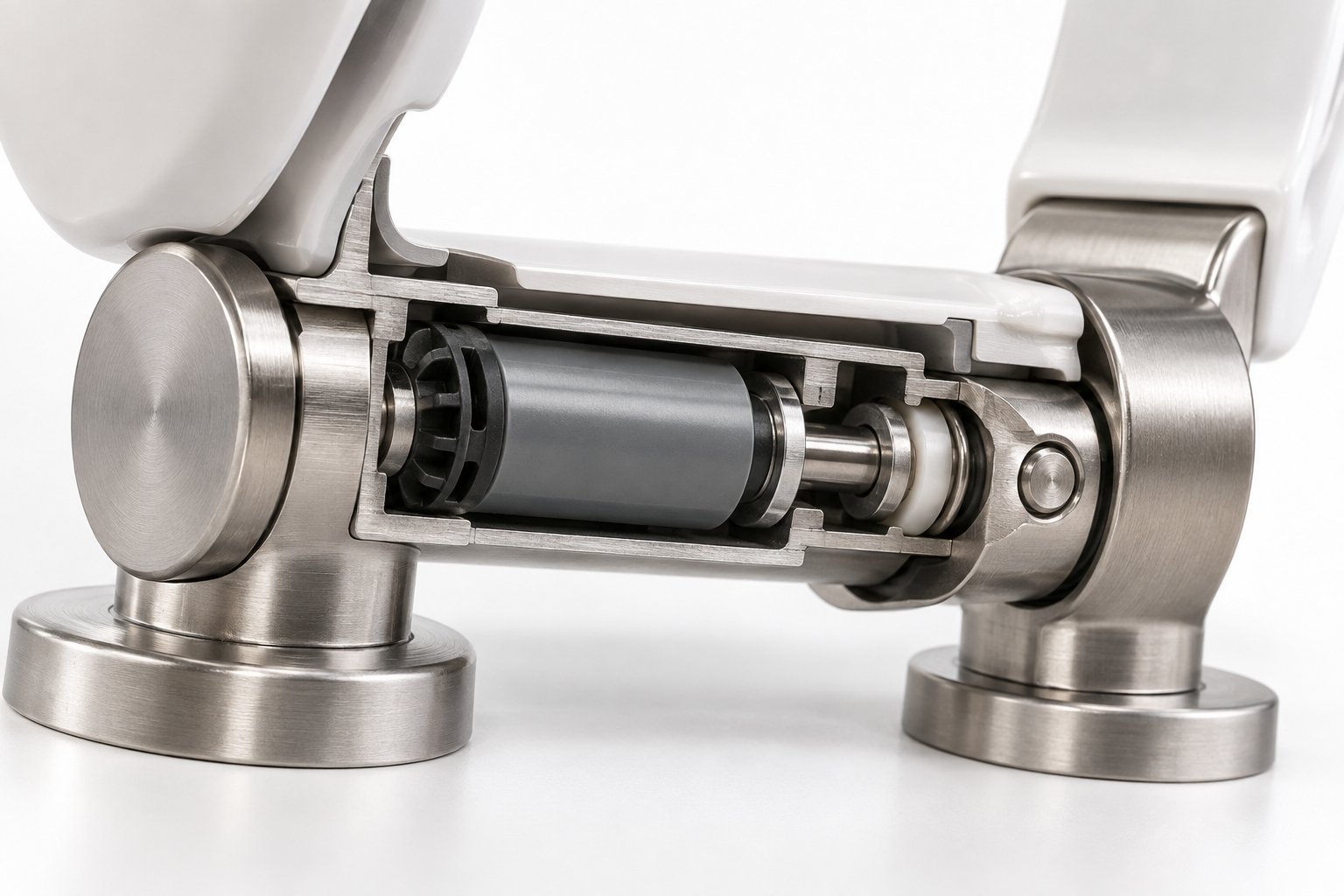
Picture a tiny cylinder hidden inside the hinge housing, no bigger than a finger. That cylinder is a rotary damper, and it is the heart of every slow close toilet seat hinge. Inside it, a rotor or piston sits submerged in a viscous fluid — usually silicone oil — within a precisely sealed chamber. When you release the toilet lid, gravity pulls it downward, and the hinge begins to rotate. That rotation drives the internal rotor through the silicone oil, and the fluid's resistance is what converts a free-falling slam into a smooth, quiet descent.
Think of it like dragging a paddle through thick honey. The faster you push, the more resistance you feel. The same principle governs the damper: as the lid accelerates under gravity, the fluid pushes back harder, progressively slowing the motion until the lid settles gently onto the seat. Rotary damper designs rely on carefully calibrated torque values — typically ranging from 50 to 600 Ncm depending on the seat's size and weight — to match the dampening force to each specific lid. Too little torque, and the lid still drops too fast. Too much, and it feels sluggish, hovering awkwardly before finally closing.
Some manufacturers use pneumatic (air-based) dampers instead of hydraulic (fluid-based) ones, though these are less common in toilet seat applications. Hydraulic designs tend to deliver more consistent, predictable motion across temperature changes and humidity levels — both critical factors in a bathroom environment. A quality hydraulic damper can perform reliably through 30,000 or more cycles at room temperature, which translates to years of daily household use.
In metal hinges, the damper housing and the surrounding pivot components benefit directly from the rigidity and dimensional stability of metal construction. The damper needs to sit in a precisely shaped pocket within the hinge body. If that pocket flexes, expands, or distorts even slightly, the damper loses its alignment, and the controlled closing motion degrades. Metal holds those tolerances cycle after cycle in a way that softer materials simply cannot.
Why Metal Matters for Soft-Close Longevity
Here is where the connection between hinge material and dampening performance becomes impossible to ignore. The rotary damper itself may be engineered to last tens of thousands of cycles, but it does not operate in isolation. It depends entirely on the hinge body surrounding it to maintain its position, alignment, and mounting pressure. If the structure holding the damper fails, the damper's engineering becomes irrelevant.
Plastic hinge bodies are vulnerable to a specific failure pattern under repeated dampening stress. Each closing cycle applies rotational force to the hinge housing. Over thousands of repetitions, plastic begins to exhibit micro-flexing at the pivot point and around the damper pocket. This flexing is often invisible at first — you will not see a crack, but you may notice the soft-close action becoming slightly less smooth or the lid descending a bit faster than it used to. Eventually, the accumulated fatigue leads to visible cracking, usually at the bolt holes or the damper mounting area. Once the hinge body deforms, the damper can no longer create the precise fluid resistance it was designed for, and the soft-close effect degrades or fails entirely.
Metal hinge bodies resist this degradation far more effectively. Stainless steel and brass maintain their shape under repetitive rotational stress, keeping the damper seated correctly and the pivot axis true. The mounting hardware securing the hinge to the bowl also plays a critical role here — hinges for soft close toilet seat systems must remain rigidly anchored to the porcelain. Any looseness between the hinge base and the bowl introduces play that disrupts the damper's calibrated resistance. Even a fraction of a millimeter of wobble at the mounting point translates to uneven force on the damper, accelerating wear and producing that frustrating "almost soft-close" behavior where the lid slows down but still drops the final inch.
Soft-close performance depends as much on mounting stability as on the damper itself. A perfectly engineered toilet seat damper will underperform if the mounting hardware loosens, corrodes, or allows the hinge body to shift on the bowl rim.
This is precisely why the quality of the fixing kit — the bolts, nuts, washers, and brackets that anchor everything to the porcelain — matters so much in slow close toilet seat hinges. Budget mounting hardware made from corrosion-prone metals or undersized fasteners will gradually loosen in a humid bathroom, undermining the soft-close mechanism long before the damper itself wears out. OEM-grade stainless steel fixing kits, such as Tianyun's Stainless Steel Fixing Kits, are engineered specifically to maintain the tight mounting tolerances that soft-close damper systems require over extended use. Built for OEM toilet seat production, these kits pair corrosion-resistant stainless steel construction with precision-machined threads and protective washers, ensuring that the hinge base stays locked to the bowl with zero play — the exact stability that keeps hinges soft close toilet seat mechanisms performing like new through years of daily cycles.
The takeaway is straightforward: a slow close toilet seat hinge is only as durable as its weakest structural link. Investing in a quality damper inside a metal hinge body, secured by corrosion-resistant mounting hardware, gives the entire system the best chance of delivering smooth, quiet closes for the long haul. Skip any one of those three elements, and the soft-close experience starts to slip away far sooner than it should.
Of course, even the best-engineered hinge system will not perform correctly if it does not physically fit your toilet. Bolt spacing, seat shape, and brand-specific mounting designs all affect compatibility — and getting those measurements right before you buy saves both money and frustration.
Compatibility Guide for Toilet Shapes and Brands
Buying the strongest, most corrosion-resistant metal hinge on the market means nothing if the bolt holes do not line up or the hinge arms sit at the wrong angle for your seat. Compatibility is the silent deal-breaker that turns a confident online purchase into a frustrating return. The tricky part? Most product listings assume you already know what fits your toilet. They rarely explain how seat shape, bolt spacing, and brand-specific engineering affect whether a given hinge set will actually work. Here is how to figure that out before you spend a dollar.
Round vs. Elongated Seat Compatibility
Most toilet bowl seat hinges use standardized bolt hole spacing, which means the point where the hinge attaches to the porcelain is consistent across many toilet models. That can create a false sense of security. You might assume any hinge with the right bolt spacing will work on any bowl, but the seat shape sitting on top of those hinges matters more than you might expect.
Toilet bowls come in two primary shapes: round and elongated. Victorian Plumbing's measuring guide notes that round bowls typically measure about 16.5 inches (42 cm) from the bolt holes to the front rim, while elongated bowls stretch to roughly 18.5 inches (47 cm). That extra two inches changes the weight distribution and balance point of the entire lid. An elongated toilet seat with metal hinges places the center of gravity farther forward compared to a round seat. If the hinge mechanism is not calibrated for that longer lever arm, you may notice uneven soft-close behavior — the lid descends smoothly on one side but drops slightly faster on the other — or the seat may not center properly over the bowl.
For standard free-falling hinges, this mismatch is less noticeable. But for soft-close systems, the damper torque is tuned to a specific lid weight and length. An elongated toilet seat with metal hinges and 4 bumpers, for example, distributes its weight and contact points differently than a round seat with two bumpers, and the hinge needs to account for that. When shopping, always verify whether the hinge set is rated for round, elongated, or both. Universal hinge kits often accommodate both shapes by offering adjustable hinge arm positions, but double-checking the specifications is always worth the extra minute.
Brand-Specific vs. Universal Hinges
Here is where compatibility gets genuinely complicated. Some toilet manufacturers design proprietary hinge mounting systems that only accept their own replacement parts. American Standard toilet seat hinges, for instance, sometimes use unique hinge post shapes or non-standard bolt configurations that differ from generic aftermarket hardware. If you own one of these toilets and grab a universal hinge set, you may discover that the bolt diameter is slightly off, the hinge post does not sit flush, or the seat wobbles despite being tightened correctly.
An american standard toilet seat hinge replacement sourced directly from the manufacturer will match perfectly, but it often comes at a premium price and with limited material options. Aftermarket universal toilet seat hinges, on the other hand, are designed to fit the broadest possible range of bowls. They typically ship with multiple washer sizes, adjustable bolt sleeves, or slotted mounting plates to compensate for minor dimensional differences between brands.
So how do you determine which route to take? Follow these steps before placing an order:
- Measure bolt hole spacing: Use a tape measure to find the center-to-center distance between the two toilet seat holes on your bowl. The standard is 5.5 inches (approximately 14 cm), but some models use spacing in the 140-160mm range, so always confirm.
- Check bolt diameter: Remove an existing bolt and measure its shaft diameter. Common sizes are 6mm, 8mm, and 10mm. A mismatch of even 1mm means the bolt will either not fit through the hole or will rattle loosely inside it.
- Verify hinge post shape: Look at the top of the hinge where it meets the seat. Some hinges use round posts, while others use D-shaped posts that lock into a matching socket on the seat to prevent rotation. A round post in a D-shaped socket will spin freely and never hold the seat stable.
- Confirm seat weight capacity: Heavier seats — especially solid wood or thick duroplast models — need hinges rated for their weight. An undersized hinge may close too quickly, fail to dampen properly, or fatigue faster under the extra load.
If your toilet uses a proprietary system and you want the flexibility of aftermarket metal hinges, search for the specific model number of your toilet (often stamped inside the tank or on the back of the bowl) and cross-reference it against the hinge manufacturer's compatibility chart. Many reputable aftermarket brands now list compatible toilet models alongside their dimensional specifications.
How to Measure for a Replacement Hinge
Grab a tape measure and your existing hardware — even if the old hinges are broken, the remnants still tell you exactly what you need. Work through this checklist before shopping:
- Center-to-center bolt distance: Measure from the center of one toilet seat hole to the center of the other. Write this number down in both inches and millimeters to match whichever unit the manufacturer lists. The standard is 5.5 inches (140mm), but never assume — verify.
- Bolt hole diameter: Measure the inside diameter of each hole in the porcelain rim. If you still have the old bolt, measure the shaft. The new bolt must pass through the hole smoothly without excessive play.
- Hinge post length: If your seat uses a post-and-socket attachment (common with quick-release designs), measure the length of the post from the hinge base to its tip. A post that is too short will not engage the locking mechanism securely; one that is too long may prevent the seat from sitting flat on the bowl rim.
- Overall seat length: Measure from the midpoint between the bolt holes straight to the front edge of the bowl. This confirms whether you need a round or elongated hinge configuration and ensures the damper torque will match the seat's weight distribution.
- Clearance beneath the bowl rim: For bottom-fix hinges, check that there is enough space between the underside of the rim and the nearest obstruction — a water supply line, a bidet attachment bracket, or the wall — to fit and tighten the mounting nuts.
Taking these five measurements adds maybe three minutes to the process but eliminates the guesswork that leads to wrong orders and wasted weekends. Photograph the old hinges alongside the tape measure for a quick reference you can pull up on your phone while browsing product listings at the store or online.
With the right measurements in hand and a clear understanding of your toilet's mounting style, choosing a compatible hinge set becomes straightforward rather than stressful. But compatibility only gets the hinge onto the bowl — it does not guarantee the hardware will stay in top condition. Metal hinges face their own set of wear patterns and failure modes that are worth recognizing early, before a small issue turns into a full replacement job.
Signs Your Metal Toilet Seat Hinges Need Replacement
A quality set of metal hinges can quietly do its job for years without drawing any attention. That is the whole point — when hinges work correctly, you never think about them. The trouble is that this invisibility also means problems develop gradually, and by the time you notice the wobble or hear the clunk, the damage may have progressed beyond a simple fix. Recognizing the early warning signs gives you a chance to act before a minor annoyance becomes a broken toilet seat hinge that leaves the lid unusable.
Common Signs of Hinge Wear and Failure
A wobbling seat is not just an inconvenience — it is a diagnostic signal. Ziax's engineering breakdown emphasizes that a seat shifting sideways, clicking at the hinge, or rocking under load should be investigated before the damage spreads. Tightening the bolts might fix a new issue, but recurring movement usually points to something deeper.
Watch for these telltale symptoms:
- Seat shifting or sliding sideways: If the seat moves laterally when you sit down or stand up, the mounting bolts have likely lost their clamping force. The bolt holes in the hinge bracket may be worn or the underlying washers compressed, allowing play that no amount of retightening can permanently resolve.
- Visible rust or corrosion on hinge components: Orange rust spots on steel parts, greenish patina on brass, or white powdery deposits on zinc alloy all indicate active corrosion. Even surface-level discoloration means the protective finish has been compromised, and structural weakening is not far behind.
- Cracking around bolt holes: This is especially common where metal brackets meet plastic seat material, but it can also appear on the porcelain rim if bolts were over-tightened. Hairline cracks near the toilet lid hinge mounting area grow rapidly under repeated stress.
- Soft-close mechanism losing effectiveness: Does the lid slow down partway but then drop the last couple of inches? Or does it descend unevenly, one side faster than the other? These are signs that the damper is wearing out, the hinge body has shifted, or both. A degraded soft-close is rarely a standalone problem — it usually reflects mounting instability or internal component fatigue.
- Persistent loosening despite retightening: You tighten the bolts on Sunday, and by Wednesday the seat is wobbling again. Repeated loosening means the fastening system is no longer holding preload. The bolt threads may be stripped, the expansion plugs compressed beyond recovery, or the hinge base itself may be deformed.
- Squeaking or grinding noises during pivot: Metal-on-metal contact without adequate lubrication, or corroded pivot pins, creates audible friction every time the lid opens or closes. This is both an annoyance and a sign that the pivot mechanism is wearing unevenly.
Any one of these symptoms on its own can sometimes be resolved with a targeted fix. Two or more appearing together, however, strongly suggest that the toilet lid hinges have reached the end of their functional life.
How Long Metal Hinges Typically Last
There is no single number here because too many variables influence longevity. Quoting a blanket "10-year lifespan" would be misleading when the reality depends on a chain of interacting factors:
- Material quality: Stainless steel hinges with precision-machined threads will outlast zinc alloy hardware with stamped components by a wide margin, as covered in the material comparison earlier.
- Bathroom humidity levels: A well-ventilated bathroom with an exhaust fan keeps moisture from lingering on metal surfaces. A windowless, poorly ventilated space exposes every toilet seat hinge part to persistent dampness that accelerates corrosion, particularly on chrome-plated or zinc surfaces.
- Cleaning chemical exposure: Bleach-based cleaners, acidic bowl solutions, and abrasive scrubbing compounds strip protective coatings faster than mild soap and water. Ziax's analysis notes that moisture and cleaners attack the entire assembly over time, especially under commercial cleaning routines.
- User weight and frequency of use: A primary family bathroom serving four or five people daily subjects the hinges to significantly more load cycles than a guest powder room used a few times a week. Heavier users also apply greater lateral and downward force at the pivot point during every sitting.
- Installation quality: Properly aligned, correctly torqued mounting bolts distribute force evenly and prevent the progressive loosening cycle that leads to premature failure. A rushed installation with misaligned bolts or missing washers shortens lifespan dramatically regardless of hinge quality.
What you can say with confidence is that metal hinges generally outlast plastic by a substantial margin. Where a plastic hinge might crack within one to three years of regular household use, a well-maintained stainless steel or brass hinge in a reasonably ventilated bathroom can remain solid for a decade or more. But "metal" does not mean "invincible." Corrosion is the primary enemy, and it works silently — by the time you notice rust on the surface, internal degradation may already be undermining the structural integrity of replacement toilet lid hinges you installed just a few years ago.
When Repair vs. Full Replacement Makes Sense
Not every hinge problem demands a complete swap. Sometimes a quick intervention saves both time and money. Other times, partial fixes only delay an inevitable failure. Here is how to judge which scenario you are in.
Tightening or minor adjustment is enough when: the bolts have simply loosened over time, the hinge components show no visible corrosion or cracking, the soft-close damper still functions smoothly, and the seat returns to full stability after retightening. In this case, check the washers, confirm the bolts are not cross-threaded, and snug everything back down. Adding a drop of thread-locking compound can help prevent the bolts from backing out again.
Replacing individual toilet seat hinge parts makes sense when: a single component — one bolt, a washer, or a rubber bumper — is damaged but the rest of the assembly remains structurally sound. Many hinge manufacturers sell replacement bolts, nuts, and washers separately. If the hinge body, pivot pins, and damper are all in good condition, swapping one worn piece is practical and cost-effective.
Full replacement is the right call when: corrosion has visibly spread across the hinge body or mounting bolts, the soft-close damper no longer dampens (the lid drops freely or inconsistently), cracking has appeared around the bolt holes or pivot area, or the hinge base has deformed enough that the seat will not stay centered on the bowl. At this stage, partial fixes are band-aids. A corroded bolt may hold for another month, but the weakened metal is already compromised. A failing damper cannot be serviced in most consumer-grade hinges — the damper and hinge body are a single sealed unit. Attempting to nurse a structurally degraded assembly along risks a sudden failure that could damage the porcelain bowl or leave the seat unusable at the worst possible moment.
When in doubt, lean toward full replacement. Replacement toilet lid hinges are relatively inexpensive compared to the cost and inconvenience of a cracked bowl or a seat that gives way under someone. And the replacement process itself is more straightforward than most people expect — a task that rarely requires a plumber and can be handled with basic household tools in under thirty minutes.
How to Replace Metal Toilet Seat Hinges Step by Step
Thirty minutes, a few basic tools, and zero plumbing experience — that is genuinely all it takes. A toilet seat hinge replacement ranks among the simplest bathroom fixes you can tackle yourself, yet plenty of people put it off for weeks because the job sounds more technical than it actually is. Whether you are swapping out corroded hardware, upgrading from plastic to metal, or handling a toilet seat hinge replacement soft close upgrade, the process follows the same logical sequence: prep, remove, install, test.
Tools and Preparation
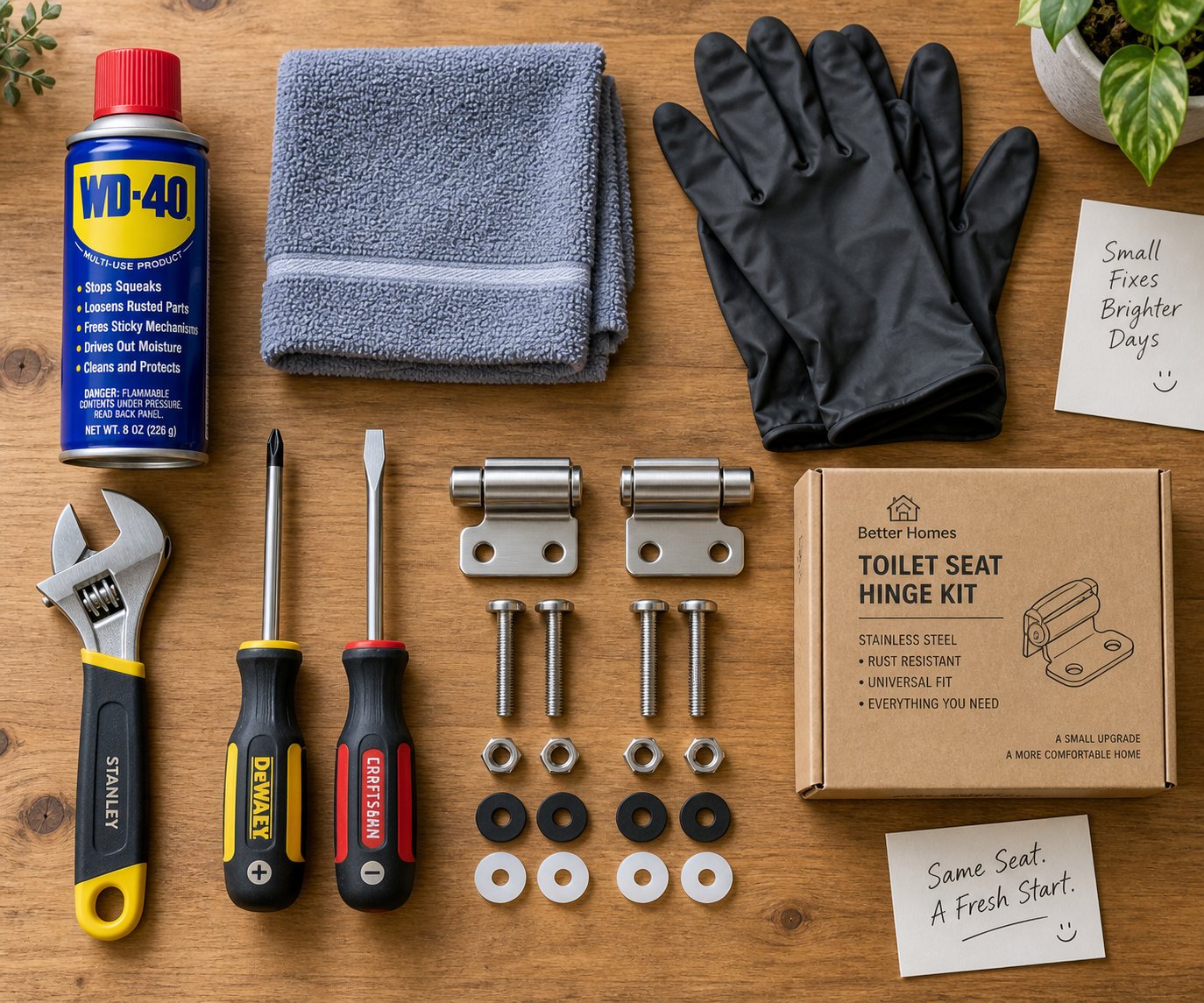
Before you touch a single bolt, gather everything you need so you are not hunting through drawers mid-job. Here is your short list:
- Adjustable wrench or pliers: For gripping and turning nuts underneath the bowl. A small adjustable wrench works best in tight spaces.
- Screwdriver (flathead and Phillips): Many hinge bolts have slotted or Phillips heads on top. Having both types on hand covers virtually every configuration.
- Penetrating lubricant: A spray like WD-40 or PB Blaster is essential for loosening corroded bolts. If the old hinges have been in place for years, assume you will need this.
- Rag or old towel: Lay this across the porcelain rim and tank lid to protect surfaces from accidental tool scratches.
- Gloves: Rubber or nitrile gloves keep your hands clean and improve grip on slippery fasteners.
- Mini hacksaw (just in case): A last resort for bolts that refuse to budge, which we will cover below.
One easy-to-miss step: if your toilet has a bidet attachment or bidet seat with a water supply line running near the hinge area, shut off the water valve and disconnect the line before you start. A wrench slipping onto a pressurized hose turns a simple job into a wet disaster. Also, drape a towel over the exposed porcelain near the bolt holes — one careless clank from a metal wrench can chip the glaze permanently.
Removing Old Metal Hinges
Removal is the part most people dread, and honestly, it is the only step where things can get frustrating. The issue is almost always corrosion. Metal bolts sitting in damp porcelain holes for years develop a rust bond that makes them feel welded in place. Here is how to work through it methodically.
Start by locating the mounting bolts. On top-fix designs, you will see decorative caps or twist covers on the bowl rim near the back of the seat. Pop or twist these off to reveal the bolt heads. On bottom-fix models, the bolt heads sit on top while wing nuts or hex nuts secure them from underneath. Flip up the seat and lid so they are out of the way, and feel under the bowl rim to locate the nuts.
Apply penetrating lubricant generously. Spray the bolt heads, the nuts, and the seam where the bolt passes through the porcelain. Give the lubricant at least 10 to 15 minutes to work its way into the threads. For severely corroded fasteners, a second application after the initial soak helps considerably. Home Depot's installation guide specifically recommends penetrating oil or a small hacksaw for stubborn bolts that will not release.
Hold the bolt head and turn the nut. Use a screwdriver on top to keep the bolt from spinning while you turn the nut counterclockwise underneath with your wrench. This two-handed technique prevents the common problem of the bolt just rotating endlessly in place. If you are working alone, wedge the screwdriver handle against the tank or wall to free up both hands for the wrench.
Dealing with frozen bolts: If the nut still will not budge after lubricant and firm pressure, do not force it to the point of cracking the porcelain. This is where the mini hacksaw earns its place in your toolkit. Slide the blade between the nut and the underside of the bowl rim and carefully saw through the bolt shaft. Protect the porcelain with tape or a folded cloth as a buffer. The cut takes a minute or two per bolt, and it cleanly resolves what would otherwise be a standoff between corroded metal and fragile ceramic.
Once both bolts are free, lift the entire seat and hinge assembly straight up and off the bowl. Clean the exposed bolt holes and the surrounding rim thoroughly — this is your one chance to scrub an area that has been sealed off for years.
Installing New Metal Hinges
With the old hardware gone and the mounting surface clean, installation is refreshingly straightforward. If you are handling soft close toilet seat hinge replacements, the process is identical to standard hinges — the damper mechanism is already built into the hinge body, so there is nothing extra to assemble. Follow this sequence:
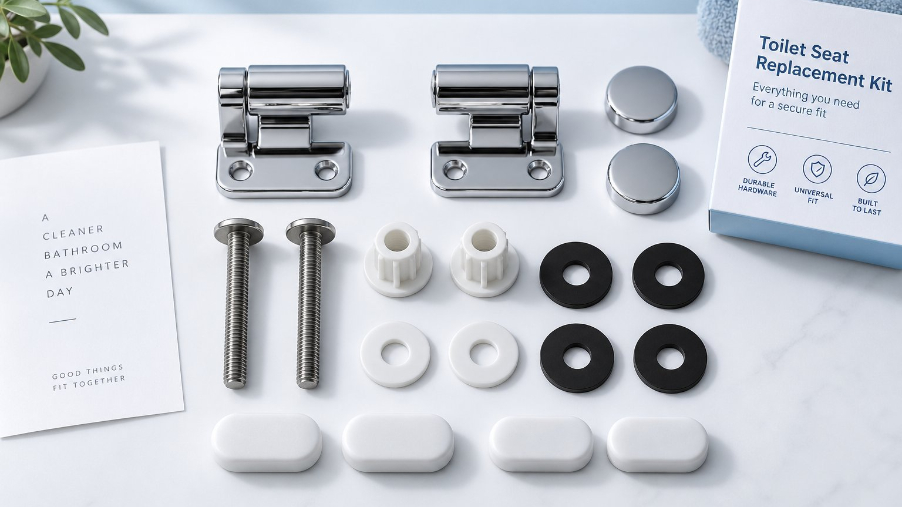
- Position the new hinge brackets over the mounting holes. Set the hinge assembly on the bowl rim with the bolt holes aligned directly over the porcelain openings. Most replacement toilet seat hinges include rubber or nylon washers — place these between the metal bracket and the porcelain to protect the glaze and provide a non-slip grip.
- Insert the bolts through the hinges and the bowl. Drop each bolt down through its respective hole with the head sitting on top. If your kit includes plastic sleeves or spacers, slide them onto the bolt shaft before feeding it through — these center the bolt in the hole and prevent metal-to-porcelain contact inside the opening.
- Hand-tighten the nuts from underneath. Thread the nuts onto the bolts by hand first. This step is critical: hand-tightening lets you feel whether the threads are engaging cleanly. If a nut resists or grinds, back it off and re-align rather than forcing a cross-threaded connection that will strip later.
- Check seat alignment before snugging down. With the nuts hand-tight, open and close the lid and seat several times. Watch for even gaps on both sides of the bowl. If the seat pulls to one side, loosen the bolts slightly and nudge the hinge brackets until the seat centers properly. This is the step most people skip, and it is the step that prevents the seat from sitting crooked for the next five years.
- Snug-tighten with a wrench — but stop short of maximum force. Use your adjustable wrench to turn each nut an additional quarter to half turn past hand-tight. That is it. Over-torquing is the single biggest installation mistake. Excessive force can crack the porcelain around the bolt holes, strip the bolt threads, or compress the washers so severely that they lose their cushioning effect. The bolts need to be firm, not gorilla-tight.
- Open and close the lid several more times to confirm stability. Sit on the seat and shift your weight slightly side to side. There should be zero lateral movement. If the seat shifts, tighten each nut another eighth of a turn and retest. For soft-close models, verify that the lid descends smoothly and evenly without slamming or hovering unnaturally.
- Snap hinge covers into place. If your hinges include decorative caps or covers, press or twist them over the bolt heads. These are not just cosmetic — they shield the bolt heads from moisture and cleaning chemicals, slowing corrosion at the most exposed point of the assembly.
The entire installation typically takes 10 to 15 minutes once the old hardware is out of the way. If you are learning how to fix toilet seat hinge wobble for the first time, you will likely find that the removal of corroded old bolts consumed more effort than installing the new ones ever could.
One final note on toilet seat hinges replacement: resist the temptation to reuse old bolts, nuts, or washers even if they look fine. Corrosion weakens metal internally before it shows on the surface, and reused fasteners are the most common reason a fresh hinge set loosens prematurely. New hinges deserve new hardware — and nearly every quality replacement toilet seat hinge kit includes a complete set of fasteners for exactly this reason.
With a solid installation behind you, the next question is how to keep those new hinges performing at their best. Bathroom humidity, cleaning chemicals, and everyday use all take a toll on metal hardware — but a few simple maintenance habits can dramatically extend the life of the entire assembly.
Maintaining Metal Hinges in High-Moisture Bathrooms
Fresh hinges installed, seat perfectly aligned, soft-close gliding like butter — it feels great on day one. But a bathroom is one of the harshest environments in your home for any metal component. Steam from hot showers, splashed water, condensation on cold surfaces, and the chemical cocktail of cleaning products all work against your toilet lid hardware every single day. The good news? A few simple habits can keep your metal toilet seat hinge performing like new for years instead of slowly deteriorating into the corroded, wobbly mess you just replaced.
Cleaning Metal Hinges Without Damaging Finishes
Here is a scenario that plays out constantly: you scrub the toilet with a powerful cleaner, spray the bowl and seat generously, and some of that product drips or splashes directly onto the hinges. Over weeks and months, the wrong cleaner quietly eats through chrome plating, strips protective coatings, or etches the surface of stainless steel. The hinge still looks fine at a glance — until one day you notice dull patches, pitting, or the first orange speck of rust.
The key is understanding which products are safe and which ones silently damage your toilet seat brackets and hinge finishes. PPA Kaizen's fixture maintenance guide recommends sticking to mild soap and water for routine cleaning of chrome and stainless steel bathroom hardware, and reserving vinegar solutions for occasional mineral deposit removal only. Horow's cleaning guide takes this further, warning specifically against bleach, chloride-based cleaners, and abrasive pads on chrome and stainless surfaces.
This table gives you a quick reference to keep near your cleaning supplies:
| Safe Cleaning Methods | Methods to Avoid |
|---|---|
| Mild dish soap diluted in warm water, applied with a soft cloth or sponge | Bleach-based toilet bowl cleaners splashed or sprayed onto hinge surfaces |
| White vinegar and water solution (1:1 ratio) for occasional mineral deposit removal — rinse and dry thoroughly afterward | Abrasive scrubbing pads, steel wool, or scouring powders that scratch chrome and brushed finishes |
| Damp microfiber cloth for quick daily wipe-downs after cleaning the bowl | Acidic toilet bowl cleaners (hydrochloric acid-based) that strip chrome plating and corrode zinc alloy |
| Soft-bristle toothbrush for reaching around bolt heads and tight crevices | Ammonia-based cleaners in combination with other products, which can cause chemical reactions on metal surfaces |
| Silicone-based spray lubricant on pivot points (wipe away excess) | Leaving any cleaning product sitting on metal surfaces without rinsing — even "safe" cleaners become corrosive with prolonged contact |
One detail people consistently overlook: even mild cleaners cause damage if you leave them in contact with the metal too long. Wipe the product on, clean the surface, rinse with plain water, and dry. That final drying step is the most important part. Moisture sitting on metal is how corrosion starts, and a quick pass with a dry cloth after every cleaning session takes five seconds but adds years to the life of your stainless toilet seat hinges.
Preventing Corrosion in Humid Bathrooms
Cleaning habits only address part of the moisture equation. The bigger challenge is ambient humidity — the invisible water vapor that hangs in the air after every shower and gradually condenses on every cool surface in the room, including your toilet bowl hinges and their mounting hardware.
PPA Kaizen's humidity management guide identifies ventilation as the single most effective defense against moisture damage to bathroom fixtures. Running an exhaust fan during and for at least 15 minutes after showers pulls moisture-laden air out before it settles on metal surfaces. If your bathroom has a window, cracking it open during and after showering creates cross-ventilation that accelerates drying dramatically. For consistently humid bathrooms without adequate built-in ventilation, a small standalone dehumidifier can reduce ambient moisture levels enough to make a noticeable difference in how quickly corrosion develops on exposed hardware.
Beyond ventilation, a few proactive steps go a long way:
- Wipe down hinges after cleaning the toilet. Every time you clean the bowl and seat, take an extra moment to dry the hinge area — the brackets, bolt heads, toilet seat hinge covers, and the gap where the hinge meets the porcelain. This removes both cleaning chemical residue and trapped moisture.
- Apply a thin coat of mineral oil or silicone lubricant periodically. Every two to three months, dab a small amount of food-grade mineral oil or silicone spray onto exposed metal surfaces and pivot points. This creates a hydrophobic barrier that repels water and slows oxidation. Wipe away any excess so surfaces are not slippery.
- Check bolt tightness every few months. Humidity causes subtle expansion and contraction cycles in both metal and porcelain. Over time, this can gradually loosen mounting bolts. A quick hand-check with a wrench every three to four months catches loosening before it progresses to wobbling or shifting.
- Inspect rubber and nylon washers for degradation. The protective washers between metal brackets and porcelain can compress, crack, or harden over time. If they lose their cushioning, metal starts contacting ceramic directly, and both the hinge and the bowl suffer. Replace washers at the first sign of flattening or cracking.
Think of these habits as routine maintenance rather than extra chores. Each one takes under a minute, and together they form a simple defense system that keeps humidity from silently undermining your hardware.
Troubleshooting Common Metal Hinge Problems
Even with good maintenance, issues can pop up. The difference between a well-maintained hinge and a neglected one is that problems on a maintained hinge tend to be minor and fixable — while neglected hardware usually needs full replacement by the time you notice something is wrong. Here are the most common problems and their targeted fixes:
- Seat shifting or sliding sideways: Tighten the mounting bolts a quarter turn at a time, alternating between left and right bolts to maintain even pressure. If the seat still shifts after tightening, check whether the rubber washers beneath the brackets have compressed flat — replacing them restores the grip that keeps everything centered.
- Persistent loosening despite retightening: The bolt threads may be worn or the expansion anchors (on top-fix models) may have lost their grip. Apply a small drop of non-permanent thread-locking compound to the bolt threads before retightening. This fills micro-gaps in the thread engagement and prevents vibration-induced loosening without making future removal difficult.
- Squeaking or grinding during pivot: Friction between the hinge pin and pivot bushing usually causes this. Apply a drop of silicone lubricant directly to the pivot point where the lid and seat rotate. Avoid petroleum-based lubricants like WD-40 for this purpose — they evaporate quickly in warm, humid air and can degrade rubber or nylon bushings over time. Silicone stays put and remains effective much longer.
- Surface rust on steel components: Catch it early and you can often save the hinge. Rub the affected area gently with a paste of baking soda and water using a soft cloth. For slightly more stubborn spots, fine-grade (0000) steel wool works, but use it sparingly and only on stainless steel — never on chrome plating, which it will scratch through. After removing the rust, dry thoroughly and apply a thin coat of mineral oil to seal the cleaned surface.
- Chrome plating flaking or peeling on toilet bowl hinges: Once the chrome layer begins lifting, there is no effective repair. Exposed brass or steel underneath will corrode rapidly in bathroom humidity. This is a replacement situation — the hinge has served its useful life, and patching the finish only delays the inevitable by weeks, not months.
- Soft-close mechanism speeding up or slamming: If the lid descends faster than it used to, the internal damper fluid may have degraded or leaked. Verify that the hinge base is still firmly mounted — even slight looseness at the mounting point disrupts damper calibration. If tightening the bolts does not restore the smooth close, the damper unit has likely worn out and the hinge assembly needs replacing.
Most of these fixes take five minutes or less, and catching problems at the "minor annoyance" stage prevents them from escalating into the kind of failure that leaves you shopping for a completely new hinge set on a Sunday afternoon. Regular attention — a quick visual check, a wipe-down, an occasional tightness test — is the simplest way to protect the investment you have already made in quality metal hardware.
Maintenance keeps your current hinges healthy, but what happens when you are shopping for the next set? Whether you are replacing worn-out hardware or outfitting a new bathroom, the final decision comes down to matching the right material, mechanism, and build quality to your specific situation.
Choosing the Right Metal Hinges for Lasting Performance
You have walked through materials, mechanisms, compatibility measurements, installation steps, and maintenance routines. That is a lot of ground to cover, and when you are standing in a store aisle or scrolling through product listings, all those details can blur together. So let's distill everything into a practical framework you can actually use at the point of purchase. The goal is simple: match the hinge to your bathroom, your habits, and your expectations so you buy once and forget about it for years.
Matching Hinge Choice to Your Needs
Every bathroom is different. A metal hinge toilet seat in a busy family home faces demands that a guest powder room will never see. The right choice depends on three intersecting factors — material, mechanism, and compatibility — and each one filters your options in a specific way.
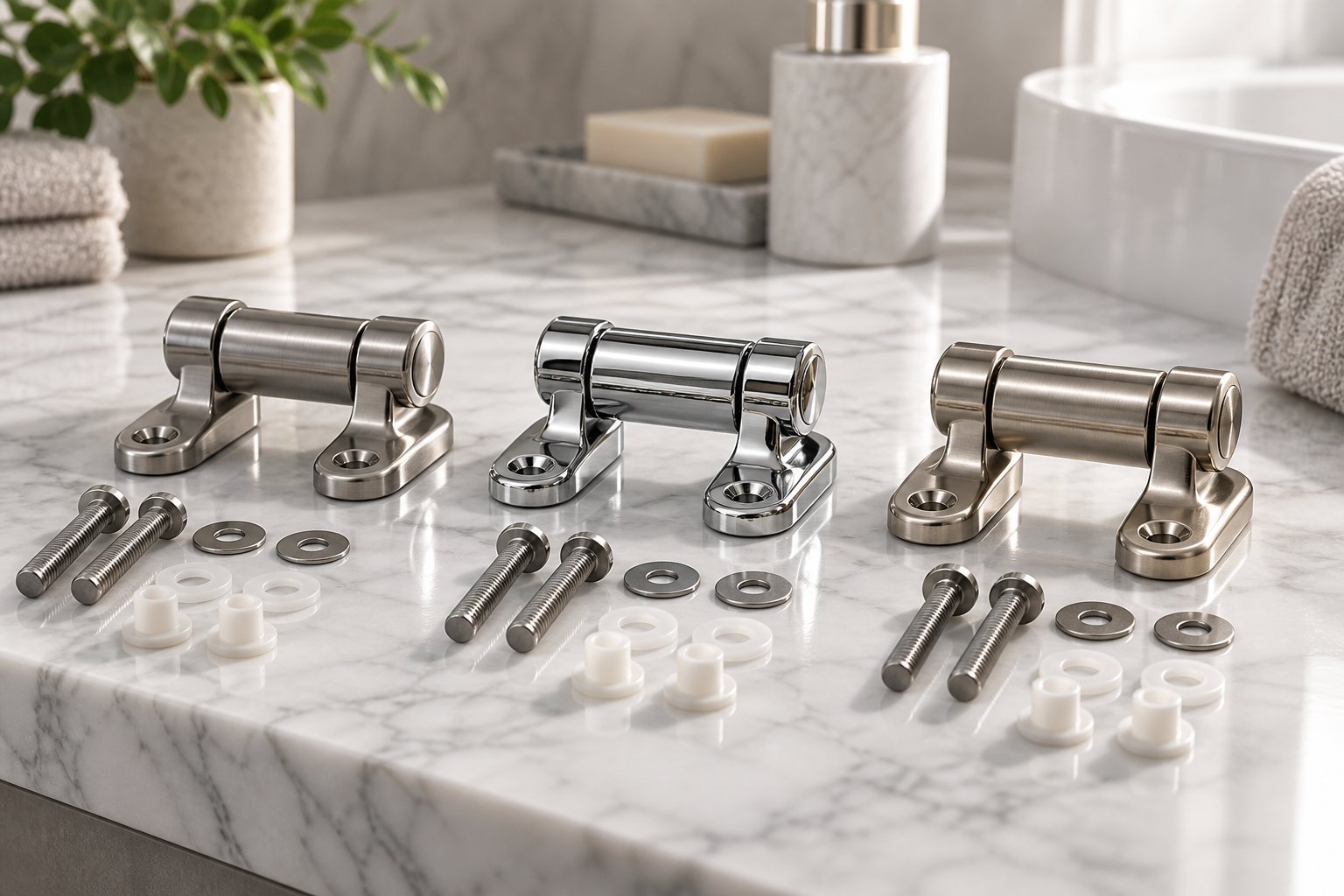
Material sets the durability ceiling. Stainless steel delivers the highest corrosion resistance and load-bearing strength, making it the clear pick for primary bathrooms, humid climates, or households with heavier users. Chrome-plated brass strikes a balance between polished aesthetics and solid structural performance, fitting well in standard residential bathrooms with decent ventilation. Zinc alloy serves as a functional metal upgrade over plastic when budget is the primary constraint, though its shorter lifespan makes it best suited for lighter-use situations.
Mechanism determines the daily experience. Soft-close dampening eliminates slamming noise and reduces impact wear on the seat and bowl — a meaningful upgrade for any toilet that sees regular family use. Quick-release functionality transforms cleaning from a frustrating, grime-around-the-edges chore into a simple lift-and-wipe routine. Standard free-falling hinges cost less and involve zero mechanical complexity, which is perfectly adequate for a secondary bathroom where noise and convenience are lower priorities.
Compatibility is the non-negotiable gatekeeper. None of the above matters if the bolts do not fit the holes. Measuring center-to-center bolt spacing, confirming bolt diameter, and verifying your toilet's fix type (top-fix vs. bottom-fix) must happen before anything else.
Use this checklist as a quick reference while shopping for metal hinges for toilet seat upgrades or replacements:
- Measure bolt hole spacing — confirm 5.5 inches (140mm) or note your toilet's specific dimension.
- Identify fix type — reach under the bowl to check for existing nuts (bottom-fix) or look for top-mounted caps (top-fix).
- Determine seat shape — round or elongated — and verify the hinge is rated for that configuration.
- Choose your material — stainless steel for maximum longevity, chrome-plated brass for a balance of looks and strength, zinc alloy for budget-conscious upgrades.
- Select your mechanism — soft-close for quiet operation, quick-release for easy cleaning, or both if available.
- Check brand compatibility — if you own a toilet with proprietary mounting (like certain American Standard models), confirm the hinge kit explicitly lists your model or uses a truly universal design.
- Verify included hardware — ensure the kit comes with bolts, nuts, and protective washers rather than requiring you to source fasteners separately.
- Confirm weight rating — especially important for a heavy duty toilet seat with metal hinges, where undersized hardware leads to premature loosening and damper strain.
Running through this list takes two minutes and eliminates the most common purchasing mistakes — wrong size, wrong fix type, missing hardware — that send people back to the store or into a returns queue.
What to Look for in Heavy-Duty Metal Hinge Hardware
Budget hinges and premium hinges can look surprisingly similar in a product photo. The differences reveal themselves over time, in the details that separate hardware lasting a decade from hardware loosening within a year. When evaluating toilet seats with metal hinges or standalone hinge replacement kits, these are the qualities that matter most:
Solid stainless steel construction over plated metals. A hinge body made entirely from stainless steel resists corrosion from the inside out. Plated alternatives — chrome over brass, nickel over steel — depend on a thin surface layer that bathroom conditions gradually erode. For a metal toilet seat destined for a high-humidity environment or a household where the toilet sees heavy daily traffic, solid stainless steel removes the weakest link from the equation entirely.
Precision-machined bolt threads. Threads that are cleanly cut rather than roughly stamped engage smoothly, hold preload more consistently, and resist the vibration-induced loosening that plagues cheaper fasteners. You can feel the difference during installation — quality threads turn evenly without catching or grinding, and the nut draws tight in a predictable, controlled way.
Included rubber or nylon washers. Protective washers serve double duty: they cushion the metal bracket against the porcelain to prevent chipping, and they create a high-friction interface that keeps the hinge from shifting laterally under load. Hardware kits that skip these washers — or include flimsy, undersized ones — compromise both the bowl's finish and the hinge's long-term stability.
Mounting kits engineered for stable tension over years of use. This is the factor that separates consumer-grade hardware from professional-grade hardware. A mounting kit designed for long-term stability uses corrosion-resistant fasteners, appropriately sized expansion anchors or bolts, and washers that maintain their cushioning under sustained clamping pressure. Every component works together to keep the hinge base locked firmly to the bowl with zero play — the foundation that every other feature, from soft-close dampening to quick-release convenience, depends on.
OEM-grade hardware sets the benchmark here. Manufacturers who build toilet seats for commercial production specify mounting components that must perform reliably across thousands of units and years of service. Tianyun's Stainless Steel Fixing Kits, for example, are designed for OEM toilet seat production where soft-close hinge systems demand long-term corrosion resistance and installation stability as non-negotiable requirements. Built from solid stainless steel with precision-machined threads and protective washers, these kits represent the kind of commercial-grade mounting hardware that keeps hinge assemblies performing correctly through years of daily use in real-world bathroom conditions. For readers who want that same level of durability in a residential setting — particularly for a heavy duty toilet seat with metal hinges in a primary bathroom — exploring OEM-grade fixing kits is a practical way to ensure the mounting hardware matches the quality of the hinge itself.
Ultimately, the best metal hinges for toilet seat longevity are the ones where every component — hinge body, damper, bolts, washers, and brackets — is built to the same standard. A premium soft-close damper inside a quality stainless steel hinge body, secured by corrosion-resistant mounting hardware, gives you a system with no weak link waiting to fail. That is the combination that turns a toilet seat from something you replace every couple of years into something you genuinely forget about — which, when it comes to hinges, is exactly the point.
Frequently Asked Questions About Metal Toilet Seat Hinges
1. Are metal toilet seat hinges better than plastic ones?
In most residential settings, yes. Metal toilet seat hinges offer superior load-bearing strength, resist cracking under repeated stress, and maintain their clamping force far longer than plastic alternatives. Stainless steel hinges can last a decade or more, while plastic typically fails within one to three years of regular use. The main trade-off is a higher upfront cost and a slight risk of corrosion in poorly ventilated bathrooms. For primary household toilets that see daily family traffic, metal hinges deliver significantly better long-term value by eliminating the cycle of repeated plastic hinge replacements.
2. How do I know if my metal toilet seat hinges need replacing?
Several warning signs indicate worn-out metal hinges: the seat shifts or slides sideways when you sit down, visible rust or corrosion appears on bolts or brackets, the soft-close mechanism no longer lowers the lid smoothly, bolts keep loosening despite retightening, or you hear squeaking and grinding when the lid pivots. A single minor symptom may be fixable with tightening or lubrication, but multiple symptoms appearing together generally mean the hinge assembly has reached the end of its useful life and full replacement is the most reliable solution.
3. What is the difference between top-fix and bottom-fix toilet seat hinges?
Top-fix hinges use expanding bolts or anchors that you tighten entirely from above the bowl rim, making them ideal for wall-hung or back-to-wall toilets where access underneath is restricted. Bottom-fix hinges pass bolts through the bowl from above and secure with nuts from underneath, creating a traditional clamping connection suited to open-back and close-coupled toilets. A simple way to check which type your toilet uses is to reach beneath the bowl near the hinge holes: if you feel nuts on existing bolts, you have bottom-fix; if nothing is there, it is top-fix.
4. Can I replace plastic toilet seat hinges with metal ones?
Yes, in most cases you can upgrade from plastic to metal hinges as long as the bolt hole spacing, bolt diameter, and fix type match your toilet bowl. The standard center-to-center bolt spacing is 5.5 inches (140mm), but always measure your specific toilet before purchasing. Universal metal hinge kits often include adjustable mounting plates and multiple washer sizes to accommodate minor dimensional differences across brands. For toilets with proprietary mounting systems, check the manufacturer's compatibility chart or search for your toilet model number to confirm fitment.
5. How do I maintain metal toilet seat hinges to prevent rust?
Routine care extends metal hinge life dramatically. Clean hinges with mild soap and water rather than bleach or acidic bowl cleaners, and always dry metal surfaces after cleaning. Improve bathroom ventilation by running an exhaust fan during and after showers to reduce ambient humidity. Every two to three months, apply a thin layer of silicone lubricant or food-grade mineral oil to exposed metal and pivot points to create a moisture-repelling barrier. Check bolt tightness quarterly, and inspect rubber washers for compression or cracking. OEM-grade stainless steel fixing kits, like those from Tianyun, resist corrosion without additional plating, reducing long-term maintenance needs in high-humidity environments.
Apply This Insight to Your Project
Tell us what you are building and how the topic “Stop the Wobble: Metal Toilet Seat Hinges That Actually Last” relates to your application. Our engineering team can help evaluate the next step.