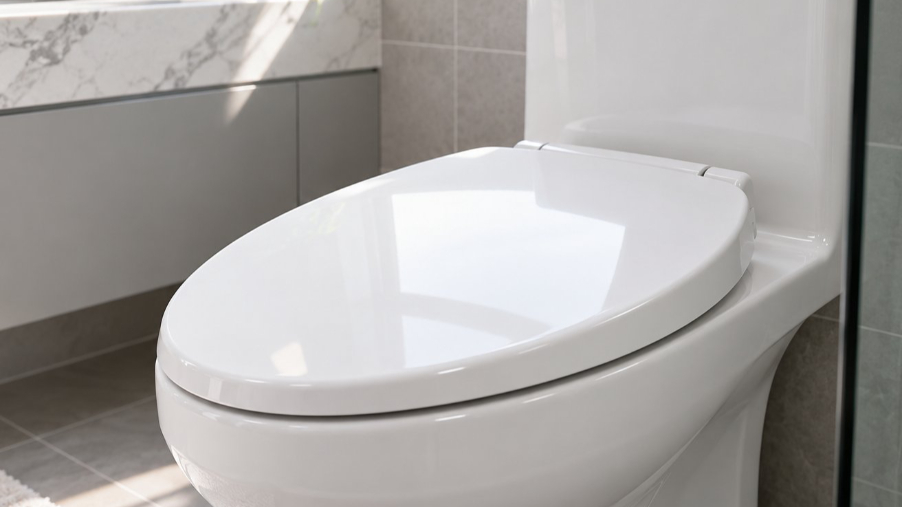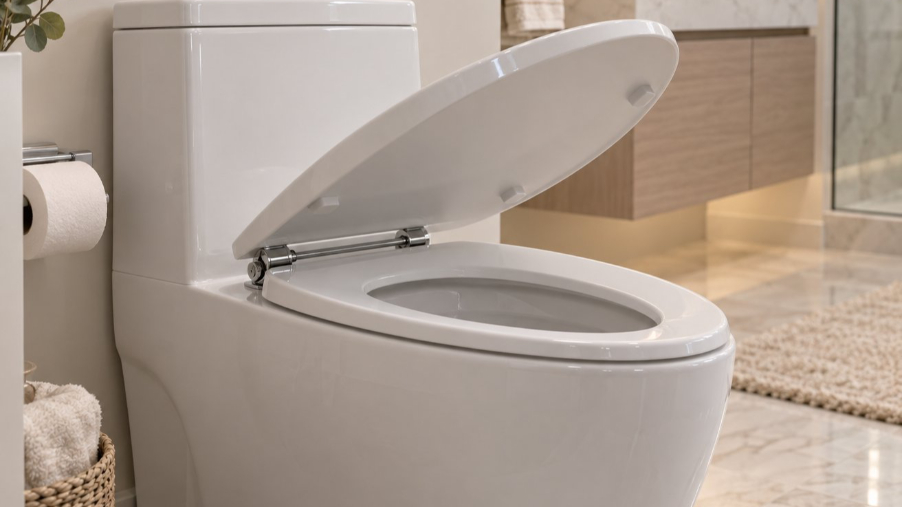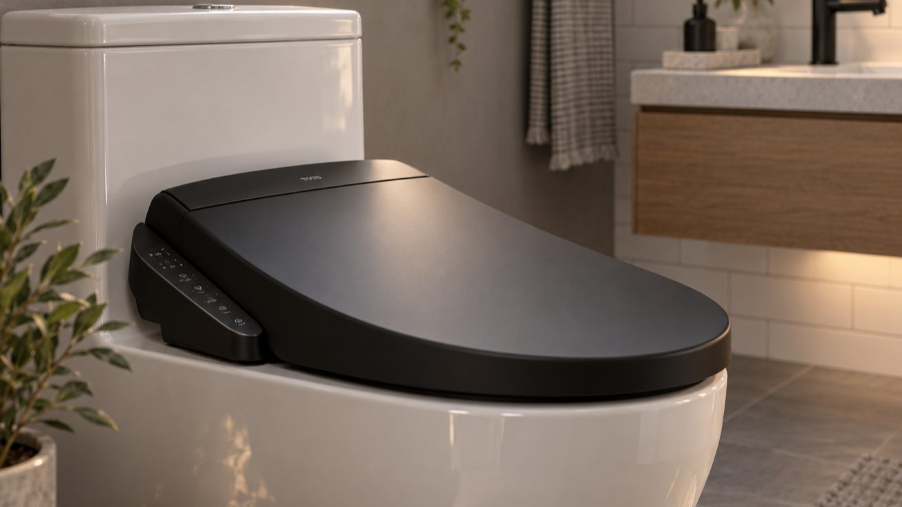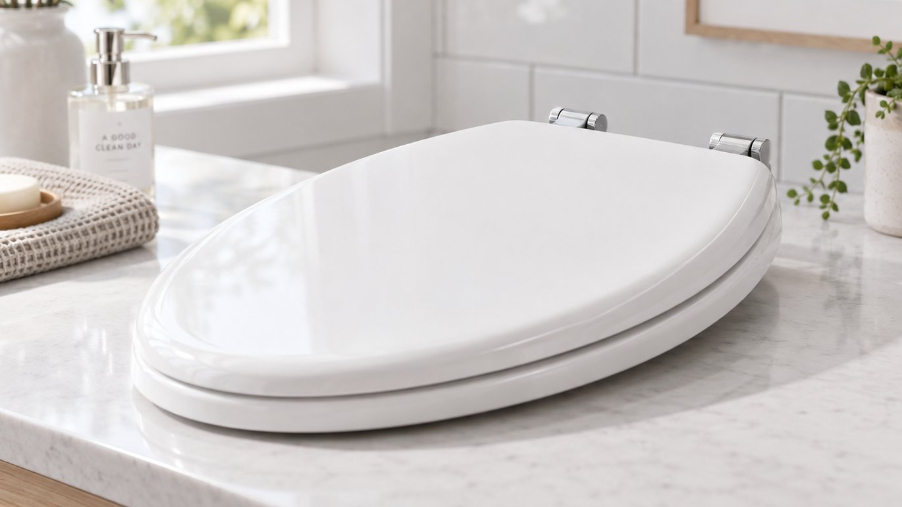
What Exactly Is a Round Open Front Toilet Seat?
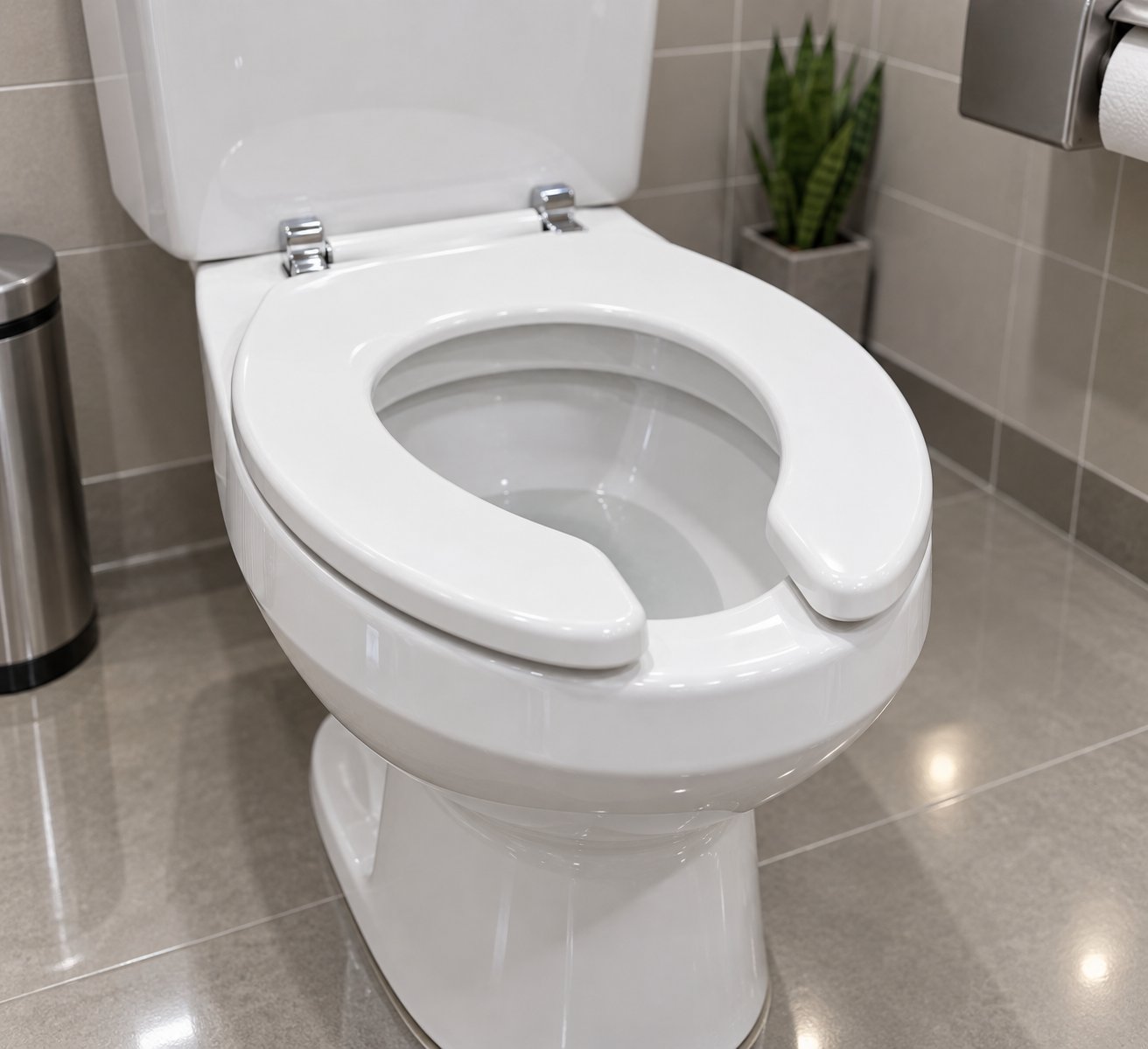
Walk into any public restroom and you will notice the toilet seat looks different from the one at home. Instead of a full oval ring, there is a gap at the front — a U-shaped opening where material has been intentionally removed. That design is not a manufacturing shortcut. It is a deliberate, code-driven feature known as an open front toilet seat.
A round open front toilet seat is a U-shaped seat with a gap at the front, designed to fit round toilet bowls that measure approximately 16.5 inches from the mounting bolt holes to the front rim. The open front reduces user contact with the seat surface and supports hygiene compliance in public and commercial restrooms.
The U-Shaped Design Explained
The easiest way to identify this style is to compare it with a standard residential seat. A closed front seat — sometimes called an O-shaped seat — forms a complete oval with no gap. A round front toilet seat with an open front, by contrast, removes a section of material at the very front of the ring, creating that distinctive U shape.
This open gap serves a practical purpose. It allows users, especially women, to wipe without their hands contacting the seat surface, a detail that plumbing codes have required in public facilities since at least 1955. The design also makes cleaning faster for janitorial staff because there is less surface area to sanitize.
Shape matters here, too. A round toilet seat with open front fits bowls that are roughly circular, measuring about 16.5 inches in length. This is shorter than elongated bowls, which extend approximately 18.5 inches. Choosing the wrong profile — say, placing an elongated seat on a round bowl — leads to overhang, wobble, and frustrated users. Some buyers also search for a round toilet seat with large opening or even a round toilet seat with extra large opening for enhanced accessibility, and those options do exist within this same U-shaped category.
Who Uses Round Open Front Toilet Seats?
Two groups rely on this product most. Commercial facility managers and contractors purchase open front round toilet seats to satisfy plumbing code requirements in offices, restaurants, schools, and hospitals. For them, it is not optional — it is the law in most jurisdictions.
The second group is residential buyers who choose the design voluntarily. Some homeowners prefer the hygiene advantages in guest bathrooms, while others find the open front more comfortable or accessible for family members with mobility challenges.
Whether you are specifying seats for a 200-unit hotel renovation or simply replacing a worn-out seat in a half-bath, the decisions ahead are the same: material, features, configuration, and correct fit. Each of those choices carries trade-offs that can affect durability, code compliance, and long-term cost — starting with why these seats are legally required in the first place.
Why Open Front Toilet Seats Exist and When They Are Required
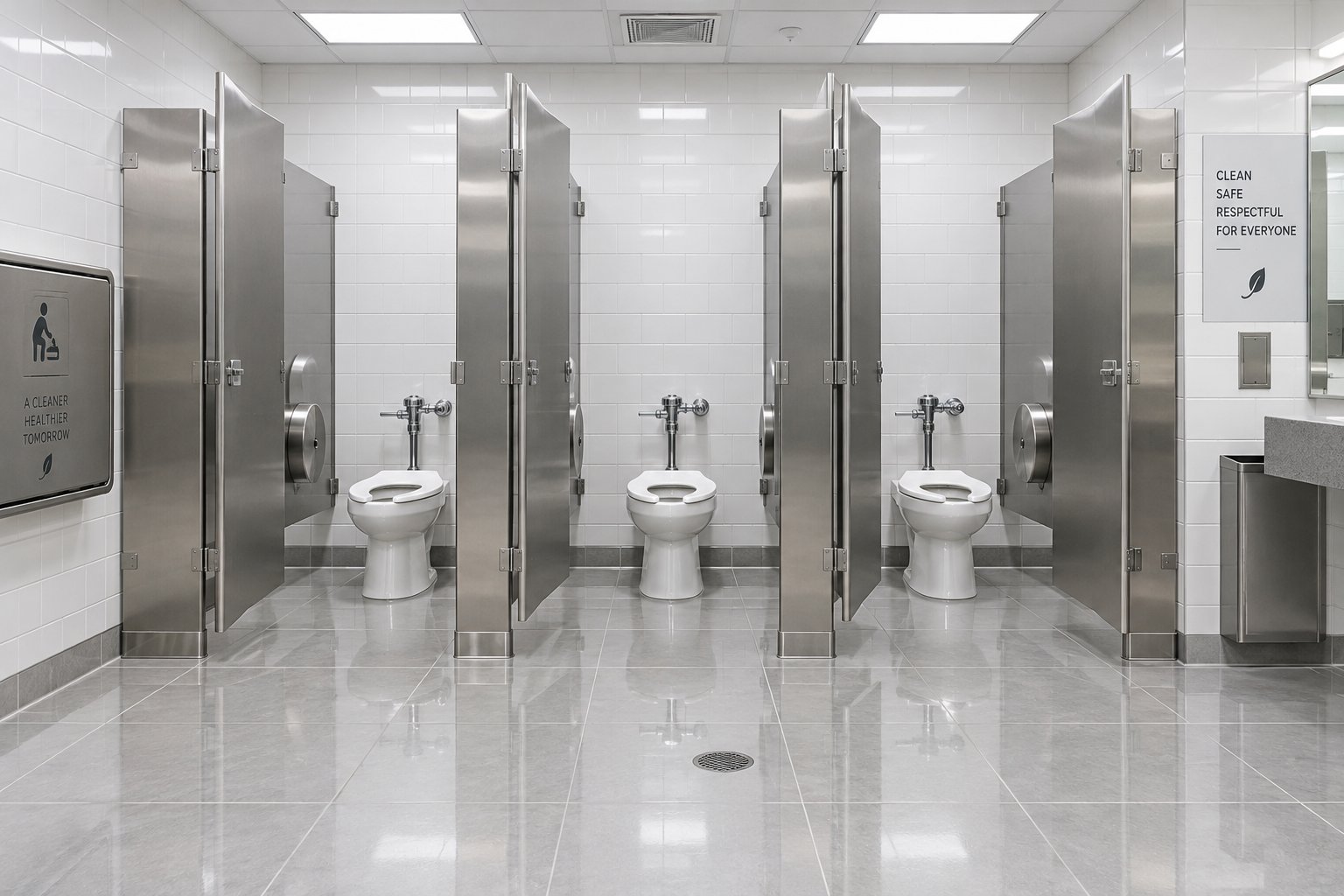
Most people assume the U-shaped gap on a public restroom seat is just a quirky design choice. It is not. That gap is written into law — or more precisely, into plumbing codes that carry the force of law in thousands of municipalities across the United States. If you manage a commercial facility or specify fixtures for new construction, understanding these requirements is not optional. Getting it wrong can mean failed inspections, costly retrofits, and potential liability.
Plumbing Code Requirements for Public Restrooms
The mandate for open front seats traces back decades. The American Standard National Plumbing Code (ASNPC) stated as early as 1955: "Water closets shall be equipped with seats of smooth non-absorbent material. All seats of water closets provided for public use shall be of the open-front type." That language has carried forward through every major code revision since.
Two primary codes govern this requirement today:
- International Plumbing Code (IPC), Section 420.3 — requires that toilet seats in public and employee restrooms be the open front type, constructed of smooth, non-absorbent material.
- Uniform Plumbing Code (UPC) — maintained by the International Association of Plumbing and Mechanical Officials (IAPMO), this code has called for open front seats in public-use water closets since 1973.
These codes are not federal laws on their own, but most cities, counties, and states adopt one of them — often with minimal modification — as their local plumbing standard. In practice, that means any restaurant, office building, hospital, school, retail store, or government facility is almost certainly required to install open front seats on every standard toilet seat in a public-access restroom.
Why the open front specifically? The reasoning centers on personal hygiene and cross-contamination. The gap at the front of the seat allows users — women in particular — to wipe without their hands or tissue contacting the seat surface. Lynne Simnick, IAPMO's senior director of code development, confirmed to Slate that the U-shape was designed to give users room to clean themselves without standing up or touching the seat directly. In high-traffic environments where hundreds of people share the same round commode seat each day, that small design detail significantly reduces the risk of germ transfer from one user to the next.
ADA accessibility guidelines add another layer. While the Americans with Disabilities Act does not specifically mandate open front seats, it does require accessible restroom configurations that support independent use. Many specifiers select open front designs in ADA-compliant stalls because the front gap provides additional clearance for users with limited mobility or those who rely on assistive devices.
Hygiene Benefits Beyond Code Compliance
Imagine a busy airport restroom where a single stall might see 300 or more users in a day. Every point of skin-to-surface contact becomes a potential vector for bacteria like E. coli, staphylococcus, and streptococcus. The open front design reduces that contact area — fewer square inches of seat surface means fewer places where germs can accumulate and transfer.
This benefit extends to the cleaning crew as well. A standard round toilet seat with a closed front has a continuous ring that traps moisture and residue in the front zone, which is the area most prone to splashing. The U-shaped cutout eliminates that section entirely, making the remaining surface faster to wipe down and sanitize. For facilities running tight janitorial schedules, that time savings adds up across dozens or hundreds of restrooms.
These practical advantages explain why some residential users choose open front designs even when no code requires it. Homeowners installing a round plastic toilet seat in a guest bathroom, for instance, sometimes prefer the open front configuration because guests feel more comfortable knowing there is less shared surface contact. Health-conscious households and families caring for immunocompromised members find the same logic compelling — the hygiene benefit that code writers recognized decades ago applies just as well in a private home.
The standard round open front seat, in other words, is not just a regulatory checkbox. It is a functional design backed by decades of public health reasoning. The real question for most buyers is not whether to choose this style — codes often make that decision for them — but how to choose between the different configurations available within the open front category.
Open Front With Cover vs Without Cover Explained
Browse product listings for a round open front toilet seat and you will run into a phrase that stops many buyers cold: "open front with cover." The Bemis 7750TDG, for example, is labeled exactly that way. So is Big John's heavy-duty model. Yet no product page actually explains what "with cover" means in this context — or why it matters for your specific restroom. The distinction is straightforward once you see it, but choosing the wrong configuration can create problems ranging from code violations to unnecessary maintenance headaches.
Open Front With Cover Configurations
"With cover" simply means the seat ships with a hinged round toilet lid that closes over the U-shaped ring. Picture the setup you are used to seeing at home — a seat and a lid that flips down on top of it — except the seat itself still has that open front gap. The lid, when lowered, conceals the gap entirely and gives the toilet a finished, residential-style appearance.
This configuration is popular in semi-public and upscale commercial settings: corporate office restrooms, medical practice waiting areas, boutique hotel lobbies, and executive suites. Facility managers in these environments want the hygiene compliance of an open front design without the institutional look. A round toilet cover also helps contain odors between uses, which matters in smaller restrooms where ventilation is limited. A Bemis round toilet seat in the "with cover" style, for instance, is a common specification for Class A office buildings that need to meet plumbing codes while maintaining a polished aesthetic.
Open Front Without Cover Options
"Without cover" means exactly what it sounds like — no lid at all. You get only the U-shaped seat ring mounted directly to the bowl. This is the version you encounter in airports, stadiums, fast-food restaurants, highway rest stops, and other high-traffic public restrooms.
Why strip away the lid? Durability and simplicity. Every additional component is a potential failure point. Lids can crack, hinge pins can corrode, and in heavily used facilities, covers get slammed hundreds of times a day. Removing the lid eliminates all of those issues. It also speeds up cleaning — janitorial staff have one less surface to wipe, and there is no lid hinge collecting grime. For venues where a round toilet cover would face constant abuse, going without is the practical choice.
| Factor | Open Front With Cover | Open Front Without Cover |
|---|---|---|
| Typical Setting | Offices, medical facilities, upscale commercial | Airports, stadiums, fast-food restaurants |
| Appearance | Finished, residential-style look | Utilitarian, institutional |
| Cleaning Ease | Additional lid surface to sanitize | Fewer surfaces, faster turnaround |
| Plumbing Code Compliance | Compliant — seat retains U-shaped opening | Compliant — seat retains U-shaped opening |
| Durability | Lid hinges add a potential failure point | Fewer components, less to break |
| Cost | Slightly higher due to lid and extra hardware | Lower — seat ring and mounting hardware only |
Both configurations satisfy plumbing code requirements because compliance hinges on the seat shape, not the presence or absence of a lid. The decision comes down to your environment. If your restroom serves a professional or guest-facing setting where appearance and odor control matter, choose the version with a round toilet lid. If you are outfitting a high-volume public facility where every component takes a beating, skip the cover and save on replacement costs over time.
Whichever configuration you select, though, the seat still needs to match your bowl — and that match depends on a measurement many buyers get wrong.
Round vs Elongated
A seat that meets every code requirement and checks every feature box still fails if it does not physically fit the bowl. And this is where a surprising number of purchasing errors happen — not with materials or configurations, but with a basic dimensional mismatch between the seat shape and the toilet it is supposed to sit on. Ordering a round open front toilet seat for an elongated bowl (or vice versa) results in either an awkward overhang past the rim or a seat that falls short of the front edge, leaving an unstable, uncomfortable gap. Both outcomes mean wasted money and a return trip to the supplier.
The fix is simple: one measurement, taken correctly, tells you exactly which shape you need.
Round vs Elongated Bowl Shapes
Every standard toilet bowl in North America falls into one of two shape categories — round or elongated. The difference is not subtle once you know what to look for, but the two can appear deceptively similar at a glance, especially when a seat is already installed.
Here is the core distinction. A round bowl measures approximately 16.5 inches from the center of the mounting bolt holes to the very front edge of the rim. An elongated bowl measures approximately 18.5 inches across that same span — a full two inches longer. Both styles share a similar width, typically between 14 and 14.5 inches at the widest point, which is why eyeballing the difference without measuring can be misleading.
Where will you find each shape? Round bowls are more common in older buildings, smaller bathrooms, powder rooms, and residential half-baths where space is tight. Their compact footprint makes them ideal for apartments and vintage homes where every inch of floor space counts. Elongated bowls, on the other hand, have become the default in newer construction. Over 70 percent of new homes in North America now install elongated toilets for the added comfort and seating area they provide.
For anyone sourcing a toilet seat for round bowl installations — particularly in older commercial buildings undergoing renovation — confirming the round profile before ordering prevents the most common fit mistake in the industry. If the bowl length lands close to 18.5 inches, you are looking at an elongated bowl and need a completely different seat, whether round or oblong toilet seat options appear in the search results.
Measuring Your Bowl to Confirm the Shape
Guessing leads to returns. Measuring takes less than two minutes. Grab a tape measure — a flexible one works best — and follow these steps.
Start at the back of the bowl where the two mounting bolt holes sit. These are the holes where the seat attaches, usually concealed under small plastic caps. Find the center point between those two bolt holes. That midpoint is your starting reference. From there, extend the tape measure in a straight line along the center axis of the bowl to the very front edge of the rim. Do not curve the tape or follow the bowl contour — keep it straight.
Your result tells the story:
- Approximately 16.5 inches (42 cm): You have a round bowl. Order round toilet seat sizes accordingly.
- Approximately 18.5 inches (47 cm): You have an elongated bowl. A round seat will not fit properly.
That single length measurement is the most important number, but it is not the only one worth checking. To ensure a secure, wobble-free fit, verify these three dimensions before placing an order:
- Bolt spread distance: Measure from the center of the left mounting hole to the center of the right mounting hole. The standard bolt spread is 5.5 inches (14 cm), and this dimension is universal across most manufacturers in North America. If yours differs — as it sometimes does on European imports or very old fixtures — you may need a specialty seat or adapter plate.
- Bowl length from bolts to front rim: This is the measurement described above. It determines whether you need a round or elongated seat and is the single most reliable indicator of bowl shape.
- Overall bowl width: Measure across the widest point of the bowl rim, roughly halfway between front and back. Standard round toilet seat measurements fall between 14 and 14.5 inches here. Anything significantly wider or narrower could indicate a custom, European, or designer bowl that requires a non-standard seat.
What about toilets that seem to fall between categories? Some buyers search for a 15 inch toilet seat or a toilet seat 15 x 14, expecting a size that splits the difference between round and elongated. In reality, a bowl measuring around 15 inches from bolt holes to rim is unusually short — possibly a compact or child-sized fixture — and requires careful comparison against manufacturer specifications rather than a standard off-the-shelf seat. True round bowls cluster tightly around 16.5 inches, and true elongated bowls around 18.5 inches, with very little gray area between them.
One final tip: if you are removing an old seat for replacement, do not assume the outgoing seat is the correct shape. Previous owners or maintenance crews sometimes force-fit the wrong size, creating the very instability problems you are now trying to solve. Always measure the bare bowl itself, not the seat that happens to be sitting on it.
Getting the shape right eliminates the most common fit failure. But shape only determines the outer profile — the material the seat is made from determines how long it lasts, how it feels, and whether it can withstand the cleaning chemicals and usage patterns your restroom demands.
Material Options for Round Open Front Toilet Seats
A seat that fits perfectly and meets every code requirement can still disappoint if the material cannot handle its environment. Picture a molded wood seat installed in a busy fast-food restroom — within months, the lacquer chips, moisture infiltrates the compressed core, and the surface becomes a breeding ground for bacteria. Or imagine a heavy-duty commercial plastic seat installed in a designer powder room where the homeowner wanted warmth and character. The seat works fine, but it looks and feels completely wrong for the space.
Material is where function, durability, and aesthetics collide. For a round open front toilet seat, the choice typically comes down to three categories: plastic (the dominant option for commercial applications), wood (a residential favorite), and a handful of specialty alternatives. Each brings distinct trade-offs in weight, scratch resistance, chemical tolerance, and tactile comfort — and picking the wrong one can cost more in replacements and maintenance than the seat itself ever did upfront.
Plastic Seat Materials Including PP and UF
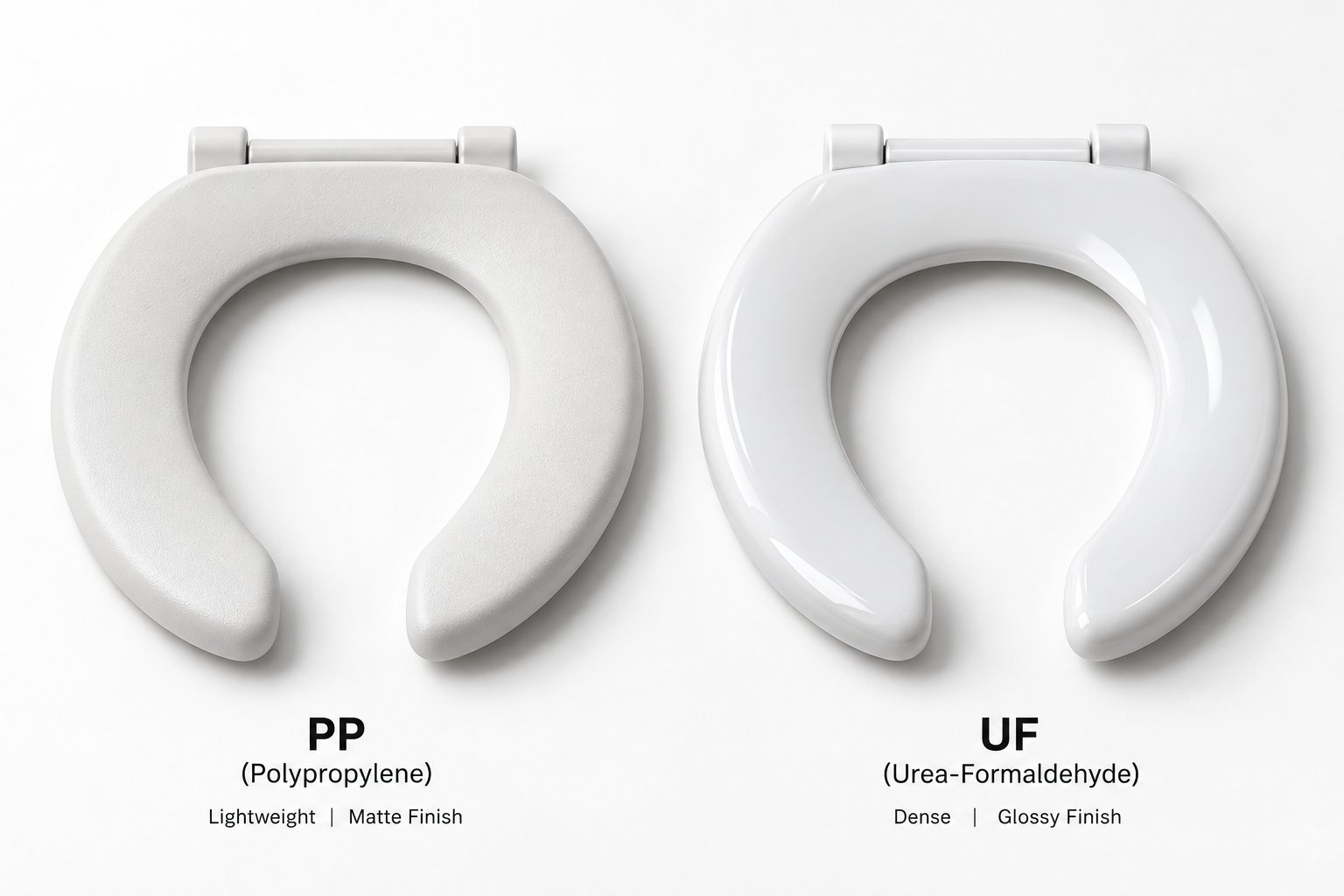
The vast majority of open front seats sold for commercial use are plastic, but that single word covers two very different materials with distinct performance profiles. Understanding the difference between polypropylene (PP) and urea-formaldehyde (UF) can save you from choosing a seat that deteriorates prematurely — or paying a premium for properties you do not actually need.
Polypropylene (PP) is the lighter, more economical option. You will find it on most budget-friendly and mid-range seats specified for high-turnover environments like school restrooms, public parks, and transit stations. PP is resistant to the harsh chemical cleaners that janitorial crews rely on — bleach solutions, quaternary ammonium compounds, and hydrogen peroxide-based disinfectants all wipe across PP surfaces without causing degradation. It is also naturally moisture-resistant and does not absorb odors. The trade-off? PP is softer than UF, meaning it scratches more easily and can develop a dull, worn appearance over time in heavy-use settings. If you have ever sat on a plastic toilet seat round in profile that felt lightweight and slightly flexible, you were likely using a PP seat.
Urea-formaldehyde (UF), also marketed as thermoset or duroplast, is the premium plastic option. UF seats are noticeably denser and heavier — pick one up and you will immediately feel the difference. That density translates to superior scratch resistance. Where a PP seat might show scuff marks after a year of commercial use, a UF seat maintains its smooth, glossy finish far longer. The material also resists staining and UV-driven discoloration, so a white UF seat still looks white years after installation rather than fading to a yellowish tint. The ceramic-like feel of UF gives it a quality perception that works well in upscale commercial restrooms, medical offices, and hospitality settings where the seat needs to perform under heavy use while still looking polished.
| Property | Polypropylene (PP) | Urea-Formaldehyde (UF / Thermoset) |
|---|---|---|
| Weight | Lightweight | Noticeably heavier, ceramic-like heft |
| Durability | Good — suitable for standard commercial use | Excellent — resists wear in high-traffic settings |
| Scratch Resistance | Moderate — shows scuffs over time | High — maintains smooth surface longer |
| Chemical Resistance | Strong — tolerates bleach and commercial cleaners | Strong — also tolerates aggressive disinfectants |
| Color Stability | May yellow or dull with prolonged UV exposure | Excellent — resists discoloration and staining |
| Feel | Slightly flexible, lightweight feel | Rigid, dense, premium tactile quality |
| Typical Applications | Schools, parks, transit, budget commercial | Hotels, medical, corporate offices, upscale commercial |
| Cost | Lower | Higher — reflects material density and longevity |
For facility managers ordering at scale, the PP vs UF decision often comes down to a simple calculus: how visible is the restroom, and how often are you willing to replace seats? A toilet seat round plastic model made from PP costs less per unit but may need replacement every two to three years in a busy public facility. A UF seat costs more initially but can last significantly longer without visible wear, reducing long-term procurement cycles. Manufacturers like Tianyun offer both PP and UF seat cover options designed specifically for sanitaryware brands and OEM manufacturers, allowing specifiers to select the exact material grade that matches their project requirements — whether that is value-driven PP for a school district rollout or premium UF for a hotel chain renovation.
Wood and Specialty Seat Materials
Step into the residential side of the market and the material conversation shifts dramatically. Round wood toilet seats remain popular for homeowners who want their bathroom to feel warm and intentional rather than clinical. A round wooden toilet seat — typically made from molded wood (compressed wood fibers bonded with resin and finished with enamel paint or lacquer) — feels warmer to the touch on a cold morning than any plastic alternative. That tactile comfort is the primary reason wood endures as a residential choice despite plastic's dominance in commercial settings.
Molded wood seats are available in a wide range of colors and finishes, from classic white enamel to natural wood-grain tones that complement traditional or rustic bathroom designs. Some manufacturers also offer a wood toilet seat round in profile with decorative patterns or hand-painted accents — a category that has no real equivalent in the commercial plastic world.
The downsides, though, are real. Wood is porous at a microscopic level, even with a quality finish. Over time, the enamel can chip from impacts or cleaning abrasion, allowing moisture to penetrate the compressed core. Once water gets in, the seat can swell, warp, and develop conditions where bacteria thrive beneath the surface coating. This is precisely why plumbing codes specify "smooth, non-absorbent material" for public restrooms — a requirement that effectively disqualifies most round wood toilet seats from commercial use.
Beyond traditional wood, a handful of specialty materials occupy niche positions in the market. Bamboo seats appeal to eco-conscious buyers and offer slightly better moisture resistance than standard molded wood, though they still fall short of PP or UF in commercial durability testing. Cushioned or padded vinyl seats exist as well, but their tendency to crack, trap moisture underneath the padding, and harbor bacteria makes them a poor choice for anything beyond short-term residential use.
The bottom line on material selection is straightforward: match the material to the setting. Commercial environments — where code compliance, chemical cleaning, and heavy daily use are non-negotiable — demand PP or UF plastic. Residential bathrooms where aesthetics, comfort, and personal preference drive the decision can accommodate wood, bamboo, or specialty finishes without concern for code restrictions. And for OEM manufacturers building toilet seat product lines, partnering with suppliers who offer both material platforms — like Tianyun's PP and UF seat cover program — provides the flexibility to serve both market segments from a single sourcing relationship, with matched dampers, hinges, and fixing systems that simplify production planning.
Material determines how long a seat lasts and how it holds up to daily abuse. But two seats made from the same material can still perform very differently depending on the hardware holding them in place and the engineering features built into the design — differences that separate a quality seat from one that loosens, slams, or fails within months of installation.
Key Features That Define a Quality Open Front Seat
Two seats sit side by side on a supplier's shelf. Same material. Same shape. Same open front configuration. Yet one will stay firmly anchored through five years of heavy commercial use while the other starts shifting and wobbling within six months. The difference is not visible at a glance — it lives in the fastening system, the hinge engineering, the damper mechanism, and the surface treatment baked into the design. These are the features that separate the best round toilet seat from one that becomes a recurring maintenance headache.
Understanding what to evaluate before you buy — rather than discovering what is missing after installation — is the difference between a one-time purchase and a frustrating cycle of replacements.
Fastening Systems and Hinge Durability
Think about what a toilet seat endures in a busy commercial restroom. It gets sat on, stood on, shifted side to side, and slammed down hundreds of times a day. Every one of those movements applies force to the two mounting bolts that hold the seat to the bowl. If the fastening system cannot absorb that stress without loosening, the seat starts sliding — and a sliding seat is not just annoying. It creates a safety risk, especially for elderly users or anyone with limited mobility.
This is why the mounting hardware deserves as much scrutiny as the seat material itself. Standard bolt-and-nut assemblies — the type you will find on most budget seats — rely on friction alone to stay tight. Over time, repeated lateral movement and vibration gradually back the nut off, and the seat begins to shift. Maintenance staff retighten it, and the cycle repeats every few weeks.
Higher-quality seats solve this with engineered fastening systems. The Bemis Stay·Tite system, for example, uses a combination of a stabilizing bushing and a nut design that spreads clamping force more evenly across the underside of the bowl. The result is a connection that resists loosening even under sustained heavy use. For facility managers overseeing dozens or hundreds of restrooms, this type of system dramatically reduces the number of maintenance calls related to loose seats — a cost saving that easily justifies the slightly higher per-unit price.
Hinge material is the other half of this equation. Plastic hinges are the most common on economy-grade seats. They are lightweight and inexpensive, but they wear faster. Plastic can deform under sustained load, and the pivot points develop play over time, causing the seat to rock even when the bolts remain tight. Stainless steel hinges are a significant step up — they resist corrosion from cleaning chemicals and moisture, maintain dimensional stability, and keep the seat aligned on its pivot axis far longer than plastic. Zinc-alloy hinges offer a middle ground: more corrosion-resistant than bare steel, lighter than stainless, and cost-effective enough for mid-range commercial specifications. If you are selecting a round open front toilet seat for any environment beyond light residential use, prioritizing metal hinges over plastic ones is one of the simplest ways to extend the seat's functional lifespan.
Soft-Close Mechanisms and Antimicrobial Features
Ever been startled by the sharp crack of a toilet seat slamming down in a quiet office restroom? That slam is not just noise — it is damage happening in real time. Each impact stresses the hinge pins, cracks the seat material incrementally, and can even chip the porcelain bowl rim over thousands of repetitions. Multiply that by a few hundred daily uses, and you understand why slamming is a leading cause of premature seat replacement in commercial settings.
A soft close round toilet seat eliminates this problem entirely. Built-in damper mechanisms — small hydraulic or pneumatic cartridges integrated into the hinge assembly — control the descent speed so the seat lowers slowly and silently from any angle. You can release the seat from a fully upright position, and it will ease itself down over several seconds without any user effort. The round soft close toilet seat category has expanded rapidly beyond residential bathrooms and into commercial specifications precisely because the noise reduction and damage prevention pay for themselves quickly.
Several major manufacturers now offer slow close round toilet seat models specifically designed for open front commercial applications. A Bemis slow close round toilet seat, for instance, pairs the damper mechanism with the company's commercial-grade hinge and fastening system, creating an integrated package that addresses loosening, slamming, and noise in one unit. Similarly, an American Standard soft close toilet seat uses damper technology calibrated for the weight and geometry of their specific seat designs. If you are evaluating a Bemis round soft toilet seat against competitors, pay attention to whether the damper is replaceable — some designs allow you to swap out a worn damper cartridge without replacing the entire seat, which extends value significantly in high-use environments.
Antimicrobial surface treatments add another layer of protection worth evaluating. Technologies like Bemis DuraGuard embed antimicrobial agents directly into the seat material during manufacturing rather than applying a topical coating that wears off over time. This means the surface actively inhibits the growth of bacteria, mold, and mildew for the life of the seat — not just until the first deep cleaning strips the coating away. For healthcare facilities, schools, and food-service environments where hygiene standards are especially stringent, antimicrobial seats offer a measurable advantage in maintaining sanitary conditions between cleaning cycles.
Weight capacity is a feature that rarely gets discussed but matters enormously in certain settings. Standard commercial seats are engineered to support between 300 and 500 pounds, which covers the vast majority of users. But some facilities — bariatric care centers, certain healthcare environments, and high-traffic public venues — need seats rated well beyond that range. Big John's heavy-duty open front model, for example, carries a rated capacity of 1,200 pounds, achieved through reinforced internal structures and oversized hinge assemblies. If your application involves any possibility of users exceeding standard weight limits, specifying an appropriately rated seat is not just a comfort consideration — it is a liability issue.
When comparing open front seats side by side, these are the features that separate a specification-worthy product from a commodity purchase. Use this checklist as your evaluation framework:
- Fastening system type: Does the seat use a standard bolt-and-nut or an engineered anti-loosening system?
- Hinge material: Plastic, zinc-alloy, or stainless steel — and is the pivot mechanism designed for commercial-frequency use?
- Soft-close mechanism: Is a damper included? Is it integrated or replaceable? How is it rated for cycle life?
- Antimicrobial coating: Is the treatment embedded in the material or applied topically? Will it survive commercial cleaning chemicals?
- Weight capacity rating: What is the documented maximum load, and does the manufacturer provide engineering test data to back it up?
- Warranty terms: What does the warranty cover — just material defects, or also hinge and damper performance? How long does coverage last?
Every item on that list represents a potential point of failure that, left unexamined, turns a seemingly good purchase into an expensive replacement cycle. The right combination of these features depends on your specific environment, usage volume, and budget — but skipping the evaluation entirely is how facilities end up replacing seats every year instead of every five.
Of course, even the most feature-rich seat is only as good as its installation. A poorly mounted seat with premium hinges will still wobble, and a perfectly engineered damper cannot compensate for bolts tightened into the wrong holes. The installation process itself carries its own set of common mistakes — most of them entirely avoidable.
Step-by-Step Installation for Round Open Front Seats
Here is the good news: installing a round open front toilet seat is one of the simplest plumbing-adjacent tasks you will ever tackle. No specialized tools. No soldering. No shutting off the water supply. The entire job — removal of the old seat and installation of the new one — typically takes 15 to 20 minutes. Yet it is also one of the most commonly botched tasks in restroom maintenance, not because the process is complicated but because small missteps lead to wobbly seats, cracked porcelain, and frustrating do-overs. Whether you are handling a single replacement round toilet seat at home or swapping out dozens across a commercial facility, following the right sequence in the right order prevents every one of those problems.
Removing the Old Toilet Seat
Before the new seat goes on, the old one has to come off — and this step trips people up more often than the installation itself, especially on seats that have been in place for years.
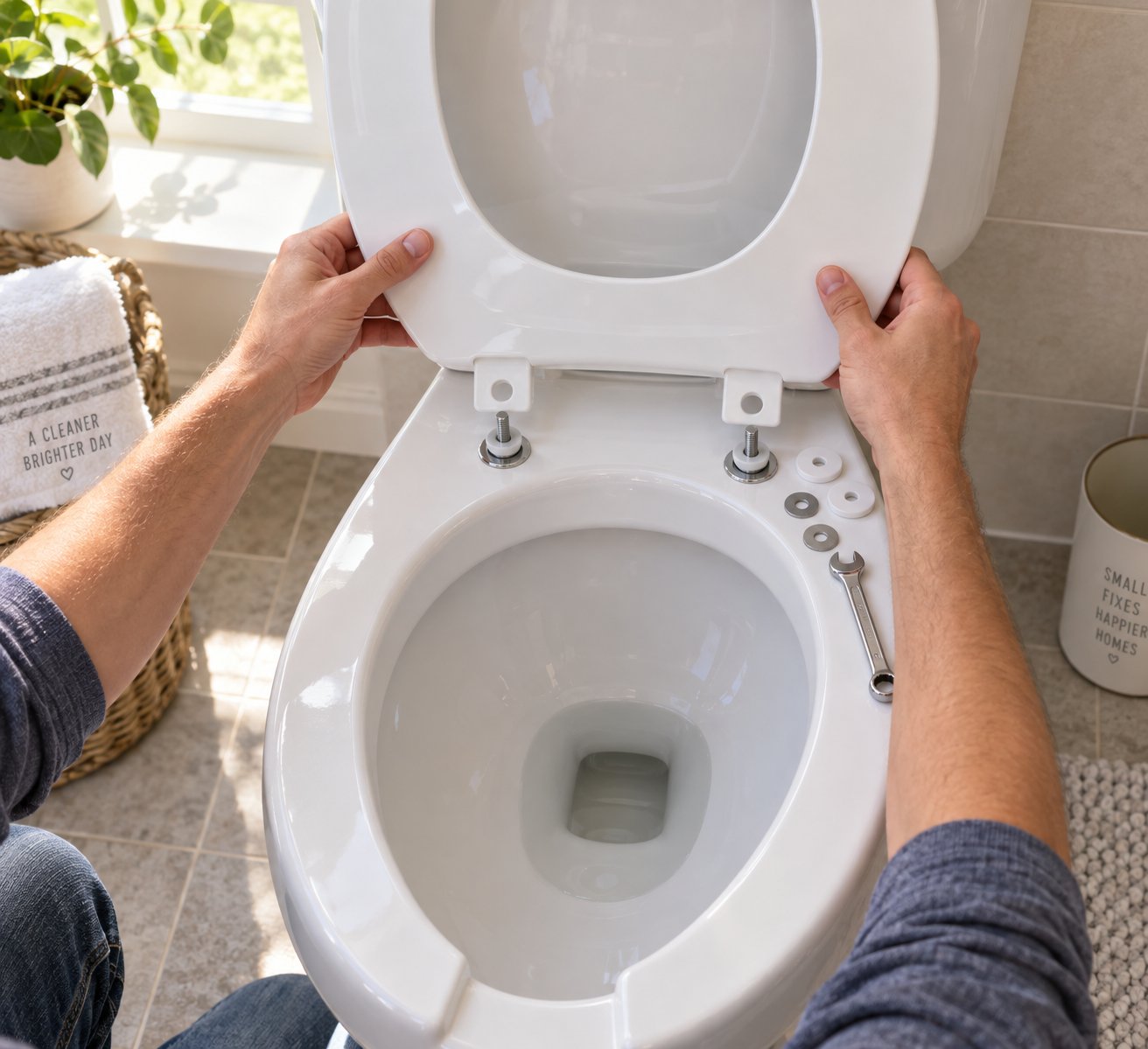
Start by locating the two mounting bolts at the back of the bowl. You will find them positioned on either side of the bowl rim, directly behind the seat hinge. On most seats, small plastic caps cover the bolt heads. Flip these caps open or pry them up gently with a flat-head screwdriver to expose the bolt heads underneath.
With the bolt heads exposed, the goal is simple: hold the nut on the underside of the bowl steady while turning the bolt on top. A standard adjustable wrench or a pair of pliers gripping the nut from below, combined with a screwdriver turning the bolt from above, is the classic two-tool approach. Turn counterclockwise to loosen. Once both bolts are free, lift the entire seat and hinge assembly straight up and off the bowl.
Sounds straightforward — and it is, unless corrosion has fused the hardware together. Metal bolts and nuts exposed to years of moisture, cleaning chemicals, and occasional splashing can seize up completely. If the bolt will not budge, apply a penetrating lubricant like PB Blaster or WD-40 directly to the bolt threads visible beneath the bowl. Let it soak for 10 to 15 minutes, then try again. Still frozen? A mini hacksaw or an oscillating multi-tool with a metal-cutting blade can slice through the bolt shank between the bowl rim and the nut. Wear safety glasses during this step — corroded metal can splinter unpredictably.
Once the old seat is off, clean the mounting area thoroughly. Residue, mineral deposits, and old gasket material left around the bolt holes can prevent the new seat from sitting flush against the porcelain. A damp cloth and a mild bathroom cleaner handle most buildup. For stubborn deposits, a plastic scraper avoids scratching the bowl surface.
Installing the New Round Open Front Seat
With a clean mounting surface, you are ready to fit the new seat. The process is methodical — rush through it and you risk the same wobble and misalignment problems that likely prompted the replacement in the first place. Follow these steps in order:
- Verify the bolt spread matches. Measure from the center of the left bowl hole to the center of the right bowl hole. The standard bolt spread is 5.5 inches (14 cm), and this dimension is consistent across the vast majority of North American toilets. If your bowl holes are spaced differently — occasionally the case with older fixtures or European imports — confirm that the new seat's hinge hardware accommodates the variation. Some seats marketed as a toilet seat for American Standard fixtures, for example, are engineered specifically for that brand's standard dimensions and may include adjustment slots in the hinge plate for minor bolt spread differences.
- Position the new seat so mounting holes align with the bowl holes. Set the seat on the bowl and visually confirm that the hinge bolt holes sit directly over the bowl's mounting holes. The seat should rest centered, with equal overhang (or no overhang) on both sides.
- Insert mounting bolts through the seat hinges and bowl holes. Drop each bolt through the hinge plate from above, threading it down through the corresponding bowl hole. Most replacement round toilet seat kits include plastic or rubber washers that sit between the bolt head and the hinge plate — do not skip these. They cushion the connection, prevent the bolt from grinding against the hinge, and create a slight grip that resists lateral movement.
- Hand-tighten nuts from below. Reach under the bowl rim and thread the nut onto each bolt by hand. Turn clockwise until the nut is snug against the underside of the bowl. Do not use tools yet — hand-tight is the right tension for this stage.
- Center the seat on the bowl and adjust position. With the nuts hand-tight, the seat can still slide slightly forward, backward, or side to side. Adjust it so the seat ring sits evenly on the bowl rim all the way around. The open front gap should be centered at the front of the bowl, not skewed to one side. This is also the moment to confirm the seat sits level — press down gently on the left side, then the right side. If one side lifts when you press the other, the seat is not resting flat on the rim, and you may need to adjust the bolt positions or check for debris under the hinge plate.
- Fully tighten hardware without overtorquing. Using a wrench or pliers on the nut below and a screwdriver on the bolt above, tighten each side in alternating quarter-turns. This alternating approach draws the seat down evenly rather than clamping one side first and pulling the seat off-center. Stop tightening when the seat feels firmly anchored with no lateral play. Here is the critical caution: do not overtighten. Porcelain is strong under compression but brittle under concentrated point loads. An overtightened bolt can crack the bowl rim — a repair that costs far more than the seat itself. If you feel the bolt suddenly tighten with increased resistance and then give slightly, you may have already stressed the porcelain. Back off a quarter-turn immediately.
- Test seat stability by applying gentle lateral pressure. Sit on the seat or press down firmly with your hands, then shift your weight side to side. The seat should not slide, rock, or lift on either side. If it does, revisit the bolt tension — likely one side needs an additional quarter-turn. Also verify that the seat still sits level and centered after the stability test, since the testing itself can shift a marginally tightened seat.
If you are performing a round toilet seat replacement on an American Standard fixture specifically, note that an American Standard replacement toilet seat often ships with brand-specific mounting hardware designed to interface precisely with that manufacturer's bowl geometry. Using the included hardware rather than repurposing old bolts from a different brand ensures the tightest, most stable fit. The same principle applies when working with any major brand — the hardware in the box was engineered for that seat, and generic substitutes may not perform identically.
The most common installation mistakes are overtightening the bolts, skipping the centering step before final tightening, and failing to check that the seat sits level on the rim. All three are preventable by following a patient, sequential process rather than rushing to finish.
A few additional tips for commercial installers handling American Standard toilet seat replacement projects or multi-unit rollouts: carry a small tube of plumber's silicone grease to lightly coat bolt threads before installation. The grease prevents future corrosion and makes the next replacement years from now dramatically easier. Also, keep a record of the seat model number and bolt spread for each restroom — when it is time to reorder, that data eliminates the guesswork and measurement delays that slow down bulk replacement projects.
With the seat securely mounted and functioning, the installation is mechanically complete. But for many buyers — especially those specifying seats for lobbies, executive suites, or guest-facing restrooms — the job is not truly finished until the seat visually matches the existing fixtures, a detail that involves more nuance than simply ordering "white."
Color Matching and Aesthetic Choices for Every Setting
"White" sounds like a simple specification — until the new seat arrives and sits a full shade brighter than the bowl it is supposed to match. That subtle mismatch, barely noticeable under showroom lighting, becomes glaringly obvious under the fluorescent fixtures in a commercial restroom or the natural light streaming into a residential half-bath. Color is one of those details that nobody notices when it is right and everybody notices when it is wrong.
For a round open front toilet seat, the color decision involves more variables than most buyers expect — not just choosing a shade, but accounting for material behavior, manufacturer-specific formulations, and the natural aging of existing fixtures.
Standard Color Options for Open Front Seats
White dominates the market by a wide margin, accounting for the vast majority of both commercial and residential seat sales. It is the default specification for offices, hospitals, schools, and restaurants — essentially any setting where the goal is a clean, neutral appearance that pairs with standard porcelain fixtures.
Beyond white, the most commonly available colors include:
- Bone: A warm, slightly yellowish off-white. Bone colored toilet seats are especially common in homes built during the 1980s and 1990s, when warmer fixture palettes were popular. Finding an exact bone match for a replacement seat can be tricky because the shade varies between manufacturers.
- Biscuit: Similar to bone but with a slightly more golden or creamy undertone. Biscuit and bone are close enough to be confused with each other, yet different enough that pairing the wrong one with your bowl creates an obvious visual clash.
- Beige: Warmer and more tan-toned than either bone or biscuit. A beige toilet seat or a beige round toilet seat pairs with earth-toned bathroom schemes, but availability in open front configurations is more limited than white.
- Black: A bold contrast choice for modern or industrial bathroom designs. A black round toilet seat makes a strong visual statement in residential settings, though a black toilet seat round in profile is less commonly stocked in open front commercial versions.
Here is where color consistency gets complicated. A seat labeled "white" from one manufacturer may not match "white" from another. American Standard's white, for example, carries a slightly different tint than a comparable shade from other fixture brands. The difference is subtle — sometimes just a fraction of a tone cooler or warmer — but when a bright white seat sits on a slightly warm white bowl, the contrast is immediately visible. This is why experienced specifiers match seats to the specific toilet manufacturer's color code rather than relying on a generic color name.
Matching Seats to Existing Fixtures
Replacement purchases present an even trickier challenge. Porcelain ages. Over years of exposure to cleaning chemicals, hard water, and ambient light, a bowl that started as crisp white may have shifted toward a faintly cream or grey tone. A brand-new seat in the original factory white will look noticeably different sitting on that aged bowl — not because the seat color is wrong, but because the bowl is no longer the color it once was.
PP and UF plastics also behave differently over time. As industry research on seat discoloration shows, color retention depends not just on the base material but on the specific pigments, stabilizers, surface finish, and exposure conditions. A UF seat generally holds its original color longer thanks to superior UV and stain resistance, while a PP seat may gradually shift in tone — particularly in restrooms with strong natural light or aggressive cleaning protocols. Two seats that look identical out of the box can diverge visually within a year if one is PP and the other is UF, or if they are exposed to different light and cleaning conditions.
To minimize mismatch headaches, follow these practical steps before ordering a replacement:
- Bring the old seat to a showroom for comparison. Hold it next to new options under the store's lighting. This is far more reliable than trying to match from memory or a photograph.
- Photograph the bowl in natural light. Artificial bathroom lighting can mask subtle color differences. A photo taken near a window reveals the true current shade of your porcelain.
- Check manufacturer color codes stamped on the bowl. Most toilets have a model number and color code stamped inside the tank or on the underside of the bowl rim. Cross-reference this code with the seat manufacturer's color chart to find the closest match.
- Consider that PP and UF materials hold color differently over time. If long-term color consistency matters — especially in guest-facing or upscale settings — a UF seat offers a better chance of maintaining its original shade through years of use and cleaning.
- Request a color sample chip when ordering in bulk. Commercial buyers specifying seats for multi-unit projects should always request physical samples and approve them against the actual fixture before committing to a full order.
What about non-standard colors? Options like a grey round toilet seat or blue-toned seats do exist, but they are typically limited to residential closed-front models. The same is true for decorative toilet seats round in profile — seats with printed patterns, artistic motifs, or novelty designs are almost exclusively closed-front residential products. If you need an open front seat for code compliance, your realistic color palette is white, bone, biscuit, beige, and black, with white being the only shade universally available across all manufacturers and configurations.
Color may seem like a minor detail compared to material selection and hinge engineering, but in guest-facing restrooms and design-conscious residential spaces, it is the first thing people notice — and the last thing you want to get wrong. For buyers sourcing seats at scale, especially across commercial projects where consistency matters across dozens or hundreds of units, the color conversation naturally leads to a broader question: how do you evaluate and select a sourcing partner who can deliver that consistency reliably?
Sourcing Round Open Front Seats for Commercial and OEM Programs
Consistency across one restroom is manageable. Consistency across 50, 200, or 1,000 restrooms — each requiring the same round toilet seat in the same color, material, and configuration — is a fundamentally different challenge. It is the challenge that commercial buyers, facility managers, and OEM toilet seat manufacturers face every time they spec a new project or refresh an existing portfolio. A single mismatched component in a bulk order does not just affect one stall. It creates a visual inconsistency, a maintenance headache, or a code compliance gap that ripples across every unit in the building.
Sourcing at scale demands a different evaluation framework than buying a single replacement seat at a hardware store. The priorities shift from "does it fit my bowl" to "can this supplier deliver compatible, code-compliant, durable assemblies reliably across hundreds or thousands of units — and can they do it again next quarter when I need more?"
What Commercial Buyers Should Prioritize
Imagine you are outfitting a new hospital wing or renovating restrooms across a 30-location restaurant chain. Every round toilet seat you install must satisfy the same checklist — and failing on any single item creates risk that compounds with volume. Here is what experienced facility managers and procurement directors evaluate before signing a purchase order:
Code-compliant open front design is non-negotiable. Every seat must feature the U-shaped gap that satisfies IPC Section 420.3 and UPC requirements. This seems obvious, but bulk orders sometimes include mixed SKUs by accident, and a single closed-front seat installed in a public restroom puts the entire facility at inspection risk.
Material durability matched to traffic volume separates a smart specification from a costly one. High-traffic venues like airports and stadiums need the scratch resistance and color stability of UF (urea-formaldehyde). Mid-traffic environments like office restrooms and schools can often perform well with PP (polypropylene) at a lower per-unit cost. Making this decision at the material level — rather than defaulting to the cheapest option across the board — reduces replacement cycles and total cost of ownership over a five-year window.
Corrosion-resistant hinges matter far more at scale than in a single residential installation. When a plastic hinge fails on one seat, you replace it. When plastic hinges fail across 200 seats within the same 18-month window, you have a systemic procurement problem. Stainless steel or zinc-alloy hinges cost marginally more per unit but dramatically reduce the volume of maintenance callbacks — a savings that facility managers of large portfolios feel directly in their operating budgets.
Reliable fastening systems that resist loosening under heavy public use are equally critical. A loose round toilet seat in a busy restroom generates user complaints, creates slip hazards, and adds unplanned labor for maintenance staff. Anti-loosening fastening systems — engineered bushings, locking nuts, and stabilizing washers — keep seats firmly anchored through thousands of daily use cycles without requiring periodic retightening. Major brands like Bemis have built their commercial reputation partly on fastening innovations for exactly this reason, and Bemis toilet seats round in profile remain among the most commonly specified open front options in institutional projects.
Weight capacity documentation rounds out the evaluation. Commercial liability requires that specified seats carry documented load ratings backed by engineering test data — not just marketing claims. Standard commercial seats supporting 300 to 500 pounds cover most use cases, but healthcare and bariatric facilities need documented ratings well above that threshold.
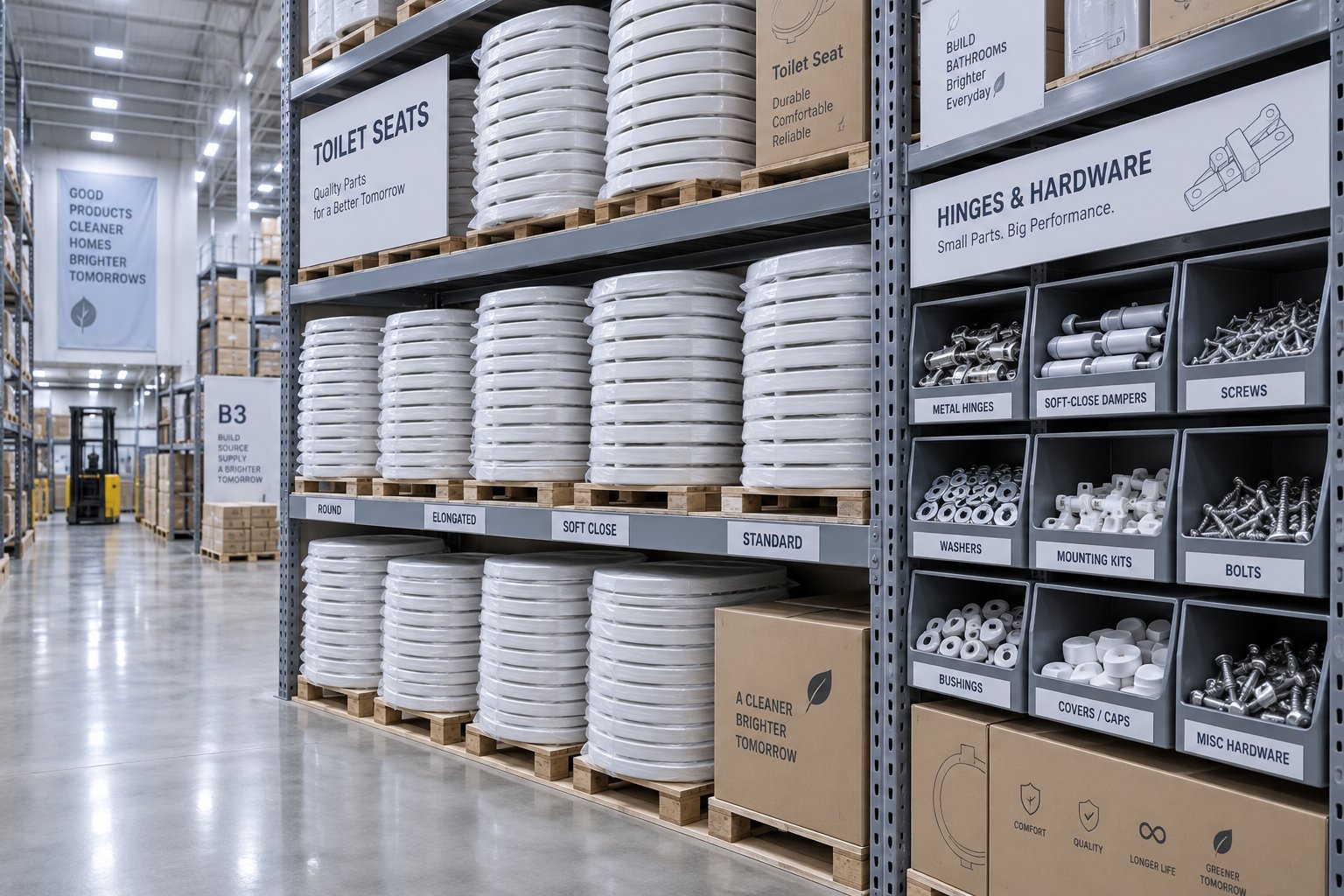
One factor ties all of these criteria together: integrated component systems. Sourcing the seat ring from one vendor, hinges from another, dampers from a third, and fixing hardware from a fourth creates a compatibility chain where any weak link undermines the entire assembly. A damper calibrated for one lid weight produces sluggish or too-fast closing on another. A hinge machined to slightly different tolerances introduces play that no stabilizer can compensate for. Suppliers who offer seat covers, dampers, hinges, and fixing hardware as a coordinated package — pre-tested and pre-matched — simplify procurement and eliminate the compatibility gambling that plagues piecemeal sourcing.
OEM and Brand Partnership Considerations
For sanitaryware brands and OEM manufacturers building or expanding toilet seat product lines, the sourcing calculus goes deeper than individual project procurement. You are not buying seats for a building — you are building a product platform that needs to serve multiple models, market segments, and regional requirements. The supplier you choose becomes a long-term engineering partner, not just a vendor filling a purchase order.
What separates a capable OEM partner from a basic seat supplier? It comes down to platform flexibility. A brand that offers both an American Standard toilet seat program and a value line for budget markets needs a supplier who can deliver premium UF seats for one SKU and cost-effective PP seats for another — using the same hinge architecture and fixing systems across both to reduce inventory complexity. A Bemis toilet program, for example, spans dozens of SKUs across residential and commercial lines, each requiring precise coordination between seat material, damper torque, hinge geometry, and mounting hardware. Any OEM supplier supporting that kind of breadth needs a production-ready platform, not a one-off manufacturing capability.
When evaluating potential OEM partners for round toilet seats and open front configurations, use this criteria list as your starting framework:
- Material options: Can the supplier produce both PP and UF seat covers at consistent quality? Do they offer different material grades within each category to serve value, mid-range, and premium market tiers?
- Soft-close damper integration: Does the supplier provide damper mechanisms matched to specific seat weights and dimensions? Are the dampers tested for cycle life — ideally 50,000 cycles or more — and available as integrated hinge assemblies?
- Hinge system variety: Can they supply standard friction, soft-close, quick-release, and adjustable hinge configurations? Is the hinge platform modular enough to serve multiple seat shapes and bowl types from the same component family?
- Fixing system compatibility: Do their mounting hardware kits support both top-mount and bottom-mount bowl designs? Is the bolt spread adjustable to accommodate regional variations beyond the standard 5.5-inch spacing?
- Color customization: Can the supplier match specific brand color codes — not just generic "white" — and maintain that color consistency across production runs spanning months or years?
- Minimum order flexibility: Are minimum order quantities structured to support both initial product launches (smaller runs for market testing) and scaled production (thousands of units per month for established SKUs)?
Suppliers who check every box on that list are rare — which is precisely why they are valuable. Tianyun's PP and UF seat cover platform is built specifically for this kind of OEM partnership, pairing seat covers with compatible dampers, hinges, and fixing systems as a complete component ecosystem. Rather than sourcing each element separately and hoping the pieces work together, sanitaryware brands and OEM manufacturers get a production-ready program where every component — from the damper torque calibration to the hinge geometry to the bolt spread — is engineered as a system. That integrated approach streamlines product development timelines and eliminates the trial-and-error sourcing cycles that delay launches and inflate prototyping costs.
Whether you are a facility manager specifying a toilet seat round in profile for a 500-unit hotel renovation, or a product director at a sanitaryware brand developing the next generation of your commercial seat lineup, the sourcing decision shapes everything downstream — durability, compliance, aesthetics, and total cost. Treat it with the same rigor you would apply to any other engineered component in your building or product portfolio, and the seat becomes one of the most reliable, lowest-maintenance items in the restroom rather than a recurring line item on the maintenance budget.
Frequently Asked Questions About Round Open Front Toilet Seats
1. Why do public restrooms use open front toilet seats?
Public restrooms use open front (U-shaped) toilet seats because plumbing codes — specifically the International Plumbing Code (IPC Section 420.3) and the Uniform Plumbing Code (UPC) — require them in public and employee restrooms. The front gap allows users to wipe without touching the seat surface, reducing cross-contamination in high-traffic environments where hundreds of people share the same fixture daily. This mandate has been in effect since at least 1955 and applies to restaurants, offices, hospitals, schools, and virtually all commercial facilities.
2. What is the difference between a round and elongated open front toilet seat?
The difference comes down to bowl length. A round bowl measures approximately 16.5 inches from the center of the mounting bolt holes to the front rim, while an elongated bowl measures roughly 18.5 inches — a full two inches longer. Round bowls are more common in older buildings, compact bathrooms, and half-baths, whereas elongated bowls dominate newer construction. To avoid purchasing errors, always measure the bare bowl from bolt holes to the front edge before ordering, since installing the wrong shape causes overhang or instability.
3. Should I choose an open front toilet seat with cover or without cover?
It depends on your setting. An open front seat with cover includes a hinged lid that closes over the U-shaped ring, providing a finished look and containing odors — ideal for offices, medical facilities, and upscale commercial restrooms. An open front seat without cover has no lid, just the seat ring, which reduces maintenance points and speeds up cleaning — best suited for high-traffic public venues like airports and stadiums. Both configurations meet plumbing code requirements because compliance is based on the seat shape, not the presence of a lid.
4. What material is best for a round open front toilet seat — PP or UF?
Polypropylene (PP) is lighter, more affordable, and resistant to harsh cleaners, making it a solid choice for budget-conscious commercial settings like schools and transit facilities. Urea-formaldehyde (UF, also called thermoset or duroplast) is denser, more scratch-resistant, and retains its color far longer, making it ideal for upscale commercial spaces such as hotels and corporate offices. Manufacturers like Tianyun offer both PP and UF seat cover options (tianyuntech.com/pp-uf-cover), allowing brands and OEM manufacturers to specify the exact material grade for their project needs.
5. How do I install a round open front toilet seat without cracking the porcelain?
Start by verifying the standard 5.5-inch bolt spread, then align the seat's hinge holes with the bowl holes and insert the mounting bolts with any included washers. Hand-tighten the nuts from below first, then center the seat on the bowl rim before using tools. Tighten each side in alternating quarter-turns to draw the seat down evenly. The critical rule is to avoid overtorquing — porcelain is strong under compression but brittle under concentrated point loads. Stop tightening as soon as the seat feels secure with no lateral play, and test stability by pressing side to side before considering the job done.
Apply This Insight to Your Project
Tell us what you are building and how the topic “Round Open Front Toilet Seat: The Code Rule Most Buyers Miss” relates to your application. Our engineering team can help evaluate the next step.