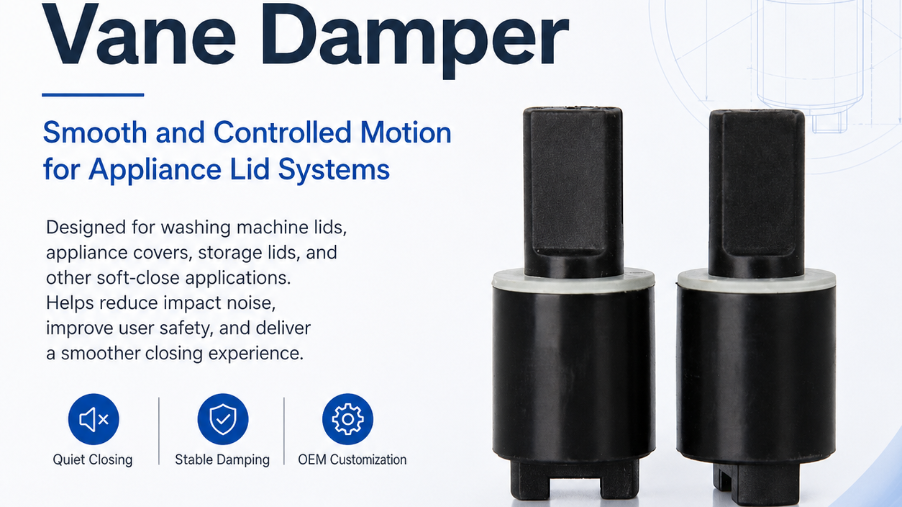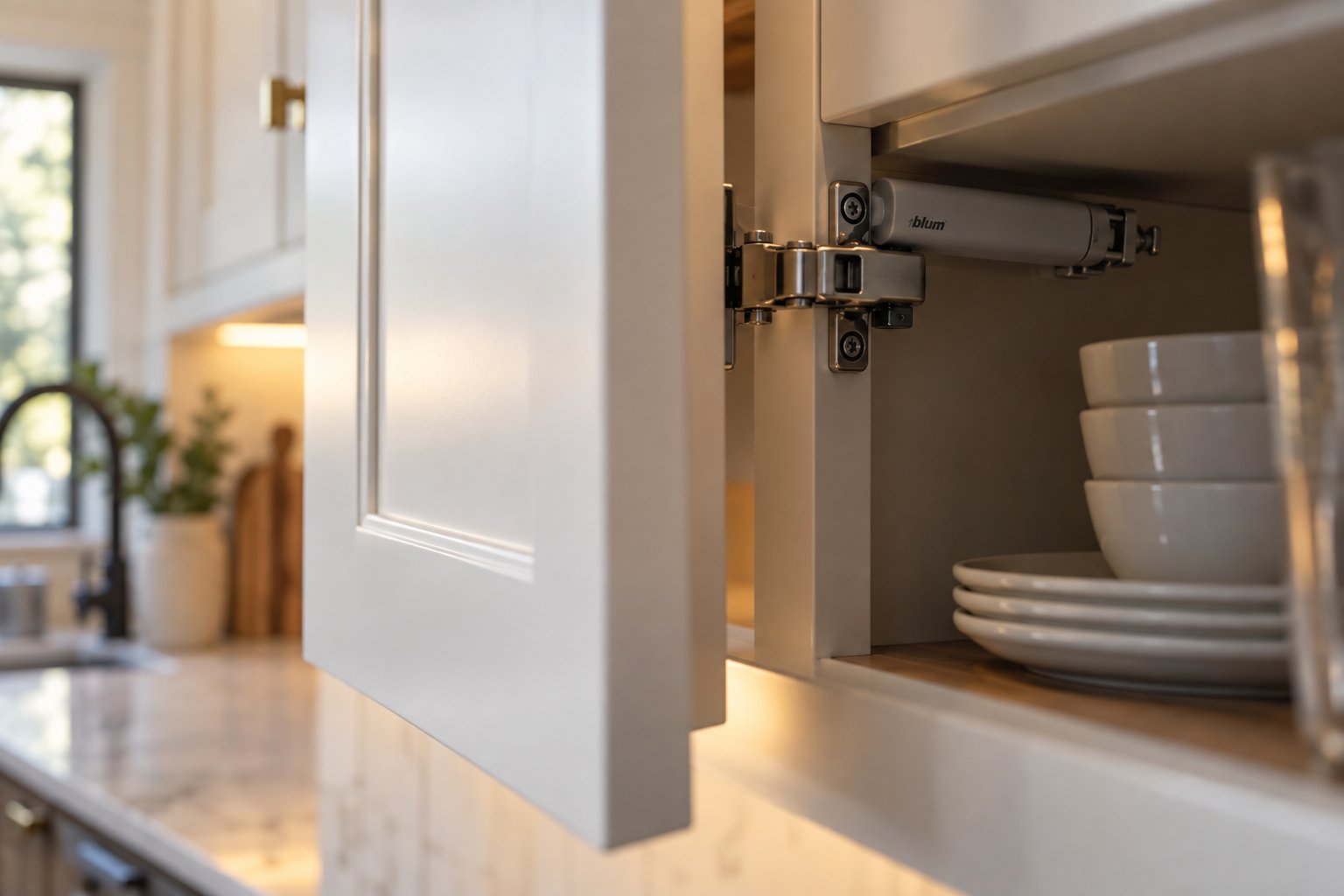
What Is a Soft Close Cabinet Door Damper
You know that satisfying, whisper-quiet close when a cabinet door glides shut without a sound? That experience usually comes down to one small but clever piece of hardware: a soft close cabinet door damper. Whether you are upgrading an older kitchen or fine-tuning a bathroom vanity, understanding what this device actually is — and how it differs from a full hinge replacement — will save you time, money, and a lot of frustration.
What a Soft Close Damper Actually Does
A soft close damper is a compact, standalone device — usually hydraulic — that mounts inside a cabinet box or onto the face frame. Its entire job is to catch a swinging door during the last couple of inches of travel and absorb the momentum so the door settles into a gentle, silent close instead of slamming. Think of it as a tiny shock absorber purpose-built for cabinetry.
A soft close cabinet door damper is a small hydraulic or pneumatic device that intercepts a cabinet door's closing motion, absorbs its kinetic energy, and guides it to a controlled, slam-free close — without replacing the existing hinges.
This distinction matters more than most buyers realize. A damper is not the same thing as a soft close hinge. Integrated soft close hinges have the damping mechanism built directly into the hinge body, meaning you swap out the entire hinge to get the slow close effect. A standalone damper, on the other hand, is an add-on. You keep your current hinges in place and simply install the damper alongside them. It is the difference between buying a whole new door lock and just adding a deadbolt — both improve function, but the scope of the project is entirely different.
Why Soft Close Matters in Modern Kitchens and Bathrooms
Imagine a busy weekday morning. Coffee is brewing, kids are grabbing cereal, and every cabinet door in the kitchen is opening and closing in rapid succession. Without dampers, that routine comes with a soundtrack of sharp, jarring slams. Soft close cabinets eliminate that noise entirely, creating a noticeably calmer environment — especially in open-concept layouts where kitchen sounds carry into living areas.
The benefits go well beyond peace and quiet, though:
- Finger safety: Doors that decelerate on their own significantly reduce the risk of pinched fingers, a real concern in households with young children.
- Reduced wear and tear: Repeated slamming stresses hinges, door frames, and cabinet finishes over time. A softclose mechanism cushions every impact, helping your cabinetry stay aligned and looking new longer.
- Perceived quality: That smooth, controlled close instantly makes even builder-grade cabinets feel more refined — a detail you will notice every single day once it is there.
These practical advantages explain why homeowners, renovators, and cabinet manufacturers alike have embraced this hardware category. Yet the real question most buyers face is not whether to add dampers — it is understanding the mechanics behind them well enough to pick the right one for their specific cabinets.
How Soft Close Dampers Work Mechanically
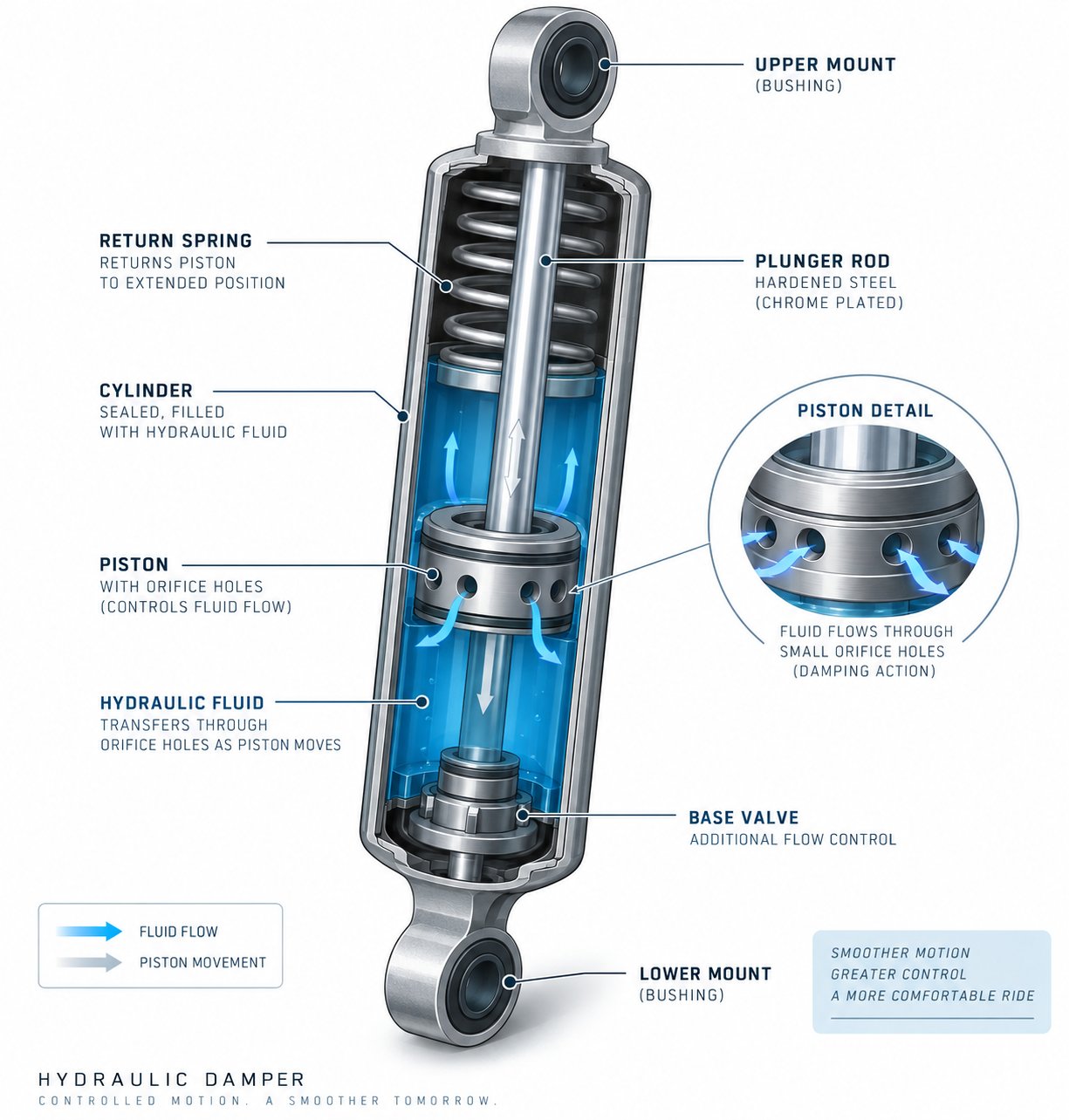
That gentle, cushioned closing action might seem like magic, but the soft close mechanism inside every piston-style damper follows a straightforward principle from physics: forcing a thick fluid through a tiny opening requires effort, and that effort absorbs energy. It is the same basic idea behind a screen-door closer or a car's shock absorber — just miniaturized to fit inside your cabinet.
Hydraulic Fluid Resistance and Controlled Motion
Picture a small sealed cylinder filled with silicone oil. Inside that cylinder sits a piston with precisely sized holes — called orifices — drilled through it. When a closing cabinet door pushes the damper's plunger inward, the piston compresses into the fluid. The silicone oil has nowhere to go except through those tiny orifice passages, and squeezing a viscous liquid through a narrow gap takes real force.
Here is the clever part: the resistance is velocity-proportional. The harder someone swings the door shut, the faster the piston moves, and the more resistance the fluid creates. A viscous damper produces force following the relationship F = c x v — force equals the damping coefficient multiplied by velocity — which means the damper is essentially self-regulating. A gentle push meets light resistance; a frustrated slam meets significantly more. Either way, the door arrives at the frame quietly.
All that kinetic energy from the swinging door does not just disappear. It converts into a small amount of heat as the fluid shears through the orifices — not enough to notice with your hand, but enough to rob the door of its momentum and deliver a smooth close every time. The silicone fluid used in quality dampers is chosen specifically because its viscosity stays relatively stable across a wide temperature range, so the soft close door damper in your kitchen performs consistently whether it is a cold winter morning or a hot summer afternoon.
Spring Return and Activation Range
You might wonder: if the piston gets pushed inward every time the door closes, how does it reset for the next use? That is where the return spring comes in. A small internal spring sits behind the piston, and once you open the cabinet door and release pressure on the plunger, that spring pushes the piston back to its starting position. The soft close damper is now cocked and ready for the next closing cycle — no manual reset needed.
Equally important is understanding when the damper actually engages. These devices do not resist the door through its entire swing. Instead, they have an "activation zone" — typically the last few inches of door travel — where the plunger makes contact and the damping action begins. Before that point, the door swings freely on its hinges. This design is intentional: you want effortless opening and closing through most of the arc, with controlled deceleration only at the very end. The exact activation range varies by product design, but the concept is universal across piston-style dampers.
Here is a quick-reference breakdown of what is happening inside:
- Sealed cylinder: Houses the silicone fluid and provides the compression chamber for the piston.
- Silicone damping fluid: Creates velocity-proportional resistance as it is forced through orifices, converting kinetic energy into heat.
- Piston with calibrated orifices: Controls exactly how much resistance the damper produces — smaller orifices mean stronger damping force.
- Return spring: Resets the piston to its starting position after each close so the damper is ready for the next cycle.
- Plunger rod and seal: Transfers force from the closing door into the piston while keeping the fluid sealed inside the cylinder.
Every one of these components works together in a fraction of a second, yet the engineering tolerances matter more than you might expect. Even a small variation in orifice diameter can shift the damping force noticeably — which is exactly why not all dampers on the market feel the same, and why product quality varies so widely across different manufacturers and price points.
Types of Soft Close Dampers and Mounting Styles
Quality differences aside, the type of damper you choose matters just as much as how well it is built. Soft close cabinet dampers come in three distinct categories, each designed for a different mounting scenario and budget. Picking the wrong category often leads to awkward fitment or underwhelming performance — so it pays to understand what is available before you start shopping.
Compact Piston-Style Dampers
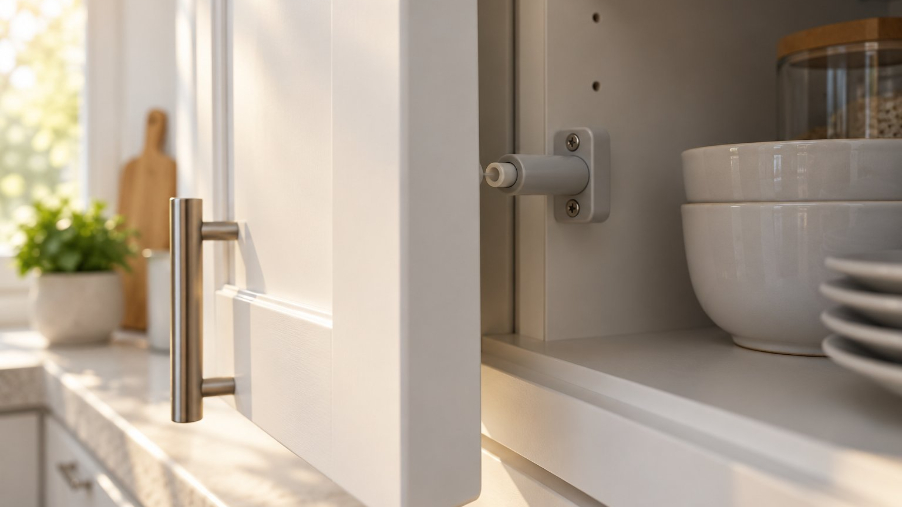
These are the workhorses of the retrofit world. A compact piston-style damper is a small, self-contained cylinder — usually around the size of your thumb — that screws directly onto the cabinet face frame or adheres to the inside of the cabinet box. When the door swings shut, it contacts the damper's plunger in the last couple of inches and decelerates to a quiet close.
Why are they so popular? Two reasons: simplicity and cost. You do not need to touch your existing hinges at all. A single screw or adhesive pad is typically all that holds the unit in place, making this the fastest path to soft close dampers for cabinets that currently have standard hinges. They are also the least expensive option per door, which makes them appealing for whole-kitchen upgrades on a budget.
Hinge-Mounted and Clip-On Damper Adapters
What if your cabinets do not have a convenient frame edge for a screw-in damper? That is where adapter-style dampers come in. A soft close hinge adapter clips directly onto the arm of an existing European-style cup hinge, adding a small damping cartridge that engages as the hinge closes. The result is essentially a damped hinge without the cost of replacing the entire unit.
The mounting concept is straightforward: the soft close adapter snaps or slides onto the hinge arm, positioning its internal piston so it activates during the final degrees of door travel. This approach works especially well on frameless cabinets where there is no protruding frame to mount a standalone piston. Compatibility is the main caveat — you need to confirm that the adapter matches your specific hinge cup diameter and arm style before purchasing.
Integrated Soft Close Hinges
The third option skips add-ons entirely. Integrated soft close hinges have a damping mechanism built right into the hinge body, combining the pivot and the cushioned close in a single piece of hardware. These represent the all-in-one solution and tend to offer the smoothest, most consistent feel because the damper and hinge are engineered to work together from the factory. The trade-off is a higher per-unit cost and the need to replace every hinge on the door. As one reference point, quality integrated soft close hinges are commonly rated for 50,000 or more cycles — significantly outlasting many budget alternatives.
The table below puts all three categories side by side so you can quickly identify which style fits your situation:
| Attribute | Compact Piston-Style Damper | Clip-On / Hinge Adapter | Integrated Soft Close Hinge |
|---|---|---|---|
| Typical mounting location | Cabinet frame edge or inside cabinet box | Existing cup hinge arm | Replaces entire hinge (35 mm cup bore) |
| Retrofit difficulty | Very easy — one screw or adhesive | Easy — clip or slide onto hinge | Moderate — full hinge swap required |
| Relative cost per door | Low | Low to moderate | Higher |
| Best use case | Budget-friendly whole-kitchen retrofit on face-frame cabinets | Frameless cabinets with compatible cup hinges | New builds, major renovations, or when hinges already need replacing |
Notice how every option revolves around one central question: what kind of cabinet and hinge setup do you already have? A piston damper that works perfectly on a traditional face-frame kitchen may be completely impractical on a frameless European-style box — and vice versa. That cabinet construction style is the single biggest variable most buyers overlook, and it deserves a closer look before you commit to any product.
Face-Frame vs. Frameless
So what exactly makes cabinet construction style such a dealbreaker? It comes down to what your damper has to grab onto. Every cabinet in your kitchen falls into one of two structural families, and each one dictates which soft close adapter for cabinet doors will actually work — and which will leave you drilling holes you regret.
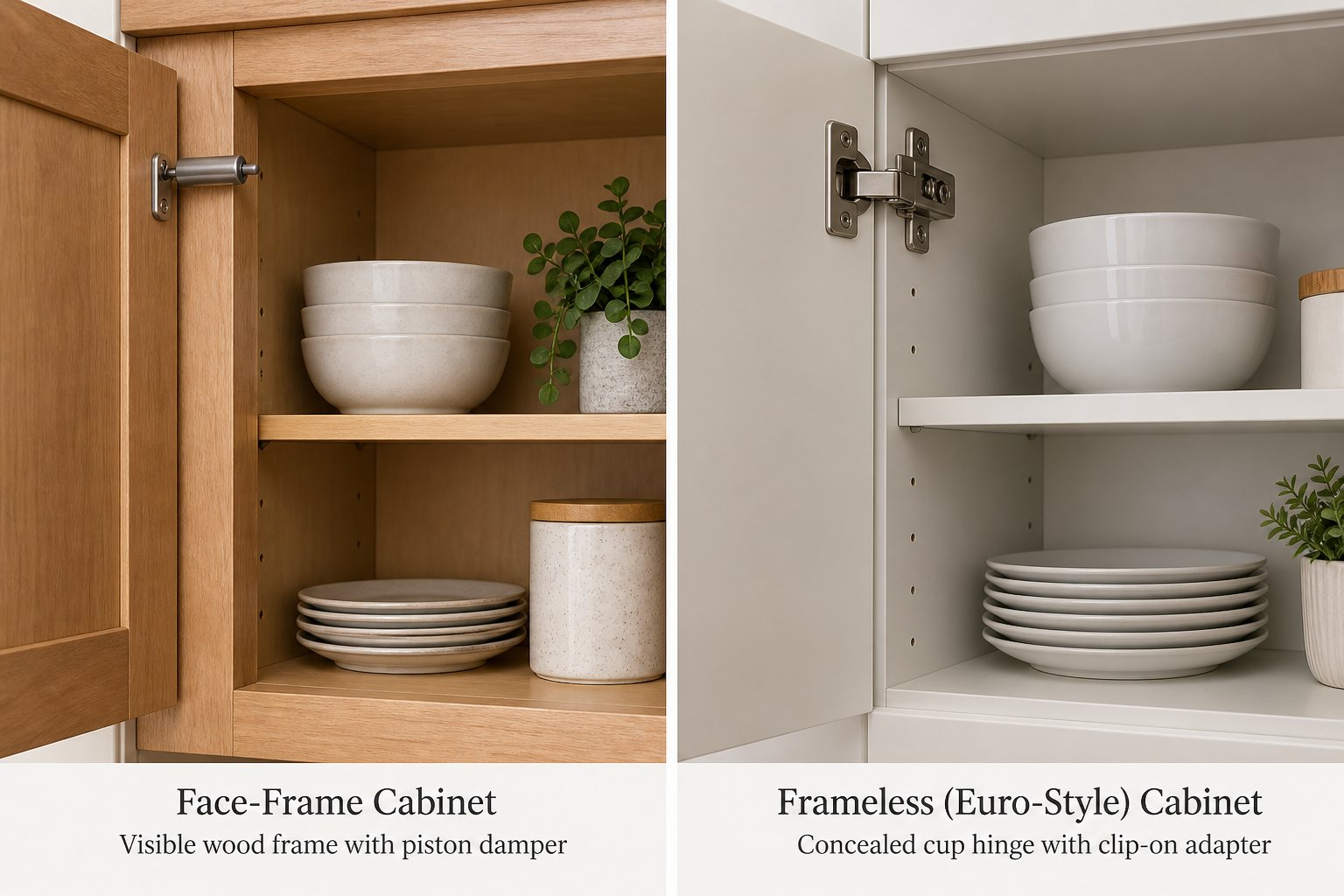
Face-frame cabinets feature a solid hardwood border — typically 1.5 inches wide — fastened to the front of the cabinet box. This frame narrows the opening slightly but creates a sturdy, exposed mounting surface. Frameless cabinets, sometimes called Euro-style or full-access cabinets, skip that front border entirely. The door mounts directly to the interior side panel, and hinges attach through a standard 35 mm cup bore drilled into the door itself. That structural difference changes everything about where and how a damper can be installed.
Damper Options for Face-Frame Cabinets
Imagine looking at the inside of a traditional North American cabinet with the door open. You will see that solid wood frame running along the front edges. That frame is your best friend when retrofitting a cabinet door soft close adapter. A compact piston-style damper screws directly into the inner edge of the frame — usually positioned in the upper corner on the hinge side — giving the plunger a clean, straight contact point as the door swings shut.
The wood frame also provides excellent screw-holding strength, which means a single pilot hole and one small screw is all you need. Placement is forgiving, too. You can mount the damper along the top rail or the side stile of the face frame depending on what works best for your door size and swing direction. This flexibility is a big reason why piston dampers remain the go-to retrofit choice for face-frame kitchens.
Damper Options for Frameless Cabinets
Frameless cabinets present a different challenge. Without a protruding front frame, there is no convenient ledge for a standalone piston damper to sit on. The cabinet's side panels are typically thin particleboard or melamine — fine for supporting a hinge, but not ideal for surface-mounting a screw-in damper near the front edge where the door needs to make contact.
This is where a soft close cabinet hinge adapter earns its place. These clip-on adapters attach directly to the arm of an existing 35 mm concealed hinge, adding a small damping cartridge without any additional drilling into the cabinet body. Because frameless systems already rely on that standardized cup-and-arm hinge design, the adapter simply piggybacks on existing hardware. The key compatibility detail is the hinge boring pattern — specifically the cup diameter and arm style. Not all adapters fit all hinge brands, so you will want to verify your hinge specs before ordering.
Alternatively, many frameless cabinet owners opt for a full integrated soft close hinge, which replaces the existing hinge entirely and uses the same 35 mm bore hole already drilled into the door. For frameless boxes, this swap is usually straightforward since the boring patterns follow European standards.
| Factor | Face-Frame Cabinets | Frameless (Euro-Style) Cabinets |
|---|---|---|
| Damper compatibility | Screw-in piston dampers, clip-on adapters, or integrated hinges | Clip-on hinge adapters or integrated soft close hinges preferred |
| Preferred damper type | Compact piston-style (most cost-effective retrofit) | Soft close cabinet door adapter that clips onto existing 35 mm hinge |
| Mounting surface | Solid hardwood face frame — strong screw hold | Thin side panel (particleboard/melamine) — limited surface-mount options |
| Installation considerations | Simple pilot hole into frame edge; forgiving placement | Must confirm hinge cup diameter and arm style for adapter fit |
| Hinge system | Hinges mount to face frame, often via adapter plate | Hinges mount directly to side panel using 35 mm cup bore |
One less common scenario worth mentioning: inset doors. These sit flush inside the cabinet opening rather than overlapping the frame. Inset configurations — found on both face-frame and frameless boxes — leave very little clearance between the door edge and the cabinet body. That tight gap can interfere with a standard piston damper's plunger. In most inset situations, a clip-on hinge adapter or an integrated soft close hinge is the safer bet, since the damping happens within the hinge mechanism itself and does not require extra clearance inside the opening.
Identifying your cabinet construction style first eliminates roughly half the products on the market in one step. Yet even after narrowing down the right damper category, another variable can make or break your results: the weight, size, and material of the doors themselves.
Why Your Cabinet Damper Must Match the Door
A damper that works perfectly on a lightweight bathroom vanity door can fail miserably on a heavy solid-oak pantry panel — and vice versa. This mismatch is one of the most common reasons homeowners end up disappointed after a retrofit. Cabinet door dampers are not one-size-fits-all, and choosing a unit with insufficient or excessive closing force leads to either persistent slamming or a door that stalls halfway and has to be pushed shut by hand.
How Door Weight Affects Damper Performance
Think of it like brakes on a vehicle. A bicycle's brakes would never stop a truck, and truck brakes on a bicycle would lock the wheels instantly. The same principle applies to cabinet dampers. A door's weight determines how much momentum the damper has to absorb in those final inches of travel, and getting this balance right is everything.
Lightweight doors — thin MDF, thermofoil-wrapped particleboard, or hollow-core panels — carry very little inertia. A single standard-force damper handles them with ease, producing a gentle, quiet close. However, there is actually a risk of over-damping with lightweight doors. As installation specialists note, a small, lightweight door equipped with too much damping force simply cannot overcome the cylinder resistance — the door stops short and has to be nudged closed manually.
Heavier doors — solid hardwood, thick MDF, or glass-paneled designs — swing with considerably more force. A standard cabinet damper may slow them down but not enough to prevent a firm thud at the end of travel. These doors need either a damper rated for higher closing force or multiple dampers working together to distribute the braking evenly. Some manufacturers publish specific weight ratings or closing-force specifications for their products, so always check the product listing before you buy. If a damper does not list any weight or force rating at all, treat that as a caution flag.
Cabinet Door Material Considerations
Weight is only half the equation. The material your doors and cabinet frame are made from also determines how well a damper stays mounted over thousands of open-close cycles. After all, a cabinet damper is only as reliable as the fasteners holding it in place.
Here are the most common cabinet door materials and what each one means for damper installation:
- Solid wood (maple, oak, cherry, birch): Excellent screw-holding strength. Pilot holes are still recommended to prevent splitting, but once installed, screws grip firmly and stay put. Solid wood doors are heavier, though — expect to evaluate whether a single damper provides enough force or if you need two.
- Plywood: The cross-laminated grain structure gives plywood the best screw-holding among engineered options. Plywood doors and frames accept screw-in dampers reliably, and the material holds up well to repeated stress at the fastener point.
- MDF (medium-density fiberboard): Adequate screw-holding when you drill proper pilot holes first. Skipping the pilot hole in MDF is a recipe for crumbling or splitting at the fastener site, especially near edges. MDF doors tend to be quite heavy relative to their size due to the material's density, so factor that into your damper strength calculation.
- Particleboard: The weakest option for screw retention. Screw threads can strip more easily over time, particularly in lower-density boards. If your cabinets are particleboard, consider adhesive-mount dampers or use specialized fasteners such as coarse-thread screws with larger shank diameters to improve holding power.
- Thermofoil or laminate over particleboard: The vinyl or laminate wrap does not add structural strength — the underlying particleboard dictates fastener performance. Same precautions apply as with bare particleboard.
Knowing your material before you order prevents the frustrating scenario of installing soft close dampers cabinet doors only to find the screws loosening within weeks because the substrate could not hold them.
Large and Heavy Doors
Standard upper cabinet doors typically weigh a few pounds and fall well within the capacity of a single damper. But kitchens and bathrooms often include oversized doors that change the math entirely — tall pantry cabinets, full-height oven surrounds, wide base-cabinet doors, or floor-to-ceiling wardrobe panels.
These large doors carry substantially more mass, and that mass is distributed over a bigger surface area. A single damper positioned near the top of a tall pantry door, for example, may slow the upper portion but allow the bottom edge to swing forward and impact the frame unevenly. The solution is straightforward: install two cabinet door dampers — one near the top and one near the bottom of the door opening. This dual-damper setup distributes deceleration across the full height of the door, producing even braking and a level close from top to bottom.
The same logic applies to unusually dense doors regardless of size. A relatively compact solid-walnut door can weigh as much as a larger particleboard panel, so weight — not just dimensions — should drive your decision. When in doubt, weigh the door with a bathroom scale before selecting your dampers. It takes thirty seconds and eliminates the guesswork that leads to returns and re-orders.
Match the damper to the door, not the cabinet. A door's weight and material determine how many dampers you need and how they should mount — get this wrong, and even premium hardware will underperform.
With door characteristics accounted for, the next logical step is weighing your upgrade options against each other — specifically, whether adding standalone dampers to your existing setup delivers better value than swapping to integrated soft close hinges entirely.
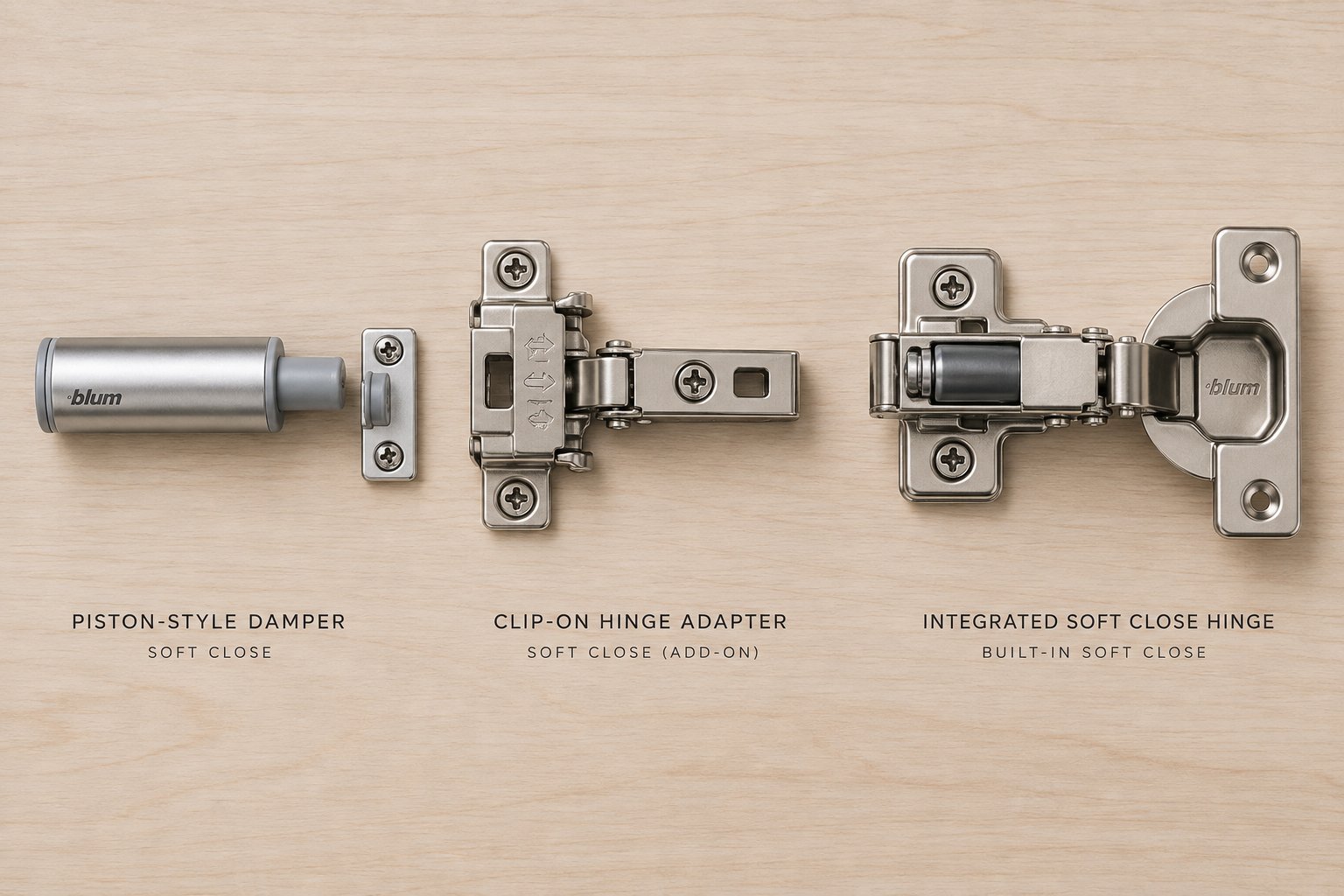
Add-On Dampers vs. Integrated Soft Close Cabinet Door Hardware
Here is where most buyers hit a wall. You know your cabinet type, your door weight, and the damper category that fits — but should you add standalone dampers to what you already have, retrofit your hinges with clip-on adapters, or rip everything out and install integrated soft close hinges from scratch? Each path delivers a quiet close, yet the cost, labor, and long-term performance differ more than most product listings let on.
Cost, Effort, and Performance Trade-Offs
The easiest way to compare your three main options is side by side. The table below breaks down add-on piston dampers, clip-on soft close hinge adapters, and full integrated soft close hinges across the dimensions that actually affect your project budget and daily satisfaction.
| Dimension | Add-On Piston Damper | Clip-On Hinge Adapter | Integrated Soft Close Hinge |
|---|---|---|---|
| Approximate cost per door | Low — typically the least expensive option | Low to moderate — adapter unit only, no hinge replacement | Higher — full hinge replacement required (two or more per door) |
| Installation time per door | 2 to 5 minutes | 5 to 10 minutes | 15 to 30 minutes (remove old hinges, mount new ones, adjust) |
| Tools required | Drill/driver, small drill bit for pilot hole (or none for adhesive mount) | None to minimal — most clip or slide onto existing hinge arm | Drill/driver, 35 mm Forstner bit (if boring new holes), screwdrivers, measuring tape |
| Aesthetic impact | Small visible cylinder inside the cabinet — subtle but not invisible | Nearly invisible — adapter hides behind the hinge arm | Cleanest look — damper is fully concealed within the hinge body |
| Adjustability | Limited — placement can be adjusted, but damping force is usually fixed | Some models offer adjustable damping speed | Best — most quality hinges offer three-dimensional door alignment plus adjustable damping engagement |
| Expected durability | Moderate — quality units last tens of thousands of cycles; budget units may leak or lose damping within a year | Moderate to high — durability tied to adapter build quality and hinge compatibility | Highest — premium integrated hinges are rated for 100,000 to 200,000 cycles with consistent damping performance |
A few things jump out from this comparison. Add-on piston dampers win on speed and budget — you can retrofit an entire kitchen in under an hour, and the per-door cost stays minimal. Clip-on soft close adapters for cabinets sit in the middle ground, offering a nearly invisible upgrade without full hinge removal. Integrated hinges cost the most and take the longest, but they deliver the tightest tolerances, the cleanest appearance, and the longest lifespan by a wide margin.
Notice the durability column especially. Premium integrated hinges from established manufacturers use engineered silicone fluids that maintain consistent viscosity across kitchen temperature swings — from cold winter mornings to heat generated during cooking. Budget add-on dampers, by contrast, sometimes rely on cheaper mineral-oil fills that stiffen in cold temperatures and thin out in heat, producing an inconsistent close that degrades noticeably over time. For manufacturers and specifiers seeking controlled soft-close motion engineered for sustained, high-cycle reliability, components like Tianyun's Home and Appliance Soft Close Dampers illustrate the kind of precision fluid-resistance design that supports quiet, dependable operation across cabinet doors, lids, and compact mechanisms in furniture and household products.
When Each Option Makes the Most Sense
Specifications aside, your real-world situation should drive the decision. Here is how to match each option to a common project scenario:
Add-on piston dampers — the budget-conscious whole-kitchen retrofit. You have 20 or more cabinet doors with perfectly functional hinges, and you want every one of them to close quietly without spending hundreds of dollars. Piston-style cabinet door soft closers screw into the face frame (or stick on with adhesive), leave your existing hardware untouched, and deliver an immediate improvement for minimal cost. This path makes the most sense when the cabinets are structurally sound but just lack that soft close feel.
Clip-on hinge adapters — the mid-range upgrade on frameless cabinets. Your Euro-style cabinets already have concealed 35 mm cup hinges in good condition, but those hinges were not built with damping. Soft close adapters for cabinets snap directly onto the hinge arm, adding the cushioned close without drilling a single new hole. It is a smart middle path: more refined than a standalone piston damper, less disruptive than tearing out every hinge.
Full integrated soft close hinges — the new-build or major-renovation play. If you are installing fresh cabinets, replacing damaged hinges anyway, or renovating the entire kitchen down to the boxes, there is little reason not to go with integrated soft close cabinet door hardware from the start. You get the best damping consistency, the widest adjustment range, and the longest service life — all in a single component. The extra per-door cost is negligible when amortized across a project that already includes demolition and reinstallation labor.
If your existing hinges are in good shape and your budget is tight, add a damper. If your hinges need replacing anyway, go integrated. Never pay twice by adding a cheap damper now and swapping hinges later.
Whichever path you choose, the quality of the individual component still matters enormously. A bargain-bin piston damper that leaks after six months wastes money regardless of how cheaply you bought it, and a poorly made hinge adapter that does not clip securely creates more frustration than it solves. The next step is learning exactly which specifications separate reliable soft close hardware for cabinets from the products that end up in a junk drawer — and how to read a product listing with enough confidence to spot the difference before you buy.
What Soft Close Damper Specifications Actually Matter
Product listings for soft close dampers can feel like alphabet soup — force ratings, activation distances, mounting types — and most descriptions skip the part where they explain what any of it means for your cabinets. The result? Buyers either grab the cheapest option and hope for the best or overthink the purchase into paralysis. Neither outcome is necessary once you know which numbers to look for and which marketing fluff to ignore.
Key Specifications to Look For
Every piece of soft close door hardware worth considering will list at least a handful of technical details. Here is what each one actually tells you:
- Closing force or weight rating: This is the single most important number on the listing. It tells you the maximum door weight the damper can decelerate to a controlled close. A damper rated for a 10-pound door will not adequately slow a 25-pound solid-oak panel. If a product does not publish any weight rating at all, that silence should raise a red flag.
- Mounting style (screw-in, adhesive, clip-on): Determines how the unit attaches to your cabinet or hinge. Screw-in models offer the most secure hold on face-frame cabinets. Adhesive options work for lightweight doors on smooth surfaces. Clip-on adapters require a compatible concealed hinge — more on that below.
- Activation distance: The length of plunger travel during which damping actually occurs, usually measured in millimeters. A longer activation distance provides a more gradual deceleration, while a shorter one delivers a quicker catch. Most soft close door dampers activate within the last 15 to 25 mm of door travel, though this varies by design.
- Adjustability options: Some dampers allow you to dial the damping speed up or down via a small screw or rotary dial. This feature is especially valuable if you have doors of varying weights across the same kitchen — one setting rarely fits every door perfectly.
- Material and build quality: Look for a metal or reinforced-polymer housing rather than thin, all-plastic construction. Internal components should include a proper silicone fluid fill — not a generic grease — and seals rated for long-term use. These details are not always listed explicitly, but reputable manufacturers typically specify the housing material and fluid type.
Evaluating Quality and Compatibility
Two soft close dampers can look almost identical on the outside and perform very differently over time. The gap between reliable soft close hardware and cheap imitations usually comes down to three internal factors most buyers never see.
First, fluid viscosity consistency across temperature ranges. A quality damper uses silicone-based fluid specifically because silicone maintains relatively stable viscosity whether your kitchen is 60 degrees in January or 85 degrees during a July cookout. Cheaper units sometimes use mineral-oil fills that thicken noticeably in cold weather and thin out in heat — meaning the closing speed changes with the seasons.
Second, durable seals that prevent leaking. The piston seal is the component most likely to fail first. When it degrades, fluid weeps past the piston, damping force drops, and eventually the unit provides almost no resistance at all. High-quality seals — often made from fluoroelastomer or silicone rubber — resist wear and temperature cycling far longer than basic rubber O-rings.
Third, corrosion-resistant housing. Kitchens and bathrooms expose hardware to humidity, cooking steam, and occasional splashes. A zinc-alloy or stainless steel body holds up where bare-steel housings develop surface rust that can eventually bind the plunger.
The practical takeaway? Lean toward soft close hardware from established cabinet hardware or component manufacturers rather than unbranded generics with no published specs. A recognizable maker stands behind published cycle-life ratings, material specifications, and warranty terms — details that anonymous sellers rarely provide.
If you are shopping for clip-on adapters specifically, compatibility verification is non-negotiable. You will need to confirm two things before purchasing: your existing hinge's cup diameter (the standard is 35 mm for most European concealed hinges) and the arm style (snap-on, screw-on, or press-in). An adapter designed for one arm profile will not clip securely onto another, and a loose adapter rattles, shifts, and eventually stops engaging the door altogether. When in doubt, remove one hinge from your cabinet, note any brand markings or model numbers stamped on the arm, and cross-reference with the adapter's compatibility list before ordering.
The most important buying rule for beginners: never purchase a soft close damper that does not publish a weight rating. If you cannot match the damper's capacity to your door's weight, you are guessing — and guessing leads to returns.
Knowing what to look for on a product page is half the battle. The other half is putting that hardware in the right spot and avoiding the handful of installation mistakes that turn even well-chosen soft close door dampers into underperformers.
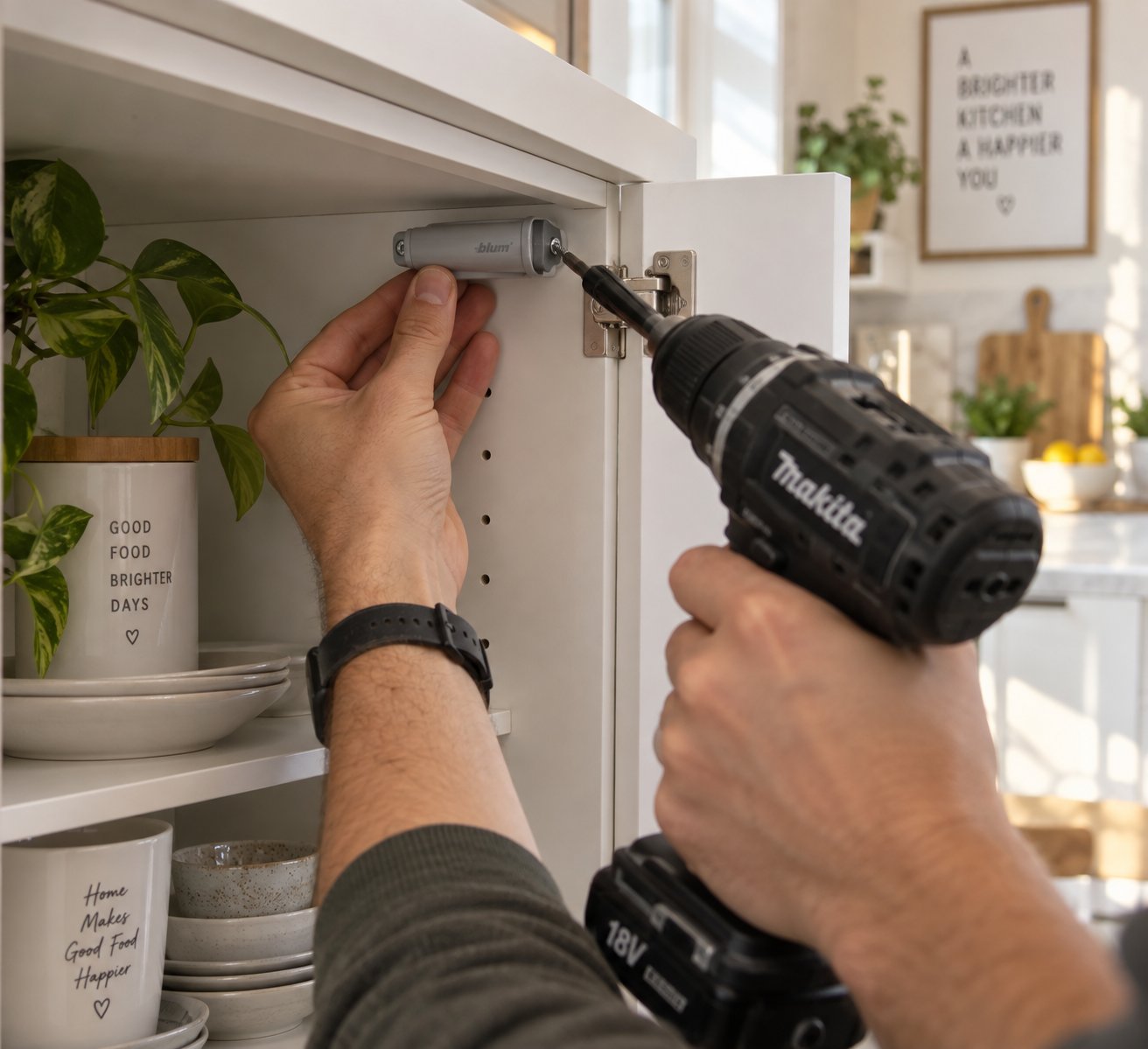
Installing a Cabinet Door Soft Close Damper
You have picked the right damper type, confirmed your cabinet construction style, and matched the unit to your door's weight. The hardware is sitting on your counter, screws included. This is the moment where everything either comes together beautifully or goes sideways — and the difference almost always comes down to where you mount the damper and how you handle the first few minutes of installation.
Whether you are a first-timer with a single screwdriver or someone who has retrofitted an entire kitchen before, the principles below apply universally to screw-in piston-style soft close adapters — the most common retrofit product on the market.
Placement Guide — Hinge Side vs. Latch Side
Imagine your cabinet door as a lever. The hinges form the pivot point on one side, and the opposite edge — the latch side — swings freely through the widest arc. Where you position your cabinet soft close adapter along that arc dramatically affects how much leverage the damper has to work with and how the close feels.
Hinge-side placement puts the damper close to the pivot point. The door edge near the hinge travels a very short distance during closing, which means the plunger engages with less linear force. This positioning works well on smaller, lighter doors where a gentle catch is all you need. It also keeps the damper tucked into the corner nearest the hinges, making it less visible when the cabinet is open. Most manufacturers — including the installation guides from major hardware retailers — recommend placing the damper in the upper corner on the hinge side as a reliable default position.
Latch-side placement positions the damper on the far edge of the cabinet opening, where the door travels the farthest and fastest. The damper intercepts more momentum here, producing a stronger braking effect. For heavier doors or situations where a single damper on the hinge side does not slow the close enough, shifting to the latch side — or adding a second unit there — can make a noticeable difference.
Vertical position matters too. Mounting near the top of the door opening is the standard approach because gravity assists the closing motion downward, and the upper corner typically stays cleanest and least obstructed by shelf contents. Placing a damper near the bottom becomes important primarily on tall doors — pantry panels, full-height oven cabinets — where a single top-mounted unit cannot control the entire door evenly.
Here is a quick-reference summary for placement by door size:
- Standard upper cabinet doors (under 24 inches tall, lightweight): One damper, upper corner on the hinge side. This handles the vast majority of kitchen and bathroom cabinet doors.
- Wide or moderately heavy doors (24 to 36 inches tall, solid wood or thick MDF): One damper on the hinge side. If the close still feels too fast, move the damper to the latch side for more leverage or add a second unit.
- Tall or heavy doors (over 36 inches, pantry or oven-height panels): Two dampers — one near the top and one near the bottom of the door opening — for balanced deceleration across the full height.
Step-by-Step Installation for Beginners
Installing a screw-in piston damper is one of the simplest cabinet upgrades you will ever tackle. The entire process takes roughly two to five minutes per door once you find your rhythm. Here is the general sequence:
1. Choose your mounting position. Hold the damper body against the inside face of the cabinet frame (or the interior side panel on frameless boxes) in the corner you selected from the placement guide above. The damper's plunger tip should extend slightly past the frame edge so that the closing door makes clean contact with it. Most soft cabinet door closers have a small flange or mounting tab with a screw hole — align that tab flat against the wood.
2. Mark the screw location. With the damper held in position, use a pencil or an awl to mark the center of the mounting hole on the cabinet frame. Precision matters here. A mark that is off by even a quarter inch can angle the plunger so it does not engage the door squarely.
3. Drill a pilot hole. Swap to a small drill bit — typically 1/16 inch or the size recommended in the damper's instructions — and drill a pilot hole at your mark. This step is not optional. As DIY installers consistently emphasize, pre-drilling prevents the cabinet frame from splitting and makes driving the screw far easier, especially in hardwood or MDF face frames.
4. Secure the damper with the mounting screw. Drive the included screw through the damper's mounting tab and into the pilot hole using a screwdriver or a drill set to low torque. Snug is the goal — do not crank the screw until the wood compresses or the tab deforms.
5. Test and adjust. Close the cabinet door at a normal pace. The door should contact the damper's plunger in the last couple of inches and glide to a quiet close. If the door stalls before fully closing, the damping force may be too strong for its weight — some dampers have a small adjustment screw at the rear of the body that lets you extend or shorten the plunger stroke to fine-tune the resistance. If the door still slams, recheck placement or consider adding a second damper.
6. Repeat across all doors. Once you have one cabinet dialed in, replicate the same placement and process on the rest. Consistency in position keeps the closing feel uniform across the entire kitchen or bathroom.
Common Mistakes That Ruin Performance
Even the best cabinet door soft close damper will underperform if the installation introduces one of these common errors. Each mistake seems small in the moment but compounds into daily frustration once you are living with the results.
- Wrong placement that reduces leverage. Mounting the damper too far from the door's contact path — or too deep inside the cabinet box where the plunger barely reaches the door — robs the unit of the mechanical advantage it needs to slow the swing. Always confirm the plunger tip extends past the frame edge enough to make solid contact with the door face.
- Skipping pilot holes and splitting the frame. This is the single most common beginner mistake. Driving a screw directly into a thin face frame or MDF edge without a pilot hole invites cracking, especially near corners where the grain is weakest. A split frame cannot hold the damper securely, and now you have both a damaged cabinet and a loose damper. Thirty seconds of pre-drilling prevents it entirely.
- Using too few dampers on heavy doors. A single standard-force damper on a tall pantry door or a dense solid-wood panel simply cannot absorb enough energy to prevent a thud. The door slows at the top where the damper is mounted but the bottom edge swings forward and impacts the frame. Two dampers — top and bottom — solve this with even braking.
- Choosing adhesive mounts on greasy kitchen surfaces. Adhesive-backed soft close cabinet adapter units are convenient on clean, smooth surfaces. But kitchen cabinets accumulate a thin film of cooking grease and moisture over time that weakens adhesive bonds. Within weeks, the damper peels off mid-use. If you want adhesive mounting in a kitchen environment, thoroughly degrease the surface with isopropyl alcohol first and apply firm pressure for at least 30 seconds. Better yet, use a screw-in model wherever the substrate allows.
- Over-tightening the mounting screw. Cranking the screw past snug does two things — it crushes the mounting tab, which can misalign the plunger angle, and it strips the screw hole in softer materials like particleboard and MDF. A stripped hole means the damper wobbles under load, and the fix usually involves filling the hole, re-drilling, and starting over. Cabinet hardware specialists warn that over-tightening is a frequent cause of misalignment and premature failure in both hinges and damper mounts alike.
Avoiding these five pitfalls does not require advanced skills — just patience and the willingness to measure twice. The payoff is a kitchen or bathroom where every door closes with the same smooth, satisfying feel, door after door, month after month.
Of course, "month after month" raises an important follow-up question: just how long can you expect these dampers to keep performing, what maintenance do they need along the way, and what does the total investment look like when you scale a project across an entire kitchen?
Lifespan, Maintenance, and Total Project Cost for Soft Close Dampers
A smooth, satisfying close on day one is great — but what about day one thousand? Cabinet soft close dampers are mechanical devices with moving parts, internal fluid, and seals that all experience wear over time. Understanding how long they realistically last, what little upkeep they require, and how the numbers add up across a full kitchen helps you plan a project that still feels like a smart investment years from now.
How Long Soft Close Dampers Last
The lifespan of a soft close damper for cabinet doors is measured in cycles, not years — because a seldom-used pantry door and a constantly opened spice cabinet age their hardware at very different rates. Quality dampers from reputable manufacturers are typically tested to endure 50,000 cycles or more under controlled conditions, with post-test verification confirming that closing time, torque, and seal integrity remain within acceptable tolerances. Premium integrated soft close hinges sometimes carry ratings of 100,000 to 200,000 cycles.
What does 50,000 cycles look like in everyday life? If you open and close a cabinet door 10 times a day — a reasonable estimate for a busy kitchen — that translates to roughly 14 years of use before the damper reaches its tested limit. Less frequently used doors, like those on upper corner cabinets or bathroom vanities, could easily stretch beyond two decades.
Degradation does not happen all at once. You will not wake up one morning to a suddenly slamming door. Instead, the close becomes slightly faster as the silicone fluid's viscosity changes with age and the internal seals experience gradual wear. This slow fade gives you plenty of warning to plan a replacement before performance drops noticeably. For manufacturers designing soft close for cupboard doors, furniture lids, and appliance panels, this predictable wear curve is exactly why engineered damper quality matters so much. Components like Tianyun's Home and Appliance Soft Close Dampers are purpose-built for sustained, high-cycle performance in furniture and household product applications — illustrating how precision engineering at the component level directly translates into the lifespan and consistency that end users experience every day.
Maintenance Tips for Maximum Lifespan
The good news? Cabinet soft close dampers are remarkably low-maintenance compared to most household hardware. There are no filters to change, no batteries to replace, and no seasonal adjustments to make. A few simple habits, however, can meaningfully extend the life of your soft closures for cabinet doors and keep them performing at their best:
- Wipe the damper body periodically: Kitchen grease, dust, and moisture film build up on every surface inside a cabinet — including the damper's plunger and housing. A quick wipe with a damp cloth every few months prevents grime from working its way past the plunger seal, which is the most common entry point for contamination. Maintenance specialists recommend avoiding harsh chemical cleaners that could degrade rubber seals or strip protective coatings.
- Check mounting screws for looseness: Repeated door impacts — even cushioned ones — can gradually vibrate mounting screws loose, especially in particleboard or MDF substrates. Give each screw a quick quarter-turn check once or twice a year. If a screw spins freely, the hole may be stripped; fill it with a wood toothpick and wood glue, let it dry, and re-drive the screw for a fresh grip.
- Watch for fluid leaks: A small oily residue around the plunger shaft or the base of the cylinder is the earliest visible sign of seal failure. Catching it early means you can replace that single damper before it stops working entirely — and before leaked fluid stains the cabinet interior. If the unit is still under warranty, a visible leak typically qualifies for replacement.
- Lubricate hinges, not the damper: Your soft close damper does not need external lubrication — the silicone fluid inside handles that. But the hinges that carry the door do benefit from a drop of silicone-based lubricant on their pivot points annually, which reduces friction and allows the damper to perform its job with less resistance working against it.
- Avoid slamming doors deliberately: It sounds obvious, but a damper engineered to catch normal closing force wears faster when subjected to repeated aggressive slams. Children (and hurried adults) are the usual culprits. The damper will handle occasional forceful closes — that is exactly what it is designed for — but making a habit of it shortens the cycle life.
Cost Analysis Across an Average Kitchen
Soft close drawers and cabinets are often framed as a luxury upgrade, but the actual math tells a more budget-friendly story than most people expect. Here is a simple framework for estimating your total project cost — no matter which damper style you choose.
Step 1: Count your doors. Walk through the kitchen and count every cabinet door you want to upgrade. A typical American kitchen has somewhere between 15 and 25 cabinet doors, though layouts vary widely.
Step 2: Multiply by per-door damper cost. Use the pricing tier that matches your chosen approach — add-on piston dampers at the low end, clip-on hinge adapters in the middle, and full integrated soft close hinges at the higher end. As a general reference, standard hinges run approximately $2 to $3 per hinge while soft close hinges range from roughly $5 to $8 per hinge, and most doors require two hinges each. Standalone piston dampers typically cost less per unit since you only need one per standard-size door.
Step 3: Factor in any extra dampers for heavy doors. Tall pantry doors, oven cabinets, or solid-wood panels that need two dampers each will bump your count up. Add those extra units to your total.
Step 4: Compare against full hinge replacement. If your existing hinges are in good condition, retrofitting with add-on dampers or clip-on adapters avoids the cost of new hinges entirely. The savings can be substantial across 20-plus doors. Full hinge replacement makes more financial sense only when you are already replacing hinges for other reasons — damage, a renovation, or a new cabinet installation — so the damping function is essentially bundled into a purchase you were already making.
For a practical example, imagine a kitchen with 20 doors. Retrofitting with low-cost piston-style soft close dampers might total less than what you would spend on a single premium faucet. Upgrading the same 20 doors with integrated soft close hinges (two per door, 40 hinges total) ranges higher but still represents a fraction of the overall cabinet budget for a kitchen renovation. Either way, spreading that cost over a decade or more of daily use — tens of thousands of quiet, controlled closes — makes the per-close investment almost negligible.
A soft close damper is one of the few home upgrades where the cost-per-use drops to virtually zero over its lifespan. Whether you spend modestly on add-on dampers or invest in integrated hinges, the daily comfort and long-term cabinet protection pay back the upfront cost many times over.
Soft close for cupboard doors, vanity cabinets, pantry panels, and even laundry room cabinetry has shifted from a luxury add-on to an expected baseline in modern homes. Armed with the mechanical knowledge, compatibility details, installation best practices, and cost perspective covered throughout this guide, you are now equipped to choose, install, and maintain the right damper for every cabinet in your home — and to enjoy that satisfying, whisper-quiet close for years to come.
Frequently Asked Questions About Soft Close Cabinet Door Dampers
1. What is the difference between a soft close damper and a soft close hinge?
A soft close damper is a standalone add-on device that mounts inside your cabinet box or onto the face frame, working alongside your existing hinges to cushion the door's closing motion. A soft close hinge, by contrast, has the damping mechanism built directly into the hinge body, meaning you replace your entire hinge to gain the quiet-close function. Dampers are ideal for budget-friendly retrofits where your current hinges are still in good condition, while integrated hinges suit new builds or situations where hinge replacement is already planned.
2. How do I know which soft close damper fits my cabinets?
Start by identifying whether your cabinets are face-frame or frameless (Euro-style). Face-frame cabinets have a solid wood border at the front and work best with screw-in piston-style dampers mounted to that frame. Frameless cabinets lack that border, so clip-on hinge adapters or integrated soft close hinges are the preferred options. Next, weigh your cabinet doors - heavier doors made from solid wood or thick MDF may need a higher-force damper or two units per door. Manufacturers like Tianyun (tianyuntech.com/home-appliance-dampers) engineer dampers with specific force ratings for different applications, so always check published weight specifications before purchasing.
3. Can I add soft close to existing cabinet doors without replacing the hinges?
Yes, and this is one of the most popular retrofit approaches. Compact piston-style dampers screw directly into the cabinet face frame or adhere to the interior panel, requiring no hinge changes at all. Clip-on adapters offer another option by snapping onto the arm of your existing concealed cup hinges. Both methods deliver a cushioned, quiet close for a fraction of the cost of full hinge replacement, and installation typically takes just two to five minutes per door.
4. How long do soft close cabinet door dampers typically last?
Quality soft close dampers from reputable manufacturers are generally tested to withstand 50,000 or more opening-and-closing cycles, while premium integrated soft close hinges can be rated for 100,000 to 200,000 cycles. At an average of 10 uses per day, a 50,000-cycle damper translates to roughly 14 years of reliable service. Degradation is gradual rather than sudden - the closing speed increases slightly over time as internal seals wear - giving you ample notice to plan a replacement before performance becomes noticeably compromised.
5. Where should I mount a soft close damper on the cabinet for best performance?
For standard lightweight upper cabinet doors, mount one damper in the upper corner on the hinge side of the cabinet opening. This position keeps the unit discreet and provides adequate deceleration for most doors. For heavier or wider doors, moving the damper to the latch side increases leverage and braking force. Tall doors such as pantry or oven-height panels benefit from two dampers - one near the top and one near the bottom - to distribute deceleration evenly and prevent the door from contacting the frame unevenly.
Apply This Insight to Your Project
Tell us what you are building and how the topic “Soft Close Cabinet Door Damper: What Nobody Tells You Before You Buy” relates to your application. Our engineering team can help evaluate the next step.