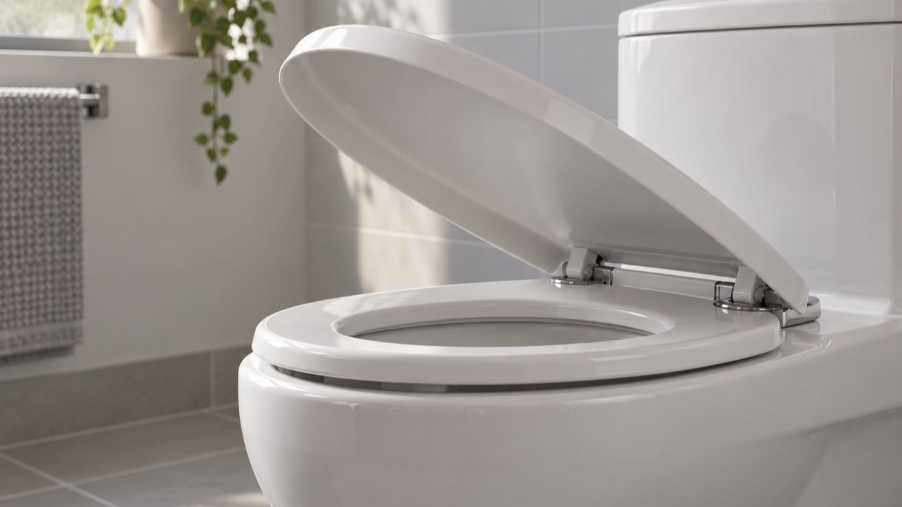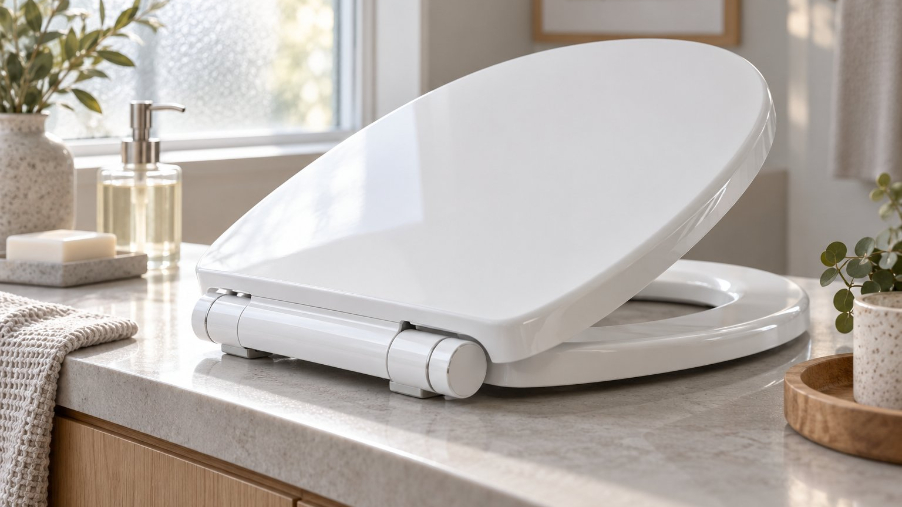
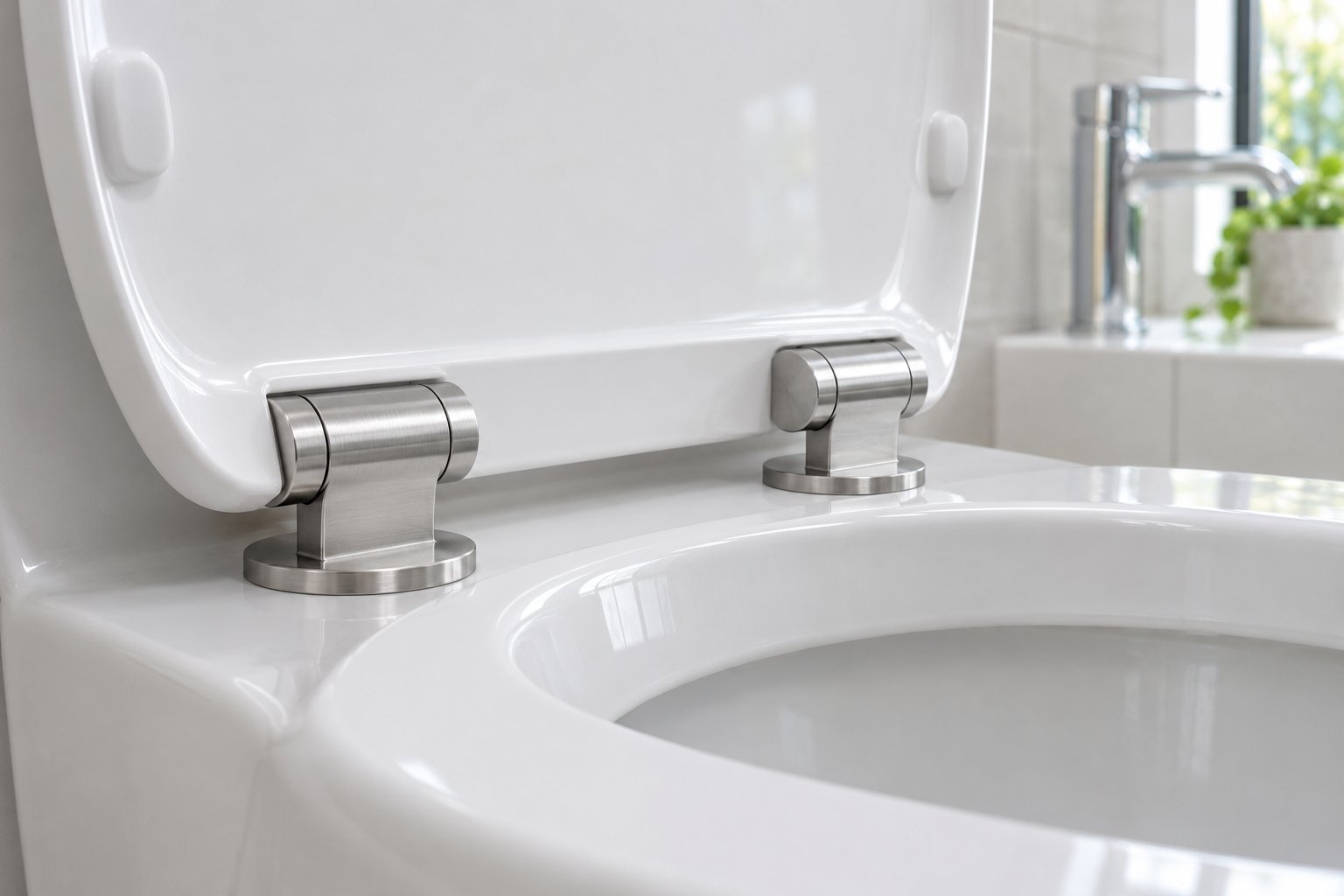
What a Toilet Seat with Metal Hinges Actually Is
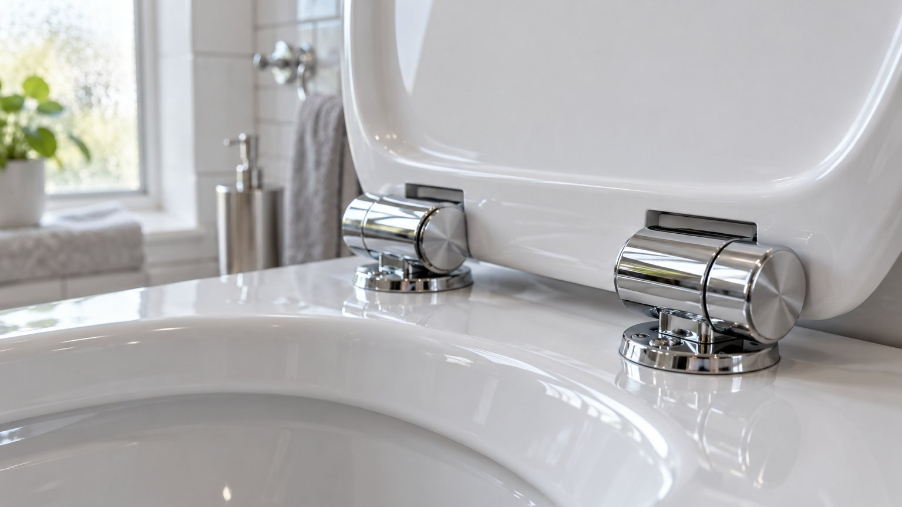
A toilet seat with metal hinges is a seat and lid assembly whose pivot hardware and mounting posts are made of metal, such as stainless steel, plated brass, or plated zinc alloy, instead of plastic. The hinges connect the seat and lid to the bowl and carry the load each time the seat is used.
When you shop for a new seat, you'll see "metal hinge" in product titles at every price point. It sounds like a clear upgrade. In practice, the phrase can describe very different hardware.
What Counts as a Metal Hinge Toilet Seat
Listings use "metal hinge" loosely. On some seats, the whole assembly is metal, from the visible post down to the bolt and nut under the bowl. On others, only the visible hinge post is metal, and the bolts, nuts, or anchors underneath are plastic. Both versions can carry the same label.
Before you buy, check which parts the spec sheet actually calls metal. Look for separate mentions of the hinge post, the mounting bolts, and the nuts or anchors. If a listing says "metal hinge" and gives no more detail, assume the hidden fixings could be plastic until the manufacturer says otherwise.
Why Toilet Seat Hinges Decide How a Seat Ages
Picture a busy morning. The hinge takes the strain each time someone sits down, shifts their weight, or lifts the seat and lets it drop. The hinge is also the only part holding the seat in place on the bowl.
That is why wobble, sideways shifting, and broken lids usually start at the hinge and not in the seat itself. Victorian Plumbing's guide to tightening a loose toilet seat says that in most cases, the bolts under the hinge covers have worked loose through everyday use. The same guide notes that plastic bolts can deform or snap and metal bolts can corrode. Each material fails in its own way.
If you search for toilet seats with metal hinges, the three top-ranking results are all shopping pages: a Home Depot product page, a topseat collection page, and an Amazon search page. Those pages help you buy a particular model. This guide shows you how to judge the hinge itself, and that means looking at what each part of it does.
Anatomy of a Toilet Seat Hinge Part by Part
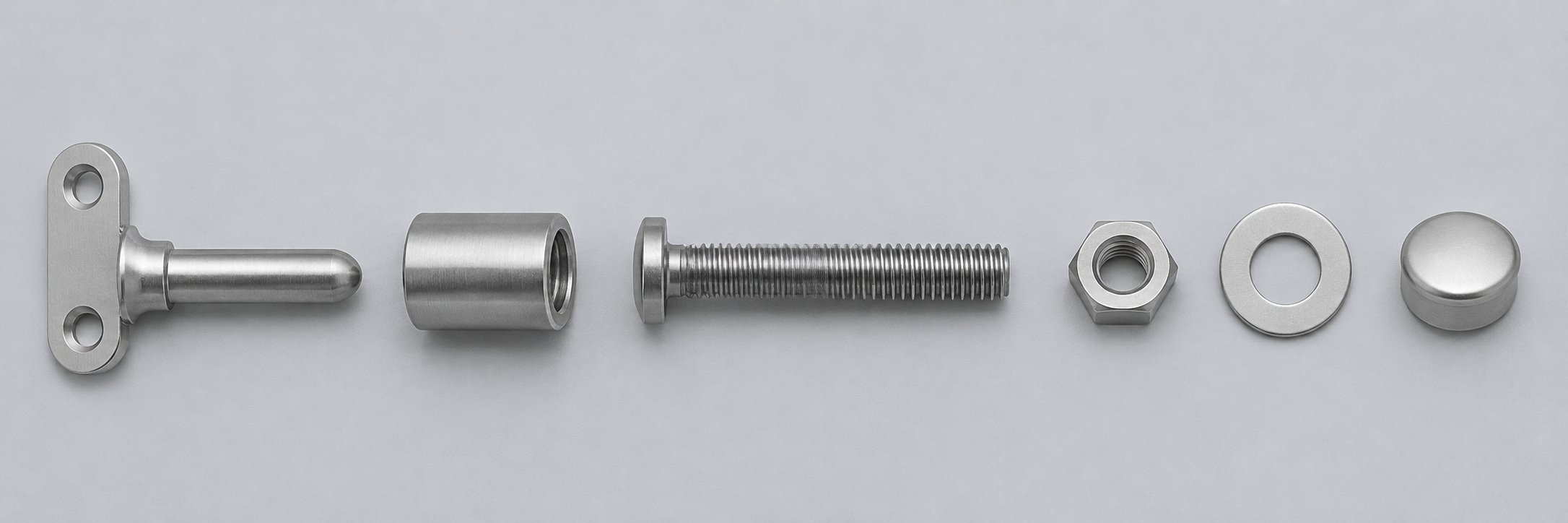
When a seat starts to shift, most people tighten whatever they can reach and hope that fixes it. You'll get further if you know which piece is actually doing the work. A toilet seat hinge is a small stack of parts, and only some of them carry weight.
The Load-Bearing Parts of a Toilet Seat Hinge
- Hinge post or block: The upright piece at the back of the seat that sits on the bowl rim. It takes the downward and sideways force when someone sits down or shifts.
- Pivot pin or barrel: The pin turns inside a barrel so the seat and lid can rotate. On soft-close designs, the barrel also holds the damper.
- Mounting bolt: The threaded rod that runs through the post and the bolt hole in the bowl. It clamps the hinge to the porcelain.
- Anchor or nut: The part that grips the bolt, either under the rim or inside the hole. If it loosens, the whole hinge loosens with it.
Parts That Loosen and Parts That Are Mostly Cosmetic
Washers and spacers sit between the post and the rim. They spread the clamping force and level the post, but they can compress over time and leave slack in the joint. Top-fixing brackets and expanding anchors hold the hinge from above, and they often cause wobble once they lose their grip in the hole. Cover caps and decorative shrouds hide the bolt heads. A toilet seat parts guide notes that bolt caps serve no structural purpose, though they keep dust and moisture off the bolt heads.
| Part | What It Does | Carries Load | Common Failure | What to Inspect |
|---|---|---|---|---|
| Hinge post or block | Supports the seat at the rim | Yes | Cracks, flexing, worn plating | Hairline cracks and finish wear at the base |
| Pivot pin or barrel | Lets the seat and lid rotate | Yes | Wear that causes play, damper failure | Side-to-side play when the seat is raised |
| Mounting bolt | Clamps the hinge to the bowl | Yes | Stripped threads, corrosion, deformation | Thread condition and rust at the bolt head |
| Anchor or nut | Grips the bolt below or inside the hole | Yes | Loosens with vibration, seizes from corrosion | Tightness and material (plastic or metal) |
| Top-fixing bracket and expanding anchor | Secures the hinge from above | Yes | Loses grip or spins in the hole | Whether the anchor stays firm when tightened |
| Washers and spacers | Spread clamping force, level the post | No | Compress, split, or go missing | Flattening or gaps under the post |
| Cover caps and shrouds | Hide bolt heads, finish the look | No | Crack, discolor, or pop off | The bolt head underneath for rust |
Top Fixing Versus Bottom Fixing
Toilet seat brackets attach to the bowl in one of two ways. With bottom fixing, the bolts go in from the top and you tighten them from under the bowl rim with a nut, often a wing nut. With top fixing, everything tightens from above, and the screw expands an anchor inside the bolt hole. Drench's toilet seat fixing guide says top fixing suits wall-hung and back-to-wall pans, where the underside is hard to reach. To check your toilet, reach under the pan near the hinge holes. If you can feel a bolt and nut, it's bottom fix.
On many designs, the toilet lid hinge and the seat hinge share one pivot on each post. Other designs give the lid and seat separate pivots. Exact parts differ by brand, so check the manufacturer's exploded diagram or installation guide before you order anything. Any load-bearing part in the table can be made of metal or plastic, and the material changes how that part holds up over the years.
Metal vs Plastic Hinges and When the Upgrade Pays Off
Is a metal hinge worth the extra money? The shopping pages rarely answer that. They list "metal hinge" as a feature and leave it there. The real answer depends on how often the bathroom gets used, who uses it, and how you clean it. The table below compares the two materials on the points that matter most over the life of a seat.
| Factor | Metal Hinges | Plastic Hinges |
|---|---|---|
| Durability | High, especially when the bolts and nuts are metal too | Moderate. Parts can deform, crack, or snap under repeated strain |
| Wobble resistance | Good. Stiff posts and threads hold their clamping force | Fair. Posts can flex and nuts can compress over time |
| Appearance | Upscale look that can match other fixtures, if the finish is good | Plain, usually color-matched to the seat |
| Corrosion behavior | Can rust, pit, or discolor, mostly where plating is thin or damaged | Cannot rust or pit, but may stain or yellow |
| Cleaning tolerance | Depends on the finish. Harsh products can attack plating | Will not corrode, though strong chemicals can dull the surface |
| Relative cost | Higher | Lower |
Where Metal Hinges for Toilet Seats Outperform Plastic
Picture a family bathroom on a school morning. Every time someone drops onto the seat or leans to one side, the hinge takes that force. Metal toilet seat hinges flex less than plastic ones, so less movement reaches the bolt and anchor. Metal threads also resist stripping. When you retighten a metal fixing, it holds that tension instead of slowly giving way. Under heavy use, the result is a stiffer joint that stays put longer.
Looks count too. One seat maker's materials guide says metal hinges "upgrade the feel" of a bathroom's decor. That makes sense when the hinge sits beside a chrome faucet or a nickel towel bar.
Where Plastic Hinges Still Make Sense
Plastic has real strengths. It cannot rust or pit, it often costs less, and it holds up fine in a guest bathroom that gets used a few times a week. Many plastic hinge designs also let you lift the seat off easily for cleaning.
A cheap metal hinge can also turn out worse than a good plastic one. Once thin plating chips or wears through, the metal underneath can discolor or corrode. You'll notice it right at the back of the seat, where everyone can see it.
When a Heavy Duty Toilet Seat with Metal Hinges Is Worth the Extra Cost
- High-traffic family bathrooms: Constant use gives the fixings more chances to work loose, and stiff metal parts resist that.
- Users who need steady support: People who lean on the seat when sitting or standing benefit from a hinge that doesn't shift sideways. A hinge is not a grab bar, though, so add proper support where it's needed.
- Households that clean often with strong products: Metal fixings stand up to repeated removal and retightening. The finish still matters. Choose solid stainless steel or good-quality plating, and check the care instructions, because some seat makers recommend mild soap only.
- Bathrooms where finish matching matters: Toilet seat metal hinges come in finishes that can match faucets, flush levers, and towel bars.
Material is only half the decision. The mechanism built into the hinge decides how the seat behaves every time you lift it or let it close.
The hinge metal, its finish, and the fixing design together decide how long a seat lasts, so the word "metal" alone does not guarantee quality.
Types of Toilet Seat Hinges and the Features Built Into Them
Have you ever let go of a seat and winced at the bang? Whether that happens depends on what sits inside the hinge. Shopping pages often show "soft close" or "quick release" as a badge or an image caption and never explain the parts behind them. The types of toilet seat hinges below range from the simplest pivot to designs that pack several features into one assembly.
Standard Fixed Hinges
A standard fixed hinge is a plain pivot. The pin turns in the barrel with nothing to slow it, so the seat and lid fall as fast as gravity takes them. It has few parts to wear out, which makes it the simplest and usually the cheapest design. The downside is noise and impact. A lid dropped from fully open lands hard on the seat and the bowl, and repeated drops can crack a wooden seat.
Soft Close and Slow Close Toilet Seat Hinge Mechanisms
A soft close toilet seat hinge adds a damper inside the hinge barrel. The damper resists the seat's rotation, so the seat and lid lower slowly once you let go. Bathroom Parts Australia describes these dampers as plastic or rubber drum-type parts that create drag. Listings use "soft close" and "slow close" for the same thing.
Damper strength is a design setting, chosen to suit a particular seat and lid. If the damper is too weak for a heavy lid, the lid can still drop faster than you expect. If it is too strong for a light lid, the lid may stop before it closes. The same supplier notes that most slow close toilet seat hinges cannot be adjusted, so the match has to be right when you buy. Dampers also wear out. That supplier puts the average life of soft close hinges at about 40,000 to 55,000 open and close actions before they need replacing.
Quick Release and Toilet Seat Latch Designs
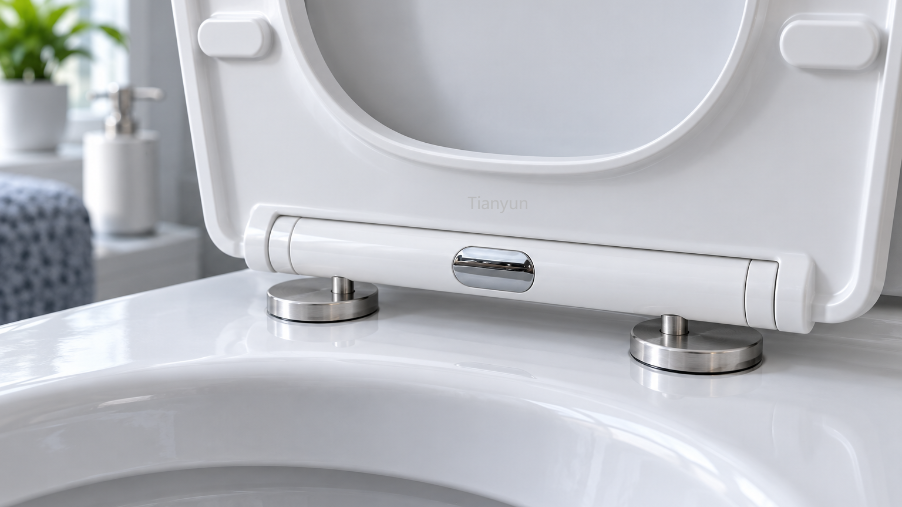
Quick-release hinges let the seat lift off its posts so you can clean the gap around the hinge. Many designs use push buttons on the hinge, and others use a latch or clip. Some listings also say "magnetic quick release." For example, topseat describes its Magic Hinge as a magnetic system with stainless steel docking hardware that releases without tools or buttons. A label like this tells you that a release exists. It does not tell you how the release behaves day to day. Read the installation guide to see how the seat comes off, how it goes back on, and how it locks into place.
Adjustable Hinge Toilet Seat Options
Adjustable hinges let you move the posts or fixings so the seat lines up with the bowl. Some use slotted bases or sliding posts. Others use top fixings that can shift position before you tighten them. This helps when the bolt holes sit slightly off from where the seat expects them, or when the seat hangs over one side of the rim. The manufacturer sets the adjustment range, so compare it with your bowl before you buy.
| Hinge Type | What It Does | What to Check Before Buying | Possible Drawbacks |
|---|---|---|---|
| Standard fixed | Plain pivot with no damping | Hinge and fixing materials | Slamming, noise, impact on the seat and bowl |
| Soft close or slow close | A damper lowers the seat and lid slowly | Whether both seat and lid are damped, and whether replacement dampers are sold | Dampers wear, may not suit the lid's weight, and are usually not adjustable |
| Quick release (button or latch) | Seat lifts off its posts for cleaning | How release and re-seating work in the installation guide | Small buttons or clips can be awkward to use or wear over time |
| Magnetic quick release | Seat lifts off and docks back with magnets | How the seat locates on its base and stays in place | The mechanism differs by brand, so check parts availability |
| Adjustable | Posts or fixings shift to align the seat with the bowl | Adjustment range compared with your bowl's bolt holes | Extra joints can loosen if they are not fully tightened |
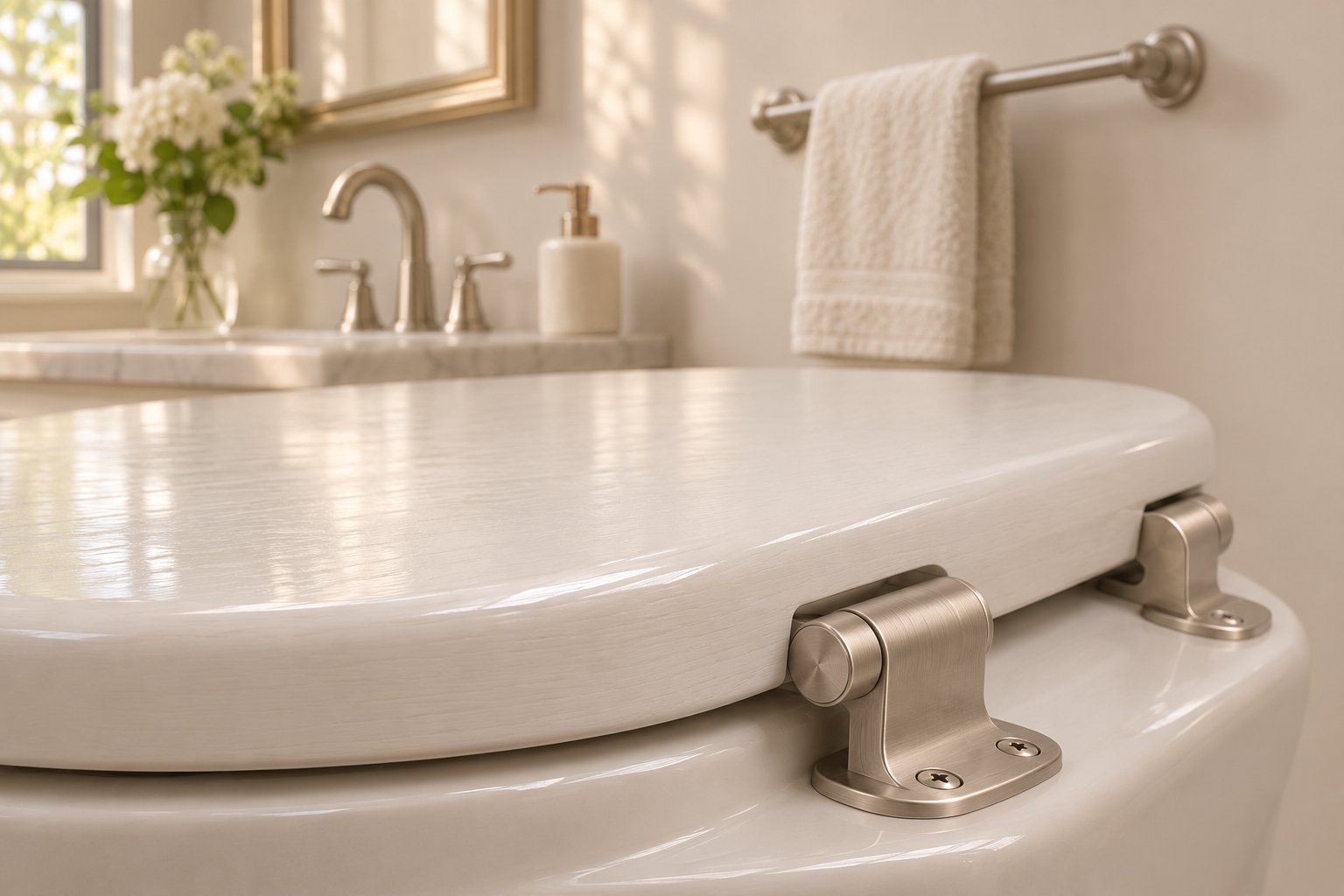
Many seats combine these features. A single metal hinge can include soft close, quick release, and adjustable fixings, and the magnetic design mentioned above includes soft close as standard. Each added feature is one more part to check on the spec sheet. Every one of these mechanisms also sits inside a metal housing, and that metal and its finish decide how well the hinge holds up in a damp bathroom.
Hinge Metals, Finishes, and Seat Materials That Work Together
Two hinges can look the same in a product photo and still age very differently. What matters is the metal under the shine and the seat the hinge is bolted to.
Stainless Steel Toilet Seat Hinges Versus Plated Brass and Zinc
On a solid stainless steel hinge, the finish and the material are the same thing. Stainless steel has chromium all the way through, so a scratch uncovers more of the same metal and not something weaker. One hinge maker's material comparison says good stainless steel toilet seat hinges usually use Grade 304, which is about 18% chromium and 8% nickel. The same source says Grade 316 adds molybdenum, which makes it the better pick near the coast or wherever chloride exposure is high.
Plated parts work differently. A chrome plated brass replacement toilet seat hinge has a brass body covered by a thin layer of chrome. Many budget chrome hinges are plated over zinc alloy or steel instead. Plating protects the metal underneath only while it stays intact. Once it chips or wears away at a friction point, such as the pivot, moisture can reach the base metal. Most listings don't give plating thickness, so look for the alloy or stainless grade on the spec sheet. If the spec sheet names neither, ask the seller before you buy.
Watch the wording in search results, too. A stainless steel toilet seat usually means a seat made entirely of metal, the kind you find in correctional facilities and some public restrooms. It is a different product from a wood or plastic seat with stainless hinges.
Matching Hinge Finish to Bathroom Fixtures
Look at your faucet, flush lever, and towel bars before you pick a finish. Polished chrome is bright and reflective like a mirror. Brushed nickel is softer and often slightly warmer. Brushed stainless has a matte silver grain. The same comparison guide says a brushed stainless hinge goes well with both chrome and satin nickel faucets. It also points out that hinges are small and partly hidden by the seat, so a close match is usually enough.
Finish names are not an industry standard. Two brands can both say "brushed nickel" and still differ in color and grain, because each uses its own plating and brushing process. If an exact match matters to you, compare photos taken in daylight and check the return policy before you install.
How Seat Materials Pair with Metal Hinges
The seat material affects how well the hinge works. A heavy lid needs a damper strong enough to control it. Screws also hold differently in wood than in plastic.
| Seat Material | Weight | Moisture Behavior | How the Hinge Attaches | What to Look for in Listings |
|---|---|---|---|---|
| Enameled wood | Heavy | The enamel coating seals the wood. Chips can let water in and swell the core | Usually screwed into the underside of the seat and lid | Whether the damper suits a heavy lid, and what the hinge screws are made of |
| Oak veneer | Medium to heavy | A thin layer of real wood over a core. Worn finish can stain or lift | Screws pass through the veneer into the core | The core material and the type of sealant |
| Bamboo | Medium | Dense, but still depends on its sealed finish | Screwed directly into the bamboo | A sealed finish, and a hinge finish that suits the warm wood tone |
| Plastic | Light | Does not absorb water, but can scratch or stain | Screws or clips into molded mounting points | Whether the metal hinge is a separate part, and whether the damper suits a light lid |
To see this in a real listing, look at the Bemis Weston, which pairs an enameled wood seat with a brushed nickel metal hinge. Bemis's mixed metals page sells the Weston in chrome, brushed nickel, and matte black, and calls the hinges "non-tarnish." From that you learn the seat material and the finish name. You don't learn the base metal under the finish or what the fixings are made of. "Non-tarnish" is a claim, and claims like it need checking before you rely on them.
Reading Listing Claims About Hinges for Toilet Seats
On most product pages, the hinge gets a few words in the title and maybe a badge on the photo. Those words are a place to start. They rarely tell the whole story. The table below lists common terms used for hinges for toilet seats, what each one tells you, and what you still need to find out.
| Listing Term | What It Tells You | What It Leaves Out | What to Check in the Spec Sheet |
|---|---|---|---|
| "Metal hinge" | At least one visible hinge part is metal | Which parts are metal, and which metal they are | The material of the post, the bolt, and the nut or anchor |
| "Brushed nickel" | The color and texture of the finish | The base metal underneath, the plating quality, and the exact shade | The base alloy or stainless grade, plus the care instructions |
| "Soft close" | A damper slows the closing motion | Whether the seat and the lid are both damped, and whether you can buy replacement dampers | Which parts close slowly and whether replacement hinges are sold |
| "Quick release" | The seat comes off its posts | How the release works and how the seat locks back on | The release and re-seating steps in the installation guide |
| "Never loosens" | The brand claims its fastening resists loosening | How it works, and whether the warranty covers it | The fixing type, the fastener material, the installation steps, and the warranty terms |
| "Magic Hinge" | A topseat trademark for its magnetic quick-release system | It names a release feature, not a fastening method | The separately named fastening system and whether spare parts are available |
Why a Toilet Seat with Hinges Works Loose
Imagine someone sitting down a little off center. The seat is pushed sideways, and that force pulls at the bolt. Several causes usually add up:
- Side-to-side loads: Shifting weight twists the hinge post against the rim and works the fixing back and forth.
- Plastic nuts or anchors that compress or creep: Plastic held under constant clamping force slowly deforms, so a tight joint gradually loses tension.
- Vibration: Every time the seat and lid open and close, small movements travel down to the threads.
- Fixings never tightened fully: If the fixings were left loose at installation, the joint has slack from day one.
How to Evaluate "Never Loosens" and Similar Claims
Take the Bemis Weston 1526NISLP 000 as an example. Its listing carries the label "Never Loosens," which Bemis ties to its Stay-Tite fastening system. The brand's Stay-Tite feature page lists hundreds of products under that one feature, including both plastic and enameled wood seats. So the label describes a fastening family used across many seats, and it says little about the particular seat in front of you.
topseat uses a different naming scheme. Magic Hinge is a registered U.S. trademark for the brand's magnetic quick-release system. The anti-loosening claim belongs to a separate system, which the brand calls Arch-Tite. If you read only one of those names, you could easily confuse the release feature with the fastening feature.
Anti-loosening designs across the market tend to use a few general approaches:
- Locking anchors that resist turning once they are set.
- Secondary tightening mechanisms that help keep the main fixing in place.
- Metal-to-metal threads, which don't creep the way plastic does.
This guide does not describe how any proprietary system works. To learn the actual mechanism, read each brand's installation guide, which shows the parts and the steps. Also check the warranty. Find out whether it covers loosening and whether it requires you to install the seat exactly as instructed.
Using Reviews and Spec Sheets Together
Thousands of reviews with a high average rating look reassuring. However, one review page often covers a whole product family, so it mixes shapes, finishes, and sometimes older hinge versions. If a seat has many reviews but few of them mention the hinge, those reviews tell you little about the hinge. Cross-check them like this:
- Read the spec sheet first and note what it says about the hinge material, the fixings, and the fixing type.
- Search or filter the reviews for words like "hinge," "loose," "wobble," and "rust."
- Check the review dates. A seat that feels solid in its first week can loosen months later, so later reviews and follow-up updates are more useful.
- Confirm that each review refers to the variant you plan to buy, with the same shape and finish.
- If reviewers complain about a part that the spec sheet calls metal, or praise a feature it never mentions, ask the seller about it before you buy.
A claim is only as specific as the spec sheet behind it.
Every one of these claims also assumes the seat fits the bowl it sits on. Listings explain shape and measurements even less than they explain hinges.
Shape and Fit Checks Before You Buy
Have you ever ordered a seat that looked right online, only to find it hanging past the front of the bowl? Most fit problems come from guessing the shape or misreading a number on the listing. A few minutes with a tape measure prevents both.
How to Tell a Round Bowl from an Elongated Bowl
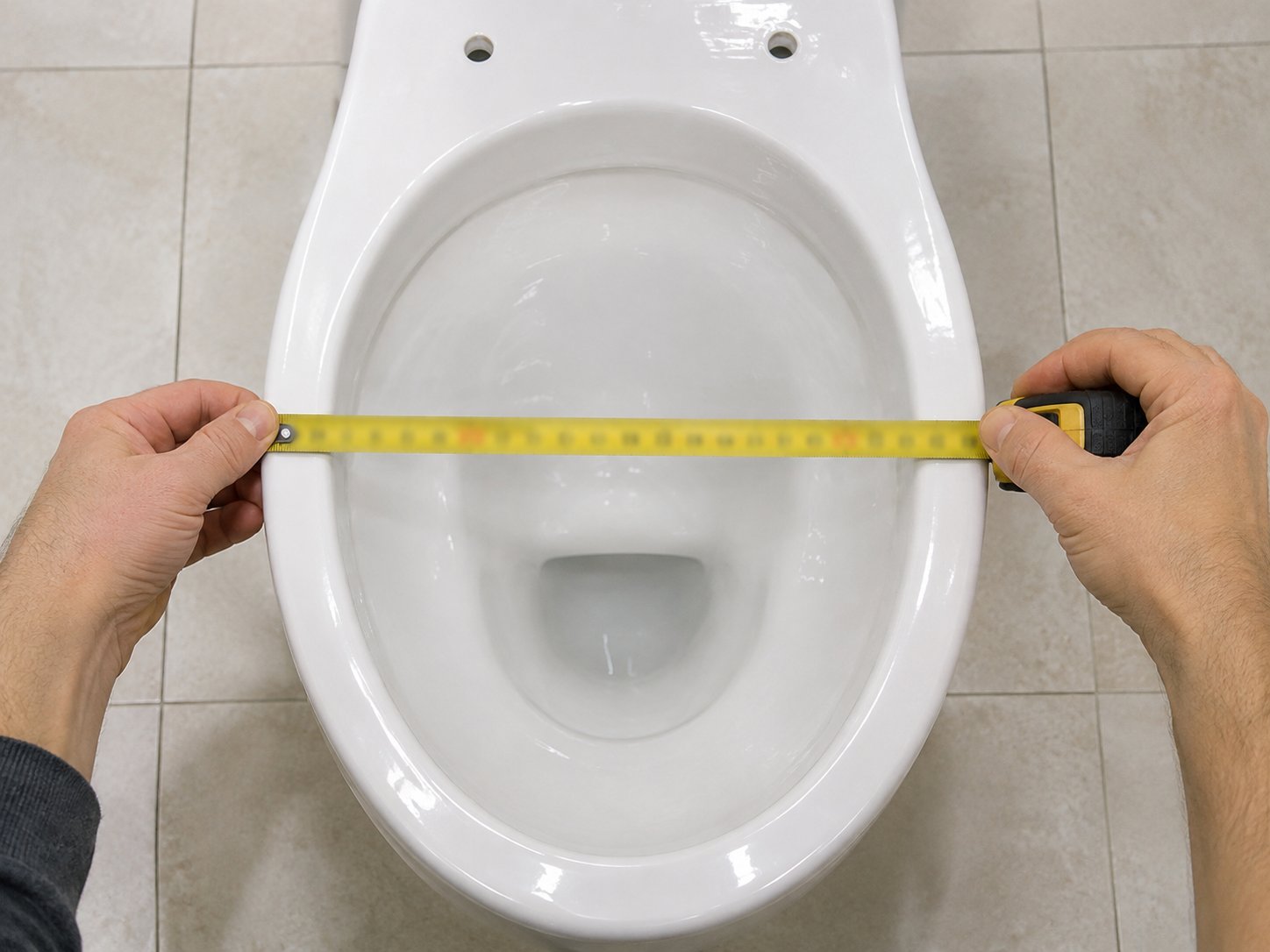
Measure the bowl, not your old seat. Lift the seat and lid and find the two bolt holes at the back. Measure from the center point between them straight to the front outer edge of the rim. Then measure the rim width at its widest point, from outer edge to outer edge.
Lowe's measuring guide gives the typical figures. Round bowls run about 16.5 inches long and elongated bowls about 18.5 inches. Most standard bowls are around 14 to 14.5 inches wide, and the standard bolt-hole spacing is 5.5 inches. If your numbers are well off from these, you may have a specialty toilet. In that case, the bowl maker's specifications are the safer guide.
Check the shape on each product page as well, because category pages can mix shapes. topseat's elongated collection, for example, appears to include some round-seat SKUs. Before you add a seat to your cart, confirm the shape listed for that exact SKU.
Using a Spec Table to Check Fit and Clearance
A retailer spec table gives you numbers to compare with your own measurements. The Home Depot listing for the Bemis Weston 1526NISLP 000 works well as an example. One shopper in its Q&A asked whether "diameter" means length, which shows how easily these labels confuse people.
| Dimension | Listed Value | How to Use It |
|---|---|---|
| Depth | 18.44 in | Compare it with your bowl length. Check clearance to the tank at the back and to the front edge of the rim. |
| Width | 14.19 in | Compare it with your rim width. Check the space to any nearby walls, cabinets, or vanities. |
| Height | 2.25 in | This is the thickness of the closed seat and lid. Check the clearance under the tank or any wall-hung cistern that overhangs the back of the rim. |
The listing doesn't say where each dimension was measured, such as whether the depth includes the hinge posts. Treat the figures as a close guide, not an exact match. The same listing also mentions "precision seat fit" adjustability, which helps when the seat needs to shift slightly to line up with the rim.
Checking Toilet Bowl Hinges Clearance for an Elongated Toilet Seat with Metal Hinges
Metal hinge posts come in many shapes and sizes, so check the back of the bowl as carefully as the front.
- Bolt-hole spacing: Measure center to center. The standard is 5.5 inches, but confirm that your spacing falls within the hinge's listed spacing or adjustment range.
- Hinge post footprint: Each post base should sit flat on the rim around the bolt hole. If that area is narrow or sloped, a wide post can rock or hang over the edge.
- Opening past vertical: When raised, the seat and lid should tip slightly past upright and rest there without hitting the tank, cistern, or flush buttons. If the tank stops them before they pass vertical, the seat can fall forward when someone lets go.
- Fixed or adjustable post position: If the holes sit off center, or the seat has to move forward or back to clear the tank, choose an adjustable hinge toilet seat. Check its adjustment range against your measurements.
A seat that fits perfectly on day one still has to get through years of damp air, spray bottles, and wet cleaning cloths. Over that time, the hinge finish matters more than any measurement.
Cleaning and Care to Prevent Pitting and Discoloration
When you spray cleaner into the bowl, where does the overspray end up? A lot of it lands on the toilet seat hinges, and it often stays there. Your cleaning habits will decide how well the finish holds up over the years.
How Cleaning Chemicals Affect Stainless Toilet Seat Hinges and Plated Finishes
Chlorine bleach, acidic descalers, and abrasive pads cause most finish damage. Hamberger Sanitary's care recommendations warn that abrasive, chlorinated, or acidic products can discolor a seat and cause rust on the hinges. The same guide says that even a vinegar-based cleaner should be rinsed off and dried, because the acid it leaves behind can lead to rust.
Plated and solid parts react differently. On a chrome plated hinge, an abrasive pad can scratch through the thin outer layer, and chemicals can attack any weak spot. Once the base metal is exposed, pitting and rust spots follow. Stainless toilet seat hinges have no coating to wear through, so a scratch doesn't uncover a weaker metal. Stainless steel can still stain or pit if bleach or acid residue sits on it, though. It resists corrosion well, but no metal is immune.
Humidity and Trapped Moisture Around the Hinge Seat
Water collects where you can't see it. Cover caps hold drips over the bolt heads, and the joint where the post meets the rim stays damp long after the rest of the seat has dried. That trapped moisture speeds up corrosion. Run the exhaust fan after showers and dry the hinge area after cleaning. An Essentials Fix hinge guide notes that keeping the area dry can slow pitting once it has started on a chrome hinge.
A Simple Maintenance Routine for Metal Toilet Seats
- Wipe with a mild cleaner and rinse. Use neutral soap or a window or alcohol-based cleaner on a soft cloth, then wipe again with clean water.
- Dry the hinge area. Go around the posts, the cover caps, and the gap at the rim.
- Keep harsh products off the metal. Raise the seat and lid while bowl cleaner sits in the bowl, and wipe splashes off right away.
- Use quick release to clean under the posts, if your seat has it. Follow the brand's method. Hamberger, for example, says to bring the seat and lid upright and lift them straight up and evenly.
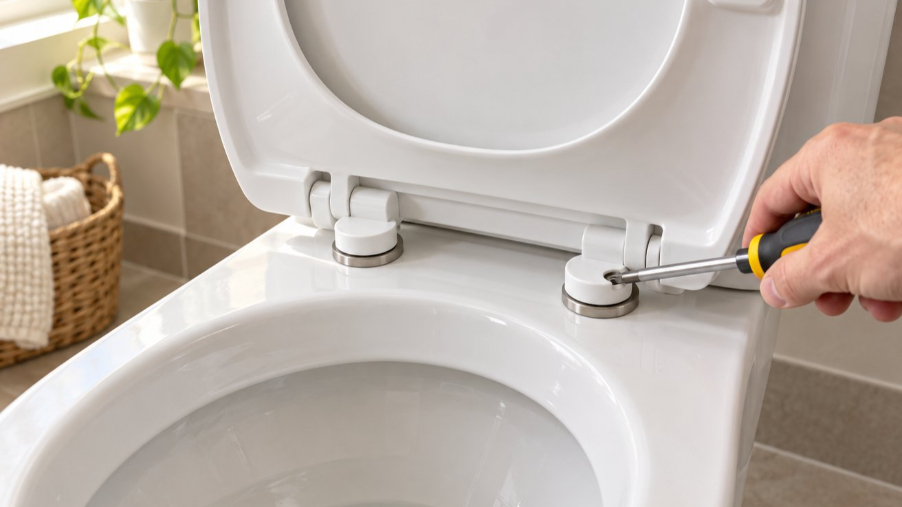
- Check the fixings now and then. Retighten them following the manufacturer's guide, and don't overtighten.
- Replace corroded fixings before they seize. A rusted bolt is much harder to remove later.
Replace the hardware if you see any of these warning signs:
- Pitting that has gone through the finish
- Rust staining on the posts or the rim
- A damper that no longer slows the seat or lid
- A post that still wobbles after you retighten it
Follow each manufacturer's care instructions, and read the warranty terms on cleaning. Globe Union's care policy states that damage caused by cleaning chemicals or improper cleaning methods voids its warranty, and other brands may set similar terms.
A worn damper or a pitted post doesn't always mean you need a whole new seat. Often the seat and lid have years left, and only the seat hinges have worn out.
Hinge Replacement and Soft Close Repair Options
If the seat still looks good, throwing it out because of one tired hinge feels wasteful. Often you only need new hardware. The catch is that the new parts have to fit the old seat and the bowl exactly.
When to Replace Toilet Seat Hinges Instead of the Whole Seat
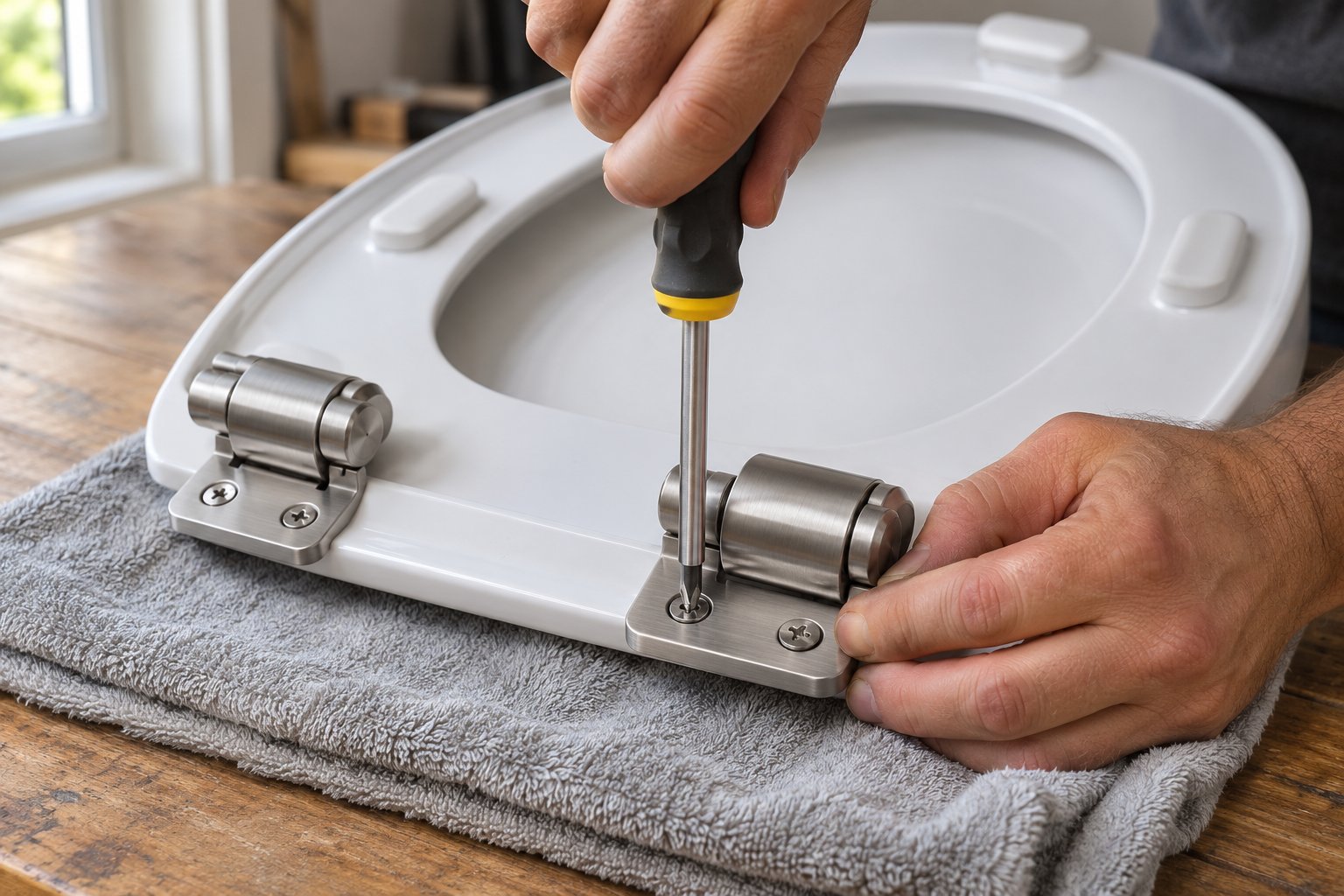
Replace only the hinges when the seat and lid are sound, with no cracks, no warping, and no damage around the mounting points. A damper that no longer slows the lid and a pitted post are both hinge-only jobs. So is a chrome plated brass toilet seat hinge replacement after the plating has failed. MEITU's hinge replacement guide adds loose bolts, broken hinge covers, and worn rubber plugs to the list of problems you can fix without a new seat.
Buy a new seat when it is cracked near the hinge, when the mounting holes in the seat are damaged, or when the hinge is fused to the seat. A hinge can be fused because it was molded into the seat or because corrosion has seized it in place. The cost difference can be small. For a typical plastic clip-on soft-close seat, wikiHow puts a replacement hinge set at under $15 and a full new seat at about $50 or less.
Compatibility Checks for Hinges for Soft Close Toilet Seat Repairs
- Hole spacing and pattern: Turn the seat and lid over and measure the screw holes on the underside. The new hinge plates must line up with them.
- Bowl mounting dimensions: Measure the bolt-hole spacing on the bowl, center to center. Compare it with the spacing or adjustment range listed for the hinge.
- Top or bottom fixing: A top-fix kit tightens an anchor inside the hole. A bottom-fix kit needs room for a nut under the rim. Choose the kit that matches your bowl.
- Seat material and thickness: A screw sized for a thick wood or MDF seat can be too long for a thin plastic one, and a short screw may not grip a dense seat well.
- Lid weight: A damper set for a light lid can let a heavy enameled wood lid drop too fast. MEITU also notes that some dampers only fit on one side, left or right. It advises against mixing old and new dampers because the seat and lid can then close unevenly.
Replacement Hardware Routes Compared
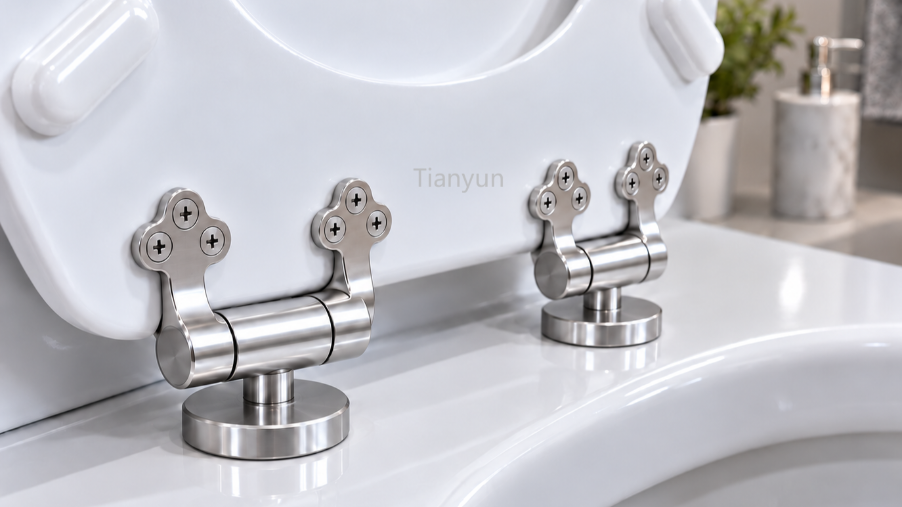
Whichever route you choose, a complete spec sheet makes the decision easier. Tianyun's TY-P029D hinge set shows what a full listing should state: brushed stainless steel, soft closing for both the seat and the lid, two-button quick release, position-adjustable top fixing, and an included TY-DM9 fixing kit. Look for each of those details on any hinge product page. The TY-P029D is a component made for manufacturers of MDF, wooden, and resin seats. It is not a complete seat and not a universal retrofit, so confirm that it fits your seat, lid, and bowl before you order. For manufacturers and specialist repairers, OEM and ODM projects can set the mounting dimensions, damping torque, and fixing components.
| Hardware Route | Pros | Cons |
|---|---|---|
| Metal soft-close component hinge set, such as the TY-P029D | Stainless steel parts, seat and lid both soft close, quick release and adjustable top fixing in one assembly, fixing kit included | Made for seat manufacturers, not a universal retrofit. Fit with the seat, lid, and bowl must be confirmed |
| Replacement hinge kit from the original seat brand | Most likely to match the hole pattern, damper strength, and finish | May not be available for older or discontinued models |
| Generic replacement loo seat hinges | Easy to find and often inexpensive | Fit varies, hidden fixings may be plastic, and the damper may not suit your lid |
| Replacing the full seat | Every part is new and matched, and a new warranty applies | Costs more, creates more waste, and the shape and fit checks start over |
Fit is only the first test for a replacement hinge. A hinge that holds up well in a dry guest bathroom can wear out quickly in a humid family bathroom that gets scrubbed every day.
Matching Hinges to Your Bathroom and a Final Buyer Checklist
Think about the room the seat will go in. Does steam from a daily shower hang in the air? Does someone scrub the toilet with bleach every few days? Do small children let the lid slam? Each answer changes which hinge features matter most.
Choosing WC Seat Hinges for Humidity, Harsh Cleaning, and Heavy Use
Use the table below to match WC seat hinges to the conditions in your bathroom. Most bathrooms fit more than one row, so combine the priorities that apply to you.
| Bathroom Condition | Hinge Priorities | What to Check |
|---|---|---|
| High humidity | Solid stainless steel or high-quality plating. Cover caps that seal out water or let it drain | The stainless grade or base alloy on the spec sheet, and how the caps sit over the bolt heads |
| Frequent cleaning with strong chemicals | A finish that tolerates your cleaning products. Quick release so you can reach under the posts | The care instructions, the warranty terms on cleaning, and the release and re-seating steps |
| Households with young children | Soft-close lids that protect fingers and reduce slamming | Whether both the seat and the lid are damped, and whether the damper suits the lid's weight |
| Heavy daily use | Metal fixings, an anti-loosening design, and adjustable posts | The material of the bolts and nuts or anchors, the fixing type, and the adjustment range |
Some brands also make seats built around young children. topseat's TinyHiney training-ring seat is one example. Check the hinge details on a seat like that the same way you would on any other seat.
Commode Seat Hinges and Toilet Lid Hinges Checklist
The checks are the same whether a listing calls the parts commode seat hinges or toilet lid hinges:
- Confirm bowl shape and measurements. Measure the length, the rim width, and the bolt-hole spacing, then confirm the shape listed for the exact SKU.
- Check which parts are actually metal. Look for the post, the bolt, and the nut or anchor listed separately.
- Match the finish to the room's fixtures. Compare photos taken in daylight, because the same finish name can look different from one brand to the next.
- Read the installation guide behind any anti-loosening claim. Find the fixing type, the fastener material, and what the warranty covers.
- Confirm care requirements. Note which cleaners the brand allows and whether harsh products void the warranty.
Where to Find Reliable Hinge Specs
- Component supplier pages: Tianyun's TY-P029D listing states the material, the soft closing for both seat and lid, the two-button release, the position-adjustable top fixing, and the included TY-DM9 fixing kit. It is a component for seat manufacturers, not a complete or universal seat, and OEM or ODM projects can set mounting dimensions, damping torque, and fixing components.
- Manufacturer installation guides: These show exploded diagrams, the fixing type, and the steps for releasing and retightening the seat.
- Retailer spec tables: Tables like the Home Depot one for the Bemis Weston give dimensions you can check against your bowl. They often don't say where each measurement was taken.
- Owner discussions: A best toilet seat reddit thread can show how hinges hold up after months of use. Treat these posts as anecdotal, because each owner has a different bowl, installation, and cleaning routine.
Buy the seat only after the listing, the installation guide, and your own measurements all agree.
FAQs About Toilet Seats with Metal Hinges
1. Are metal hinges better than plastic hinges on a toilet seat?
In a busy bathroom, metal hinges are usually the better choice, as long as the whole fixing is well made. Metal posts and threads flex less than plastic, so they stay tight through daily sitting, shifting, and lifting. Plastic hinges still have advantages. They never rust, they cost less, and they work well in a guest bathroom that is used only now and then. Watch out for cheap plating. When a thin chrome layer wears through, the hinge can discolor and end up looking worse than plastic. To judge a hinge, check three things together: the metal it is made of, the quality of its finish, and whether the bolts and nuts under the bowl are metal too.
2. Why does my toilet seat keep coming loose even with metal hinges?
A metal hinge post does little good if the parts holding it down are weak. Many seats sold as having metal hinges still use plastic nuts or expanding anchors underneath, and plastic slowly gives way under constant clamping pressure. Each time someone sits down off center, the sideways push works the fixing back and forth. Opening and closing the seat adds small vibrations that loosen it further. Fixings that were never fully tightened at installation loosen fastest. Find out what your nut or anchor is made of, and retighten it as the brand's guide describes without overtightening. If the seat keeps working loose, switch to metal fixings or a seat with an anti-loosening system the brand documents. If a post still wobbles after you retighten it, replace the hardware.
3. Can I replace just the hinges on a soft close toilet seat?
Yes, as long as the seat and lid have no cracks or damage near the mounting points and the hinge is not molded into the seat or seized by corrosion. Before you order, confirm five things: the screw-hole pattern on the underside of the seat and lid, the bolt-hole spacing on the bowl, whether the bowl needs top or bottom fixing, a screw length that suits the seat's thickness, and a damper strong enough for the lid's weight. A replacement kit from the original seat brand is usually the closest match. Component hinge sets such as Tianyun's TY-P029D show what a complete spec should list: brushed stainless steel, soft closing for both seat and lid, two-button quick release, position-adjustable top fixing, and an included TY-DM9 fixing kit. The TY-P029D is designed for manufacturers of MDF, wooden, and resin seats, and it is not a universal retrofit. Confirm that it fits your seat, lid, and bowl before buying. Manufacturers working on OEM or ODM projects can specify the mounting dimensions, damping torque, and fixing components.
4. Do stainless steel toilet seat hinges rust?
Stainless steel hinges resist rust much better than plated ones, but no metal is completely rust-proof. Grade 304 is a common choice for good stainless hinges. Grade 316 contains molybdenum and suits homes near the coast or other places with heavy chloride exposure. Even solid stainless can stain or pit when bleach or acidic cleaner is left on it. Raise the seat and lid while bowl cleaner sits in the bowl, wipe off splashes, then rinse and dry the hinge area. Plated hinges need more care, because a scratch through the thin outer layer exposes the base metal to moisture.
5. How do I know which toilet seat shape and size will fit my bowl?
Measure the bowl itself, not your old seat. Measure from the midpoint between the two bolt holes to the front outer edge of the rim, then measure the rim at its widest point. As a rough guide, round bowls are about 16.5 inches long, elongated bowls are about 18.5 inches long, and the standard bolt-hole spacing is 5.5 inches. Check the shape on the page for the exact SKU, because collection pages can mix round and elongated seats. Make sure the raised seat can tip slightly past upright without hitting the tank. If the bolt holes sit off center, choose a seat with adjustable hinges.
Apply This Insight to Your Project
Tell us what you are building and how the topic “Toilet Seat With Metal Hinges: What Listings Won't Tell You” relates to your application. Our engineering team can help evaluate the next step.