How Do You Know What Toilet Seat to Buy in Three Steps
The Short Answer to How Do You Know What Toilet Seat to Buy
Have you ever stood in a store aisle staring at rows of toilet seats that all look the same? Picking one feels like it should be easy. Often it isn't.
You know what toilet seat to buy by first measuring your toilet bowl, then identifying the toilet's brand and model, and finally matching the seat's shape, size, mounting style and material to those facts. Fit comes first. Features and finish come second.
Retailers agree on the starting point. The Lowe's buying guide says finding a seat that fits your toilet is the key factor. Material and comfort features come after that.
Why the Measure Identify Match Method Works
Two seats can look almost the same in a photo and still not fit your toilet. The seat might be too short for the bowl. The bolt holes might not line up. The hinge might not suit the way your toilet is mounted. There are many types of toilets, and the differences between them are often small details you won't see from across the room. If you learn how to size a toilet seat with a tape measure and then check the model number, you take the guesswork out. The same logic applies whether you're looking at a Beneke toilet seat, a wooden toilet seat or a basic plastic toilet seat.
What This Guide Covers and What It Does Not
This guide is a neutral, fit-first reference. It is not a product funnel. Retailer and manufacturer guides usually point you toward their own catalogs. The only goal here is to help you choose a seat that fits your bowl. The guide covers rigid toilet seats and lids. Fabric lid covers, disposable covers and padded add-on accessories are outside its scope.
Want to skip ahead? Here are the three steps:
- Measure the bowl's length, width and bolt-hole spacing.
- Identify the toilet's brand and model.
- Match shape, size, mounting and material to your needs.
Before you measure anything, it helps to know which bowl shapes you might find. Across the types of toilets in today's homes, the word 'standard' covers less than most people expect.
Toilet Seat Shapes and Sizes You Need to Recognize
Are all toilet seats the same size? No. Toilet sizes vary from home to home, and a seat only works when it matches the bowl under it. Keep two ideas separate here. Bowl shape is the outline of the porcelain rim. Seat length and width describe the seat you buy. Seats are made to fit a bowl shape, so you need to know the bowl shape first.
Round vs Elongated Toilet Seat Sizes
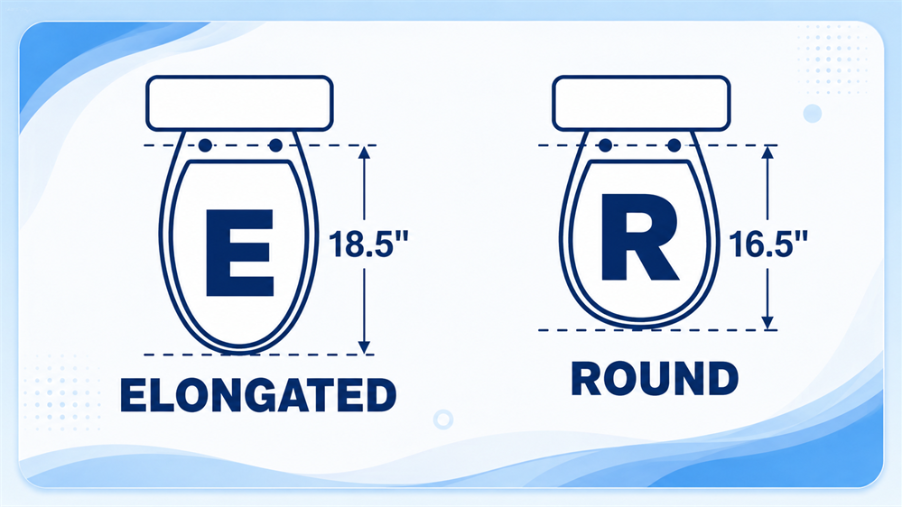
Round and elongated are the two most common types of toilet seats because they match the two most common bowls. The difference is mostly length. In TOTO's WASHLET fit chart, a round bowl measures about 16.5 inches from the midpoint between the mounting holes to the front of the rim. An elongated bowl measures about 18.5 inches. Both usually have the same bolt spacing of about 5.5 inches center to center, which InspectAPedia lists as the standard hinge bolt spread.
If you look straight down at the bowl, a round bowl looks close to a circle and an elongated bowl looks like a longer oval. When the shapes get mixed up, you'll see it right away. An elongated seat on a round bowl hangs past the front, and a round seat on an elongated bowl leaves part of the rim uncovered.
Compact Elongated and Square or D-Shaped Bowls
Some bowls are harder to classify. A compact elongated bowl has an oval front on a shorter footprint. It takes up floor space more like a round toilet, yet Premier Bidets notes that it usually takes an elongated seat, so check the maker's spec sheet before you buy. Square or D-shaped bowls have flat sides or a squared front. Badeloft describes them as less common than round or elongated bowls. Because of that squared outline, you often need a seat made for that brand or model line.
Toilet Seat Sizes Chart at a Glance
| Shape | Typical Bowl Length (mounting-hole center to front rim) | Typical Bolt-Hole Spacing | Distinguishing Traits | Common Fit Pitfalls |
|---|---|---|---|---|
| Round | About 16.5 in | About 5.5 in | Nearly circular from above, shorter front | Buying an elongated seat that overhangs the rim |
| Elongated | About 18.5 in | About 5.5 in | Longer oval front | Buying a round seat that leaves the rim exposed |
| Compact elongated | Falls between the standards | Confirm on your bowl | Oval front on a shorter footprint | Calling it round because the toilet looks small |
| Square / D-shaped | Varies by model | Confirm on your bowl | Flat sides or squared front | Trying a universal seat when the bowl needs a brand-specific one |
For most people, one length measurement is enough to tell round from elongated. The trouble starts with in-between and squared bowls, because their toilet bowl dimensions don't match a standard wc seat size. Imagine your tape reads 17.5 inches. Is the toilet compact, or did the tape slip at an angle? Measuring carefully answers that question, so how to measure a toilet seat correctly matters as much as the number you get.
How to Measure a Toilet Seat the Right Way
Most retailer guides reduce measuring to one tip: check the length. That works for many bowls. It doesn't help much when your number looks odd. A fuller routine takes about ten minutes, and it answers most of the questions behind how to tell what toilet seat I need.
Tools You Need Before You Measure a Toilet Seat
You don't need anything special. Badeloft recommends the same basic kit for measuring a whole toilet, and it works just as well for the seat.
- A tape measure that locks and lies flat
- Paper and pencil, or a notes app, to record each number
- A smartphone to photograph the bowl, the hinge area and any markings
- Gloves and a cleaning wipe, since you'll be handling the hinge area
How to Measure a Toilet Seat for Replacement Step by Step
- Remove or lift the old seat. You're measuring the porcelain bowl, not the seat. People sometimes call the rim the porcelain toilet seat, but the plastic or wood seat on top may not match the bowl, especially if a previous owner bought the wrong size.
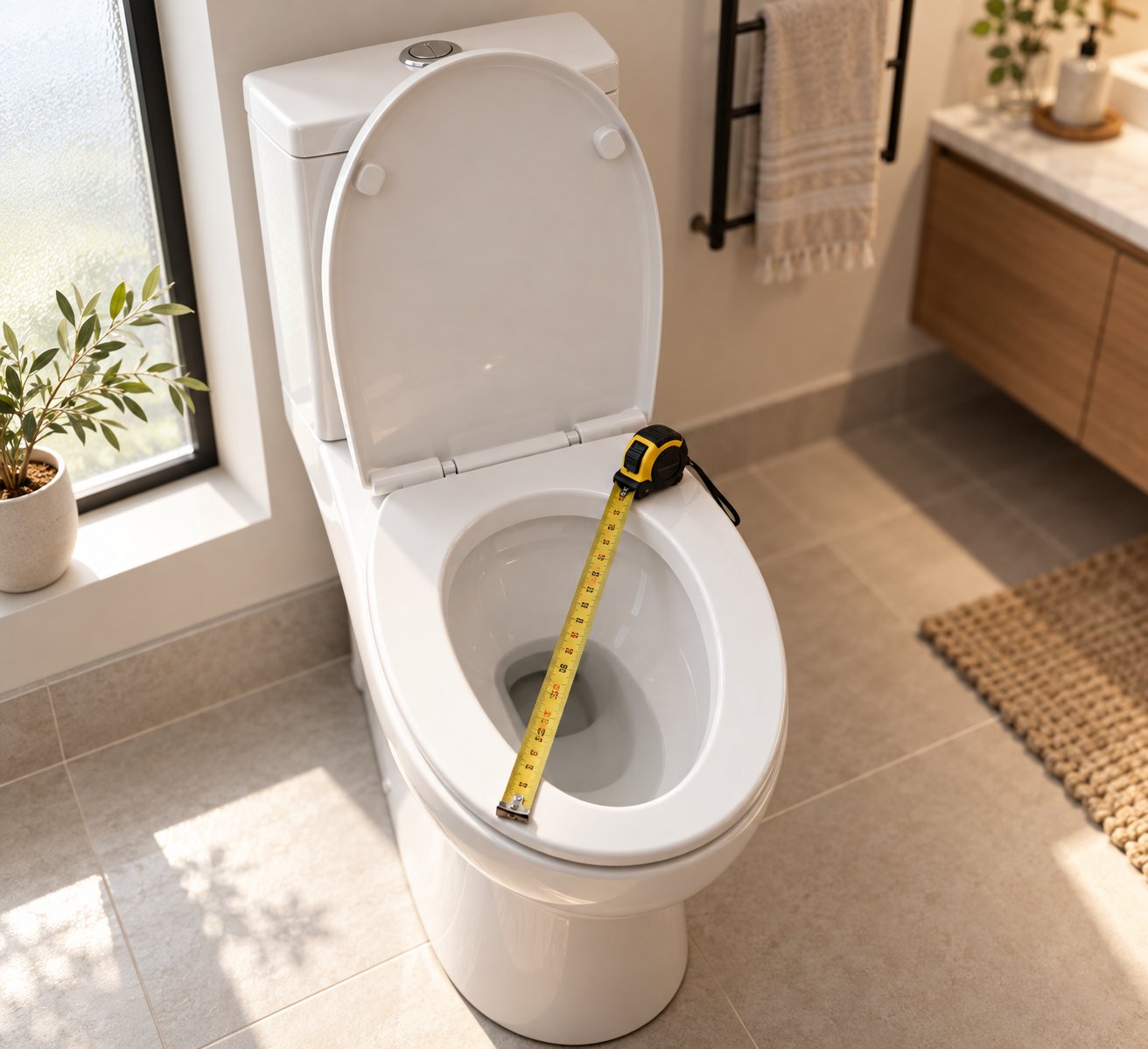
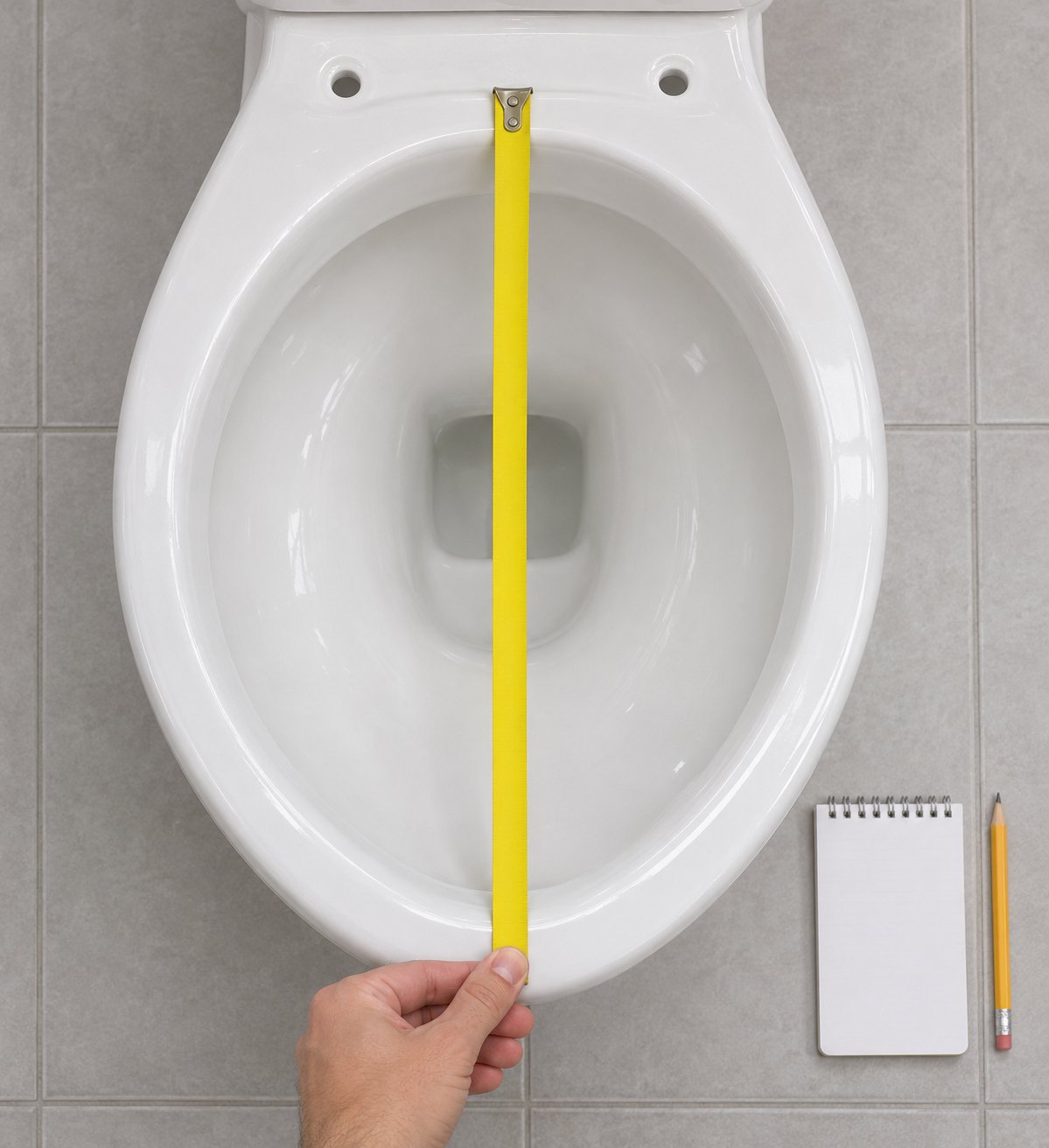
- Measure the length. Find the midpoint between the two mounting holes. With standard spacing, that point sits about 2.75 in from each hole center, as ToiletSeats.com explains. Hook the tape there, hold it flat and centered, and run it to the outer front edge of the rim. About 16.5 in points to round. About 18.5 in points to elongated.
- Measure the width. Measure side to side across the widest outer point of the rim. Width alone won't tell round from elongated, but it confirms the seat won't overhang. It also gives a supplier one more clue if your bowl turns out to be unusual.
- Measure the bolt-hole spacing. Measure from the center of one mounting hole to the center of the other. About 5.5 in is standard. If you get a clearly different number, you probably have a non-standard bowl.
- Note the hinge type and bolt access. Look under the back of the rim. Can you reach the nuts from below, or are the holes hidden behind a skirted side? Write down what you see and take a photo, because this decides what kind of mounting hardware you'll need.
How to Read Your Measurements and Handle In-Between Results
Are all toilet seats the same size? Your own numbers will show you why they aren't. If the length lands near 16.5 or 18.5 in and the bolt spacing is near 5.5 in, you have a standard bowl. Most seats labeled round or elongated should fit it, whether you're planning a Beneke toilet seat replacement or comparing Lowe's toilet seats in the aisle.
Things change when your results fall between the two references, or when the bolt spacing is far from 5.5 in. Those numbers often point to a compact or proprietary bowl. Measure once more to rule out a slipped tape. If the number holds, stop shopping by shape alone and identify the toilet's model instead.
Hinge adjustment also affects the final fit. Many hinges let you slide the seat a little forward or back, and that range varies from product to product. It can fine-tune a close match, but it can't correct the wrong shape. Check the seat's specs rather than counting on adjustment to make up the difference.
Common measuring mistakes to avoid:
- Measuring the old seat instead of the bowl
- Starting at the back of the tank or the wall. That gives you an overall toilet size for planning the room, not a seat measurement.
- Holding the tape at an angle or letting it sag into the bowl opening
- Measuring to the inner edge of the rim instead of the outer front edge
- Rounding numbers before you write them down
Measure twice, order once. The best toilet seat on paper is only right for you if your measurements back it up.
A tape measure can describe your bowl, but it can't tell you what the bowl is called. When the numbers land in between, the most reliable clue is often printed somewhere on the toilet itself.
Identify Your Toilet Before You Choose a Replacement Seat
Have your measurements landed in a gray zone? The toilet itself can often settle the question. A model number tells you which bowl you have, even when two toilets look almost identical. It also turns rough toilet seat sizes into firm toilet seat specifications that you can check against a product listing.
Where to Find the Brand and Model Number on Your Toilet
Grab a flashlight and check these spots. The marking may be stamped into the porcelain or printed in ink. If it's faint, Plumbing Deals suggests wiping away mineral buildup with a damp rag.
- Inside the tank: usually on the back wall, near the water line.
- Underside of the tank lid: useful, but it may show only a lid part number and not the full model number.
- Back of the bowl behind the seat hinge: lift the seat and look at the area between the mounting bolts.
- The base or foot: markings are less common here, but it's worth a quick look.
Photograph every marking you find, even partial ones. On a two-piece toilet, the tank and the bowl can come from different model lines if someone replaced one half, as Plumbing by the Book points out. When you're buying a seat, the bowl is the part that counts.
Using the Old Seat as a Clue
The old seat can confirm the shape and hinge style you're working with. Some seats also carry their own markings. Kohler, for example, prints the model number on the underside of the hinge on most of its newer plastic seats, so you have to remove the seat to read it.
Be careful, though. The seat may not be the original, and its brand may not match the toilet at all. Whether you're settling a plastic versus wood toilet seat question or doing a simple toilet cover seat swap, measure the bowl first. Use the old seat only as a cross-check.
What to Do When There Is No Model Number
Older or generic toilets sometimes have no readable marks at all. You're not stuck. This is where knowing how to measure toilet seat dimensions pays off. Before you contact the manufacturer or a seat supplier, gather:
- Your three measurements: length, width and bolt-hole spacing
- A clear photo of the bowl profile, taken from above and from the side
- A note on the hinge mounting style, including whether you can reach the bolts from below
With that package, a support team can match your bowl much faster than it could from a description alone. The same information helps whether you're comparing Home Depot toilet seats or ordering from a specialist. Sometimes, though, the answer is a surprise: your toilet turns out to be a design that a standard seat was never meant to fit.
Non-Standard Toilet Types That Need Special Seats
Imagine you've measured carefully and ordered the right shape. Then you kneel down to install the seat and find there's no way to reach the bolts. This happens more often than you'd think. Some toilets break the usual rules on purpose, so they need their own planning step.
One-Piece and Skirted Toilets With Concealed Mounting
Skirted toilets have smooth sides that cover the trapway, and many one-piece models share that sleek look. The design is easy to wipe clean, but it often hides the mounting points. You can't reach under the rim to hold a nut in place. American Standard notes that seats for skirted, or concealed trapway, toilets must be designed to mount from the top, because the bolts can't be reached the way they can on a standard toilet.
That means the hardware narrows your options before shape even comes into it. A nice contour or a standard toilet seat height won't help if the hinge can't attach. Look for top-mount wording on the box or spec sheet before you buy.
Square, D-Shaped and Brand-Specific Bowls
Generic seats have the hardest time with squared bowls. A round or elongated seat leaves the flat front corners exposed, or it hangs awkwardly past the sides. Many of these bowls need a seat made for that exact model line, and that's why the model number from the previous step matters so much. Knowing how to measure for a toilet seat gives you the toilet bowl size. The model number tells you which toilet seat lid was actually designed for it.
If You Have an RV Toilet
RV toilets play by their own rules. The etrailer team advises identifying the toilet first, starting with the model sticker on the back. The area around the base and near the foot pedal is also worth checking. Seats from brands such as Dometic/SeaLand and Thetford are often proprietary, so a residential seat usually won't fit.
The matching really does happen at the model level. In that same etrailer answer, a specific replacement seat was confirmed only after the toilet was identified as a 310 Series Part-Timer. A general shape label wasn't enough.
Red flags that a standard seat probably won't fit:
- Bolt-hole spacing clearly different from about 5.5 in
- Hidden fasteners, or no access under the back of the rim
- A squared or D-shaped front
- RV or marine use
If you spot any of these, a retailer's list of best toilet seats matters less than finding the one made for your model. If you clear all of them, your shortlist gets much shorter. At that point, great toilet seats start to set themselves apart by something you'll notice every day: what they're made of.
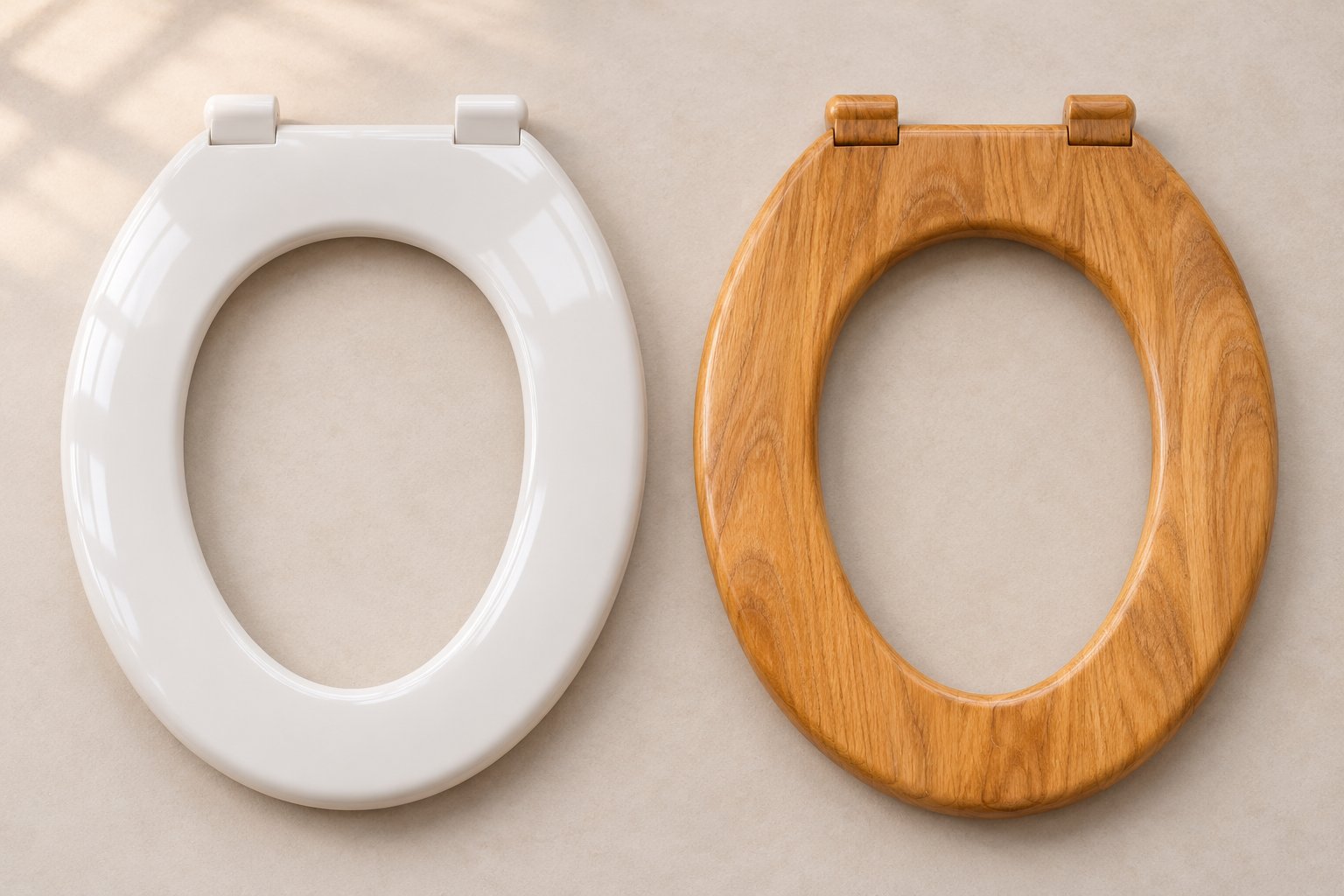
Wood or Plastic Toilet Seat and Other Material Choices
Most shoppers start with this question, but it works better as your last one. Should you go wood or plastic? Material can't fix a bad fit. It does shape how the seat feels, how it ages and how much care it needs.
What Are Toilet Seats Made Of
Plastic is the most popular toilet seat material, and wood comes second, according to the Lowe's materials guide. Plastic seats usually use one of two materials. One is polypropylene (PP). The other is urea-formaldehyde (UF), a thermoset sometimes described as duroplast-style. A material breakdown from Simple Project describes the trade-offs between them in detail.
| Material | Feel | Durability Considerations | Cleaning and Maintenance | Typical Use |
|---|---|---|---|---|
| Polypropylene (PP) plastic | Light, slightly flexible, smooth | Resists moisture and many chemicals. Softer surface can wear and may yellow with age. | Easy to wipe down. Avoid harsh abrasives. | Everyday family bathrooms, budget-friendly replacements |
| Urea-formaldehyde (UF) | Hard, glossy, porcelain-like | Harder and more scratch-resistant, but more rigid than PP. The raw material has limited heat resistance. | Smooth surface cleans easily | Buyers who want a firmer, higher-gloss finish |
| Molded wood (enameled) | Heavier, substantial, warmer to the touch | Enamel finish resists wear, but chips can let moisture reach the core. | Mild soap only, to protect the gloss | Homes that want a solid, traditional feel |
| Solid wood | Warm, natural grain | Can absorb moisture and crack or warp if the seal fails. | Harder to clean. Finish needs periodic care. | Decor-driven or rustic bathrooms |
You'll notice that no row wins every column. The comfiest toilet seat is usually the one that matches your bowl and has a contour you like. Material adds warmth or firmness on top of that. Material also won't do much to change toilet seat height, because the bowl sets most of that.
Plastic vs Wood Toilet Seat Pros and Cons
Plastic Pros
- Non-porous surface that is easy to clean
- Resists moisture, chipping and cracking
- Lighter, so you can lift it off easily for deep cleaning
Plastic Cons
- Can crack or yellow if it sits in direct sunlight
- Lighter feel that some people find less substantial
Wood Pros
- Warmer to the touch, with a heavier, solid feel
- Offers rustic or classic looks that plastic can't easily match
Wood Cons
- Can absorb moisture and warp if poorly sealed
- Finish needs gentle cleaning. Bemis recommends mild soap for both materials.
Imagine a humid bathroom with a sunny window. Plastic handles the moisture, while wood handles the light better. Top rated toilet seats come in both materials, so ratings won't decide this for you. Whether you're browsing commode seats at Lowes or searching for a toilet seat near me, the label will usually say only wood or plastic. It rarely says PP or UF.
PP and UF Seats for Buyers Specifying a Material
Manufacturers and private-label buyers need a more specific answer. If you're specifying a replacement toilet seat line, the real question is PP or UF. Tianyun's PP and UF toilet seat collection is one reference point for that comparison, along with soft-close hinge matching. It is aimed at OEM development, not retail purchase. It also doesn't list individual models or dimensions. Confirm round, elongated or heavy-duty requirements directly with the supplier, and bring your bowl data from the how to measure a toilet seat for replacement steps above.
Whichever material you choose, the seat still meets the bowl at only two points. Those two small hinges decide more about everyday use than most buyers expect.
Hinges Mounting and Comfort Features Worth Checking
Have you ever had a seat that shifts sideways every time you sit down? The bowl shape is usually fine in that case. The problem tends to be in the small parts at the back.
Parts of a Toilet Seat and Lid Explained
A basic seat has only a few parts. Homedit's toilet parts guide names the lid, seat, hinges, bolts and bolt covers. Here is the full list of what you'll handle during installation:
- Seat ring: the open ring you sit on
- Lid: covers the seat when it's closed
- Hinges: attach the seat and lid to the bowl and let them pivot
- Bumpers: small pads under the seat and lid that rest on the rim and keep things steady
- Mounting bolts: pass through the bowl's holes and hold the hinges in place
- Nuts or anchors: lock the bolts, either below the rim or inside the hole
Top-Mount vs Bottom-Mount Hinges and Hinge Adjustment
Bottom-mount hardware tightens from under the bowl. You drop the bolts through the holes and secure each one with a nut underneath. That only works if there's room behind the bowl to reach in. Top-mount hardware tightens from above, so it suits the concealed and skirted toilets covered earlier. Tap Warehouse notes that a top-fix seat will usually fit a toilet that originally had a bottom-fix one, but not the other way round. Whether you're comparing a Lowes toilet seat or browsing toilet seats Home Depot carries, check the box for the mounting type.
Adjustable hinges let you move the seat slightly forward or back. That can center a near-match. It can't fix the wrong bowl shape or bolt spacing, so think of it as fine-tuning, not a rescue.
Soft-Close, Quick-Release and Comfortable Toilet Seat Features
Soft-close hinges use a small internal mechanism to lower the lid slowly, so it doesn't slam shut at night. Less impact also means less wear on the seat and hinges. Quick-release hinges unclip by hand, so you can lift the whole seat off and clean the hard-to-reach area around the hinges. The two features often come together on the same seat.
The trade-off is in the hinge material. Plastic hinges can't rust. Lower-quality metal hinges can corrode or seize in a humid bathroom, so look for stainless steel if you prefer metal.
Comfort isn't a ranking. It comes from a seat that matches your bowl, a contour you like and a material that feels right to you. Ferguson also points out that a securely fitted seat that doesn't wiggle feels better and tends to last longer.
Toilet Seat Height and What a Seat Can Change
The bowl sets most of a toilet's height. Across common commode types, a standard seat adds only a little on top. That's why height doesn't come up when people ask how do you measure for a new toilet seat. Length, width and bolt spacing are the toilet seat dimensions that matter. Raised and accessibility seats are a separate category, with their own fit rules.
Mounting style, hinge type, comfort and height add up to a lot of details. They're easy to lose track of when a product page shows five stars and a Buy button.
Final Checks Before You Buy a New Toilet Seat
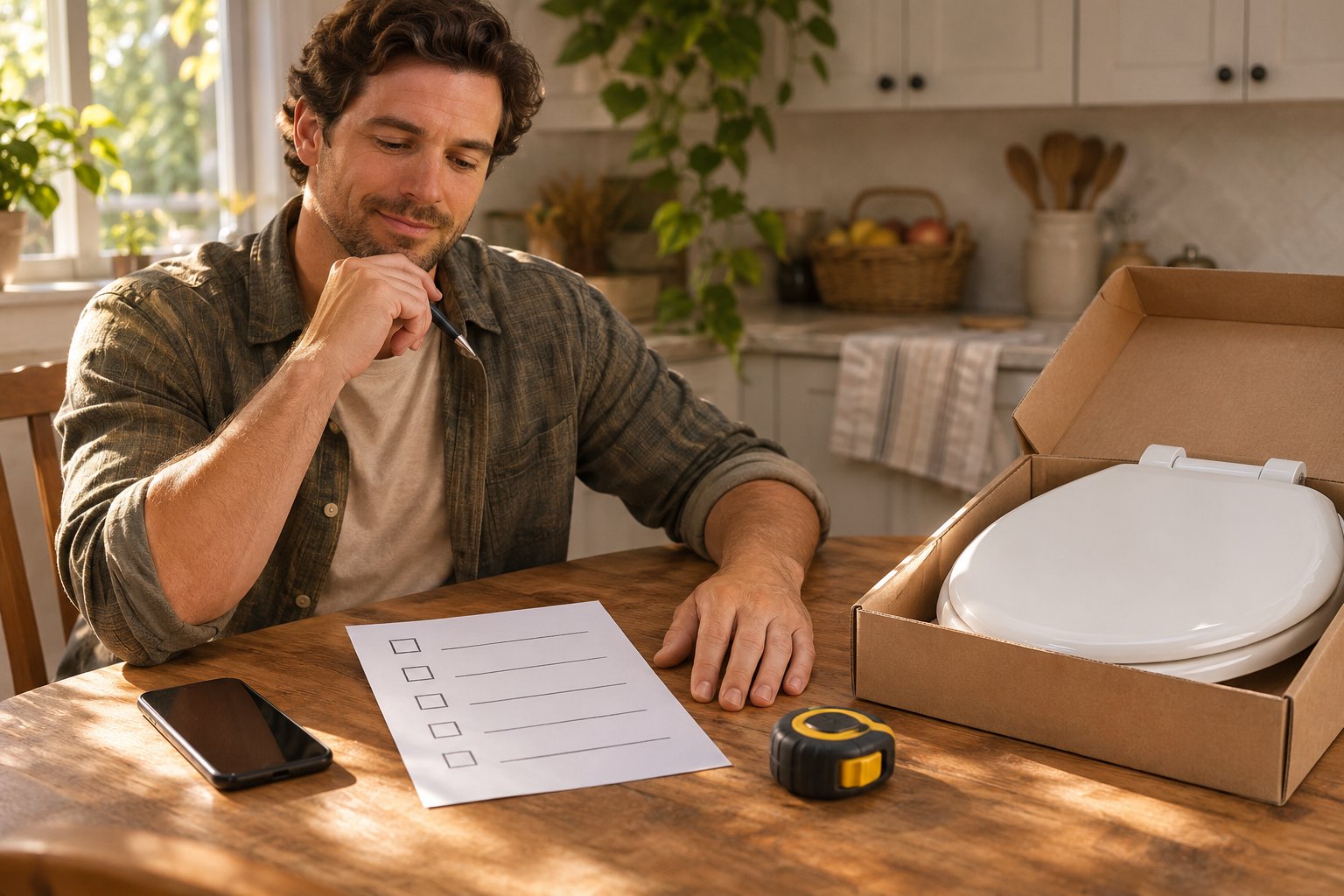
By now you have the numbers, the photos and maybe a model number. That's everything you need. Before you click Buy, take two minutes to hold the listing up against your notes. A quick comparison now is much easier than a return trip later.
Before You Click Buy Toilet Seat Checklist
Go through each line. If you can't tick one off, go back to how to measure for a new toilet seat before you order.
- Bowl shape: round, elongated, compact elongated, or square/D-shaped.
- Length: about 16.5 in for round or about 18.5 in for elongated. Measure from the midpoint between the mounting holes to the outer front edge of the rim.
- Bolt spacing: about 5.5 in center to center. A clearly different number means you need a model-specific seat.
- Mounting hardware: top-mount for skirted or concealed bowls, bottom-mount if you can reach under the rim.
- Brand and model compatibility: the listing names your toilet or its bowl type. If you're matching a branded seat, such as a Vortens toilet seat for a Vortens bowl, confirm the model line.
- Material: PP, UF, molded wood or solid wood, chosen for your bathroom's moisture and light.
- Hinge type: soft-close, quick-release and the adjustment range you need.
- Proprietary or RV: if either applies, buy the seat made for that exact model.
Does the seat length on the listing run a bit longer than your bowl? That's normal. Seats are often measured differently. Kohler measures from the hinge to the front of the seat and lists its elongated seats at 18-5/8 in or more.
What Best and Top Rated Toilet Seats Really Mean
Search for toliet seats and you'll get plenty of best-of lists. Labels like best rated toilet seats reflect one retailer's or reviewer's criteria, such as price, features or reviews from people whose bowls may differ from yours. They aren't independent rankings. A five-star seat that overhangs your rim is a one-star seat in your bathroom. Confirm the fit first, then let ratings help you choose among seats that fit.
Separating Toilet Seat Price From Installation Cost
Treat the product cost and any installation labor as two separate line items. A standard bottom-mount swap is often a simple DIY job. Top-mount hardware on a skirted bowl takes more patience. A bidet seat also needs an electrical outlet nearby, as Kohler notes. If you hire help, ask for a quote that lists labor apart from the seat.
A seat is only right if it fits the bowl, so measure first, identify second, and let ratings, materials and features come last.
A Sourcing Path for Manufacturers and Private-Label Buyers
For buyers who develop seat lines, this checklist becomes a specification sheet. Beewill's importer guide warns that calling a seat universal doesn't guarantee compatibility. It recommends confirming fixing-hole distance and hinge adjustment range, ideally with a technical drawing, reference model or physical sample.
Tianyun's PP and UF toilet seat collection is one place to take that next step. Bring your bowl measurements, mounting-hole spacing, hinge requirements, including top- or bottom-mount and soft-close, and your PP or UF choice to the inquiry. The collection doesn't publish models, dimensions, colors or prices. Confirm round, elongated, color and heavy-duty needs directly with the supplier, and approve a sample before production. Fit is never assumed. Whether you're replacing one seat or specifying thousands, your bowl's measurements decide what fits.
Toilet Seat Buying FAQs
1. Are all toilet seats the same size?
No. Seats are built to match a bowl shape, and bowls vary. Most homes have either a round bowl, which measures roughly 16.5 inches from the midpoint between the mounting holes to the front rim, or an elongated bowl at roughly 18.5 inches. Both usually share a bolt spread of about 5.5 inches. Compact elongated and square or D-shaped bowls don't fit neatly into either group, and they cause most sizing mistakes. A generic 'standard' label on the box doesn't guarantee a match, so check your bowl's numbers against the listing before you order.
2. How do I measure my toilet for a replacement seat?
Take the old seat off so the tape sits on the porcelain. Hook the tape at the midpoint between the two bolt holes and run it flat to the outer front edge of the rim to get the length. Measure across the widest outside point for the width, then measure from the center of one bolt hole to the center of the other. Also look under the back of the rim to see whether you can reach the nuts from below. If the length falls between the round and elongated references, measure again. If the number holds, look up the toilet's model before you buy.
3. Will an elongated toilet seat fit a round toilet bowl?
Usually not. An elongated seat on a round bowl sticks out past the front rim, which looks awkward and can flex or crack under load. A round seat on an elongated bowl leaves part of the rim uncovered and feels short. Compact elongated bowls are the exception that confuses people. They take up floor space like a round toilet but often need an elongated seat, so confirm with the manufacturer's spec sheet instead of judging by how big the toilet looks.
4. Is a plastic or wood toilet seat better?
Neither wins every category, so pick a material after you've confirmed the fit. Plastic is non-porous, light and easy to remove for cleaning, and it handles humid bathrooms well, although it can yellow in strong sunlight. Wood feels warmer and more solid, but it needs gentle cleaning and can warp if moisture gets past the finish. Within plastic, polypropylene (PP) is lighter and a little flexible, while urea-formaldehyde (UF) is harder, glossier and more scratch-resistant. Manufacturers and private-label buyers choosing between PP and UF can use Tianyun's PP and UF collection as a starting reference. Shape, color and heavy-duty needs still have to be confirmed with the supplier.
5. What kind of seat do I need for a skirted, one-piece or RV toilet?
Skirted and many one-piece toilets hide the bolt holes behind smooth sides, so you usually need a top-mount seat that tightens from above. Check the box or spec sheet for top-mount hardware before you buy. Square, D-shaped and other brand-specific bowls often need a seat from the same model line. RV toilets from brands like Dometic/SeaLand and Thetford are often proprietary, so find the model sticker on the back or near the base and buy the seat made for that exact toilet. A residential seat rarely fits them.
Apply This Insight to Your Project
Tell us what you are building and how the topic “How Do You Know What Toilet Seat to Buy? Your Bowl Holds the Clue” relates to your application. Our engineering team can help evaluate the next step.