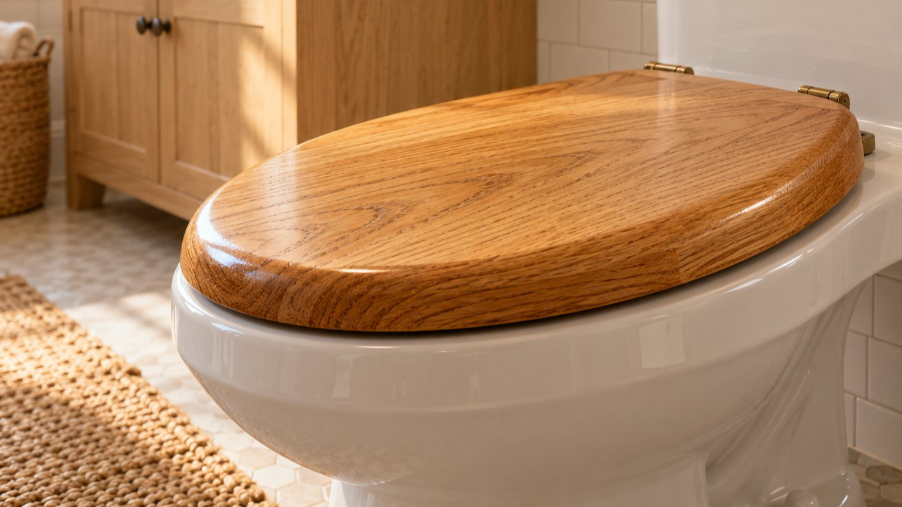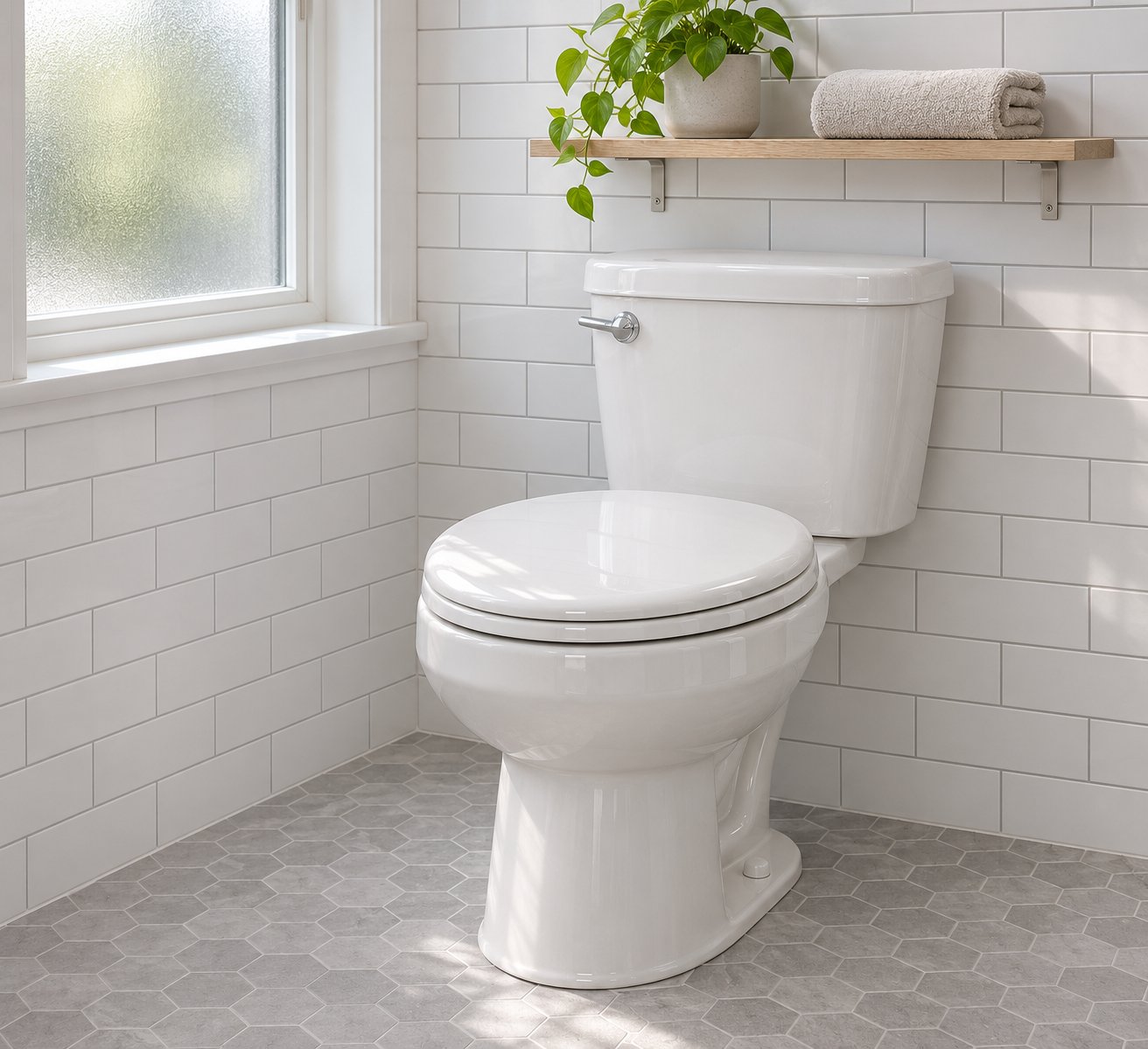
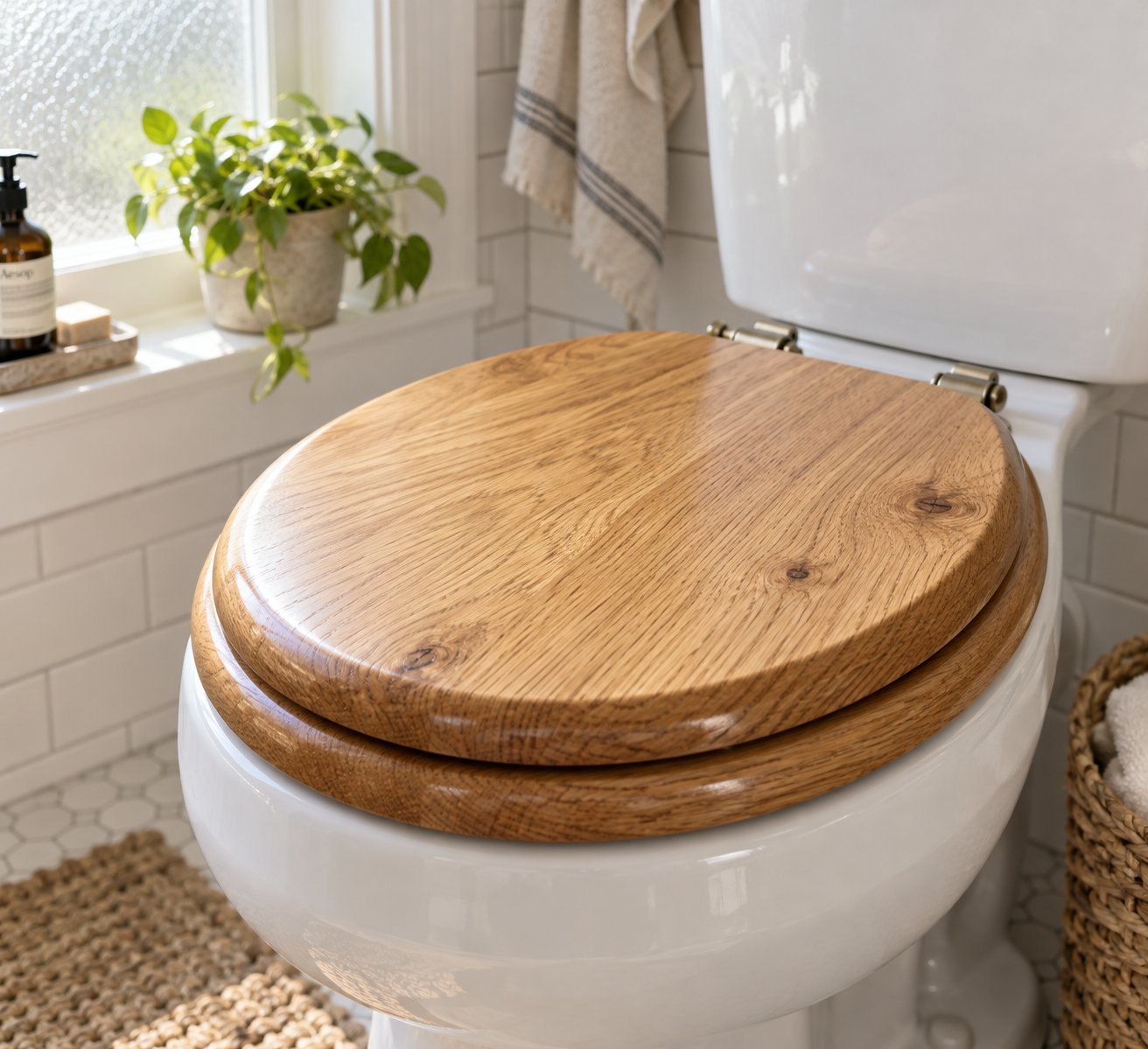
What Is a Wooden Round Toilet Seat and Why Does It Matter
Search for a wooden round toilet seat online and you will find page after page of product listings, prices, and "add to cart" buttons. What you will not find is a single resource that actually explains what you are buying, how to choose the right one, and how to keep it looking great for years. That gap is exactly why this guide exists.
A round wooden toilet seat is a seat crafted from solid wood, bamboo, or wood-composite materials and shaped to fit standard round toilet bowls. These bowls measure roughly 16.5 inches from the mounting bolt holes to the front of the bowl rim, giving them a near-circular profile that is shorter and more compact than elongated models. The seat itself is designed to rest securely on that rim, providing comfort, hygiene, and a finished appearance to the toilet.
A wood toilet seat offers a warmth and aesthetic dimension that plastic alternatives simply cannot replicate, yet it requires informed decision-making around moisture protection, hinge quality, and proper sizing to avoid warping, cracking, or a poor fit.
This article is your brand-neutral, education-first resource. It covers material choices, fitting and measurement, hinge technology, finishes, installation, and long-term maintenance, so you can make a confident purchase without relying on marketing claims alone.
What Defines a Wooden Round Toilet Seat
Every wooden toilet seat, regardless of material or price, shares the same core anatomy:
- Lid - The top cover that closes over the seat ring, shielding the bowl when not in use.
- Ring (seat) - The open, horseshoe-shaped piece you actually sit on.
- Hinges - The hardware at the back that connects the lid and ring to the toilet bowl, allowing both to pivot open and closed.
- Bumpers - Small rubber or silicone pads on the underside of the ring and lid that cushion contact with the porcelain bowl, prevent sliding, and reduce noise.
The round shape is the critical distinction. A round bowl measures approximately 16.5 inches front to back, while an elongated bowl stretches to about 18.5 inches, creating an oval profile. Installing an elongated seat on a round bowl leaves an awkward overhang at the front; placing a round seat on an elongated bowl leaves exposed porcelain. Neither scenario is comfortable or visually acceptable, which is why accurate measurement matters before you shop.
Why an Informed Choice Matters
A wooden loo seat is not a one-size-fits-all commodity. Several factors directly influence how long it lasts, how it feels, and how well it complements your bathroom:
- Wood type - Solid hardwood, bamboo, and molded wood composites each bring different strengths in durability, moisture resistance, and appearance.
- Finish durability - The coating on the wood determines whether the seat resists moisture, stains, and cleaning chemicals or breaks down within months.
- Hinge mechanism - A quality hinge keeps the seat stable and aligned, while a soft-close damper prevents slamming that can crack wood over time.
- Correct bowl measurement - Confirming a round versus elongated fit is a simple step that prevents returns and frustration.
Each of these factors deserves a closer look, and the differences between wood types are where most buyers encounter the first real decision point.
Wood Types Compared From Solid Oak to Molded Composites
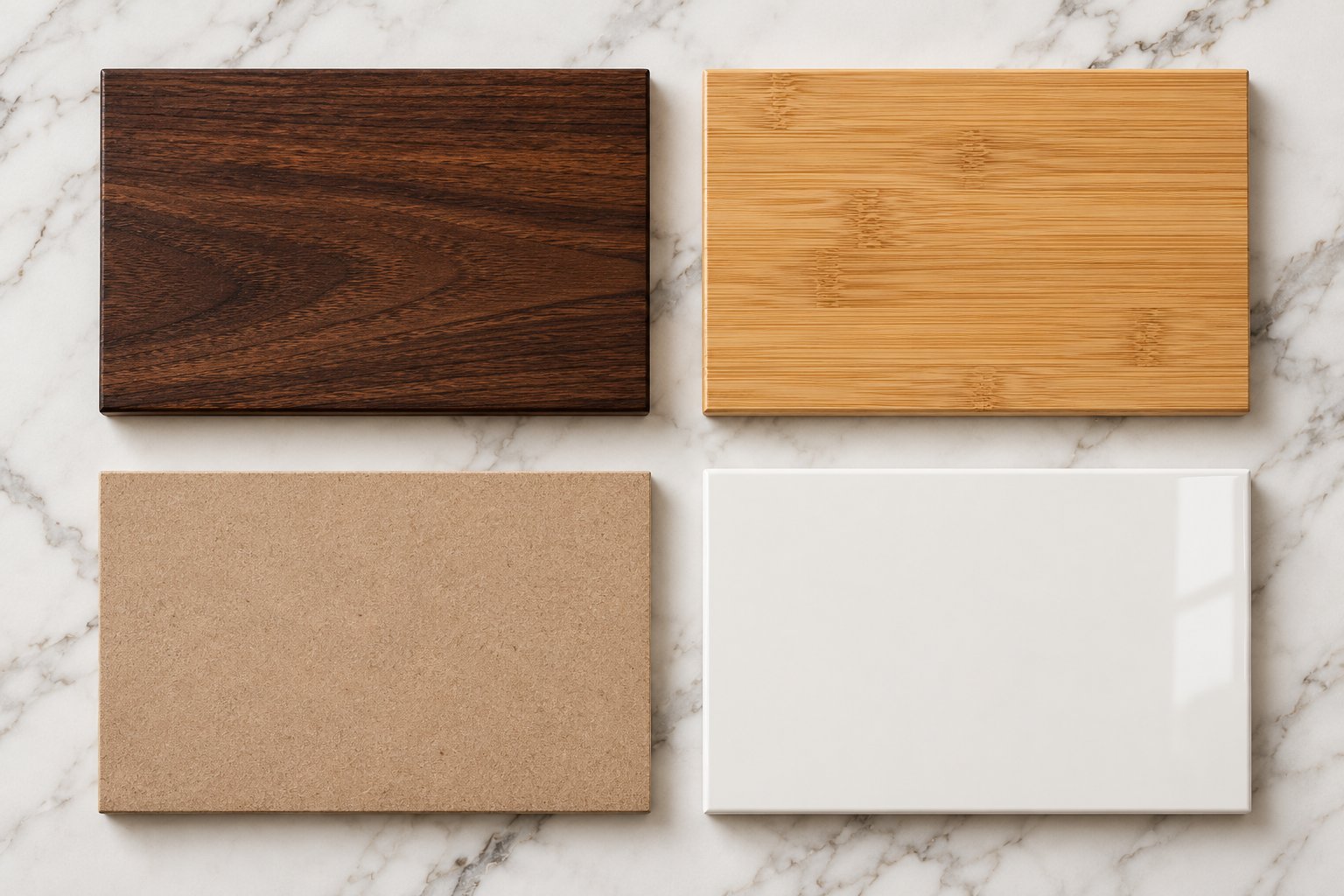
Not all wooden toilet seats are carved from the same tree, and the material hiding beneath the finish has a bigger impact on performance than most buyers realize. Four broad material categories dominate the market, each with distinct trade-offs in durability, moisture resistance, weight, and price. The comparison table below puts them side by side before we dig into the details.
| Material Type | Durability | Moisture Resistance | Weight | Approximate Price Tier | Best For |
|---|---|---|---|---|---|
| Solid Hardwood (Oak, Walnut, Maple) | High, but depends on finish quality | Moderate - requires quality sealant | Heavy | Mid to High ($40 - $120+) | Premium, rustic, or traditional bathrooms |
| Bamboo | High | Naturally higher than most hardwoods | Light to Medium | Mid ($30 - $70) | Eco-conscious and modern spaces |
| Molded Wood / MDF | Highly consistent and stable | Good when properly sealed | Medium | Low to Mid ($20 - $60) | Everyday residential, hotels, rentals |
| Enameled Wood | High surface durability | Excellent - non-porous coating | Medium | Low to Mid ($20 - $60) | Easy-clean priority, classic white or color-matched bathrooms |
Prices fluctuate by retailer and region, but the relative tiers give you a reliable frame of reference. Let's break each category down.
Solid Hardwood Options
Imagine running your hand across a seat and feeling genuine wood grain beneath your fingertips. That is the appeal of solid wood toilet seats made from oak, walnut, or maple. Each plank carries unique grain patterns, color depth, and a density that gives the seat a reassuring, substantial feel.
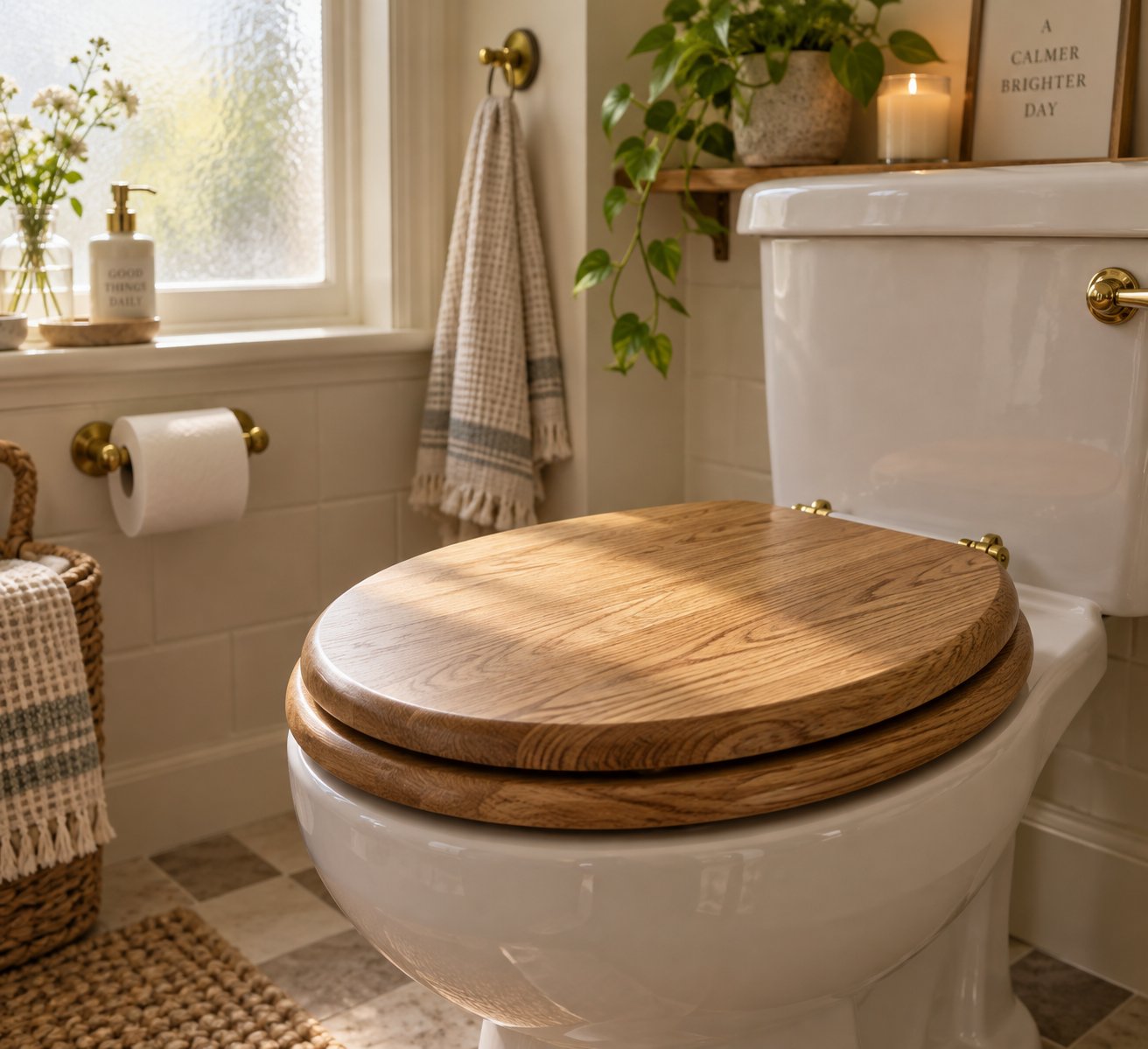
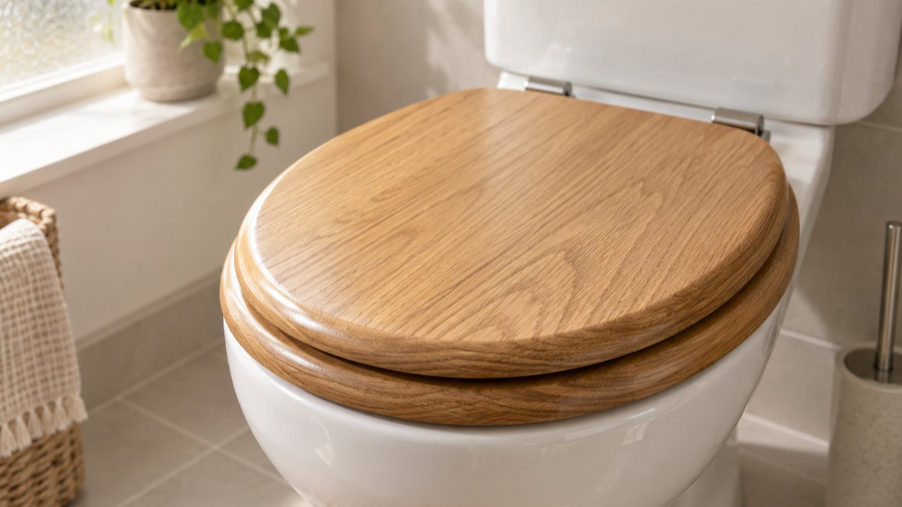
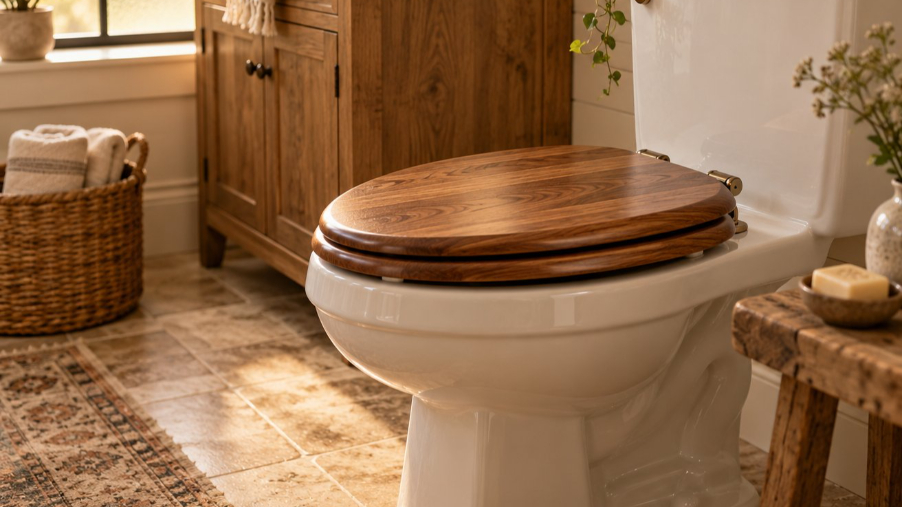
Among the hardwood choices, oak toilet seats remain one of the most searched and purchased variants. A solid oak toilet seat delivers a tight, prominent grain that stains beautifully and pairs with nearly any bathroom palette, from honey-toned farmhouse schemes to darker espresso finishes. Walnut offers a richer, darker character with swirling grain lines that lean toward a more contemporary or upscale look. Maple, lighter in color and exceptionally hard, provides a clean, almost Scandinavian simplicity.
The trade-off? Solid hardwood is heavier than other options and carries a higher price tag. More importantly, natural wood is inherently porous. Without a high-quality multi-coat sealant, moisture from splashes, humidity, and cleaning products will gradually penetrate the fibers, leading to swelling, warping, and eventual cracking. If you gravitate toward oak toilet seats or any other hardwood, verifying the finish quality is non-negotiable, and that topic gets its own dedicated section later in this guide.
Bamboo as a Renewable Alternative
Bamboo occupies a unique space in the wooden seat category. Technically a grass rather than a hardwood, bamboo grows to harvest maturity in as little as three to five years, making it one of the most rapidly renewable building materials available. That sustainability factor alone draws environmentally minded buyers.
Performance backs up the eco credentials. Bamboo has a naturally higher silica content compared to most traditional hardwoods, which gives it better inherent moisture resistance. You will also notice it is lighter than an oak or walnut seat, making installation and daily use more comfortable. Visually, bamboo delivers a clean, linear grain with a warm golden tone that suits modern and minimalist bathroom designs especially well.
The main consideration is finish compatibility. Bamboo responds well to polyurethane and lacquer coatings, but lower-quality finishes can peel where the grain joints meet, so look for seats with evenly applied, multi-layer protection.
Molded Wood Composite and MDF
Here is where a common misconception deserves correcting. Many buyers assume a molded wood toilet seat or an MDF-based seat is somehow a cheap imitation of "real" wood. In reality, these are engineered materials designed for consistency, and they can outperform solid wood in several practical ways.
A toilet seat made from molded wood starts as wood fibers bonded with resin, then compressed under high pressure and temperature inside precision molds. The result is a seat with uniform density, a stable structure that resists cracking, and better humidity resistance compared to natural boards that can expand and contract with seasonal changes. MDF follows a similar principle, using fine wood fibers and adhesive pressed into dense, flat panels before being shaped.
Because the surface is smooth and uniform, MDF-based seats accept enameled and painted finishes exceptionally well, producing a consistent color and sheen that would be difficult to achieve on natural grain. Production efficiency also keeps costs lower, which is why molded wood seats dominate in hotels, rental properties, and large residential projects where reliable performance at scale matters most. Dismissing them as inferior misses the point entirely. They are purpose-built for the humid, high-use environment of a bathroom.
Enameled Wood Seats
Think of an enameled wood toilet seat as the bridge between the warmth of wood and the easy-care practicality of plastic. The construction starts with a molded wood or MDF core, and then multiple layers of enamel paint are applied and cured to create a smooth, non-porous outer shell.
That shell is the key advantage. Because enamel seals every surface, the seat becomes highly resistant to moisture penetration, staining, and discoloration. Cleaning is as simple as a wipe with mild soap and water, no specialized wood cleaners needed. The most popular enameled finish is classic white, which fits seamlessly into traditional and cottage-style bathrooms, but black, biscuit, and custom-color options are widely available as well.
Underneath that glossy or matte exterior, the wood-composite core still provides a warmer feel and a more solid weight than a hollow polypropylene seat. You get the tactile substance of wood without the maintenance anxiety of exposed grain. For buyers who love the idea of a wooden round toilet seat but worry about upkeep, an enameled option is often the most practical starting point.
Material choice sets the foundation, but it only tells half the story. How a wood seat actually stacks up against its plastic counterpart across comfort, hygiene, and environmental impact reveals whether the investment truly makes sense for your bathroom.
Wooden Versus Plastic Toilet Seats and How They Compare
Picture sitting down on a toilet seat on a cold winter morning. If that seat is plastic, you already know the jolt. If it is wood, you barely notice. That single moment captures one of the most common reasons buyers begin searching for a wood or plastic toilet seat comparison, but comfort is only one factor in a decision that also involves aesthetics, durability, hygiene, and environmental responsibility.
The table below lays out the full side-by-side picture before we unpack the nuances.
| Criteria | Wooden Toilet Seat | Plastic Toilet Seat |
|---|---|---|
| Comfort and Warmth | Feels warm to the touch; no cold shock | Cold surface, especially in unheated bathrooms |
| Aesthetic Appeal | Natural grain, rich texture, premium look | Uniform molding; limited visual character |
| Durability | Sturdy and long-lasting when properly finished | Can crack, flex, or yellow over time |
| Hygiene | Requires quality finish to seal porous surface | Non-porous; easy to sanitize |
| Weight | Heavier; feels more substantial and stable | Lighter; easier to handle during installation |
| Stain Resistance | Excellent with enamel or polyurethane finish; vulnerable if raw or thinly coated | Naturally stain-resistant; may discolor from UV or harsh cleaners |
| Price Range | $20 - $120+ depending on wood type | $10 - $50 for most models |
| Environmental Impact | Renewable resource; biodegradable | Petroleum-derived; not biodegradable |
Numbers and bullet points tell part of the story, but context tells the rest. Let's look at where each material genuinely excels.
Where Wood Outperforms Plastic
The warmth advantage is not marketing fluff. Wood is a natural insulator, meaning it does not conduct heat away from your body the way polypropylene does. In practical terms, a wooden round toilet seat feels comfortable the instant you sit down, regardless of the room temperature. For bathrooms without radiant floor heating or in climates with cold winters, that difference is noticeable every single day.
Aesthetics push the gap even further. A wood toilet seat brings grain variation, depth, and texture that no plastic mold can replicate. Whether you lean toward a honey-toned oak for a farmhouse bathroom, a dark walnut stain for a traditional space, or a clean white enameled surface for a cottage look, wood adapts to interior design styles in ways that feel intentional rather than generic. Plastic seats, by contrast, tend to look exactly like what they are: uniform, functional, and forgettable.
Then there is the environmental angle, and it is a meaningful one. Solid wood and bamboo are renewable resources that can be harvested from responsibly managed forests. Even MDF and molded wood composites use wood fiber that often comes from managed forestry operations. Plastic toilet seats, on the other hand, are overwhelmingly made from polypropylene, a thermoplastic derived from petrochemicals. They are not biodegradable, and recycling infrastructure for mixed-material toilet seats is limited at best. If sustainability matters to you, a wooden seat aligns with that priority in a way plastic simply cannot.
Durability deserves a mention here too. A well-finished hardwood or quality molded-wood seat holds up remarkably well over years of daily use. The solid construction resists the flexing and hairline cracking that thinner plastic seats develop over time, especially around hinge mounting points where stress concentrates.
Where Plastic Has an Edge
Honesty matters more than cheerleading, and plastic seats do earn their popularity for valid reasons. The most significant advantage is inherent moisture resistance. Polypropylene and thermoset plastics are non-porous by nature. Water, urine, cleaning chemicals, and humidity simply cannot penetrate the surface. There is no finish to maintain, no sealant to inspect, and no risk of swelling or warping from absorbed moisture.
That non-porous quality also translates directly into easier hygiene maintenance. You can scrub a plastic seat with most household bathroom cleaners, including bleach-based products, without worrying about damaging the material. On a poorly finished or raw wood surface, those same cleaners can strip protective coatings and allow moisture to seep in, potentially leading to stains or bacterial absorption. The key phrase here is "poorly finished." A high-quality enameled or polyurethane-coated wooden seat closes this gap significantly, but it does not eliminate the need for mindful cleaning.
Weight is another practical consideration. Plastic seats are noticeably lighter, which can make one-person installation more convenient. Cost also favors plastic for budget-conscious shoppers. Entry-level polypropylene seats start under fifteen dollars, while even the most affordable molded-wood options sit closer to twenty or twenty-five dollars.
Making the Right Choice for Your Bathroom
The plastic or wood toilet seat question does not have a universal answer. It depends on what you value most. Here is a simple framework to guide your decision:
- Choose wood if warmth, visual character, and environmental responsibility top your list, and you are willing to select a seat with a quality multi-coat finish and reliable hinges.
- Choose plastic if absolute minimum maintenance is your primary concern, budget is tight, or the seat will be used in a high-traffic commercial setting where frequent chemical cleaning is unavoidable.
- Consider enameled wood as a middle ground if you want the substance and warmth of wood with stain resistance and cleaning ease that approaches plastic.
- Factor in design cohesion. A rustic, traditional, or transitional bathroom almost always looks better with a wood seat. A utilitarian or ultra-modern space may suit plastic just fine.
- Weigh long-term cost. A cheap plastic seat that cracks and yellows in two years may cost more over a decade than a single quality wooden seat that lasts five to ten years with basic care.
For most homeowners upgrading a residential bathroom, a well-made wooden round toilet seat delivers a better overall experience. The comfort is immediate, the aesthetic impact is real, and the sustainability advantage is tangible. The caveat, as this article keeps emphasizing, is that material quality alone is not enough. The right fit matters just as much, and that starts with a tape measure and a sixty-second check you should never skip.
How to Measure Your Toilet Bowl for a Round Wood Seat
A gorgeous oak finish and perfectly engineered hinges mean nothing if the seat does not physically fit your toilet. Sounds obvious, right? Yet ordering the wrong shape is one of the most common return reasons for toilet seats, and the fix takes less than a minute with a tape measure. Before you spend a dollar, grab that tape measure and confirm exactly what your bowl requires.
Round Versus Elongated and How to Tell the Difference
Every residential toilet bowl sold in the United States falls into one of two standard shapes: round or elongated. The difference comes down to a single measurement, the distance from the mounting bolt holes at the back of the bowl to the front outer edge of the rim.
- Round bowls measure approximately 16.5 inches from bolt holes to front rim. They have a near-circular profile and are especially popular in smaller bathrooms, powder rooms, and older homes where space is limited.
- Elongated bowls measure approximately 18.5 inches from bolt holes to front rim. They have a distinctly oval shape that extends further forward, offering a larger seating area.
That two-inch gap between the shapes creates real problems when ignored. Place a wood toilet seat round model on an elongated bowl and you will have exposed porcelain at the front, an unstable fit, and a seat that shifts under body weight. Flip the mistake and install a wooden elongated toilet seat on a round bowl, and the seat overhangs the front edge awkwardly, looks wrong, and invites accidental bumps. Neither scenario is comfortable, safe, or visually acceptable.
If you are shopping for toilet seats elongated wood options or round wood toilet seats, the shape designation is not interchangeable. Confirming your bowl shape is the non-negotiable first step.
Step-by-Step Measuring Instructions
You do not need professional tools or plumbing experience. Here is exactly what to have on hand:
- A standard measuring tape (a flexible sewing tape or a rigid retractable tape both work)
- A pencil or marker to mark reference points if needed
With those two items ready, follow this process:
- Lift the existing seat and lid so you have a clear view of the bare bowl rim. If the toilet has no seat currently, even better, there is nothing in the way.
- Locate the two bolt holes at the back of the bowl. These are the openings where the seat hinge hardware mounts. On most toilets they sit just in front of the tank or the rear wall of the bowl.
- Find the center point between those two bolt holes. You can eyeball this or lightly mark it with a pencil. This center point is your measurement starting position.
- Measure straight forward from that center point to the very front outer edge of the bowl rim. Keep the tape flat and follow a straight line down the center of the bowl. Round bowls will read approximately 16.5 inches, while elongated bowls will read approximately 18.5 inches.
- Measure the width across the widest part of the bowl from one outer rim edge to the other for secondary confirmation. Round bowls are nearly as wide as they are long, giving them that circular profile. Elongated bowls are noticeably narrower relative to their length, producing the characteristic oval shape.
One additional check is worth your time: measure the bolt hole spacing. Place the tape from the center of one bolt hole to the center of the other. The standard distance on most toilets is 5.5 inches (140 mm). Virtually all wood toilet seats round and elongated alike are manufactured to this specification, but verifying it avoids the rare surprise of encountering a non-standard fixture, particularly in older homes with vintage plumbing.
If your front-to-back measurement lands right around 16.5 inches and the bowl looks roughly circular from above, you are shopping for a round seat. Write that number down, double-check it once, and you have eliminated the most preventable sizing mistake in the entire purchase process.
With the correct shape confirmed, the next factor that separates a satisfying long-term experience from a frustrating one lives at the back of the seat, where hinge engineering and damper quality quietly determine whether your lid glides shut or slams hard enough to crack wood.
Hinge Systems and Soft-Close Mechanisms Explained
Hinges do not get much attention during the shopping process, yet they are the single piece of hardware that determines whether your seat stays aligned, feels stable, and closes quietly or slams loud enough to wake the house. A beautiful finish and perfect bowl measurement mean little if the hinge fails within six months. Understanding what is available and what actually matters helps you avoid that outcome.
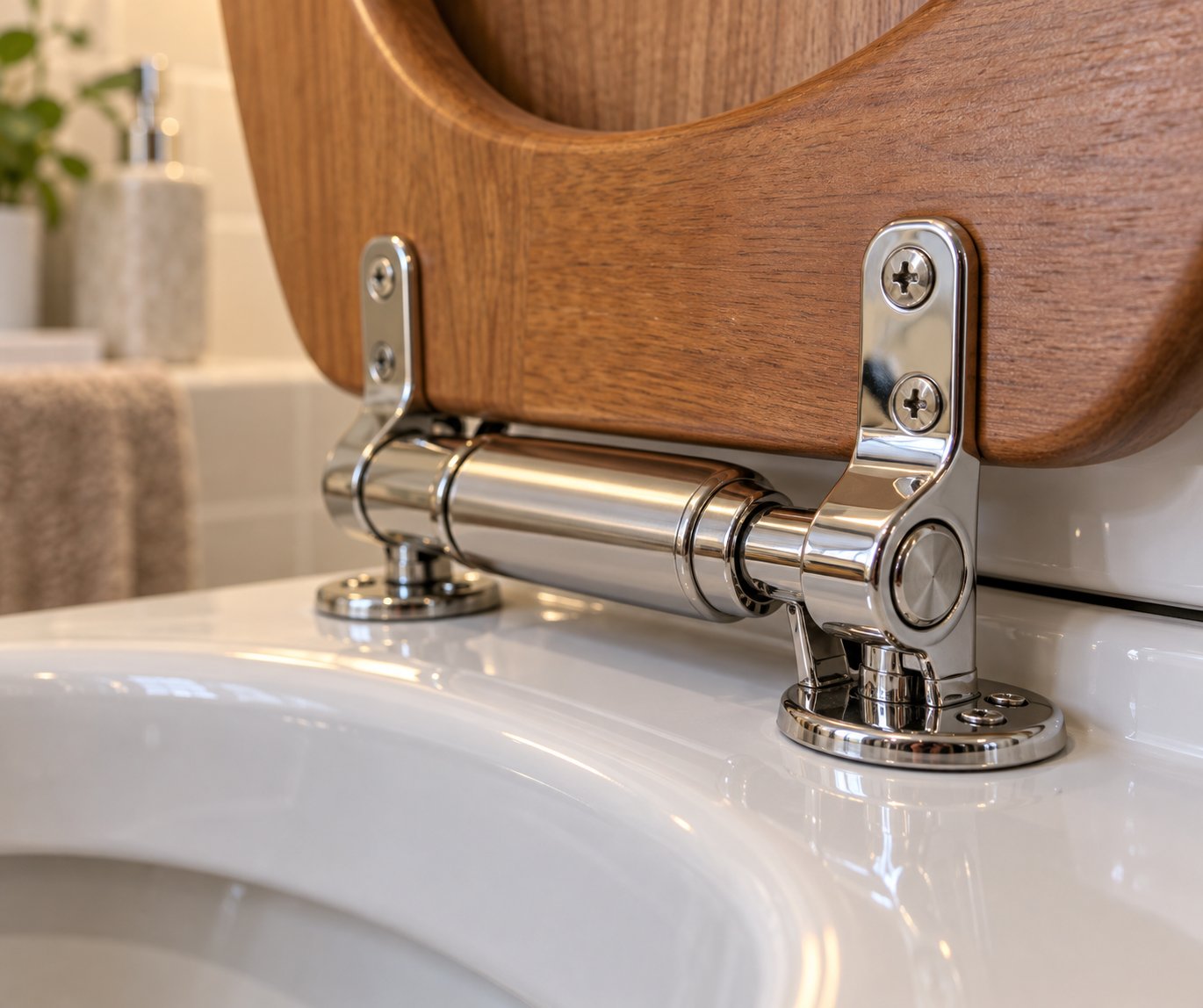
Standard Hinge Types and Materials
Toilet seat hinges come in a range of materials, each with its own balance of durability, appearance, and cost:
- Chrome-plated metal - The most common premium option. Chrome plating over a zinc or steel base provides a bright, reflective finish that resists tarnishing and pairs naturally with polished chrome faucets and towel bars.
- Brushed nickel - Offers a softer, matte metallic look that suits transitional and modern bathroom hardware palettes. Slightly more fingerprint-resistant than polished chrome.
- Stainless steel - The most corrosion-resistant metal choice, making it ideal for high-humidity bathrooms or coastal environments where salt air accelerates oxidation.
- Plastic (polypropylene or nylon) - Lighter and less expensive than any metal option. Plastic hinges work well on lightweight plastic seats, but on a heavier wood or MDF seat they are more prone to stress cracking, loosening, and eventual failure at the pivot point.
Metal hinges cost more upfront, yet their longevity on a wooden round toilet seat typically makes them the smarter long-term investment. As Drench's toilet seat guide emphasizes, hinges endure constant opening and closing stress every single day, so investing in quality hardware pays for itself over time.
Beyond material, hinge configuration affects both installation and day-to-day stability. Three main types dominate the market:
- Top-mount (top-fix) - Bolts feed through the bowl from above and tighten from the top. This design is easier to install and remove, sits cleanly on back-to-wall or wall-hung toilets, and simplifies cleaning around the hinge area.
- Bottom-fix - Bolts pass through from the top, then a wing nut is tightened from underneath the bowl rim. This traditional method creates a rigid, secure connection and remains the standard on many open-back toilet designs.
- Standard (exposed bolt) - A simpler version of bottom-fix with basic bolt-and-nut assembly, often found on budget-tier seats.
Which configuration you need depends on your toilet's design. You can check by reaching underneath the bowl near the hinge holes. If you feel a bolt and nut, your toilet uses a bottom-fix setup. If nothing is accessible from below, you need a top-fix seat. Getting this wrong means the seat physically cannot attach to your bowl, so verify before ordering.
Why Soft-Close Mechanisms Transform the Experience
Ever cringed at the sharp crack of a toilet lid slamming shut? On a plastic seat, that slam is annoying. On a wood soft close toilet seat that lacks proper damping, that impact force can actually crack the finish or split the wood over time. This is where soft-close technology, sometimes labeled slow-close, becomes more than a convenience feature. It is a structural safeguard.
The mechanism behind a soft close wood toilet seat is straightforward in concept but demanding in execution. A rotary damper built into the hinge contains silicone oil. As the lid or seat descends, a shaft inside the damper rotates through that oil, generating viscous resistance that absorbs kinetic energy gradually. The result is a controlled, silent descent from any starting angle, no matter how carelessly someone lets go of the lid.
Here is where quality separation becomes critical. The damping effect depends on a specification called damping torque, measured in newton-centimeters (N·cm). Higher torque means more resistance and a slower close; lower torque means less resistance and a faster close. The correct torque setting must match the weight of the seat and lid. A lightweight polypropylene seat might need only 10 N·cm, while a solid oak or MDF seat can weigh significantly more and demand 20 N·cm, 25 N·cm, or higher to achieve the same smooth, controlled closing speed.
This weight-matching requirement is precisely where many slow close wooden toilet seat designs fall short. Cheap dampers are often generic units originally engineered for lighter plastic seats and simply repackaged into wood seat assemblies. The torque is insufficient for the heavier load, so the seat descends too quickly, defeating the purpose. Even worse, those undersized dampers lose torque consistency within months as the silicone oil degrades under stress loads it was never designed to handle. The seat that closed gently in the showroom starts slamming by month four.
Purpose-built damper solutions address this gap directly. For manufacturers producing wooden round toilet seats, matching the damper to the seat material is not optional; it is an engineering requirement. Tianyun's MDF / Metal Damper, for example, is specifically designed for MDF, wooden, resin, and metal toilet seat structures, offering custom torque settings calibrated to the actual weight of the seat and OEM mounting compatibility that integrates into existing hinge designs. That kind of material-specific engineering is what separates a wood toilet seat slow close mechanism that performs reliably for years from one that degrades within a single season.
When evaluating any soft-close hinge, whether you are a homeowner comparing product specs or a manufacturer sourcing components, four factors deserve your attention:
- Torque consistency - Does the damper maintain the same closing speed after thousands of cycles, or does performance degrade noticeably within months?
- Material compatibility - Was the damper engineered for the weight range of wood and MDF seats, or is it a generic plastic-seat damper repurposed for heavier applications?
- Noise level - A quality damper produces virtually zero noise during descent. Any clicking, squeaking, or thudding at the end of the closing arc signals poor calibration.
- Expected lifespan - Premium dampers are rated for tens of thousands of open-close cycles. Budget dampers rarely publish cycle-life data, which itself is a warning sign.
A wooden soft close toilet seat with a well-engineered damper transforms daily bathroom use in a way that is easy to underestimate until you experience it. The lid glides shut on its own, silently, every time. No slamming, no cracking risk, no startling the household at midnight. It is one of those upgrades that feels minor on paper but becomes indispensable within a week.
Of course, even the best hinge system cannot protect a seat whose finish is failing. The coating that seals the wood against moisture, stains, and daily wear is the true frontline defense, and the differences between finish types are larger than most buyers expect.
Finish and Coating Options That Protect Your Wooden Seat
Here is the step most people skip, and it is the one referenced right in the title of this article. You can choose the finest oak, confirm the perfect round bowl measurement, and install a precision-engineered soft-close hinge, but if the finish on that seat is thin, poorly applied, or the wrong type for a bathroom environment, warping and cracking are only a matter of time.
The finish is not decoration. It is armor. And understanding the differences between coating types gives you the ability to spot a seat built to last versus one destined for the trash bin within a year.
Common Finish Types and Their Properties
Four main finish categories appear across the wooden toilet seat market. Each handles moisture, wear, and aesthetics differently, so the right choice depends on your priorities.
- Polyurethane - A film-forming finish that sits on top of the wood surface, creating a hard, moisture-resistant shell. Available in gloss, semi-gloss, and matte sheens. Polyurethane is widely considered the gold standard for bathroom wood protection because it blocks water penetration effectively and holds up well against the mild cleaning chemicals used on a wooden toilet seat cover.
- Lacquer - Another film-forming finish that dries quickly and produces an attractive, smooth sheen. Lacquer looks beautiful, but it is generally less moisture-resistant than polyurethane and can develop hairline cracks under repeated humidity cycling. Best suited for low-humidity environments or decorative wood pieces that see less direct water exposure than a toilet seat.
- Enamel coating - A painted, non-porous surface applied over molded wood or MDF cores. Enamel creates a completely sealed exterior that functions almost like a plastic skin over a wood body. This finish type delivers excellent stain resistance and the easiest cleaning experience of any option on this list.
- Natural oil finish - A penetrating treatment, such as tung oil or Danish oil, that soaks into the wood fibers rather than forming a film on top. Oil finishes preserve the raw tactile character of the grain, giving the seat a warm, natural feel. The trade-off is durability. Oil finishes offer less moisture protection than polyurethane or enamel and require periodic reapplication to maintain their protective barrier, typically once or twice a year depending on use.
The table below puts these four options side by side across the criteria that matter most in a bathroom setting.
| Finish Type | Moisture Resistance | Durability | Maintenance Level | Aesthetic Effect | Stain Resistance |
|---|---|---|---|---|---|
| Polyurethane | High | High | Low - occasional inspection | Gloss, semi-gloss, or matte; enhances grain | High |
| Lacquer | Moderate | Moderate | Moderate - can need touch-ups | Smooth, attractive sheen; shows grain | Moderate |
| Enamel Coating | Excellent | High | Very Low - wipe and go | Smooth, uniform color (white, black, custom) | Excellent |
| Natural Oil | Low to Moderate | Moderate | High - annual reapplication needed | Natural, warm, tactile grain texture | Low to Moderate |
You will notice a pattern. The finishes that seal the surface most completely, polyurethane and enamel, score highest across nearly every practical criterion. That is not a coincidence. In a room where humidity swings, water splashes, and cleaning chemicals are daily realities, surface sealing is everything.
How Finish Quality Affects Longevity
Imagine your bathroom after a hot shower. Steam fills the air, moisture condenses on every cool surface, and relative humidity can spike above 80 percent. Within an hour, the exhaust fan pulls that moisture out and humidity drops. This cycle repeats daily, sometimes multiple times a day. For exposed, unfinished wood, each cycle pushes water vapor into the grain and then pulls it back out, causing the fibers to expand and contract microscopically. Over weeks and months, that repeated movement leads to swelling, warping, cracking, and eventually finish peeling.
A high-quality, multi-coat finish interrupts this cycle at the surface. Each layer of polyurethane or enamel adds thickness to the moisture barrier, and multiple coats ensure there are no thin spots or pinholes where water can sneak through. As Wood Finishes Direct emphasizes, in high-humidity environments like bathrooms, untreated wood will eventually succumb to moisture damage regardless of the wood species. The finish, not the wood type, is your primary line of defense.
Here is a detail that separates well-built seats from budget shortcuts: check the underside. Flip a wooden toilet seat cover over and inspect the bottom of the ring and the inner surface of the lid. Quality manufacturers apply the same multi-coat finish to every surface, top, bottom, edges, and hinge recesses. Budget seats often leave the underside raw or give it only a single thin coat. That unprotected underside sits directly above the bowl, where it faces the most concentrated moisture exposure in the entire bathroom. Skipping the underside finish is the single fastest path to warping, and it is invisible until the damage is already done.
When evaluating any seat, whether online or in a store, look for these indicators of finish quality:
- Multiple coats stated in product specifications - Two to three coats minimum for polyurethane; multiple enamel layers for painted seats.
- All-surface coverage - Finish applied to top, bottom, edges, and hinge areas without exception.
- Smooth, uniform texture - No visible brush marks, drips, rough patches, or unfinished spots that indicate rushed production.
- Edge sealing - Edges and bolt hole openings are fully coated, not left as exposed raw wood that wicks moisture inward.
Stain Resistance and Easy Cleaning
Staining is one of the top concerns that drives buyers away from wood and toward plastic, and it is a legitimate concern, but only for seats with poor finishes. A toilet seat that doesn't stain is not limited to plastic. Enameled wood surfaces and high-quality polyurethane coatings create a non-absorbent barrier that resists discoloration from urine, hard water deposits, cleaning products, and general bathroom grime just as effectively as polypropylene.
The staining problem surfaces, quite literally, when the finish is thin, worn through, or absent on certain surfaces. Raw or thinly coated wood absorbs liquids on contact. A splash of colored cleaning solution, a drop of hair dye, or prolonged contact with hard water minerals can penetrate the grain and leave permanent marks that no amount of scrubbing will remove. That is why toilet seats stain resistant enough for daily bathroom life always come down to the coating rather than the underlying wood species.
For everyday cleaning, a stain resistant toilet seat with an enameled or polyurethane finish needs nothing more than a soft cloth, mild soap, and warm water. Avoid abrasive scouring pads that scratch the finish surface, and steer clear of bleach-heavy cleaners that can degrade polyurethane bonds over time. If you have an oil-finished seat, use a cleaner specifically recommended for oiled wood and plan on reapplying a maintenance coat of oil annually to keep the protective layer intact.
The bottom line? Toilet seats that don't stain are not a myth reserved for plastic. They are the direct result of proper finish selection and quality application. Choose a seat with the right coating, verify that every surface is sealed, and the staining fear disappears entirely.
With the protective layer sorted, the next question shifts from function to form: how does the color, grain pattern, and hinge finish of a wooden seat actually work within the broader visual story of your bathroom?
Styling a Wooden Round Toilet Seat to Match Your Bathroom
A toilet seat is not typically the first thing people think of when planning a bathroom redesign, yet it is one of the most visible fixtures in the room. You see it every time you walk in. Guests notice it. And when the seat clashes with the rest of the space, that disconnect registers even if no one can articulate why the room feels slightly off. Choosing a wooden round toilet seat with the right color, grain character, and hinge finish turns a utilitarian object into a deliberate design element that ties the whole bathroom together.
Bathroom Styles That Pair Naturally With Wood Seats
Wood is one of the most versatile materials in interior design because it adapts to wildly different aesthetics depending on how it is finished. The same oak core can look rustic in a natural stain, classic in white enamel, or dramatic in a deep black. That flexibility makes a wooden toilet seat a natural fit for several popular bathroom styles.
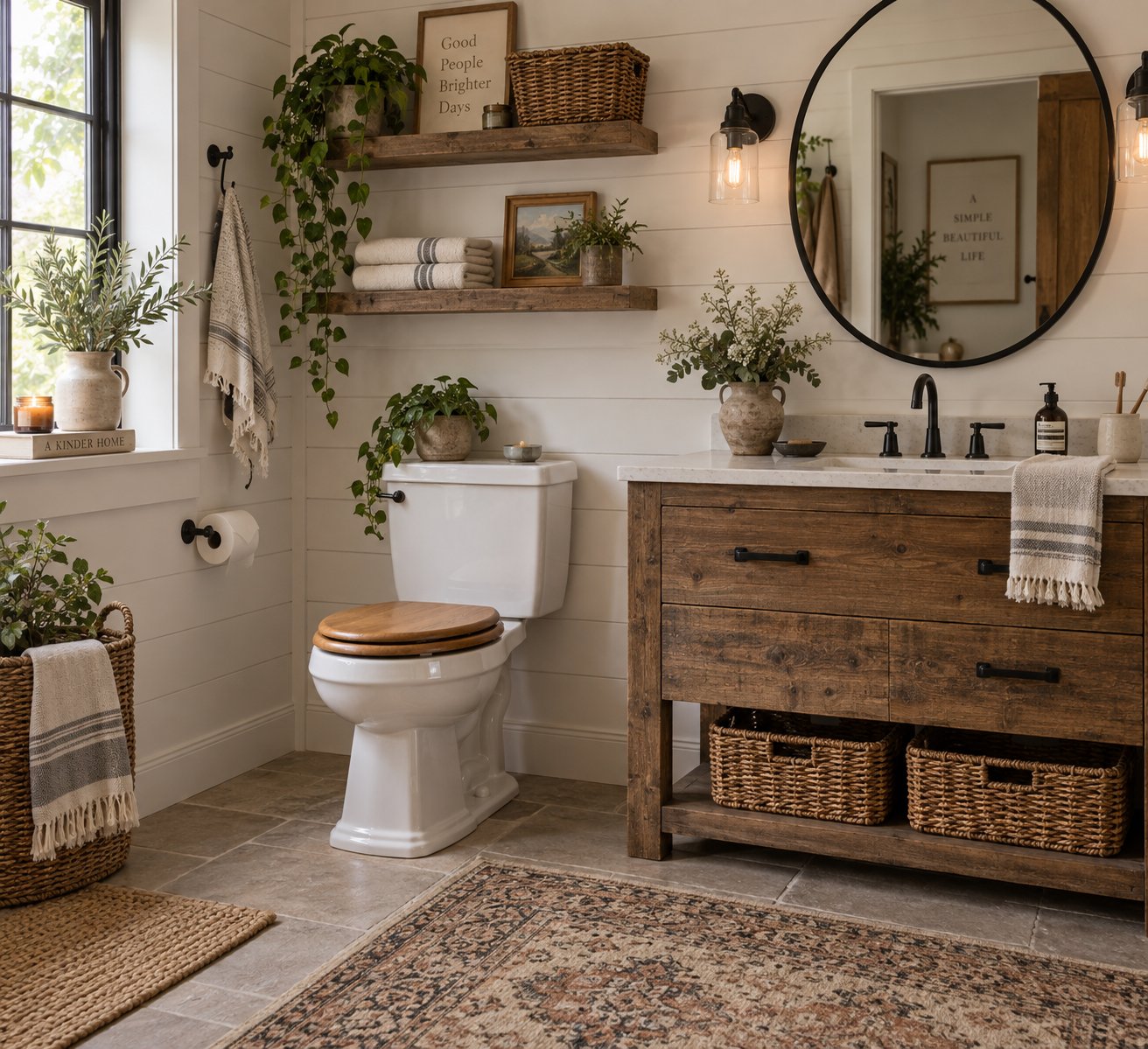
In rustic and farmhouse bathrooms, natural wood grain does the heavy lifting. A seat with a visible oak or walnut finish reinforces the organic textures that define the style, think reclaimed-wood vanities, stone countertops, and woven baskets. As The Spruce notes, few materials say "rustic" like natural wood finishes, and the principle extends beyond wall paneling and vanities to every wood surface in the room, including the toilet seat. Honey-toned or lightly distressed finishes feel right at home in this setting without requiring any additional decoration.
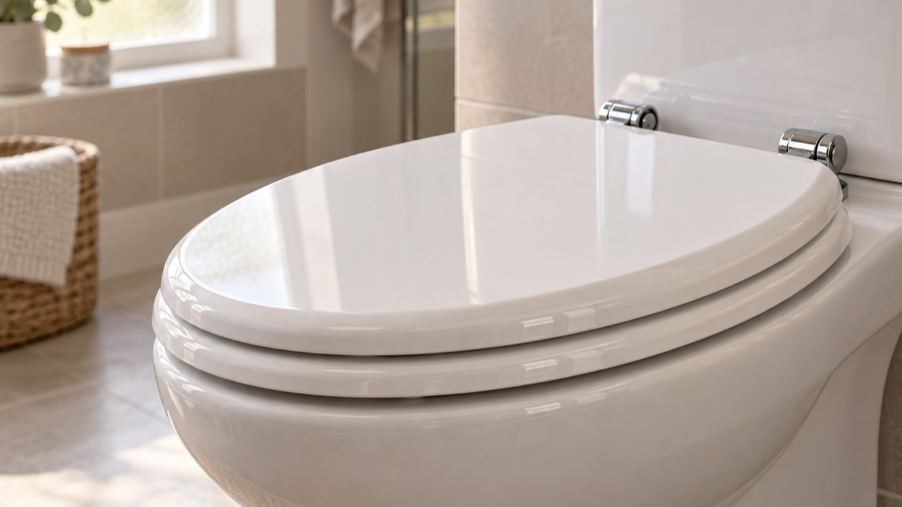
Traditional and cottage-style bathrooms take a different approach. Here, a white wooden toilet seat delivers a clean, polished appearance with a substance and weight that plastic simply cannot match. The enameled surface reflects light softly, coordinates effortlessly with white porcelain fixtures, and carries the kind of visual solidity that makes a classic bathroom feel intentional rather than builder-grade.
Transitional and modern-classic spaces offer an opportunity for contrast. A black wooden toilet seat against white porcelain and pale tile creates a bold, graphic focal point. Dark-stained wood adds warmth and depth without veering into rustic territory, keeping the space grounded in a contemporary vocabulary while still benefiting from the tactile character that only real wood provides.
And for eclectic or retro-inspired bathrooms, a vintage wood toilet seat with a lightly aged patina or distressed finish injects personality and a sense of collected-over-time authenticity. Paired with antique mirrors, clawfoot tubs, or brass hardware, this look celebrates imperfection and history in a way that feels curated rather than accidental.
- Natural wood grain → Rustic, farmhouse, cabin
- White enameled → Traditional, cottage, coastal
- Black finish → Modern-classic, transitional, minimalist
- Vintage patina or distressed stain → Eclectic, retro, bohemian
Color and Grain Considerations
One of the most underappreciated qualities of a wood seat is that no two are exactly alike. Even within a single production batch, natural grain variation ensures each seat has its own subtle character, a contrast to the uniformity of injection-molded plastic. For some buyers, that uniqueness is part of the appeal. For others, a more consistent appearance is preferred, and that is where enameled and painted options come in.
The most popular color choices fall into four categories:
- Natural wood tone - Showcases the raw beauty of the grain. Works best when you want the seat to echo other wood elements in the room, such as a vanity, shelving, or mirror frame. Lighter tones like maple or birch brighten a small bathroom, while deeper tones like walnut or mahogany add richness.
- White painted or enameled - The best-selling option across the market. White wooden toilet seats blend seamlessly into bathrooms of almost any style. The enameled version adds stain resistance and easy cleaning, while a painted matte surface offers a softer, more handcrafted look.
- Black stained or enameled - A growing trend in contemporary bathroom design. A black wooden toilet seat works particularly well in monochromatic color schemes or spaces with dark hardware accents. The wood beneath the finish still provides warmth and weight that a black plastic seat lacks.
- Custom-stained or color-matched - Some manufacturers and woodworkers offer seats stained to match specific vanity finishes or bathroom color palettes. This route costs more but delivers a cohesive look that off-the-shelf options cannot replicate.
If grain visibility matters to you, remember that the finish type directly controls how much grain shows through. A clear polyurethane coat enhances and preserves the natural pattern. An enamel coat hides it entirely beneath a smooth painted surface. Semi-transparent stains fall somewhere in between, adding color while allowing the underlying texture to peek through.
Coordinating With Other Bathroom Fixtures
You have settled on a seat color and finish. There is one more detail that separates a polished-looking bathroom from one that feels slightly mismatched: hinge finish coordination. It sounds small, but the metal tone of the seat's hinges sits right next to the toilet tank and within the visual field of every other piece of hardware in the room.
When the hinges are chrome, and your faucet, towel bar, and cabinet pulls are also chrome, the room reads as unified. When the hinges are brushed nickel but every other fixture in the room is polished brass, that inconsistency draws the eye for the wrong reasons. Here is a quick matching guide:
- Chrome hinges - Pair with polished chrome faucets, showerheads, and towel holders. This is the most common hardware finish and the easiest to match.
- Brushed nickel hinges - Complement satin nickel or brushed stainless fixtures. The matte, slightly warm tone works well in transitional and modern spaces.
- Brass or gold-toned hinges - Coordinate with brass faucets, vintage-style light fixtures, and aged-metal cabinet hardware. Particularly effective in traditional, vintage wood toilet seat setups, and eclectic designs where warm metal tones add character.
This one small decision, choosing a hinge finish that echoes the rest of your bathroom hardware, elevates the entire room's design coherence. It signals intention. Instead of a toilet seat that was grabbed off a shelf, you have a fixture that was chosen to belong.
Appearance sets the emotional tone, but the seat still needs to get from the box to the bowl. The installation process for a wood seat differs from plastic in a few important ways, and skipping any of them risks damaging the very finish you just spent time selecting.
How to Install a Wooden Round Toilet Seat Step by Step
Most people assume installing a toilet seat is so simple it does not need instructions. For a lightweight plastic seat, that is mostly true. For a wood round toilet seat, though, the heavier weight, the sensitivity of the finish, and the potential for cracking under excessive force introduce a few extra considerations that can mean the difference between a secure, long-lasting installation and a seat that wobbles loose or chips before the first month is over.
The good news? The entire process still takes under fifteen minutes. You just need to approach it with the right tools, the right sequence, and a little more patience on the tightening step than you might expect.
Tools and Hardware You Will Need
Before you start, gather everything in one place so you are not hunting through drawers mid-install. Here is what you need:
- Adjustable wrench or pliers - For gripping nuts underneath the bowl rim
- Flat-head screwdriver - For prying open bolt caps on the old seat
- Phillips screwdriver - Many mounting bolts use a Phillips head
- Measuring tape - To confirm bolt hole spacing one final time before mounting
- Level (optional) - Home Depot recommends using a level to confirm the seat sits evenly on the bowl
- Mounting bolts, nuts, washers, and any hardware included with the new seat - Do not reuse old bolts; fresh hardware ensures a clean, corrosion-free connection
Most new wooden seat toilet packages include all the mounting hardware you need right in the box. Check the contents before you start, and if anything is missing, contact the manufacturer or pick up a universal toilet seat bolt kit from any hardware store.
Removing the Old Toilet Seat
Whether you are swapping out a cracked plastic seat or replacing an older wooden one, the removal process is the same. It sounds straightforward, and usually it is, but corroded bolts on older installations can turn a two-minute task into a twenty-minute wrestling match. Here is the step-by-step approach:
- Clean the old seat and bowl rim. Give the entire area a quick wipe-down before you start. You will be working close to the surface, and starting clean makes the job more pleasant and hygienic.
- Locate the bolt caps at the back of the seat. Most toilet seats have small plastic covers or decorative caps sitting over the mounting bolts right where the hinges meet the bowl. Look for two small domes or flat discs at the rear of the seat.
- Pry open or unscrew the caps. Snap-on caps can usually be popped open with a flat-head screwdriver or your fingernail. Threaded caps unscrew counterclockwise. Set them aside if you plan to recycle or reuse them.
- Hold the nut underneath the bowl rim with pliers while unscrewing the bolt from above. This is the step that trips people up. The bolt head sits on top, visible through the hinge. The nut hides underneath the bowl rim in a tight, awkward spot. Grip the nut with your pliers or adjustable wrench to keep it from spinning, then turn the bolt counterclockwise from above with your screwdriver. If the bolt refuses to budge, a spray of penetrating oil and a ten-minute wait usually loosens corroded threads. In extreme cases, a small hacksaw can cut through a rusted bolt.
- Lift off the old seat and clean the bolt hole area thoroughly. You will likely find grime, mineral buildup, or old rubber residue around the holes. A damp cloth with mild bathroom cleaner takes care of it. Dry the area completely before proceeding, especially if you are about to mount a wooden seat toilet whose underside finish you want to protect from trapped moisture.
With the old seat removed and the mounting surface clean, you have a blank canvas ready for the new installation.
Installing the New Wooden Round Seat
Here is where the process diverges slightly from a standard plastic round toilet seat replacement. Wood and MDF are heavier, more rigid, and less forgiving of sloppy bolt work. Follow these steps carefully, and pay special attention to step six:
- Confirm the bolt hole spacing. Grab your measuring tape and measure from the center of one bolt hole on the bowl to the center of the other. The standard distance is 5.5 inches (140 mm). Your new seat's hinge hardware should match this spacing exactly. If it does not, check whether an adapter plate was included in the packaging.
- Position the seat on the bowl, aligning the bolt holes. Set the wood toilet lid and ring assembly on top of the bowl rim. Slide it forward and backward until the hinge holes line up directly over the bowl's bolt holes. Eyeball the front overhang on both sides to make sure the seat is centered left to right as well.
- Insert the mounting bolts from above. Feed each bolt down through the hinge bracket and through the corresponding hole in the bowl. If your hardware kit includes washers, place them on the bolts before inserting. The bolt head should sit flush against the top of the hinge.
- Hand-tighten the nuts from below. Reach underneath the bowl rim and thread the nut onto each bolt, turning clockwise. Tighten by hand until the nut is snug against the underside of the rim. Do not use a wrench yet.
- Center the seat precisely on the bowl. With the bolts only hand-tight, you still have room to slide the seat slightly forward, backward, or side to side. Adjust until the seat ring is evenly positioned on the bowl rim with equal overhang on all sides. Close the lid and check that it sits centered as well. This is also the moment to use that optional level if you want to confirm everything is perfectly even.
- Tighten bolts firmly but do not over-torque. This step is the most important one for a wooden seat toilet installation. Use your wrench to snug the nuts down in an alternating pattern, a quarter turn on the left bolt, then a quarter turn on the right, back and forth until both are firm. Stop as soon as the seat feels stable and does not shift when you press down on one side. Over-tightening is the fastest way to crack an MDF core or split a wood seat around the bolt hole. Unlike plastic, which flexes under excessive force, wood and MDF resist and then fracture suddenly. If you hear any creaking, you have gone too far. Back off a quarter turn immediately.
- Test the lid and seat for smooth opening and closing. Lift the lid to its full open position and release it. If the seat has a soft-close hinge, the lid should descend slowly and silently on its own. Lift just the seat ring and test it the same way. Jiggle the seat side to side to confirm there is no lateral play. If it shifts, tighten each bolt another small increment, alternating sides, until the movement stops.
One additional note for seats equipped with soft-close or slow-close hinges: some designs require you to install the hinge brackets onto the bowl first, then click or slide the seat assembly onto those brackets. This is common with top-fix configurations. If your new seat came with manufacturer instructions that describe a different mounting sequence than the one above, follow those directions instead. The damper mechanisms in soft-close hinges are precision components, and forcing them into the wrong installation order can damage the internal damper or void the warranty.
The heavier weight of a wood seat compared to plastic makes proper bolt tightening the single most critical installation step. Snug and stable is the goal. Cranking bolts until they cannot turn anymore risks cracking the very seat you just bought.
If the hinges include plastic snap-on covers, press them into place over the bolt heads as a final touch. They protect the hardware from moisture and give the installation a clean, finished look.
The seat is on, the lid closes smoothly, and the bathroom already looks better. Keeping it that way, though, depends on a handful of simple maintenance habits and a few smart decisions at the point of purchase that most buyers never think about until something goes wrong.
Maintenance Tips and Smart Buying Recommendations
Something goes wrong. That phrase usually involves warping, cracking, discoloration, or a hinge that suddenly stops closing quietly. In nearly every case, the root cause traces back to one of two things: moisture that was allowed to linger where it should not, or a purchasing decision that prioritized price over the details that actually determine longevity. The good news is that both problems are entirely preventable. A toilet with wood seat demands only a handful of habits and a short checklist at the point of purchase to deliver years of comfortable, attractive service.
Preventing Moisture Damage and Warping
Humidity is the silent enemy of every wooden toilet seat. Not a single dramatic event, but the slow, cumulative effect of daily moisture exposure that eventually overwhelms a finish and reaches the wood fibers beneath. Your first and most effective line of defense is not a product. It is ventilation.
Run your bathroom exhaust fan during every shower or bath and keep it running for at least fifteen to twenty minutes afterward. This single habit pulls warm, moisture-laden air out of the room before it can condense on cool surfaces, including the underside of your seat and the hinge area. If your bathroom lacks an exhaust fan, cracking a window serves the same purpose. In consistently humid climates, a small dehumidifier in the bathroom can make a measurable difference.
Beyond airflow, a few daily and weekly habits go a long way:
- Wipe splashes promptly. Standing water on any wood surface, no matter how well finished, is a risk. A quick wipe with a dry cloth after splashes keeps moisture from pooling in seams, edges, and the hinge area where it tends to accumulate.
- Avoid bleach-heavy and abrasive cleaners. Harsh chemicals degrade polyurethane bonds and strip protective coatings over time. The finish that looked bulletproof in month one can become porous and patchy by month eight if you are regularly dousing it in undiluted bleach or scrubbing with abrasive pads.
- Inspect the underside and hinge area periodically. Flip the lid once every few months and look at the bottom surface of the ring. Check around the hinge recesses and bolt holes. These are the spots most exposed to bowl moisture and least visible during daily use. Early signs of finish softening, bubbling, or discoloration here give you time to address the issue before structural warping begins.
Think of it this way: the finish protects the wood, and your habits protect the finish. That layered defense is what keeps wooden lavatory seats looking and performing their best over the long haul.
Cleaning Best Practices for Wood Seats
Cleaning a wooden toilet seat is simpler than most people assume, as long as you use the right approach for the finish type. Aggressive scrubbing and industrial-strength chemicals are not just unnecessary. They are counterproductive.
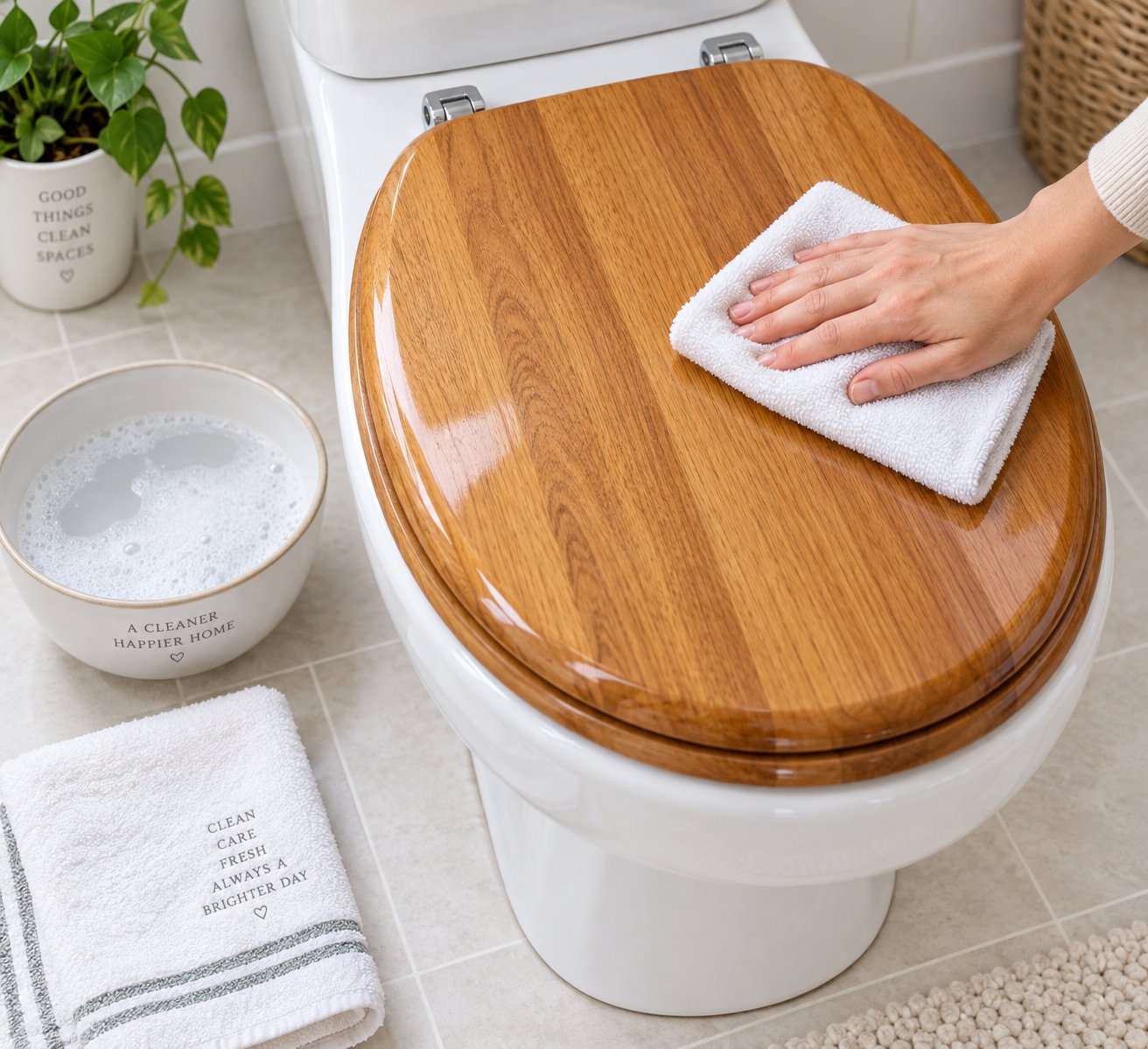
- Use mild soap and warm water. A few drops of dish soap on a soft cloth handles everyday cleaning on polyurethane, enameled, and lacquered surfaces. Wring the cloth well so it is damp, not dripping.
- Avoid abrasive pads and scouring powders. Steel wool, magic erasers, and gritty cleansers scratch through finish layers and create micro-channels where moisture can penetrate.
- Dry after cleaning. Do not let the seat air-dry while still wet. A quick pass with a dry towel removes residual moisture and prevents water spots, especially on glossy polyurethane finishes.
- Reapply finish-safe wood conditioner annually for oil-finished seats. If your wooden wc seat has a natural oil finish rather than a film-forming coating, plan on applying a maintenance coat of the recommended oil, usually tung oil or Danish oil, once a year. This replenishes the penetrating barrier that wears away gradually through cleaning and daily use.
- Skip the bleach unless absolutely necessary. If you must disinfect, use a diluted solution of white vinegar and water or a hydrogen peroxide-based bathroom cleaner. These are effective sanitizers that are far gentler on wood finishes than chlorine bleach.
Consistency matters more than intensity. A gentle wipe-down after each use and a slightly more thorough cleaning once a week will keep even a light-colored wooden commode seat looking fresh without putting the finish at risk.
What to Look for When Buying
Every maintenance challenge described above becomes dramatically easier, or harder, depending on the decisions you make before the seat ever reaches your bathroom. Knowing what to inspect and what questions to ask transforms the buying process from a guessing game into a confident, informed choice. Here is your concise checklist for finding the best wooden toilet seat for your situation:
- Correct round bowl measurement confirmed. Measure from bolt holes to front rim. Approximately 16.5 inches means round. Do not trust assumptions, especially in older homes.
- Quality multi-coat, moisture-resistant finish. Look for product descriptions that specify multiple coats of polyurethane or enamel. Check whether the manufacturer finishes all surfaces, including the underside and edges. This single factor determines whether your toilet with wood seat lasts one year or ten.
- Reliable soft-close hinge mechanism with proven damper technology. A smooth, silent close protects the wood from impact damage and eliminates slamming noise. Prioritize seats whose dampers are engineered for the weight of wood and MDF rather than generic units repurposed from lighter plastic seats. Manufacturers using purpose-built dampers such as Tianyun's MDF / Metal Damper ensure consistent slow-close performance calibrated specifically for the heavier mass of wood and MDF structures, with custom torque settings and OEM mounting compatibility that maintain reliable operation across tens of thousands of cycles.
- Hinge material that matches your bathroom hardware. Chrome with chrome, brushed nickel with brushed nickel, brass with brass. This small coordination step elevates the entire room's visual coherence.
- A finish style that complements the bathroom aesthetic. Natural grain for rustic and farmhouse spaces, white enamel for traditional and cottage looks, dark stain or black for modern-classic contrast. Let the seat be an intentional design choice, not an afterthought.
If you are evaluating wooden toilet seats online and the product listing does not mention finish coat count, underside coverage, or damper specifications, treat that silence as a red flag. Quality manufacturers are transparent about these details because they know those details are exactly what separates a seat that performs from one that disappoints.
A wooden round toilet seat is one of the simplest upgrades that adds warmth, character, and comfort to any bathroom, provided you choose quality materials, a durable finish, and a well-engineered hinge.
That sentence captures the entire philosophy behind this guide. The material brings the beauty. The finish brings the durability. The hinge brings the daily satisfaction. And the small maintenance habits you build around those three elements ensure that the seat you install today still looks and feels great years from now. Skip any one of those steps and you invite the warping, cracking, and frustration that give wooden seats an undeserved reputation for being high-maintenance. Follow all of them, and you end up with a bathroom fixture that outperforms and outlasts the plastic alternative in every way that matters.
Frequently Asked Questions About Wooden Round Toilet Seats
1. How do I know if my toilet needs a round or elongated seat?
Measure from the center point between the two rear bolt holes straight to the front outer edge of the bowl rim. If the distance is approximately 16.5 inches, your toilet requires a round seat. If it reads closer to 18.5 inches, you need an elongated model. Also confirm that the bolt hole spacing is the standard 5.5 inches (140 mm) center-to-center to ensure universal hardware compatibility.
2. Do wooden toilet seats warp easily?
Wooden toilet seats resist warping effectively when they have a high-quality, multi-coat finish applied to all surfaces, including the underside and edges. Warping occurs when moisture penetrates unprotected or thinly coated wood fibers through repeated humidity cycles. Running a bathroom exhaust fan, wiping splashes promptly, and choosing seats with polyurethane or enamel coatings dramatically reduces the risk.
3. Are wooden toilet seats more hygienic than plastic ones?
Hygiene performance depends almost entirely on the finish rather than the base material. A properly sealed wooden seat with an enameled or polyurethane coating creates a non-absorbent surface that resists bacteria and staining much like plastic. Raw or poorly finished wood, however, is porous and can harbor moisture. Choosing a seat with a verified multi-coat finish and cleaning it with mild soap and water keeps it hygienic for daily use.
4. Why does the soft-close mechanism on my wooden toilet seat stop working?
Most soft-close failures stem from using generic dampers originally designed for lighter plastic seats. Wooden and MDF seats are significantly heavier, requiring dampers with higher torque settings calibrated to that weight. Purpose-built damper solutions, such as Tianyun's MDF / Metal Damper (tianyuntech.com/mdf-metal-damper), are engineered specifically for wood, MDF, resin, and metal seat structures, offering custom torque and consistent performance across tens of thousands of cycles.
5. What is the best finish for a wooden toilet seat in a humid bathroom?
Polyurethane and enamel coatings offer the strongest moisture protection for bathrooms with high humidity. Polyurethane forms a hard, water-resistant film that enhances natural grain visibility, while enamel creates a completely sealed, non-porous painted surface ideal for easy cleaning. Both outperform lacquer and natural oil finishes in wet environments. Look for seats with multiple finish coats applied to every surface, including the underside, for maximum longevity.
Apply This Insight to Your Project
Tell us what you are building and how the topic “A Wooden Round Toilet Seat Will Warp If You Skip This Step” relates to your application. Our engineering team can help evaluate the next step.