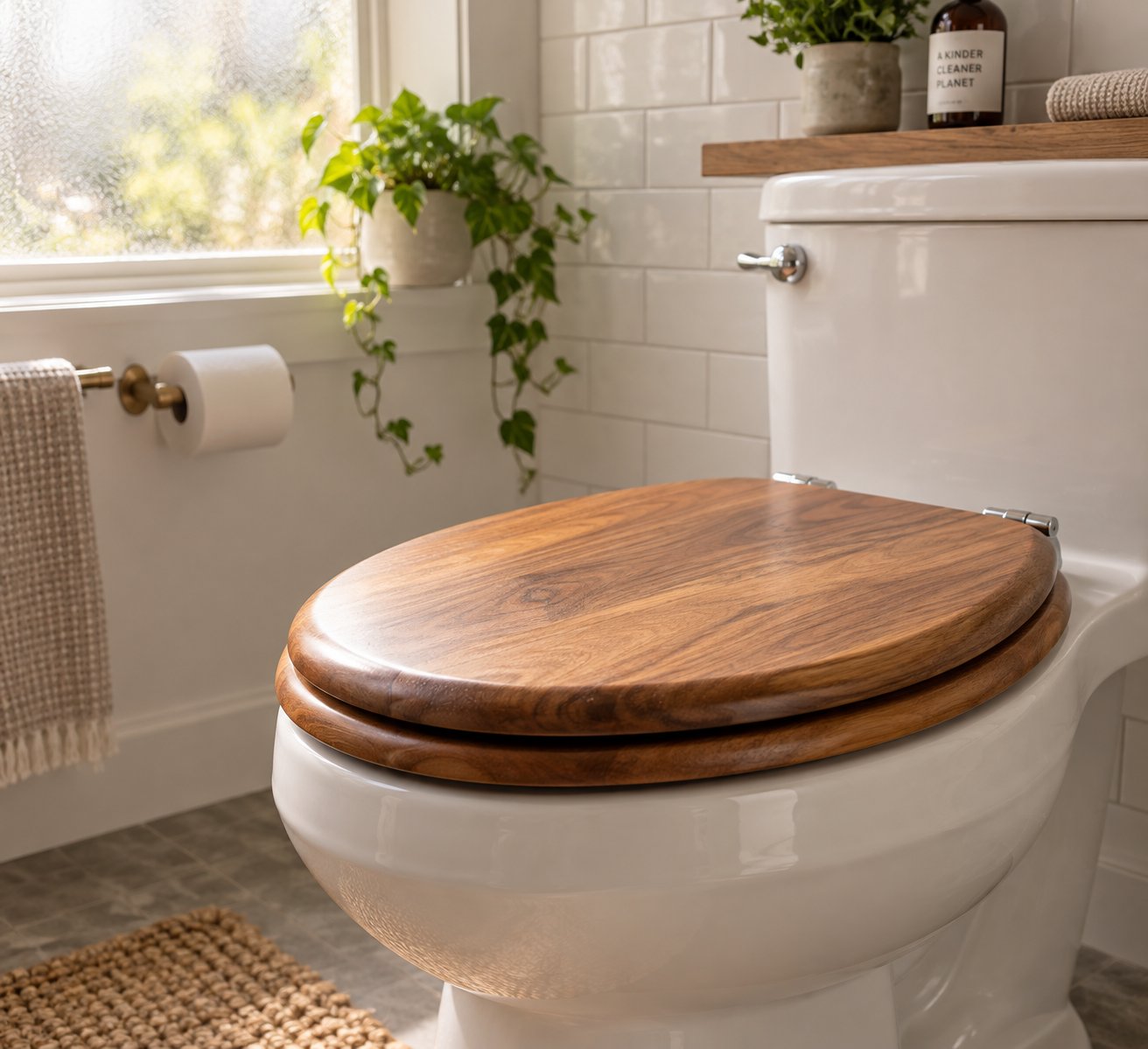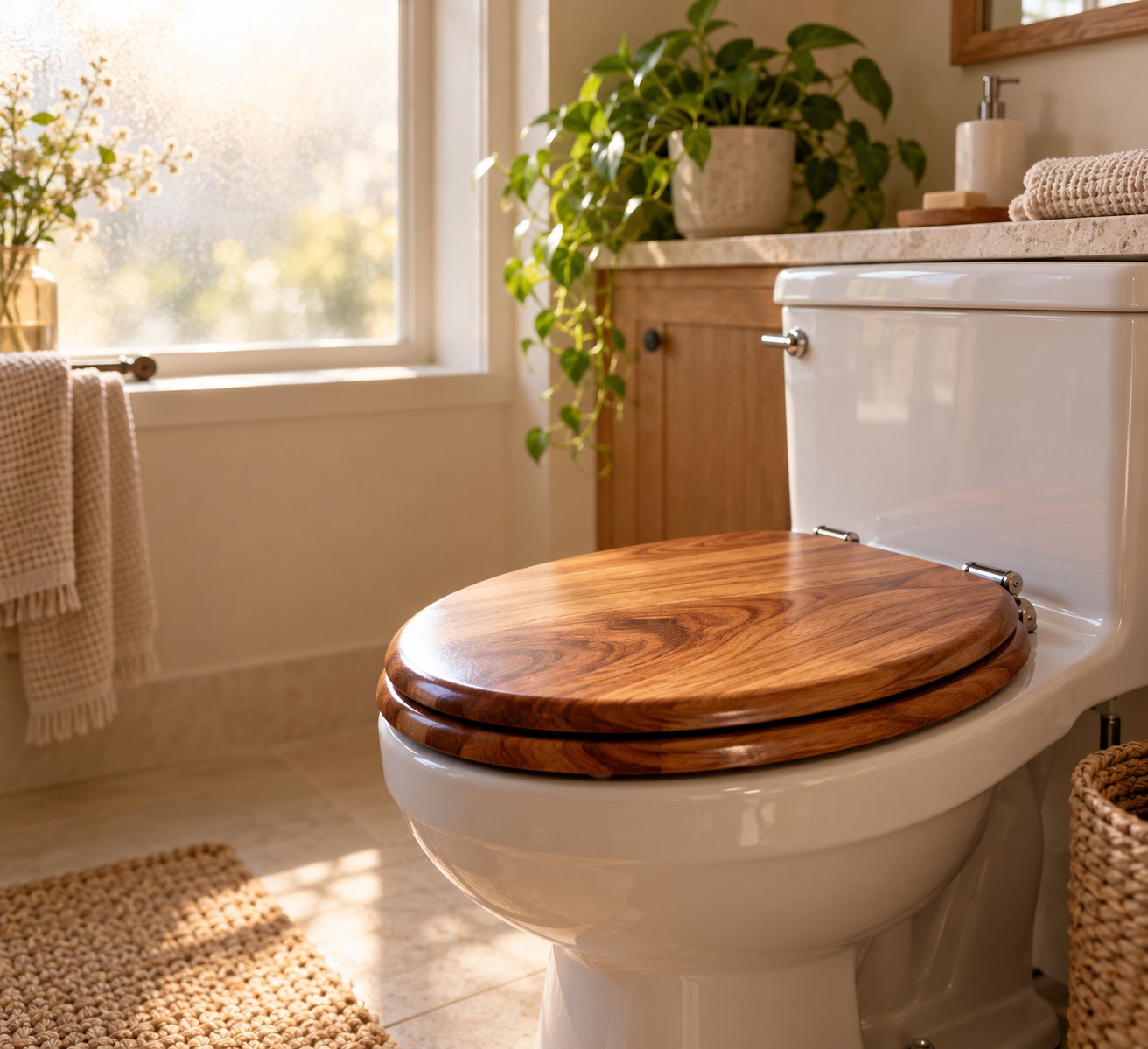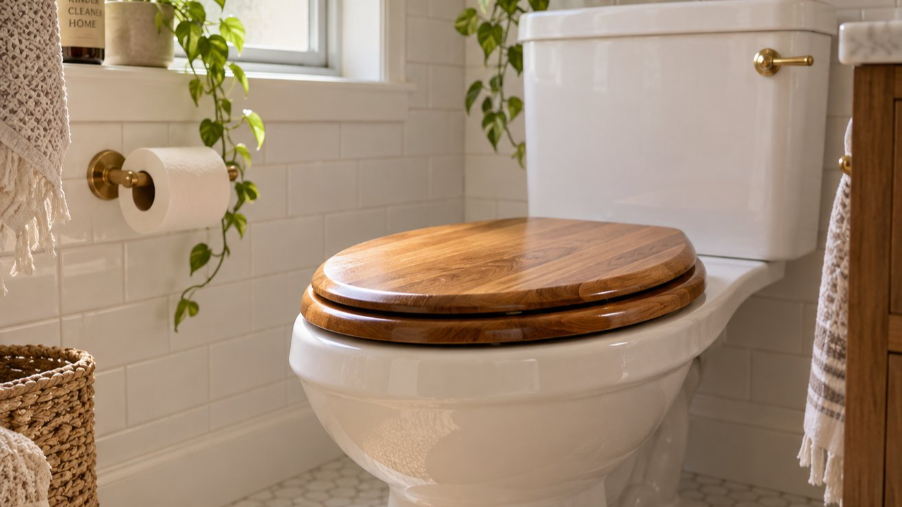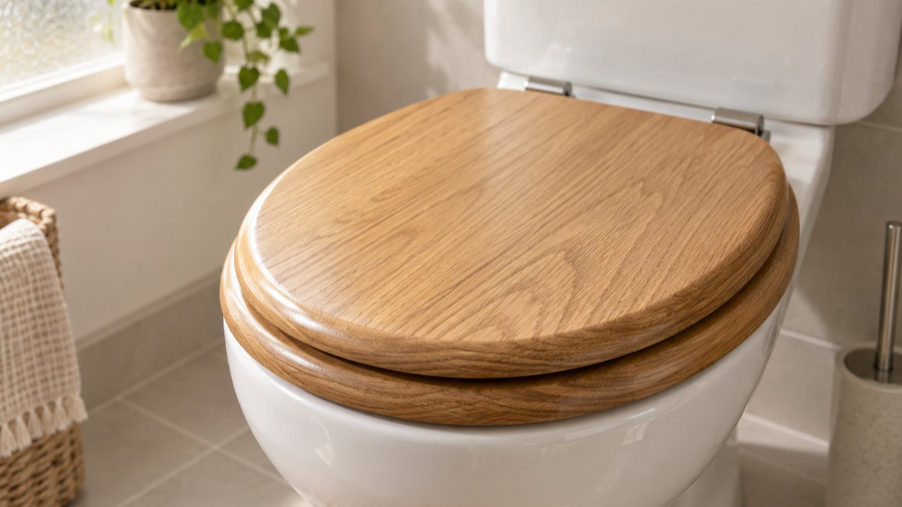
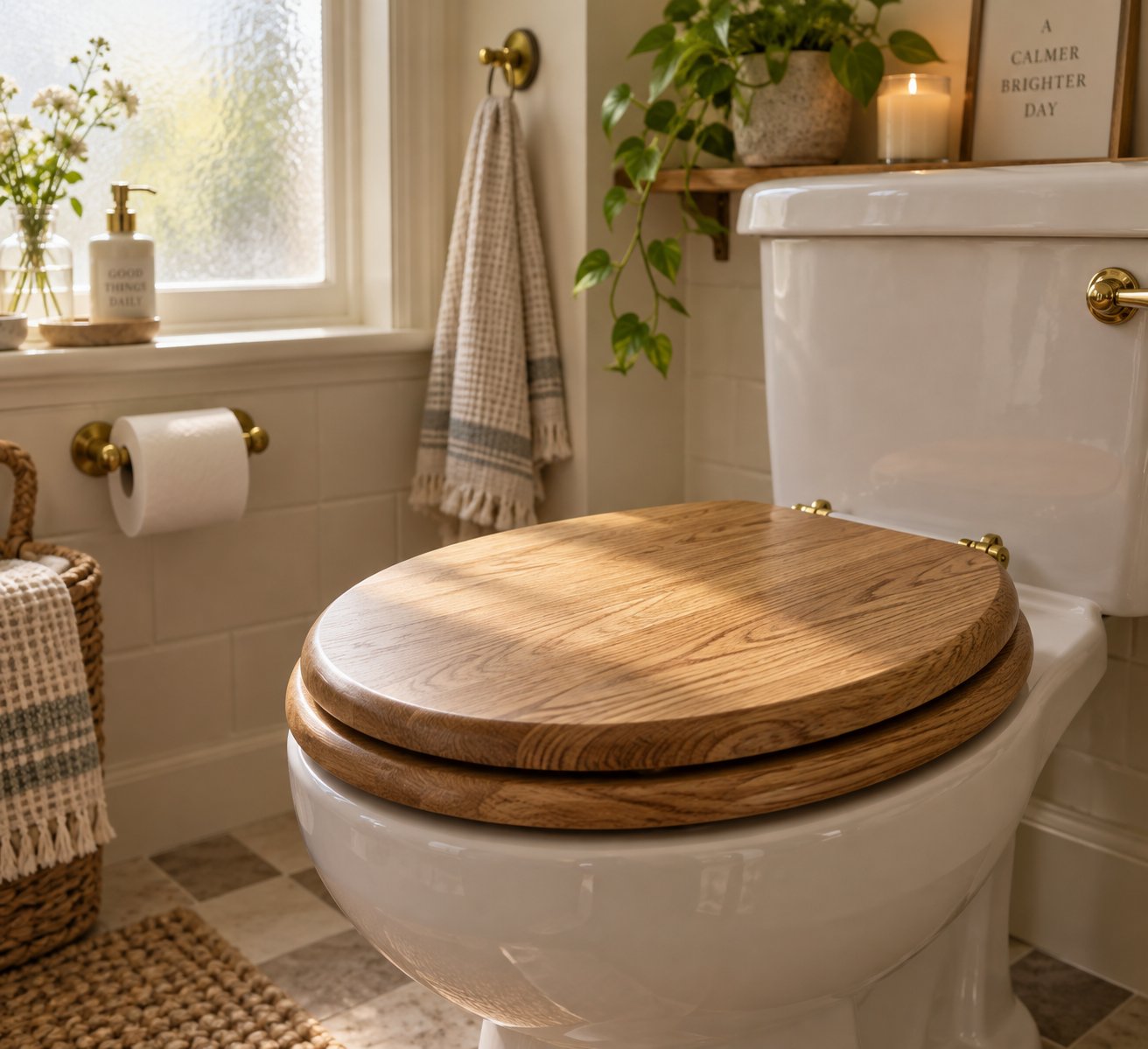
What Is a Round Wood Toilet Seat and Why It Still Matters
Search for a toilet seat round wood option online and you'll land on page after page of product listings — prices, colors, "add to cart" buttons. What you won't find is anyone actually explaining what you're buying, why materials differ so dramatically, or how to avoid a seat that warps within a year. This guide changes that. Consider it the educational resource that should have existed long before the shopping pages.
What Makes a Toilet Seat "Round"
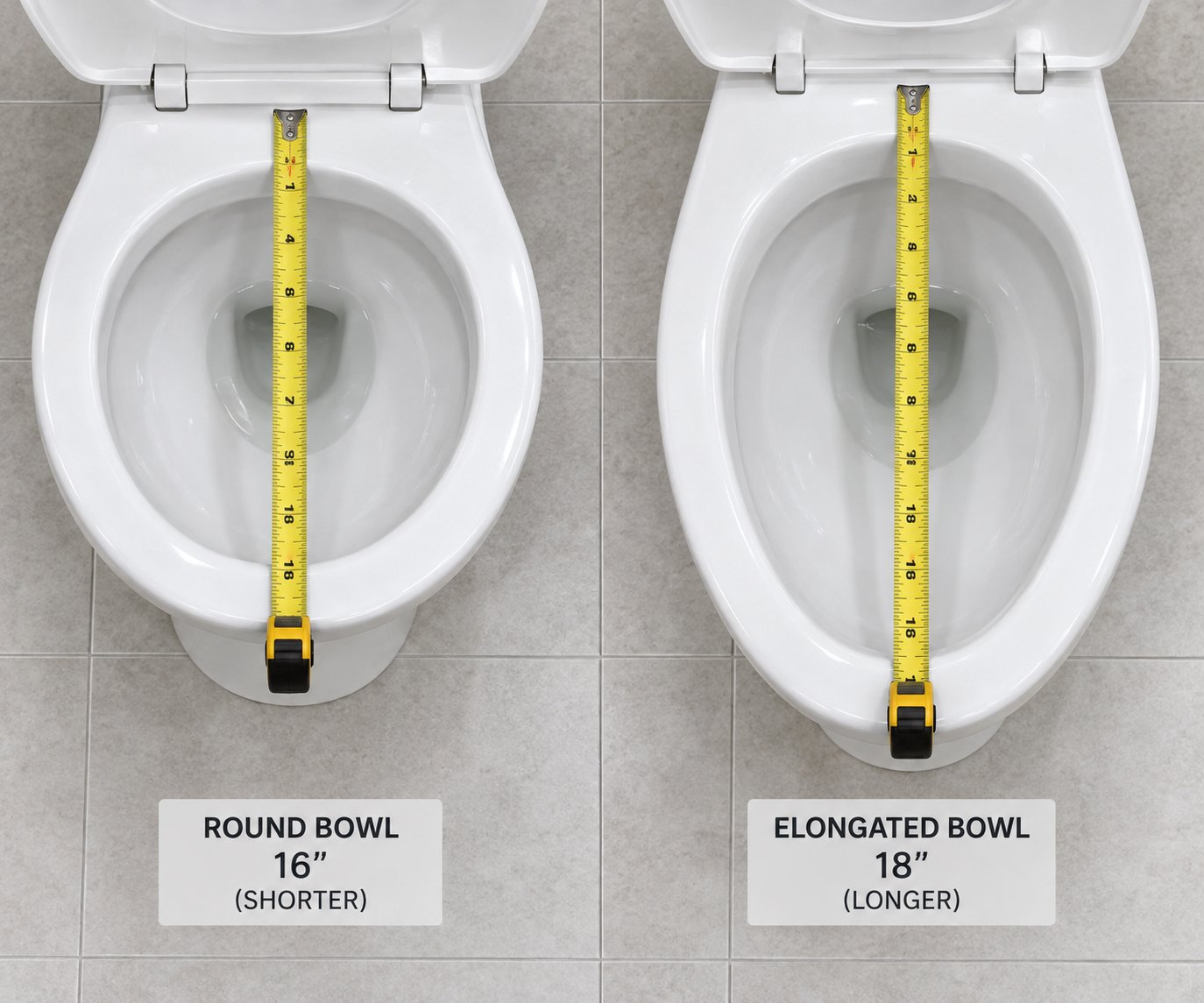
A round toilet seat gets its name from the bowl shape it sits on. Measure from the center point between the two rear mounting bolt holes straight forward to the front tip of the rim, and a round bowl will land at approximately 16.5 inches. That shorter front-to-back profile gives the bowl a more circular appearance compared to its elongated cousin, which stretches roughly two inches farther forward.
Who benefits most from a round toilet seat? If you have a smaller bathroom, a half-bath, a powder room, or an older home built before elongated bowls became the builder's default, chances are you're working with a round bowl. The compact footprint saves several critical inches of floor space — a difference that matters when the door barely clears the front of the toilet. You'll also find round bowls in apartments, condos, and anywhere square footage is at a premium. For millions of households, the round front toilet seat isn't a compromise. It's the only option that fits.
Wood vs Molded Wood vs Wood Veneer Construction
Here's where most shoppers get tripped up. A wood toilet seat can mean three very different things depending on how the manufacturer uses the word "wood." Understanding these distinctions upfront saves you from surprises down the road.
- Solid hardwood seats — Carved or shaped from actual timber like oak, walnut, or bamboo. These seats have visible grain patterns, natural warmth, and a premium feel, but they require quality finishes to handle bathroom moisture.
- Compression-molded wood-fiber seats — Made from wood fibers bonded under high pressure into a uniform, dense body. Often marketed simply as "wood" or "molded wood," these seats offer consistent shapes and smoother surfaces than raw timber. Many feature a baked-on enamel coating for easy cleaning.
- Wood-veneer-over-MDF seats — An MDF (medium-density fiberboard) core wrapped or topped with a thin layer of real wood veneer or a painted finish. These deliver the look of wood at a lower price point, though the MDF core is more vulnerable to moisture if the surface seal is ever compromised.
Each construction type carries trade-offs in durability, moisture resistance, and aesthetics. Recognizing what you're actually holding — solid timber, pressed fibers, or an engineered composite — is the first step toward a purchase you won't regret.
Why Round Wood Seats Remain Popular
Plastic dominates the toilet seat market, so why do wooden toilet seats keep selling? Pick one up and you'll notice the difference immediately. Wood feels warmer to the touch, especially on a cold morning — no jarring shock when you sit down. That tactile comfort is something plastic simply can't replicate.
Beyond comfort, a wooden toilet seat brings aesthetic versatility that fits nearly any bathroom style. A natural oak seat anchors a rustic farmhouse look. A white enameled molded seat blends into a sleek, modern space. A dark walnut finish elevates a traditional powder room. Wooden lavatory seats offer a design range that mass-produced plastic models struggle to match.
Market trends reinforce this staying power. Major manufacturers continue expanding their round wood seat lines rather than phasing them out, a clear signal that consumer demand isn't fading. For homeowners renovating older bathrooms or designing compact spaces with character, the round commode seat in wood remains a deliberate, style-conscious choice — not a leftover from another era.
Of course, choosing the right shape is only half the equation. The real question most buyers face next is whether their bowl is actually round or elongated — and how to measure it without second-guessing. Getting that measurement wrong means dealing with returns, wobble, or an overhang that never looks right.
Round vs Elongated Toilet Seats and How to Measure Yours
Getting the shape wrong is the single most common reason people end up returning a toilet seat. It sounds like it should be obvious — round or elongated — but when you're staring at a bare bowl with no seat for comparison, the difference isn't always intuitive. A tape measure and about sixty seconds are all you need to get it right the first time.
Standard Dimensions for Round and Elongated Bowls
The defining measurement for any toilet bowl is the distance from the mounting bolt holes at the rear to the very front tip of the rim. A round front bowl measures approximately 16.5 inches along that line, while an elongated bowl stretches to roughly 18.5 inches — about a two-inch difference that has a real impact on fit, comfort, and available floor space.
Keep in mind that these numbers carry a tolerance of about plus or minus half an inch depending on the manufacturer. A round bowl might measure anywhere from 16 to 17 inches and still be classified as round. Similarly, elongated bowls may fall between 18 and 19 inches. That half-inch variance rarely causes fitment issues because seat manufacturers design their products to accommodate the same range, but it does mean you shouldn't panic if your tape reads 16.25 or 16.75 instead of a perfect 16.5.
Here's a side-by-side look at the key round toilet seat dimensions compared to elongated models:
| Specification | Round | Elongated |
|---|---|---|
| Front-to-back length (bolt holes to rim tip) | ~16.5 inches | ~18.5 inches |
| Typical bowl width | ~14 inches | ~14 inches |
| Bolt-hole spacing (center to center) | 5.5 inches (standard) | 5.5 inches (standard) |
| Ideal room situation | Compact bathrooms, half-baths, powder rooms | Spacious bathrooms, master baths, ADA-compliant setups |
Note: Bolt-hole spacing of 5.5 inches center-to-center is nearly universal across manufacturers, but always verify yours before ordering. A small number of older or specialty toilets use non-standard spacing, and discovering that mismatch after you've opened the packaging is frustrating.
How to Measure Your Toilet Bowl at Home
You don't need any special tools — a standard tape measure or even a rigid ruler works perfectly. The key is knowing exactly where to start and stop your measurement. Many people make the mistake of measuring total toilet length from the back of the tank to the front of the bowl. That number is useless for determining round toilet seat sizes because it includes the tank, which has nothing to do with seat fit.
Follow these steps instead:
- Locate the two mounting bolt holes at the back of the bowl. They sit on a flat area of the rim, usually covered by small plastic caps if a seat is currently installed. If a seat is in place, flip up the bolt caps or remove the seat entirely for a clearer view.
- Find the center point between those two bolt holes. Since they're spaced about 5.5 inches apart, the center point is roughly 2.75 inches from either hole. Place the end of your tape measure at that midpoint.
- Measure straight forward to the front-center edge of the bowl rim. Keep the tape running along the centerline of the bowl — don't angle it to the side.
- Read the measurement. If it lands at approximately 16.5 inches, you have a standard round toilet seat bowl. If it reads approximately 18.5 inches, you have an elongated bowl.
That's it. The entire process takes less than a minute and eliminates the guesswork that leads to wrong orders and return shipping headaches. If you're somewhere between 17 and 18 inches and can't decide whether your bowl is round or oval, you likely have an uncommon transitional shape — sometimes called a round or oval toilet seat — and you'll want to check the manufacturer's specification sheet for your specific toilet model before choosing a seat.
Can You Put an Elongated Seat on a Round Bowl?
This question comes up constantly, and the short answer is: technically you can bolt it on, but you really shouldn't. An elongated toilet seat on a round toilet will overhang the front of the bowl by roughly two inches. That overhang creates several problems at once.
First, the front of the seat has no bowl rim underneath it to provide support. When someone sits down and their weight shifts forward, the unsupported section flexes downward. Over time, this repeated stress can crack the seat body or fatigue the hinge bolts. Second, the seat won't anchor as securely because the bolt-hole alignment — while technically compatible — positions the seat's center of gravity farther forward than intended. The result is lateral wobble, especially on heavier wood seats where the extra mass amplifies any instability. Third, there's a genuine safety concern: a wobbly, overhanging seat can shift unexpectedly, which is particularly risky for children and elderly users.
The reverse scenario — placing a round front toilet seat on an elongated bowl — is equally problematic. The seat will be too short, leaving the front portion of the bowl rim exposed and uncomfortable to sit on.
Bottom line: always match your seat shape to your bowl shape. A standard round toilet seat belongs on a round bowl, and an elongated seat belongs on an elongated bowl. The five minutes spent measuring upfront is far easier than dealing with a seat that never quite feels stable.
Knowing your exact bowl shape and size is the foundation, but it only tells you what will physically fit. The next layer of the decision — and the one that determines how your seat actually looks and performs years from now — is understanding the wood species and finish options available within that round-seat category.
Wood Species and Finish Types That Define Seat Quality
Imagine two round wood seats sitting side by side on a store shelf. Both are labeled "wood." Both are the same shape. One costs $30, the other $120. What are you actually paying for? The answer almost always comes down to two things: the material inside the seat body and the finish protecting its surface. These two factors determine everything from how the seat feels when you sit down to whether it still looks good three years from now — yet almost no product listing bothers to explain them.
Solid Hardwood Options and Their Characteristics
A solid wood toilet seat is exactly what it sounds like: shaped from real timber, sanded smooth, and sealed with a protective coating. You'll notice the grain pattern immediately — it's unique to each seat, which is part of the appeal. The three hardwood options you'll encounter most often are oak, walnut, and bamboo, and each brings a distinct personality to your bathroom.
Oak is the workhorse of the solid wood seat world. It's widely available, reasonably priced for a hardwood, and features a pronounced grain pattern that adds visual texture. Oak is naturally dense, which gives it good resistance to daily wear. If you want an oak toilet seat that holds up, look for one finished with polyurethane — that combination of hard grain and strong sealant creates a durable pairing.
Walnut sits at the premium end. Its rich, dark chocolate tones and subtler grain create a refined look that elevates a powder room or traditional bathroom instantly. Walnut is slightly softer than oak, but when properly sealed, it performs well in residential settings. Expect to pay more — the wood itself costs more to source, and the seats are typically produced in smaller batches.
Bamboo occupies an interesting middle ground. Technically a grass rather than a hardwood, bamboo grows rapidly and is frequently marketed as an eco-friendly alternative. Some manufacturers offer bamboo round seats, though they rarely provide educational context about what "eco-friendly" actually means in this case. The sustainability claim holds up in the sense that bamboo reaches harvest maturity in three to five years versus decades for hardwood trees. However, the adhesives, finishes, and transportation involved in manufacturing still carry an environmental footprint. Bamboo seats tend to have a lighter, more contemporary look with a tight, linear grain pattern.
Here's how these materials compare across the factors that matter most for a solid wood toilet seat:
| Material | Durability | Moisture Resistance | Price Range | Aesthetic Character |
|---|---|---|---|---|
| Oak | High — dense, hard grain | Moderate — needs quality finish | Mid-range | Prominent grain, warm golden tones |
| Walnut | Moderate-high — slightly softer | Moderate — needs quality finish | Premium | Rich dark tones, subtle grain |
| Bamboo | Moderate — depends on lamination | Moderate — can absorb moisture at edges | Mid-range | Light color, tight linear grain, modern feel |
| Molded wood | High — uniform density throughout | Good — enameled surface resists moisture | Budget to mid-range | Smooth, uniform, available in many colors |
Molded Wood and MDF-Core Seats Explained
Here's a fact that surprises most shoppers: many seats marketed simply as "wood" never started as a plank of timber. A molded wood toilet seat is made from real wood fibers, but those fibers have been broken down, mixed with binding resins, and compressed under high pressure into a uniform, dense body. The result looks nothing like a tree — it's smooth, consistent, and free of knots or grain variations.
Why does this matter? Because a molded toilet seat actually offers some practical advantages over solid hardwood. The compression process eliminates the natural weak points in timber — knots, grain direction changes, and density variations — that make solid wood vulnerable to cracking and warping. The uniform density also means the seat can be shaped into more precise, consistent forms that fit standardized bowl rims reliably every time.
MDF-core seats follow a similar principle. MDF is made from compressed wood fibers bonded with resin, then finished with a lacquer, paint, or foil wrap. The core is stable and heavy, giving the seat a substantial feel that lightweight plastic can't match. The critical vulnerability, though, is moisture: if the painted or sealed surface chips, cracks, or wears through, water can reach the raw MDF core underneath. Once that happens, the fibers swell and delaminate — and the damage is essentially irreversible.
You'll often see the term "enameled wood" in product descriptions. This refers to a baked-on enamel coating applied over a molded wood-fiber or MDF body. Think of it as a hard, smooth shell that seals the compressed wood completely. An enameled wood toilet seat has a glossy or semi-glossy surface that wipes clean easily and resists stains better than a natural wood finish. It's the reason most white or colored "wood" seats on the market feel so smooth — that surface is enamel paint, not exposed timber.
For a toilet seat molded wood construction often represents the sweet spot between the warmth of real wood fibers and the practical durability that a bathroom environment demands. You get a seat that feels heavier and more substantial than plastic, stays warmer to the touch, and holds up well against humidity — as long as the enamel coating remains intact.
Finish Types and What They Mean for Longevity
The material inside the seat matters, but the finish on the outside is what actually faces your bathroom's humidity, cleaning products, and daily use. A beautiful oak seat with a poor finish will deteriorate faster than a basic molded seat with a high-quality enamel coating. Finish selection is where longevity is truly decided.
Here are the four finish types you'll encounter on round wood seats and what each one means for long-term performance:
- Lacquer — Produces a glossy, attractive surface that dries quickly during manufacturing. Lacquer leaves a hard and glossy surface that looks beautiful initially, but it offers only moderate moisture protection compared to other options. In a high-humidity bathroom, lacquer can begin to cloud, crack, or peel over time if not maintained. It's a reasonable choice for low-traffic powder rooms but less ideal for steamy master baths.
- Polyurethane — The strongest moisture barrier commonly used on hardwood toilet seats. Polyurethane cures through a chemical process that creates a tough, water-resistant film. It's available in matte to high-gloss sheens and is highly resistant to household cleaning chemicals once fully cured. If you're buying a solid wood seat for a bathroom that sees daily showers, a polyurethane finish is your best defense against moisture penetration.
- Enamel paint — The standard finish on molded wood and MDF-core seats. Enamel is baked onto the seat body at high temperatures, forming a smooth, uniform, and hard-wearing surface. It cleans easily, resists staining, and provides a consistent color across every seat in a production run. The trade-off is that enamel finishes can chip if struck hard, and once chipped, the exposed wood fiber beneath becomes a moisture entry point.
- Natural oil finishes (tung oil, linseed oil) — These penetrating oils soak into the wood grain rather than forming a film on top. The result is a warm, natural look that highlights the wood's character without adding surface gloss. The downside? Oil finishes offer the least moisture protection of any option on this list and require periodic reapplication — typically every few months in a bathroom setting — to maintain their protective qualities.
Think of the relationship between material and finish this way: the wood species or composite determines the seat's structural integrity, while the finish acts as the shield that keeps bathroom moisture from undermining it. A polyurethane-sealed oak seat and an enamel-coated molded wood seat can both last for years in a well-ventilated bathroom. A natural-oiled seat in a poorly ventilated space, on the other hand, may start showing damage within months.
Finish quality also dictates your cleaning options. Enamel and polyurethane surfaces tolerate mild bathroom cleaners without issue, while natural oil finishes can be stripped by the same products. Knowing what's on your seat's surface tells you exactly how to care for it — and how aggressively your bathroom's environment will test it over time.
Material and finish set the stage for durability, but there's a mechanical component that affects your daily experience even more directly: the hinge system. The way a seat opens, closes, and attaches to the bowl determines whether it slams, wobbles, or glides shut quietly — and wood seats place unique demands on hinge hardware that most buyers never consider until something goes wrong.
Hinge Types and Soft-Close Mechanisms Explained
You've picked your wood species and verified your finish type — but none of that matters if the hinge fails. A beautiful oak seat that slams shut every time someone lets go of the lid isn't just annoying; it's actively damaging the seat body, stressing the bolt holes, and rattling the porcelain underneath. For a toilet seat round wood option, hinge selection is arguably the most overlooked decision in the entire purchase — and it's the one you'll live with every single day.
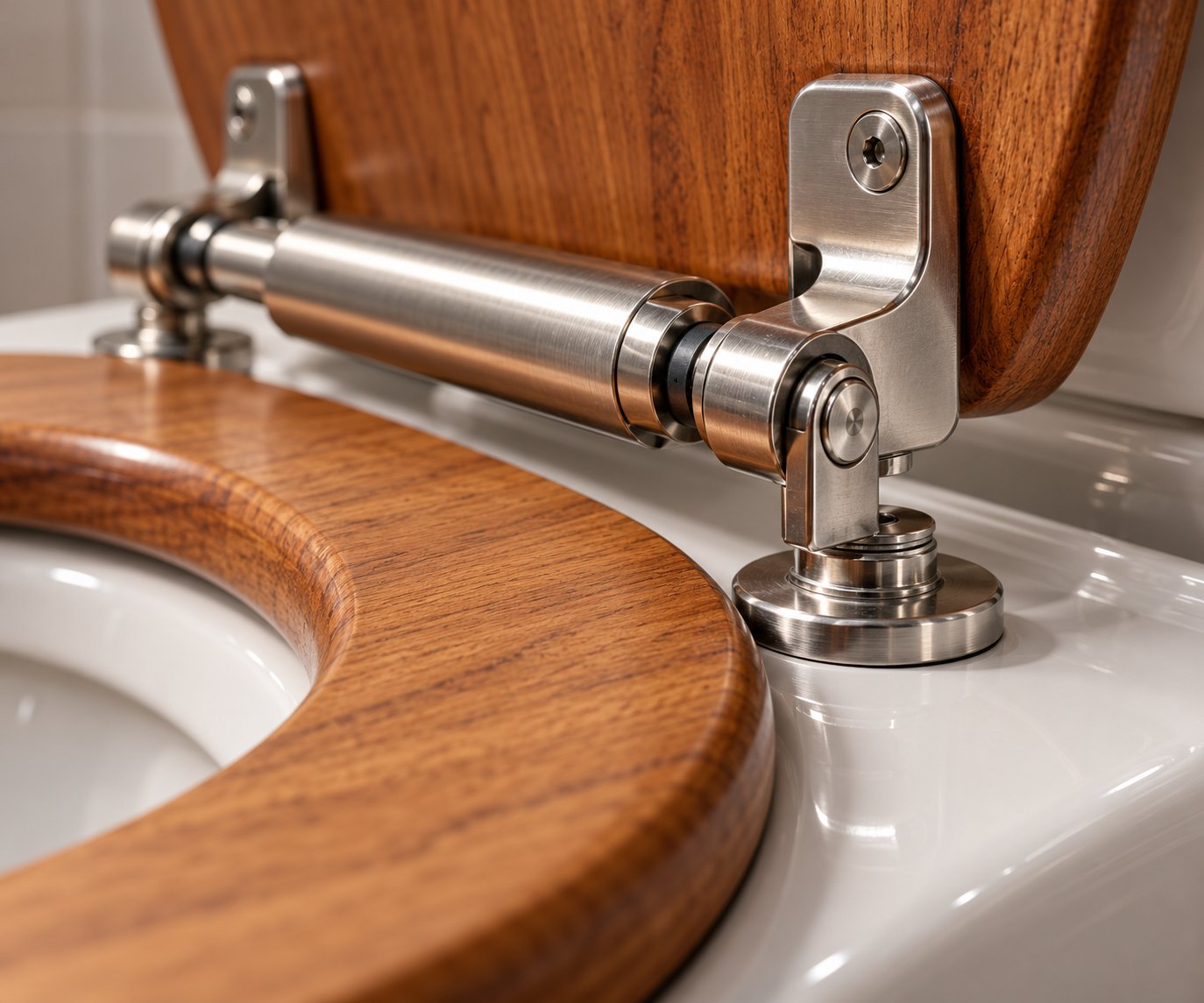
Here's the challenge: wood and molded-wood seats are significantly heavier than their plastic counterparts. That extra weight amplifies every weakness in a poorly designed hinge. A flimsy mechanism that works fine on a lightweight plastic lid will fatigue, loosen, or break under the constant load of a dense hardwood or MDF seat. Understanding the three main hinge categories — and the engineering behind soft-close performance — puts you in a far better position to choose a seat that still feels solid a year or two from now.
Standard, Slow-Close, and Quick-Release Hinges Compared
Every round wood seat on the market uses one of three hinge systems, and each one involves real trade-offs. Some manufacturers reference proprietary hinge names — Topseat, for instance, markets a "Magic Hinge" system — but the underlying categories remain the same across the industry. Here's how they compare:
| Hinge Type | Closing Behavior | Ease of Cleaning | Durability | Best Use Case |
|---|---|---|---|---|
| Standard metal hinges | Manual close — seat drops freely when released | Moderate — seat must be unbolted for thorough cleaning | High if made from stainless steel or zinc alloy | Budget-friendly setups, low-traffic bathrooms |
| Slow-close / soft-close hinges | Controlled descent via internal damper — seat lowers slowly and quietly | Moderate — removal depends on mounting design | Moderate to high — damper mechanism has a finite cycle life | Family bathrooms, bedrooms nearby, households with children |
| Quick-release hinges | Varies (may include soft-close) — primary feature is one-click seat removal | Excellent — seat detaches in seconds for full bowl access | Moderate — release mechanism adds a potential wear point | High-traffic bathrooms where thorough cleaning is a priority |
A soft close wooden toilet seat uses the second category — and it's the one most buyers are drawn to. The appeal is straightforward: no more slamming, no pinched fingers, no startling crashes at 2 a.m. when someone forgets to lower the lid gently. For families with young children, a soft close round toilet seat isn't just a convenience feature. It's a genuine safety upgrade.
Quick-release hinges deserve attention too, especially if cleaning is high on your priority list. Being able to pop the seat off without tools means you can wipe down the entire bolt-hole area and the back rim of the bowl — the spots where grime builds up most stubbornly. Some premium seats combine both features: soft-close operation with a quick-release detach mechanism. These tend to cost more, but the combination solves the two biggest daily frustrations simultaneously.
How Damper Mechanisms Create Soft-Close Performance
Ever wondered what's actually happening inside those hinges when the lid drifts shut in that satisfyingly slow arc? The answer is a small but precisely engineered component called a rotary damper.
A rotary damper controls the hinge's closing speed through calibrated resistance — measured as torque. Inside the damper housing, a rotor turns through a viscous medium (typically silicone oil), and the resistance that medium creates determines exactly how fast or slow the seat descends. Too little resistance and the seat still drops with a thud. Too much and the lid barely moves, frustrating users who expect it to close within a few seconds of being released.
Here's why this matters specifically for a wood soft close toilet seat: torque calibration isn't one-size-fits-all. A solid oak seat weighing two to three pounds generates far more downward momentum than a thin plastic lid weighing under a pound. If you install a damper designed for lightweight plastic into a heavy wood or MDF seat, the extra mass overwhelms the resistance — and the "soft close" becomes a slightly-less-violent slam instead of a smooth, quiet descent.
This is precisely why purpose-engineered damper components exist. Tianyun's MDF / Metal Damper, for example, is designed specifically for MDF, wooden, resin, and metal toilet seat structures. The damper's torque settings can be customized to match particular seat weights, and its OEM mounting configurations accommodate different hinge designs. That level of specificity is what separates a wood toilet seat slow close experience that feels premium from one that feels like an afterthought — the damper was calibrated for the seat's actual mass and material, not borrowed from a generic plastic-seat production line.
Manufacturers who invest in material-specific damper engineering tend to produce seats with more consistent closing speeds across thousands of use cycles. The silicone-oil-based mechanism inside a quality rotary damper maintains stable performance even in humid environments, which matters enormously in a bathroom setting where temperature and moisture fluctuate constantly. A slow close wood toilet seat with a well-matched damper should close at roughly the same speed on day one and day one thousand — no gradual acceleration back toward slamming.
Why Hinge Material Matters on Wood Seats
The damper handles closing speed, but the hinge body handles structural load — and this is where many budget wood seats quietly fail. A soft close wood toilet seat is heavier than plastic, which means the hinges bear more weight every time the seat is lifted and lowered. Over weeks and months of daily use, that repeated stress either gets absorbed gracefully by quality hardware or gradually loosens inferior components.
Metal hinges — stainless steel or zinc alloy — resist this loosening far better than plastic alternatives. Metal threads hold their grip in bolt holes more reliably under load, and metal hinge arms flex less under the weight of a dense seat body. Plastic hinges can work adequately on lightweight seats, but pair them with a two-pound solid wood or MDF seat and you're likely to notice lateral wobble developing within months. That side-to-side shift isn't just annoying; it accelerates wear on the bolt holes in the porcelain, making the problem progressively harder to fix.
If you're shopping for a slow close wooden toilet seat and want it to last, here are the hinge-selection details worth checking before you buy:
- Choose metal hinge components over plastic — stainless steel or zinc alloy hinges handle the weight of wood and MDF seats without fatiguing as quickly.
- Look for through-bolt mounting — bolts that pass entirely through the seat body and secure with a nut underneath distribute load more evenly than short screws that thread into the seat material alone.
- Verify the damper is rated for your seat's weight class — a damper engineered for wood or MDF seats will specify torque appropriate for heavier lids, not just lightweight plastic.
- Check for anti-loosening hardware — lock nuts, rubber washers, or serrated flanges help prevent bolts from gradually backing out under repeated use.
- Favor seats with replaceable hinge components — if the damper or hinge wears out after several years, being able to swap the hardware without replacing the entire seat saves money and waste.
The hinge system is where engineering and everyday experience intersect. A soft close wood toilet seat with properly matched damper torque and solid metal hardware will glide shut quietly, stay firmly centered on the bowl, and resist the loosening that plagues cheaper assemblies. Skip this detail, and even the most beautiful hardwood seat becomes a source of daily frustration.
Of course, even the best hinge can't protect a wood seat from its most persistent enemy: moisture. The bathroom environment constantly tests every seal, finish, and joint — and understanding where wood seats typically fail gives you the knowledge to prevent those problems before they start.
Common Wood Toilet Seat Problems and How to Prevent Them
A bathroom is, by nature, one of the wettest rooms in your home. Steam rolls off hot showers. Condensation forms on cold surfaces. Water splashes, drips, and pools in places you don't always notice. For a toilet wood seat, this constant exposure to moisture is the single biggest threat to its appearance and structural integrity — and it's the concern that stops many buyers from choosing wood in the first place.
The good news? Most wood seat failures aren't caused by the material itself. They're caused by neglected finishes, poor ventilation habits, and cleaning mistakes that slowly strip away the protective barrier between the wood fibers and all that bathroom moisture. Address those three issues proactively and a quality round wood seat can last for years without warping, cracking, or discoloring.
Warping and Moisture Damage Prevention
When an untreated or poorly sealed wood surface absorbs moisture, the fibers swell. They don't swell uniformly, though — areas closer to the water source expand more than dry areas, and this uneven expansion creates internal stress that pulls the seat out of flat. That's warping. Leave it unchecked and the swelling eventually breaks the bond between fibers, leading to cracks that no amount of tightening or resealing can fix.
A wooden toilet seat cover doesn't have to meet this fate. Prevention is straightforward, and most of it comes down to consistent small habits rather than any complicated maintenance routine:
- Verify the seat has a quality finish before you buy — polyurethane or baked-on enamel provides the strongest moisture barrier. If the product listing doesn't specify the finish type, that's a red flag worth investigating before purchasing.
- Maintain bathroom ventilation — run your exhaust fan during every shower and for at least 15 to 20 minutes afterward. This pulls humid air out of the room before it has time to condense on surfaces, including the underside of your wood toilet lid.
- Wipe standing water off the seat promptly — splashes and condensation that sit on the surface for hours gradually work into micro-imperfections in the finish. A quick wipe with a dry cloth after use takes seconds and prevents cumulative damage.
- Avoid harsh chemical cleaners that strip protective coatings — bleach-based sprays, abrasive powders, and strong solvent cleaners can degrade polyurethane and enamel finishes over time, leaving the wood beneath increasingly exposed to moisture with every cleaning session.
Think of the finish as armor. Every habit that preserves that armor extends the life of the seat underneath it. Every habit that degrades it accelerates the very warping and cracking you're trying to avoid.
Finish Discoloration and Staining
Have you ever noticed a white wooden toilet seat slowly turning yellow over time, even though you clean it regularly? You're not imagining things — and you're not doing anything wrong. Yellowing on white-painted or enameled wood seats is one of the most common cosmetic complaints, and it typically results from two factors working together: UV light exposure and chemical reactions with cleaning products.
Bathrooms with windows allow UV rays to reach seat surfaces daily. Over months and years, that light energy breaks down certain compounds in white paint and enamel, shifting the color toward yellow or amber. Simultaneously, bleach-based cleaners — the very products many people reach for to keep white wooden toilet seats looking bright — can actually accelerate the discoloration through chemical reactions with the finish. Good Housekeeping recommends using a gentle bicarbonate of soda paste to lift stains from enamel and plastic surfaces, noting specifically to avoid using abrasive methods on wood — warm, soapy water is the safer route for wooden toilet covers.
Natural-finish seats face a different cosmetic challenge. Darkening, ring stains, and watermarks appear when moisture penetrates the finish and reacts with tannins in the wood. These marks are especially visible on lighter species like oak or bamboo. Once a stain sets into the grain, surface cleaning alone won't remove it — you'd need to sand and refinish the affected area, which isn't always practical on a contoured seat.
For long-term stain prevention, build these habits into your routine:
- Use mild soap and warm water for regular cleaning rather than bleach or ammonia-based products.
- Avoid abrasive scrubbing pads — they scratch through finish layers and create entry points for moisture and stains.
- On natural-finish wood seats, consider reapplying a thin coat of protective oil or polyurethane every six to twelve months to maintain the moisture barrier.
- If your bathroom receives strong natural light, a UV-filtering window film can slow the yellowing process on white seats significantly.
Easy clean toilet seats — particularly those with smooth enamel coatings — resist staining better than natural-finish alternatives simply because the non-porous surface doesn't allow pigments and moisture to penetrate. If low-maintenance cleaning is a priority and you want a white seat that stays white longer, an enameled molded-wood option generally outperforms a painted solid-wood one.
Loosening Hinges and How to Fix Them
You sit down and the seat shifts half an inch to the left. You reposition it, sit again, and it slides right. Sound familiar? Loosening hinges are probably the most universally frustrating problem with any toilet seat — and wood seats are more prone to it than plastic ones for a simple reason: they weigh more.
A solid wood or MDF seat can weigh two to three times as much as a comparable plastic model. Every time someone lifts the lid, lowers it, or sits down, that extra mass puts greater shear force on the hinge bolts. Over weeks and months of daily use, the bolts gradually work themselves loose — sometimes so slowly you don't notice until the seat is sliding noticeably with every use.
Before you assume the seat itself is defective, try this repair sequence:
- Tighten the existing bolts by hand. Flip open the bolt caps at the back of the seat, hold the nut underneath the bowl rim with pliers, and snug the bolt from above. The critical warning here: do not over-tighten. Excessive force can crack the porcelain bowl rim, turning a simple fix into a far more expensive problem.
- If the bolt holes feel stripped or the bolts won't hold tension, add rubber or nylon washers between the bolt head and the seat body, and between the nut and the underside of the bowl rim. These washers compress slightly under load, creating friction that helps the bolt maintain its grip even in worn holes.
- If the seat uses plastic hinge hardware and continues loosening after tightening, consider upgrading to metal hinges with locking nuts. Stainless steel or zinc alloy hinge kits are available as aftermarket replacements and handle the weight of a wood seat far more reliably than the plastic hardware that ships with many budget models.
One more detail worth noting: most residential toilet seats last around five to seven years before the combination of hinge wear, finish degradation, and general fatigue warrants replacement. If your wood seat is wobbling, stained, and showing hairline cracks in the finish, tightening the bolts is a temporary fix — the seat is telling you it's approaching the end of its useful life.
Preventing problems is always cheaper and easier than fixing them. But even a well-maintained seat still needs to handle the physical demands placed on it — and those demands vary enormously depending on who's using it and how often. Understanding how wood seats compare to other materials in structural strength and weight capacity helps you choose one that's truly built for your household's daily reality.
Weight Capacity and Structural Durability Compared
How much weight can your toilet seat actually handle? It's a question that crosses nearly every buyer's mind at some point — and yet almost no product listing, manufacturer spec sheet, or competitor guide provides a clear answer. The truth is that most residential toilet seats ship without an explicit weight rating. That doesn't mean capacity is irrelevant; it means the burden of understanding structural limits falls on you, the buyer, rather than the label on the box.
A solid toilet seat made from dense hardwood or compression-molded wood fiber behaves very differently under load than a thin plastic shell. Knowing why — and knowing where the real weak points hide — helps you pick a seat that holds up for years rather than one that cracks, flexes, or loosens after a few months of daily use.
Weight Capacity of Wood vs Plastic vs Resin Seats
The general principle is intuitive: denser, thicker materials support heavier static loads. Solid wood and molded wood seats tend to outperform standard plastic seats in raw load-bearing ability because their greater material density distributes force more evenly across the seat body. A thick oak seat simply doesn't flex the way a thin polypropylene shell does when weight is applied.
That said, a plastic round toilet seat isn't inherently fragile. High-quality plastic seats — particularly those made from urea-formaldehyde (UF) or reinforced polypropylene — can handle standard residential use without issue. The difference becomes meaningful at the extremes: heavier users, commercial settings, or bathrooms shared by large families where the seat sees dozens of use cycles every day.
If weight capacity is a genuine concern for your household, look for seats marketed as "heavy duty." A heavy duty toilet seat typically features a thicker body, reinforced hinge attachment points, and metal hardware rated for higher loads. Some models designed for bariatric or commercial applications specify weight ratings explicitly — often 300 to 1,000 pounds depending on the design — while standard residential seats rely on material thickness and hinge quality as implicit indicators of strength.
Here's how the four most common seat materials compare across the factors that influence structural performance:
| Material Type | Relative Strength | Seat Weight (Typical) | Comfort Feel | Moisture Resistance |
|---|---|---|---|---|
| Solid wood (oak, walnut, bamboo) | High — dense grain resists flexing | 3–5 lbs | Warm to the touch, substantial feel | Moderate — depends entirely on finish quality |
| Molded wood / MDF | High — uniform density eliminates weak spots | 3–4 lbs | Warm, smooth, heavier than plastic | Good — enameled surface provides reliable barrier |
| Plastic (PP or UF) | Low to moderate — thinner profiles flex under load | 1.5–2.5 lbs | Cool to the touch, lightweight | Excellent — non-porous, impervious to water |
| Resin (polyester or acrylic) | Moderate to high — rigid and thick | 3–6 lbs | Cool but substantial, often decorative | Good — sealed surface resists moisture well |
Notice that solid wood toilet seats and molded wood seats occupy similar territory in strength and weight while differing in moisture handling. A non plastic toilet seat in either of these categories will generally feel more substantial underfoot and resist the kind of flexing that makes thin plastic seats creak or bow — particularly for larger users. Resin seats offer comparable rigidity but lean toward decorative applications, often featuring embedded designs or translucent finishes that prioritize aesthetics alongside strength.
For anyone shopping for a round toilet seat with large opening or a round toilet seat with extra large opening, pay close attention to seat body thickness in addition to the opening dimensions. An enlarged opening removes material from the center of the seat, which means the remaining rim must be thick and dense enough to maintain structural integrity under load. Wood and molded wood handle this well because their density compensates for the removed material. Thinner plastic seats with oversized openings, by contrast, can flex noticeably around the cutout edges.
Why Seat Thickness and Hinge Quality Determine Durability
Here's something most buyers never consider: a thicker seat body doesn't just feel more solid — it fundamentally changes how stress distributes through the structure. When you sit down, your weight creates a downward force concentrated where your body contacts the seat. A thick seat spreads that force across a wider internal cross-section before it reaches the hinge attachment points at the rear. A thin seat concentrates more of that load directly onto the hinges because there's less material to absorb and redirect the stress along the way.
This is why hinge attachment design matters as much as the seat body itself. Metal hinges with through-bolt mounting — where the bolt passes entirely through the seat body and secures with a nut on the opposite side — create the strongest possible connection. The bolt grips the full thickness of the seat material, anchoring it from both sides. Surface-mounted screws, by comparison, only bite into a few millimeters of material. Under the repeated loading of daily use, especially with a heavier wood or MDF seat, those shallow screw threads can gradually strip out of the seat body. The result is the same loosening and wobble discussed earlier, except this time the seat material itself is damaged rather than just the hardware.
Think of it this way: a heavy solid wood seat on through-bolt metal hinges is distributing force efficiently from the moment you sit down to the point where the bolts anchor into the porcelain bowl. Every element in that chain — seat thickness, hinge material, bolt type, washer quality — either reinforces or undermines the one before it. Upgrading one component while ignoring the others limits the benefit you'll actually notice.
Choosing a Durable Seat for High-Traffic Bathrooms
Family bathrooms, kids' bathrooms, rental properties — any space where the seat gets heavy daily use demands a focus on durability over aesthetics. A gorgeous walnut seat with delicate brass hinges might look stunning in a seldom-used powder room, but it won't hold up the same way in a bathroom that sees 15 or 20 use cycles a day.
The most common failure point on any toilet seat is not the seat body itself but the hinge hardware. Investing in quality hinges often matters more than the seat material.
That insight reframes the entire buying decision. You can choose almost any seat material you prefer — solid wood, molded wood, even resin — as long as the hinge system is engineered to handle the weight and the frequency of use. A mediocre seat with excellent hinges will outlast a premium seat with cheap hardware nearly every time.
Before you buy, run through this durability checklist:
- Metal hinge components — stainless steel or zinc alloy resists loosening and fatigue far better than plastic, especially under the weight of wood and MDF seats.
- Through-bolt mounting — bolts that pass fully through the seat body and secure with a nut provide the strongest attachment. Avoid seats where the hinge relies on short screws threading into compressed material.
- Anti-loosening lock nuts — serrated flanges, nylon-insert lock nuts, or rubber washers beneath standard nuts prevent gradual bolt backing under repeated loading cycles.
- Minimum seat body thickness appropriate for the material — solid wood seats should feel dense and substantial when picked up, not thin or hollow. For molded wood and MDF, look for a body thickness of at least half an inch to ensure adequate load distribution.
- Reinforced hinge attachment area — some manufacturers add extra material density or embedded metal plates around the bolt holes to prevent the most common failure: bolt holes stripping out of the seat body over time.
If you're outfitting a rental property or a high-traffic family bathroom, a molded wood seat with metal through-bolt hinges and a quality soft-close damper often delivers the best balance of durability, comfort, and cost. Solid hardwood seats work beautifully in lower-traffic settings where their natural warmth and aesthetic character can be appreciated without the punishing wear cycle of constant daily use.
Structural integrity keeps the seat functional, but getting it onto the bowl correctly is what determines whether that strength translates into a stable, wobble-free experience from day one. The installation process for a round wood seat involves a few specific steps — and a couple of easy-to-avoid mistakes — that are worth walking through before you pick up the wrench.
How to Install or Replace a Round Wood Toilet Seat
Here's the reassuring truth: replacing a round wood toilet seat is one of the simplest home maintenance tasks you'll ever tackle. No plumbing knowledge required. No water to shut off. No risk of flooding. The entire job — removal, cleanup, and installation — typically takes 10 to 20 minutes, and the only reason it might stretch longer is dealing with old mounting bolts that have corroded in place over years of use. Whether you're swapping out a cracked plastic lid for a warm oak upgrade or handling a routine round toilet seat replacement, the steps below cover the full process from start to finish.
Tools You Need Before You Start
The tool list is refreshingly short. Most homeowners already have everything on hand, and the only purchase required is the seat itself. Gather these items before you begin so you're not hunting through drawers mid-project:
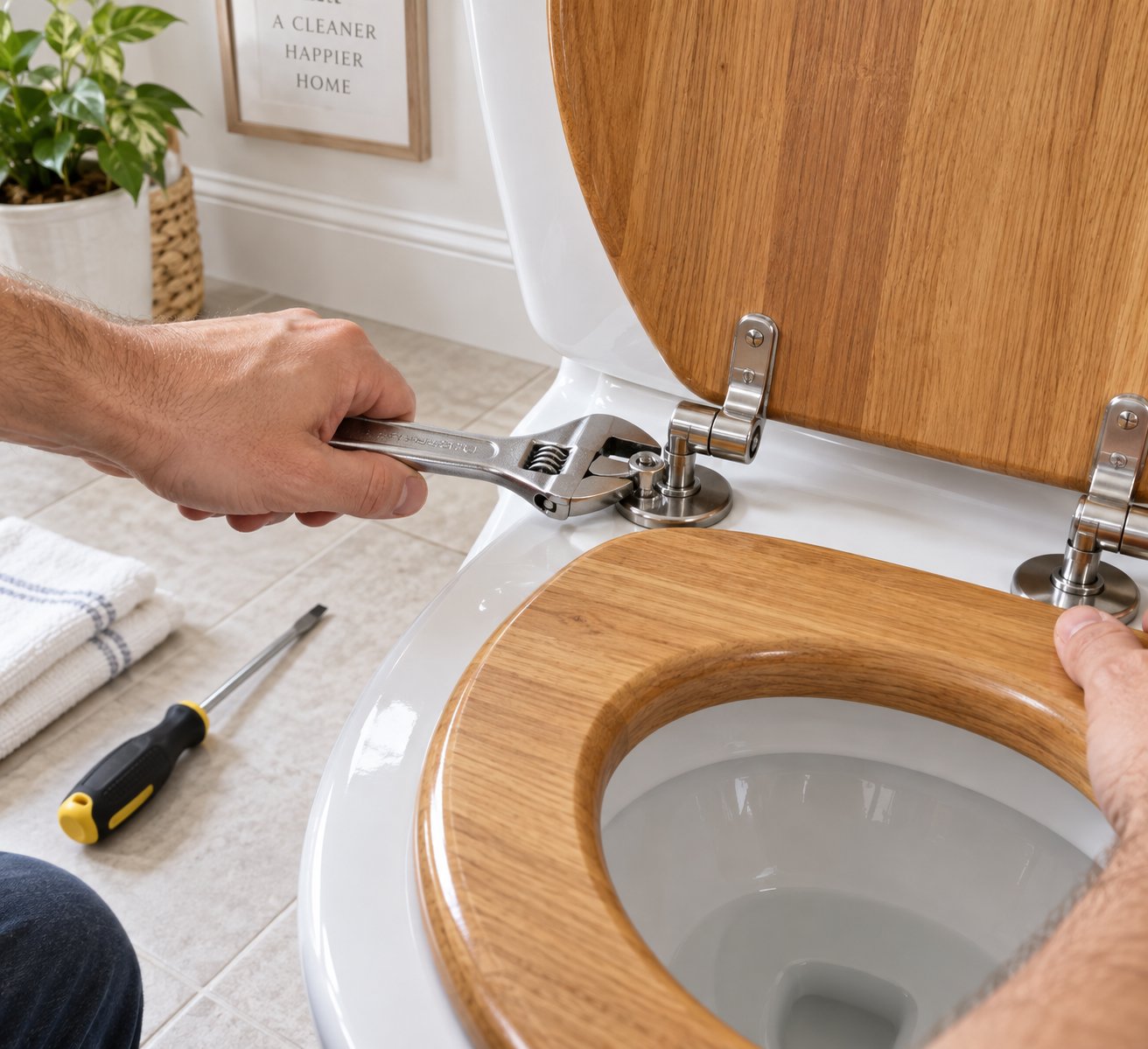
- Adjustable wrench or pliers — for gripping the nut underneath the bowl rim while you unscrew or tighten the mounting bolt from above.
- Flat-head screwdriver — many mounting bolts have a slotted head that requires a screwdriver to hold steady during removal or installation.
- Towel or rag — for wiping down the bowl surface after the old seat comes off and for protecting the porcelain if you need to apply any force with tools near the rim.
- Penetrating oil (if needed) — only necessary if you're removing an old seat with corroded metal bolts that refuse to turn. A generous application followed by a 10- to 15-minute wait usually frees even stubbornly seized hardware.
One more thing to have nearby: the tape measure you used back in the measuring step. Before you open the packaging on your replacement round toilet seat, do a final confirmation that the bolt-hole spacing on the new seat matches your bowl. The standard is 5.5 inches center-to-center, and virtually all seats sold for the U.S. market conform to it — but a 10-second check eliminates any chance of a frustrating mid-installation surprise.
Step-by-Step Removal of the Old Seat
Removing the existing seat is where most of the effort lives — not because the process is complicated, but because old hardware can fight back. A toilet seat with hinges that has been in place for years may have corroded bolts, mineral buildup around the mounting holes, or plastic nuts that have become brittle and stripped. Here's how to handle each scenario:
- Locate the two bolt caps at the back of the seat and flip them open. On most modern seats, these are small plastic covers that pop up with light finger pressure to reveal the bolt head underneath. Older seats may not have caps at all — the bolt head sits exposed on the hinge surface.
- Hold the nut underneath the bowl rim with pliers while unscrewing the bolt from above. This two-handed approach is critical. If you only turn the bolt from the top without stabilizing the nut below, the entire assembly just spins in place and nothing comes loose. Use the pliers to grip the nut firmly, then turn the bolt counterclockwise with your screwdriver or wrench.
- If the bolts are corroded or the plastic hardware is stripped, don't force it. Apply penetrating oil generously around the nut and the point where the bolt passes through the bowl. Wait at least 10 to 15 minutes — the oil needs time to work into the corroded threads. A second application and another wait often makes the difference. If the bolt still won't budge after two rounds of penetrating oil, carefully cut through it with a hacksaw blade or a mini oscillating saw. Cut as close to the nut as possible from below. This sounds drastic, but it's far safer than applying excessive force that could crack the porcelain bowl — a mistake that turns a simple seat swap into a full toilet replacement.
- Clean the bolt-hole area on the bowl rim before installing the new seat. With the old seat removed, you'll see grime, mineral deposits, and old washer residue that's been hidden for years. Wipe it all down with a damp rag or mild bathroom cleaner. Remove any old rubber or plastic washers sitting in or around the holes — your new seat comes with fresh mounting hardware, so nothing from the old installation needs to stay behind.
This cleanup step is easy to skip in the excitement of installing a new seat, but don't. A clean mounting surface ensures the new hardware seats flush against the porcelain, which directly affects how stable the round toilet bowl seat feels once everything is tightened down.
Installing a Round Wood Seat Correctly
With a clean bowl and fresh hardware in hand, the installation itself is straightforward. The key is patience during alignment and restraint during tightening — rushing either step creates problems that are annoying to fix later.
- Align the new seat's hinge bolts with the bowl's mounting holes. Set the seat on the bowl and position the hinge brackets so the bolt holes in the hinges line up directly over the holes in the porcelain. Most seats have rubber bumper feet on the hinge underside that help center the seat naturally — let them settle into place before moving on.
- Insert bolts from above and hand-thread nuts from below. Drop each bolt down through the hinge and the bowl hole, then reach underneath and start threading the nut by hand. Get both nuts started before tightening either one — this keeps the seat from shifting to one side as you work.
- Center the seat on the bowl so it sits evenly with equal overhang on both sides. Before anything is snug, look at the gap between the seat edge and the bowl rim all the way around. The seat should appear symmetrical — not shifted left, right, or forward. Adjusting position is effortless at this stage and nearly impossible once the bolts are tight.
- Tighten bolts gradually and evenly — alternate between left and right to prevent misalignment. Give the left nut a half turn, then the right nut a half turn. Repeat. This alternating approach keeps the seat centered as the hardware draws down. Hand-tighten first, then use your wrench for a final snug — firm contact against the bowl surface is the goal, not maximum torque.
- Check that the seat opens and closes smoothly without shifting. Lower the lid and seat, then lift them. Sit down gently and shift your weight side to side. There should be zero lateral movement. If you feel any wobble, identify which side has more play and give that nut another quarter turn before retesting.
A critical warning worth repeating: do not over-tighten the mounting bolts. Wood seats are heavier than plastic, and there's a natural temptation to crank the hardware down harder to compensate. Resist it. The porcelain around those bolt holes is strong but not indestructible — excessive torque can crack the bowl rim, and a cracked bowl means replacing the entire toilet. Snug and stable is the target. If the seat doesn't wobble when you shift your weight, the bolts are tight enough.
For seats with plastic wing nuts, hand-tightening plus a quarter turn is typically all that's needed. Metal hardware tolerates slightly more force, but the principle remains: stop as soon as the seat feels solid. A properly installed replacement round toilet seat should sit flat, close smoothly, and show no side-to-side play — and getting there rarely takes more than 15 minutes of actual work.
With the seat mounted and functioning, the practical side of your project is complete. But a toilet seat doesn't exist in isolation — it's a visible part of a room with its own design identity. The material, finish, and hinge style you just installed can either complement your bathroom's aesthetic or clash with it, and a few intentional style pairings make the difference between a seat that simply fits and one that genuinely belongs.
Styling Your Bathroom Around a Round Wood Seat
A toilet seat is one of the most touched, most used, and most visible fixtures in any bathroom — yet it's almost never treated as a design decision. People agonize over tile patterns, faucet finishes, and vanity hardware, then grab whatever seat is cheapest without considering whether it actually belongs in the room. That's a missed opportunity. The material, finish, and hinge details you've already learned to evaluate aren't just functional choices. They're aesthetic ones, and matching them intentionally to your bathroom's style transforms a utilitarian object into a design element that earns its place.
Rustic and Farmhouse Bathrooms
Farmhouse style thrives on warmth — exposed wood, natural textures, and a sense of lived-in comfort that softens the hard, cold surfaces bathrooms inevitably include. Architectural Digest describes the aesthetic as built on elements like shiplap walls, reclaimed wood, vintage fixtures, and warm-toned materials that make a bathroom feel cozy rather than clinical. A round wood seat fits into this world effortlessly.
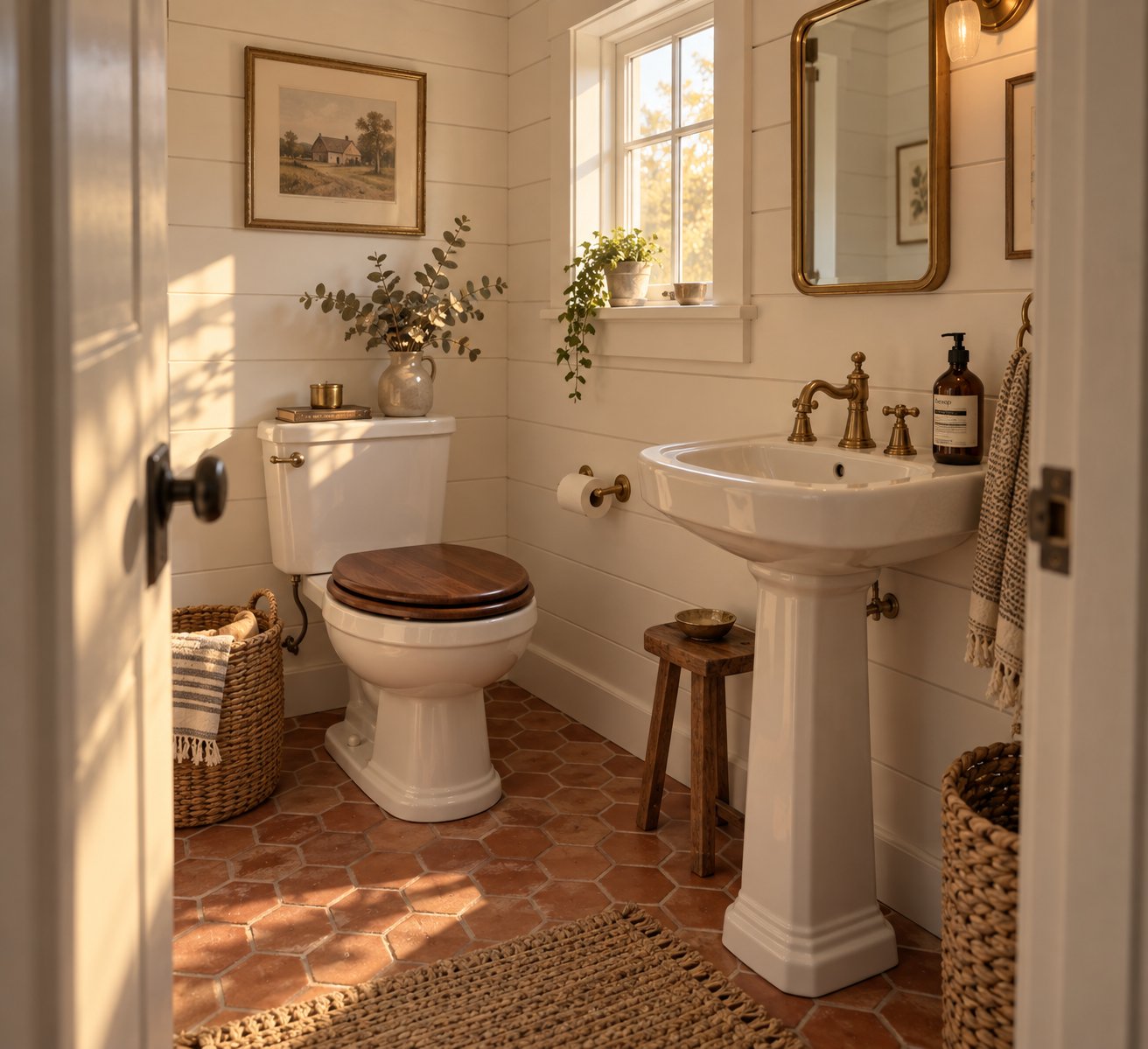
Imagine a compact half-bath with white shiplap walls, a pedestal sink with a bridge faucet, and warm terracotta floor tile. A natural-finish oak seat on that round bowl doesn't just match — it reinforces the entire design language. The visible grain pattern echoes the reclaimed wood accents. The warm golden tone of the oak picks up the earthy palette of the tile. Even the weight of a solid wood seat contributes to the farmhouse philosophy: real materials, honestly presented, built to last.
A walnut toilet seat pushes the same concept in a richer, moodier direction. Walnut's deep chocolate tones pair beautifully with the darker farmhouse variations that some designers favor — think black iron fixtures, dark-stained vanities, and moody wall colors. If your farmhouse bathroom leans more toward the dramatic end of the spectrum, a walnut seat grounds the design without competing with bolder elements around it. Pair it with oil-rubbed bronze or matte black hinges and the seat reads as an intentional vintage toilet seat choice, not an afterthought.
Modern Minimalist and Transitional Spaces
Clean lines, neutral palettes, and an absence of visual clutter — modern bathrooms operate on a completely different design principle than farmhouse spaces. Everything is edited down to essentials. Surfaces are smooth. Colors are restrained. In this context, the prominent grain pattern of a natural hardwood seat can actually feel out of place, introducing visual noise where the design calls for quiet.
This is where white enameled molded-wood seats excel. The smooth, uniform surface delivers the clean look a modern bathroom demands while still offering the weight, warmth, and durability advantages that wood-fiber construction provides over thin plastic. You get a seat that feels substantial when you sit down — no hollow flexing, no cheap clatter when the lid contacts the bowl — but looks perfectly at home next to a wall-mounted vanity, frameless mirror, and matte-finish fixtures.
A bone toilet seat offers a subtle alternative to stark white in transitional spaces — bathrooms that blend modern simplicity with just enough warmth to avoid feeling sterile. Bone or biscuit-toned enamel softens the visual temperature of the room without introducing a color that fights with surrounding finishes. Paired with brushed nickel hardware and soft gray walls, it's a combination that reads as effortlessly contemporary.
For round decorative toilet seats in modern settings, restraint is the guiding principle. The seat should blend, not dominate. A smooth finish, a soft-close hinge that operates silently, and a color that aligns with the room's palette — that's all it takes for a round wood seat to feel like a natural extension of a minimalist design.
Traditional and Vintage-Inspired Designs
Here's a detail that makes the design connection almost automatic: round toilets are more common in older homes built before elongated bowls became the builder's standard. If you're renovating a pre-1970s bathroom and working to preserve its period character, the round bowl you already have is historically appropriate — and a wood seat is the natural pairing for it.
Block Renovation emphasizes that successful vintage-inspired bathrooms blend timeless details with modern updates so the space feels fresh without losing its character. A round wood seat with polished chrome or brass hinges anchors this approach beautifully. The seat itself nods to tradition — wood was the dominant toilet seat material for decades before plastic took over — while quality modern hinges with soft-close dampers provide the functional upgrade that makes the bathroom feel current rather than dated.
A brown toilet seat in a dark-stained finish works especially well in traditional settings with rich wood cabinetry, patterned floor tile, and warm metallic accents. It adds visual weight to the lower portion of the room and ties the toilet into the surrounding millwork rather than letting it sit as an isolated white fixture. For bolder traditional statements, a black wood toilet seat creates striking contrast against white porcelain, a pairing that reads as deliberate and curated rather than mismatched.
Powder rooms deserve special mention here. Because they're small, low-traffic, and designed primarily for guests, powder rooms give you more freedom to make the seat a focal point. A round wood seat with an unusual finish, decorative hinge hardware, or a distinctive wood species can serve as a conversation piece in a way that wouldn't be practical in a heavily used family bathroom.
Here's a quick reference for matching seat styles to bathroom aesthetics:
- Rustic and farmhouse — Natural-finish oak or walnut; visible grain; oil-rubbed bronze or matte black hinges.
- Modern minimalist and transitional — White or bone enameled molded wood; smooth surface; brushed nickel or chrome hinges.
- Traditional and vintage-inspired — Dark-stained, painted, or black wood finishes; polished chrome or brass hinges; heavier seat body for a substantial feel.
- Powder room statement — Decorative finishes, unique wood species, or patterned seats that serve as focal points in a compact, guest-facing space.
Design choices set the emotional tone of a bathroom, but they still need to be grounded in the practical realities covered throughout this guide — material durability, finish quality, hinge strength, and correct sizing. The final step is pulling all of those threads together into a single decision framework that matches the right seat to your specific bathroom situation, priorities, and budget.
Choosing the Best Round Wood Toilet Seat for Your Home
You've measured your bowl, compared wood species, decoded finish types, evaluated hinge systems, and learned how to prevent the moisture damage that quietly destroys lesser seats. That's a lot of ground to cover — and it would be easy to feel overwhelmed when it's finally time to make a purchase decision. So let's simplify everything into a practical framework that matches the right seat to your specific situation. Because the best round toilet seat isn't the most expensive one or the prettiest one. It's the one that fits your bathroom's conditions, your household's demands, and your tolerance for maintenance — all at the same time.
Match Your Seat to Your Bathroom Conditions
Every bathroom presents a different combination of humidity, traffic, and aesthetic context. A wood toilet seat round option that thrives in a seldom-used powder room might fail within a year in a steamy master bath shared by four people. The table below maps common buyer scenarios to the material, finish, and hinge recommendations that make the most sense for each one:
| Bathroom Scenario | Recommended Material | Recommended Finish | Recommended Hinge Type |
|---|---|---|---|
| High-humidity master bath (daily showers, limited ventilation) | Molded wood or MDF-core | Baked-on enamel — strongest moisture barrier for humid environments | Soft-close with metal components — resists corrosion and loosening under heavy daily use |
| Low-traffic powder room or guest half-bath | Solid hardwood (oak, walnut) or molded wood | Polyurethane or natural oil (reapply periodically) — aesthetic character matters more here since moisture exposure is minimal | Standard metal or soft-close — either works well given lighter use frequency |
| Family bathroom with children | Molded wood or MDF-core | Enamel — easy to wipe clean and resists stains from small hands | Soft-close (strongly recommended) — prevents slamming and protects small fingers from pinch injuries |
| Rental property | Molded wood or MDF-core | Enamel — durable, low-maintenance, consistent appearance across units | Soft-close with quick-release — tenants benefit from quiet operation; quick-release simplifies deep cleaning between occupancies |
Notice a pattern? Molded wood and MDF-core seats appear in nearly every high-use scenario. That's not a coincidence. Their uniform density, enameled moisture barrier, and competitive pricing make them the practical workhorse for most households. Solid hardwood round wood toilet seats shine brightest in lower-traffic settings where their natural grain, warmth, and visual character can be appreciated without the punishing wear cycle of constant family use.
For families with young children, the hinge recommendation deserves extra emphasis. A soft-close mechanism isn't a luxury feature in a household where curious toddlers regularly lift and drop toilet lids. It's a finger-safety measure that eliminates the risk of a heavy wooden toilet seat round model slamming down on small hands. If you take only one recommendation from this entire guide, let it be this: in any bathroom used by children, soft-close hinges are non-negotiable.
Features That Matter Most for Long-Term Satisfaction
When you're comparing seats online and every listing blurs together — same photos, same vague descriptions, same five-star reviews that don't tell you much — it helps to have a clear hierarchy of what actually matters. These five features, ranked by their impact on your daily experience and the seat's longevity, give you a decision filter that cuts through marketing noise:
- Correct round sizing, verified by measurement. Everything else is irrelevant if the seat doesn't fit your bowl. Measure from the center point between your mounting bolt holes to the front rim — approximately 16.5 inches confirms a round bowl. This single step eliminates the most common reason for returns and buyer frustration.
- Quality hinge mechanism with a soft-close damper. This is the single feature that most affects your daily experience. You interact with the hinge system every time you use the toilet — multiple times a day, every day. A smooth, quiet close versus a jarring slam shapes how the seat feels to live with far more than the wood species or color ever will.
- Moisture-resistant finish appropriate for your bathroom's humidity level. Enamel or polyurethane for high-humidity bathrooms. Natural oil finishes only in well-ventilated, low-traffic spaces where you're willing to reapply periodically. The finish is the shield that keeps bathroom moisture from destroying the seat body underneath — match its strength to your environment's demands.
- Hinge material — metal preferred over plastic for wood seats. Stainless steel or zinc alloy hinges handle the extra weight of wood and MDF without loosening as quickly as plastic alternatives. This becomes especially important for the best wooden toilet seat options in heavier solid-wood construction, where the mass amplifies stress on every hinge component with each use cycle.
- Aesthetic match to your bathroom style. Yes, this matters — but it ranks last for a reason. A seat that looks gorgeous but warps in six months or slams shut every night at 2 a.m. delivers a terrible ownership experience regardless of how well it photographs. Get the functional fundamentals right first, then choose the finish and wood tone that complement your space.
That ranking might surprise readers who assumed material or appearance would top the list. But the reality is that hinge performance and finish durability determine whether you're still satisfied with your seat a year from now — or quietly shopping for a replacement because the "beautiful" one you bought is already wobbling and showing water damage.
Where to Focus Your Research Next
If this guide has made one thing clear, it's that the difference between a satisfying toilet seat wood round purchase and a disappointing one often hides in the details that product listings rarely mention. You can compare wood species and finish colors all day, but the component that most directly controls your everyday experience — the damper mechanism inside the soft-close hinge — almost never appears in consumer-facing marketing. That knowledge gap is worth closing before you buy.
When evaluating any wood-style round seat, ask this question: was the damper engineered for the specific weight and material of the seat, or is it a generic component borrowed from a plastic-seat production line? This distinction matters because, as covered earlier, a solid wood or MDF seat weighs two to three times more than a plastic equivalent. A damper calibrated for a lightweight plastic lid simply cannot provide the same controlled, smooth descent when it's tasked with slowing a heavier wooden body. The result is a "soft-close" label that doesn't deliver a true soft-close experience.
Manufacturers who take soft-close performance seriously source purpose-engineered damper components designed specifically for heavier seat structures. Tianyun's MDF / Metal Damper, for instance, is built for MDF, wooden, resin, and metal toilet seats with custom torque settings that match particular seat weights and OEM mounting configurations tailored to different hinge designs. When a seat manufacturer integrates this kind of material-specific damper rather than a one-size-fits-all plastic unit, the closing speed stays consistent across thousands of cycles — even in the fluctuating humidity of a bathroom environment. For readers evaluating wood toilet seats round options from any brand, knowing whether the seat uses a purpose-engineered damper designed for wood or MDF structures is one of the most meaningful quality indicators available.
The difference between a satisfying soft-close seat and a disappointing one often comes down to whether the damper was engineered for the seat's specific material and weight.
That single insight separates informed buyers from everyone else. Most shoppers compare color, price, and customer ratings — all useful data points, but none of them tell you whether the internal mechanism will still perform smoothly after a year of daily use. Asking about damper engineering gives you insider-level knowledge about what separates a premium round wooden toilet seat from a mediocre one wearing the same "soft-close" label.
Here's your final takeaway: the best round wood toilet seat for your home is the one that matches your bowl dimensions precisely, protects itself against your bathroom's moisture conditions with an appropriate finish, and closes quietly and reliably through a damper mechanism calibrated for its actual weight. Nail those three fundamentals and the aesthetic details — wood species, color, hinge finish — become enjoyable design choices rather than anxious gambles. You'll stop guessing, stop replacing warped or cracked seats every couple of years, and start treating this small but essential fixture as the intentional, long-lasting investment it was always meant to be.
Frequently Asked Questions About Round Wood Toilet Seats
1. How do I know if my toilet needs a round or elongated seat?
Measure from the center point between the two rear mounting bolt holes straight to the front edge of the bowl rim. If the distance is approximately 16.5 inches, you have a round bowl. If it reads about 18.5 inches, your bowl is elongated. The bolt-hole spacing is nearly always 5.5 inches center-to-center regardless of shape. Avoid measuring total toilet length including the tank, as that number is irrelevant to seat fitment.
2. Are molded wood toilet seats better than solid wood for bathrooms?
Molded wood seats offer several practical advantages in high-humidity bathrooms. The compression process eliminates natural weak points like knots and grain variations, and the baked-on enamel coating creates a strong moisture barrier. Solid hardwood seats deliver superior natural warmth and unique grain aesthetics but require a high-quality polyurethane finish to resist moisture. For steamy master baths or family bathrooms, molded wood with enamel is generally the more durable choice, while solid hardwood excels in low-traffic powder rooms.
3. Why does my wood toilet seat keep loosening and shifting?
Wood and MDF seats weigh two to three times more than plastic models, placing greater shear force on hinge bolts with every use. Over time, this extra load causes bolts to gradually back out. To fix this, hand-tighten the bolts without over-torquing (which can crack porcelain), add rubber or nylon washers for improved grip, and consider upgrading to metal hinges with locking nuts. If your seat uses plastic hinge hardware, switching to stainless steel or zinc alloy components significantly reduces recurring loosening.
4. What makes a soft-close hinge work properly on a heavier wood toilet seat?
The key component is a rotary damper calibrated to the seat's specific weight. Inside the damper, a rotor turns through silicone oil, and the resistance (torque) it creates controls closing speed. A damper designed for lightweight plastic cannot properly slow a heavier wood or MDF seat, resulting in a slam rather than a smooth descent. Purpose-engineered dampers like Tianyun's MDF / Metal Damper offer custom torque settings matched to wood, MDF, resin, and metal seat structures, ensuring consistent soft-close performance across thousands of cycles.
5. How do I prevent a round wood toilet seat from warping or yellowing?
Warping prevention starts with choosing a seat that has a polyurethane or enamel finish, running your exhaust fan during and after showers, and wiping standing water off promptly. Avoid bleach-based cleaners that degrade protective coatings. For yellowing on white seats, UV exposure and chemical reactions with harsh cleaners are the primary causes. Clean with mild soap and warm water instead of bleach, and consider UV-filtering window film if your bathroom gets strong natural light. Natural-finish seats benefit from periodic reapplication of protective oil or polyurethane every six to twelve months.
Apply This Insight to Your Project
Tell us what you are building and how the topic “Toilet Seat Round Wood: Stop Warping, Cracking, And Guessing” relates to your application. Our engineering team can help evaluate the next step.