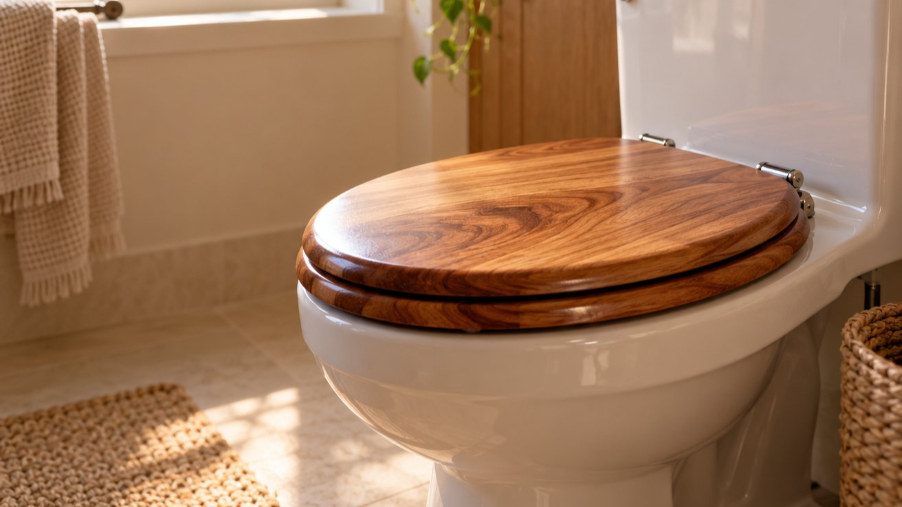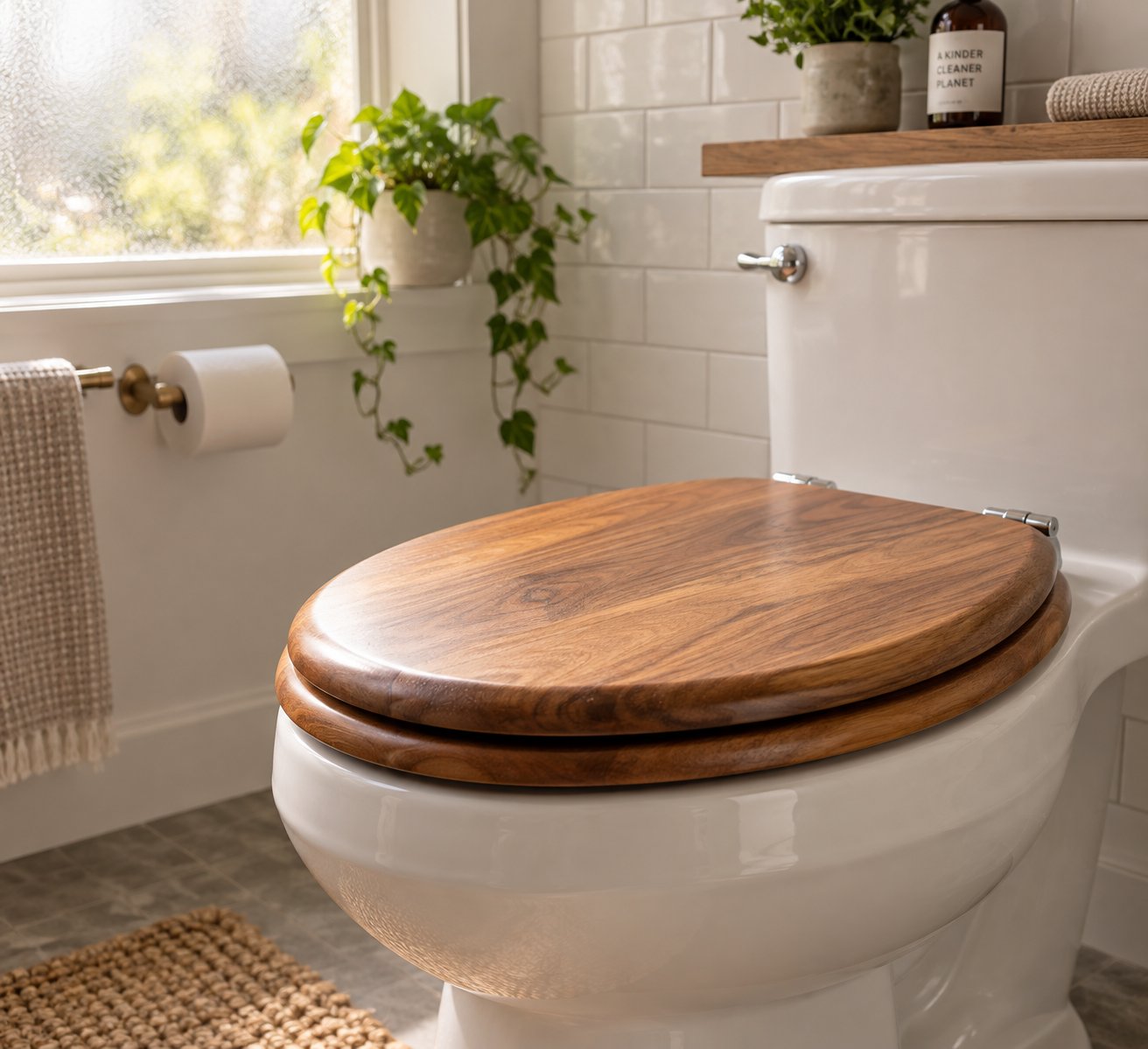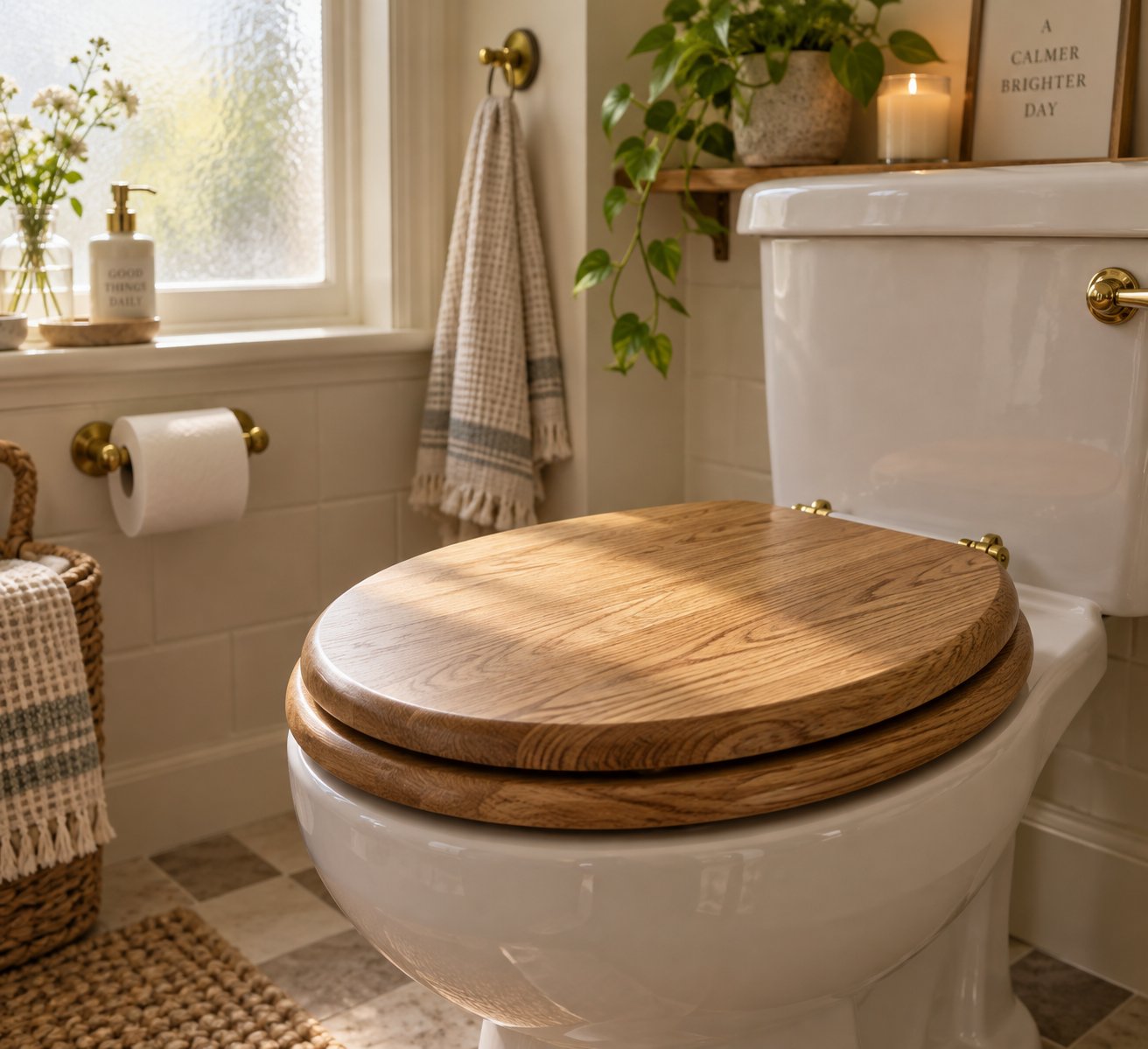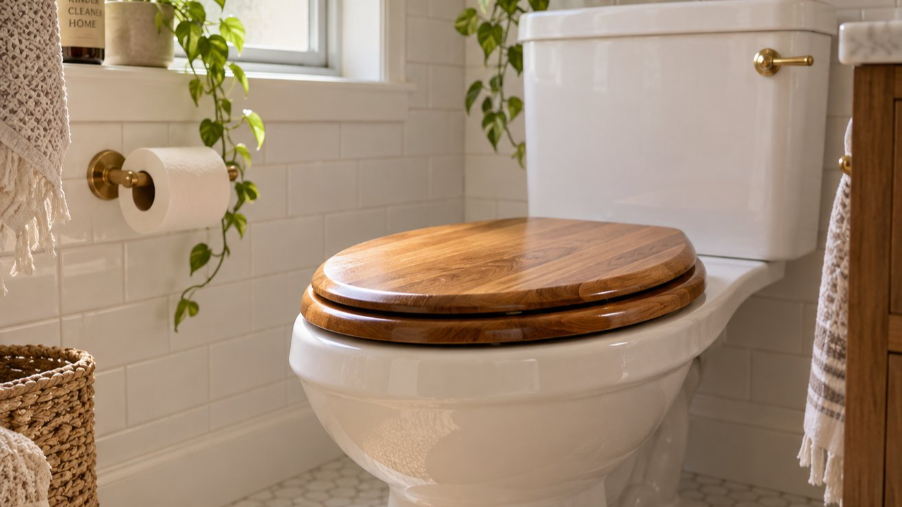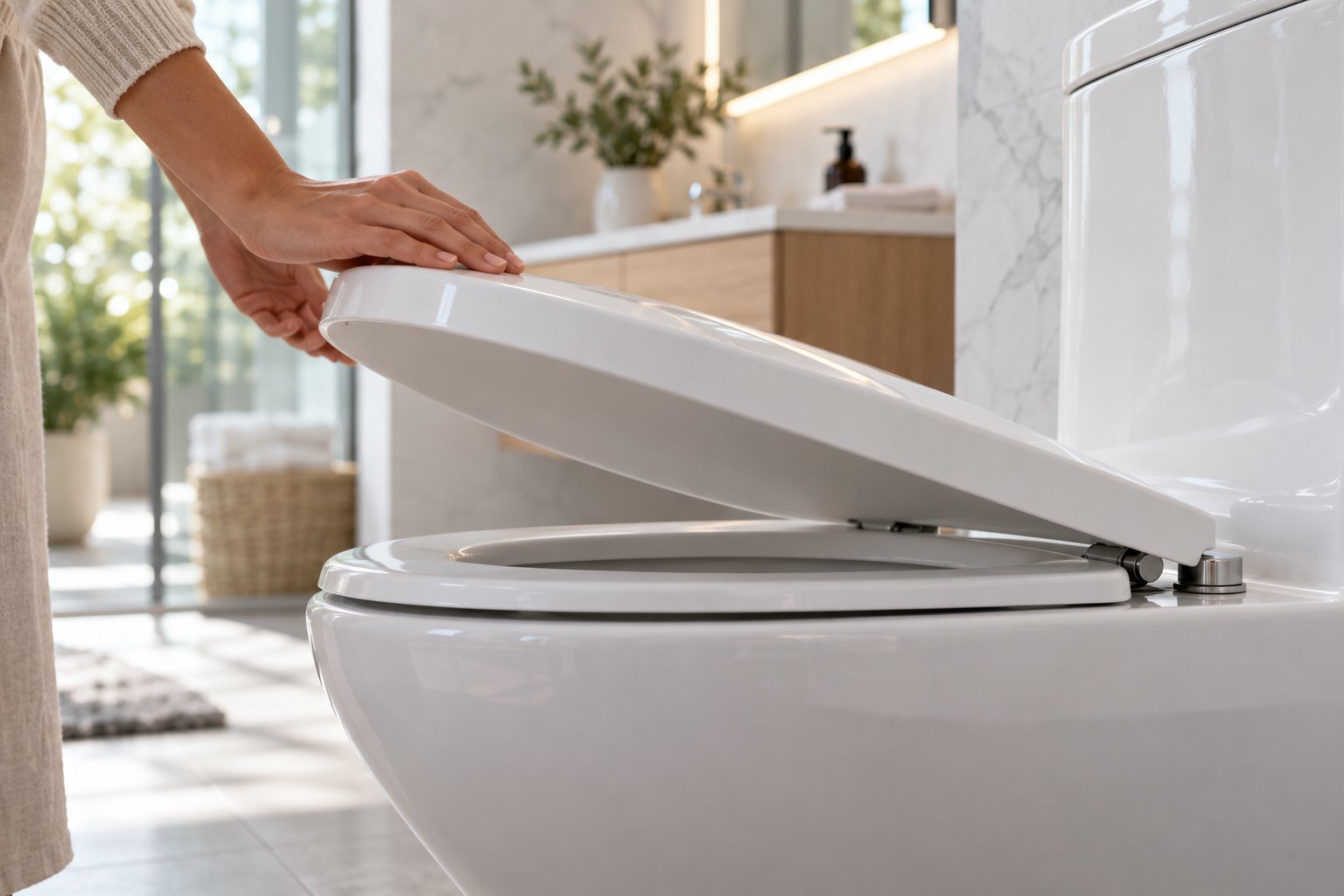
What a Soft Close Wooden Toilet Seat Really Is
Ever been jolted awake by a toilet lid crashing down in the middle of the night? A soft close wooden toilet seat is designed to end that noise. But the term covers more than most product titles reveal, so it helps to know exactly what you are buying.
What Defines a Soft Close Wooden Toilet Seat
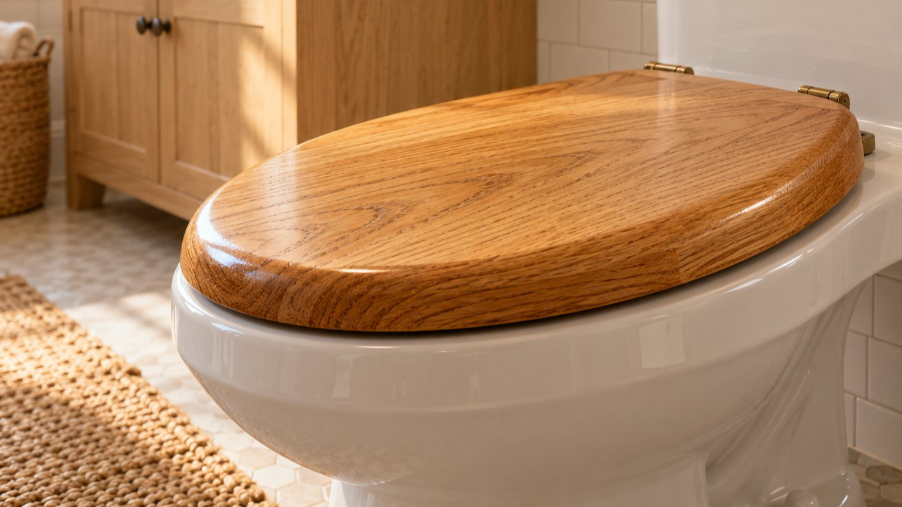
A soft close wooden toilet seat is a wood or wood-composite seat and lid paired with damped hinges that lower the lid and ring slowly instead of letting them drop.
The wood part can be solid timber, molded wood, or engineered board such as MDF. The soft close part lives in the hinge, where a damper creates drag as the lid falls. Some models slow only the lid, while others slow both the lid and the seat ring. That difference matters, so check which parts are covered before you buy.
Soft Close vs Slow Close Wooden Toilet Seat Terminology
You'll notice listings switch between "soft close," "slow close," and even "quiet close." In most retail settings, these words describe the same benefit: a lid or ring that lowers gradually instead of falling quickly. A terminology guide from Bofan also points out that these labels are not technical standards. So read the hinge details, not just the headline.
Why Wooden Toilet Seats Remain a Popular Choice
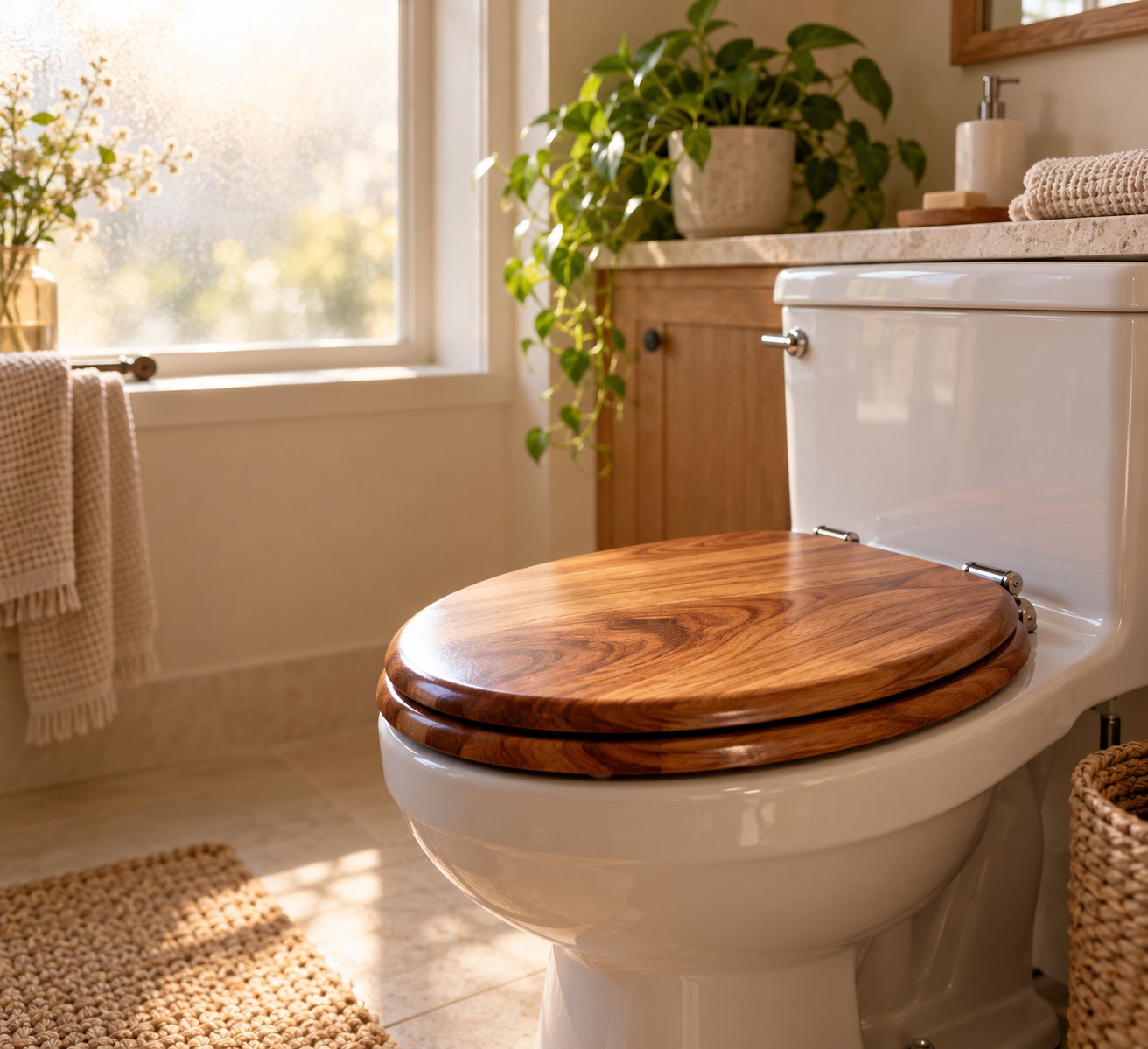
Why pick wood over plastic? Wooden toilet seats feel solid and premium, and they are warmer to the touch, a point Ironclad Plumbing highlights for chilly mornings. A wooden WC seat can also carry stains, enamels, and decorative finishes that suit both classic and modern bathrooms. The extra heft has a downside, though. Wooden lavatory seats can crack when dropped from fully open, which is exactly the damage controlled closing helps prevent.
This guide walks you through the full ownership lifecycle:
- Choose the right material and finish
- Measure your bowl for a proper fit
- Install the seat and align the hinges
- Maintain the finish and hardware
- Troubleshoot slamming or wobbling
- Replace parts or the whole seat when needed
Think of it as a practical reference rather than a product roundup. And because a heavy wood lid behaves very differently from a light plastic one, the real story begins inside the hinge.
How Soft Close Hinges Work on Heavier Wood Seats
Why does one lid glide shut while another drifts halfway and then thuds? The answer sits inside a hinge barely bigger than your thumb.
Inside a Soft Close Wood Toilet Seat Hinge
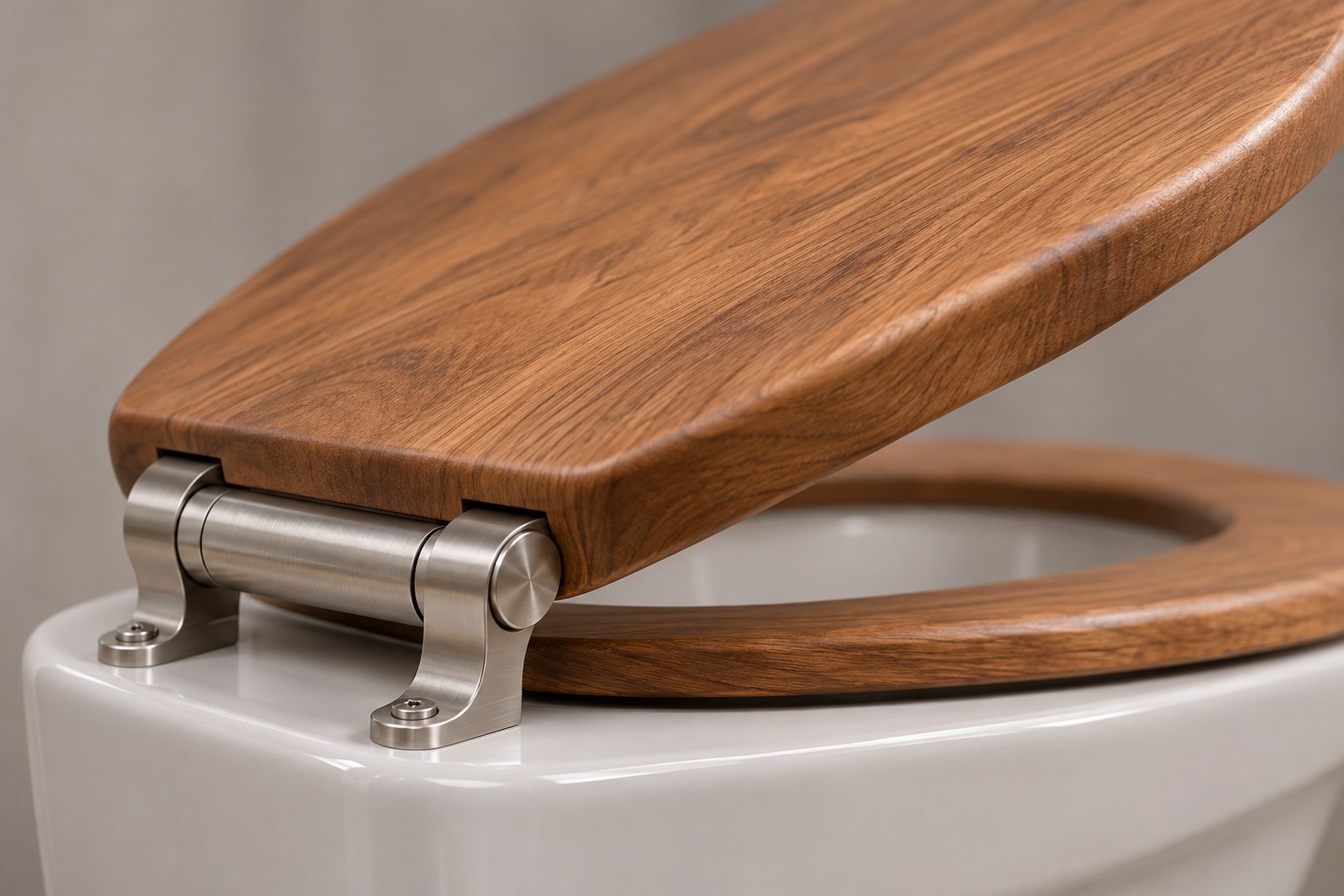
Most soft close hinges use a small damper built around a rotating shaft. As the wood toilet lid falls, the shaft turns and pushes against a thick fluid, usually silicone oil. That oil can only squeeze through a tiny gap, so it resists fast movement. Furnica compares the effect to a car shock absorber: the fluid soaks up the energy that would otherwise end in a slam. A complete assembly also includes the hinge body, a fixing kit, and buffers that cushion contact with the bowl, as Bofan's mechanism guide lays out.
Hydraulic Dampers vs Friction Hinges
Not every slow-closing hinge uses fluid. Some rely on friction, with tight-fitting or spring-loaded parts that drag against each other. Here is how the two approaches compare:
| Mechanism Type | Closing Feel | Adjustability | Typical Failure Modes |
|---|---|---|---|
| Hydraulic or rotary damper | Smooth, steady descent with a gentle finish | Usually fixed at the factory and matched to a specific seat weight | Fluid leakage, worn seals, gradual loss of damping |
| Friction hinge | Firmer and sometimes stiff or uneven | Varies by design, often none | Contact surfaces wear smooth, drag fades, squeaking |
Why Heavier Wood Seats Need Matched Damping
Imagine fitting a damper built for a light plastic lid onto a solid wooden toilet seat. The heavier lid overwhelms the fluid and drops fast near the end. Flip the scenario and a damper sized for a heavy lid can make a light one stall before it closes. Bofan notes that a damper chosen for a lightweight PP seat may not perform correctly on a heavier molded-wood lid, so torque has to match the actual seat and lid.
Component makers tackle this at the design stage. Tianyun's MDF and metal damper collection, for example, offers soft-close hinges for MDF, wooden, resin, and metal seats with custom length, damping torque, and mounting designs, supplying hardware to seat manufacturers and private-label brands rather than selling finished seats.
Common Reasons Slow Close Hinges Wear Out
- Fluid leakage: Worn seals let oil escape, so damping fades over time.
- Forcing the lid down: Pushing overrides the damper and strains its internal seals.
- Weight mismatch: An undersized damper works harder on every close.
- Uneven pairing: One damper weakens first, so one side of the wooden toilet lid closes faster.
How long should a hinge last? Makers run repeated open-close cycle tests, and Bofan discusses durability targets of 30,000 to 50,000 cycles for private-label programs, depending on the model. That figure only means something if you know which hinge and material were tested. And that is the catch: the details that decide hinge performance are often buried behind vague listing words like molded, enameled, or wood grain.
Decoding Wood Seat Product Listings
Have you ever compared two "wood" seats that looked identical, only to find one costs twice as much? The difference usually hides in a single word in the listing. Once you can read those words, you'll know what is actually under the paint.
Molded Wood Toilet Seat Explained
A toilet seat molded wood listing usually describes wood fibers bonded with resin, then pressed into a mold under heat and high pressure. Bofan explains that this process creates a dense, uniform structure that holds its shape. The surface then gets several layers of paint or protective coating, which gives the smooth, glossy look. An elongated molded wood toilet seat and a round one are made the same way. Only the mold changes. Still, density and coating quality vary between makers, so two molded seats won't always perform alike.
What Enameled Wood Toilet Seat Means
"Enameled" describes the finish, not the core. It is a commercial term for a painted or coated surface built up over a wood-based base. Bofan's wood seat guide cautions that the word should not be treated as a complete technical specification. The core underneath could be molded wood, MDF, or solid timber. Since the finish is what keeps moisture out, coverage on the edges and around the hinge area matters as much as the shine on top.
Solid Wood Toilet Seat and Wood Grain Finishes
Solid wood means the seat is shaped from natural timber such as oak, bamboo, or pine. A solid oak toilet seat shows real grain, and no two look exactly alike. That character comes with a tradeoff: natural wood reacts more to humidity and temperature swings, so it can warp or crack if the sealing is weak. "Wood grain" is different. It often describes a look rather than a material, such as a printed pattern or thin veneer over molded wood or MDF.
Reading Finish Names Like Seashell, Black and Marble
Listings often show swatches like seashell, black, espresso stain, or marble. These are finish options, not structural differences. Within one product line, a black seat and a marble-pattern seat typically share the same core and hinge. Choose the finish for your bathroom style, then judge quality on construction.
| Listing Term | What It Usually Means | What to Check in the Description |
|---|---|---|
| Molded wood | Wood fibers and resin pressed into shape, then painted | Number of coats, edge sealing, hinge type |
| Enameled wood | Multi-coat painted or sealed finish over a wood-based core | The actual core material and finish type |
| Solid wood | Natural timber, often one species such as oak | Wood species, underside sealing, cleaning limits |
| Wood grain or wood effect | Printed pattern or veneer that imitates timber | Whether it says print, veneer, or real wood |
| Color or pattern names | A finish applied to the same seat design | That core and hinge match other variants |
Trust the specifications section, not the product title, when you verify what a wood seat is made of.
Knowing the core tells you what you are paying for. It doesn't tell you whether wood beats the plastic and thermoset seats sitting right beside it on the same shelf.
Wood vs Plastic and Thermoset Seats Compared
Picture two seats side by side on a store shelf. One is a glossy enameled wood toilet seat. The other is a sleek plastic model that looks almost the same from a few feet away. Which one will you still be happy with in five years? It depends on what matters most to you: warmth, easy cleaning, weight, or price.
Wooden WC Seat vs Plastic and Polypropylene
Polypropylene, or PP, is the most common plastic seat material. It is light, non-porous, and handles water and humidity well, so cleaning is quick. The tradeoff is feel. PP feels cool at first touch and light in the hand, and lower-grade versions can scratch or discolor over time.
A wooden seat toilet setup feels far more substantial. HOROW puts typical solid wood seats at 2 to 3 kg, compared with 0.5 to 1 kg for plastic. That extra mass is why wood seats usually pair with metal hinges such as zinc alloy or stainless steel, a point toiletseats.cn makes. It is also why matched damping matters so much.
How Thermoset Compares With Wooden Lavatory Seats
Thermoset plastics, sometimes sold as duroplast, harden permanently during molding. The result is a hard, dense, non-porous surface that resists scratches and stains. It feels heavier than PP but is usually lighter than wood. Its weak spot is a sharp impact, which can chip the rigid surface. Wooden lavatory seats face a different risk: they stay hygienic only while their coating stays intact.
Comfort and Feel of White Wooden Toilet Seats
This is where wood shines. Wood conducts heat slowly, so it feels warm even on a cold morning. A white enameled seat gives you that warmth with a clean, classic look. A mahogany toilet seat adds rich color, but check the specs. It may be solid hardwood, or it may be a mahogany-tone finish over a molded core.
| Material | Durability | Scratch and Stain Resistance | Moisture Tolerance | Warmth and Feel | Relative Price Tier | Weight |
|---|---|---|---|---|---|---|
| Molded wood | Good while the finish holds | Good until the coating chips | Fair; core can swell once the finish breaks | Warm, solid | Low to mid | Medium to heavy |
| Solid wood | Good with regular upkeep | Fair; can dent, depends on sealant | Fair; needs intact sealing | Warmest, natural grain | High | Heaviest |
| Polypropylene | Good; flexes rather than cracks | Fair to good; varies by grade | Excellent; non-porous | Cool at first, light | Low to mid | Lightest |
| Thermoset | Very good; can chip on sharp impact | Very good; hard surface | Excellent; non-porous | Cool at first, dense | Mid | Medium |
Pros of Wood Seats
- Warm to the touch in cold weather
- Solid, stable feel with little flex
- Wide range of stains, enamels, and natural grain looks
- Weight that suits well-matched soft close hinges
Cons of Wood Seats
- Hygiene depends on an unbroken finish
- Moisture can damage the core once coating cracks
- Needs gentler cleaners than plastic
- Heavier lids put more stress on hinges
Choosing a material narrows your options, but it can't rescue a seat that overhangs the rim or leaves a gap at the front. A heavy wood lid makes a poor fit even more obvious, and that is where a tape measure earns its place.
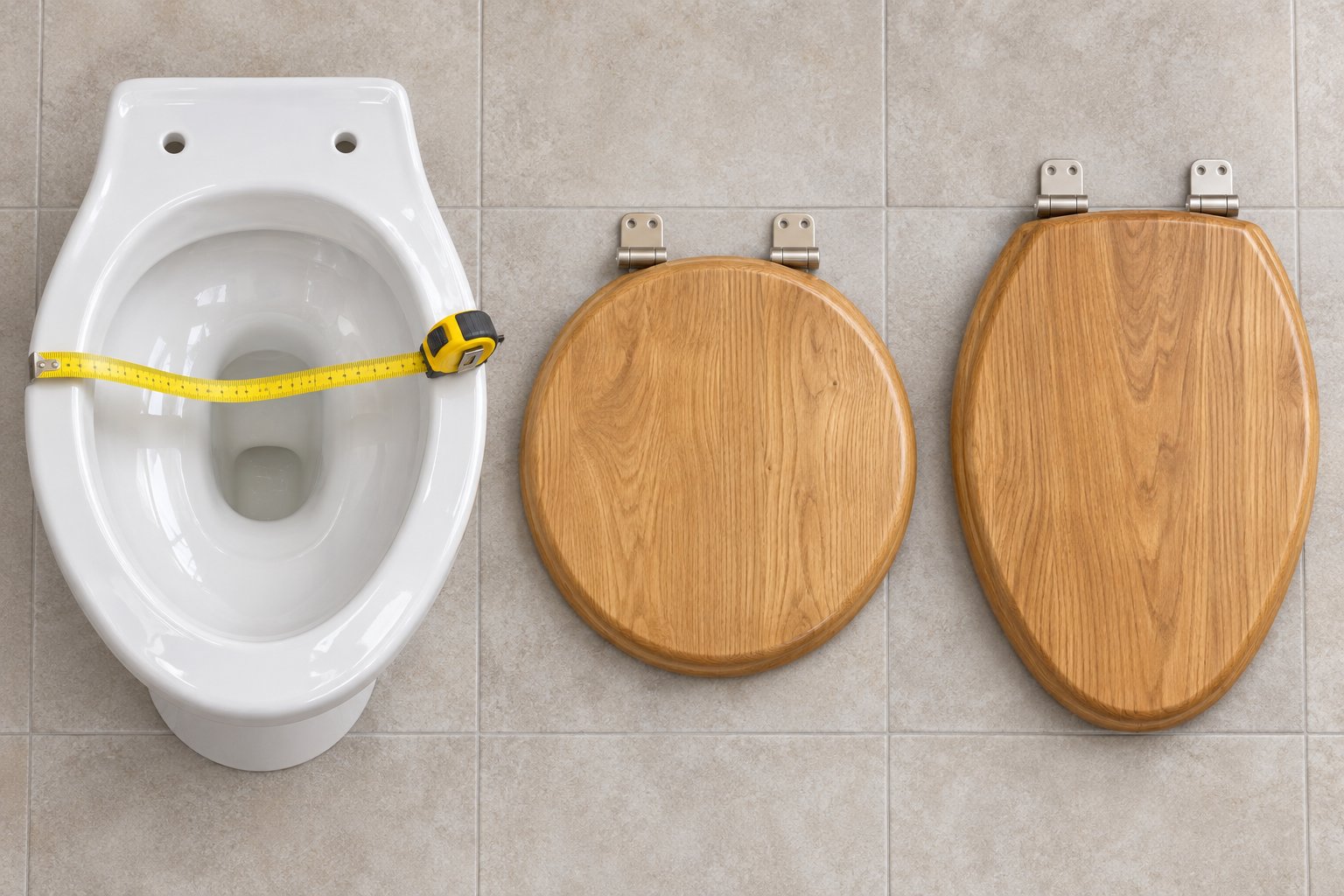
Measuring for Round or Elongated Wood Seats
Have you ever ordered a seat that looked perfect online, only to find it hanging past the rim? With a wood seat, that mistake hurts more. The extra weight turns a small overhang into a wobble, and a heavy box is no fun to ship back. Whether you typed wood toliet seat into a search bar or browsed a showroom aisle, the numbers that matter come from your own bowl.
Round Toilet Seat Wood vs Elongated Shapes
Most bowls come in two shapes. Round bowls are shorter and suit compact bathrooms. Elongated bowls extend farther forward, and HOROW's sizing guide notes they are common in newer homes. The two can look similar at a glance, which is why guessing the shape is one of the mistakes Lowe's warns against.
How to Measure Your Toilet Bowl Correctly
Measure the bowl, not your old seat. Seats can be slightly oversized or worn, so they won't give you a reliable reading.
- Lift the seat and lid and locate the two bolt holes at the back of the bowl.
- Measure the length from the center point between the bolt holes straight to the front edge of the rim. Keep the tape along the bowl's center line.
- Measure the width across the widest part of the bowl, from outer edge to outer edge.
- Measure the bolt spacing from the center of one bolt hole to the center of the other.
What 16.5 and 18.5 Inch Seat Lengths Mean
You'll see these two numbers in almost every listing. Round bowls typically measure about 16.5 inches long, while elongated bowls run about 18.5 inches. Width usually lands around 14 to 14.5 inches for either shape. Treat these as common listing values, not guarantees, and compare them with your own results.
| Your Measurement | Likely Shape | What to Do |
|---|---|---|
| Length about 16.5 inches | Round | Shop round seats |
| Length about 18.5 inches | Elongated | Shop elongated seats |
| Width about 14 to 14.5 inches | Either standard shape | Confirm the length to decide |
| Length or width far from these values | Non-standard or specialty | Check the toilet maker's specifications for a matching seat |
Checking Bolt Hole Spacing Before You Buy
The standard US bolt spread is 5.5 inches, center to center. It rarely varies, but a quick check takes seconds and rules out a frustrating surprise.
Fit also goes beyond the bowl. Look at these factors before you commit:
- Tank shape: A curved or forward-set tank may stop the lid from leaning back far enough to stay open.
- Lid clearance: Solid wood toilet seats often have thick, heavy lids that need extra room to rest securely.
- Hinge position: Hinge housings that sit farther back can push the lid against the tank or a wall-mounted shelf.
A heavy wood lid that can't rest fully open may tip forward on its own, so check the space behind the bowl as carefully as the bowl itself.
A tape measure can shrink hundreds of search results down to the seats that physically fit. Deciding which of those survivors deserves your money calls for a sharper set of filters.
A Practical Checklist for Choosing the Right Seat
Search for a wood seat at a big-box retailer and you'll face a wall of options. Walmart alone surfaces 406 results. The sidebar filters for material, shape, brand, and customer rating can narrow that list fast, but only if you know what each filter should actually tell you. Here is how to turn them into a checklist that works.
A Buyer Checklist Built From Retail Filters
- Material claims: Confirm the core in the specifications. Molded wood, MDF, and solid timber can all land under the same "wood" filter, yet they behave very differently.
- Shape and size: Match the listing to your own measurements. A good elongated toilet seat wood listing states its length and bolt spread clearly.
- Hinge type and adjustability: Check whether soft close covers the lid only or both the lid and the ring. See if the hinges can be tightened or shifted side to side for alignment.
- Hinge material: Wood is heavy, and Lowe's notes some wood seats use metal hinges to support the extra weight. Metal or reinforced hinge posts are a good sign.
- Finish: Look for a sealed or enameled surface that covers the edges and underside. Treat "antimicrobial" labels with care, since The Spruce points out these treatments protect the product, not the user.
- Hinge longevity in reviews: Search reviews for words like "hinge," "slam," and "loose" instead of skimming the star total.
Reading Reviews and Best Toilet Seat Reddit Threads Wisely
A high star average can hide a slow-building problem. Many reviews are posted in the first week, long before a damper starts to fade. Sort by most recent or lowest rating and look for patterns, such as several buyers reporting weak damping after a few months. Treat "best seller" badges as a sign of popularity, not quality.
Community threads, like "best toilet seat reddit" discussions, are great for long-term stories. Just check whether the poster had the same bowl shape and seat material as you. You'll also see shoppers search store- or brand-specific terms like Target or TOTO, or even type "wooden toilet bowl" when they mean a wood seat. Whatever you search, apply the same checklist to every result. A familiar name doesn't confirm the core material or hinge match.
Solid Oak and Mahogany Toilet Seat Considerations
Solid hardwood models are the heaviest loo seats wooden ranges offer, so hinge strength and damping matter most here. Confirm the species is real timber rather than a stain over a molded core. Check that the underside is sealed, and read the cleaning limits before you buy. Natural wood suits a well-ventilated room better than a steamy one.
Matching Seat Type to Household Needs
| Household | Suitable Seat Type | Why It Fits |
|---|---|---|
| Families with children | Enameled or molded wood with soft close on both lid and ring | Slow closing helps prevent small fingers from getting caught under a heavy lid, and a hard coating handles frequent cleaning |
| Guest bathrooms | Solid wood or a decorative stained finish | Light use means less wear, and FenSo suggests wood suits guest and traditional bathrooms |
| High-moisture bathrooms | Fully sealed enameled wood, or plastic or thermoset if moisture is constant | The finish, not the material alone, decides how well the seat resists water and stays hygienic |
| Comfort priorities | Wood in an elongated shape, if your bowl allows | Wood feels warm and solid, and elongated seats feel roomier for most adults |
Pick the seat for the room it lives in, then confirm the hinge can handle the weight of the lid you chose.
Even a seat that passes every check can wobble or slam if its bolts go on crooked. That makes the half hour you spend with a wrench just as important as the purchase itself.
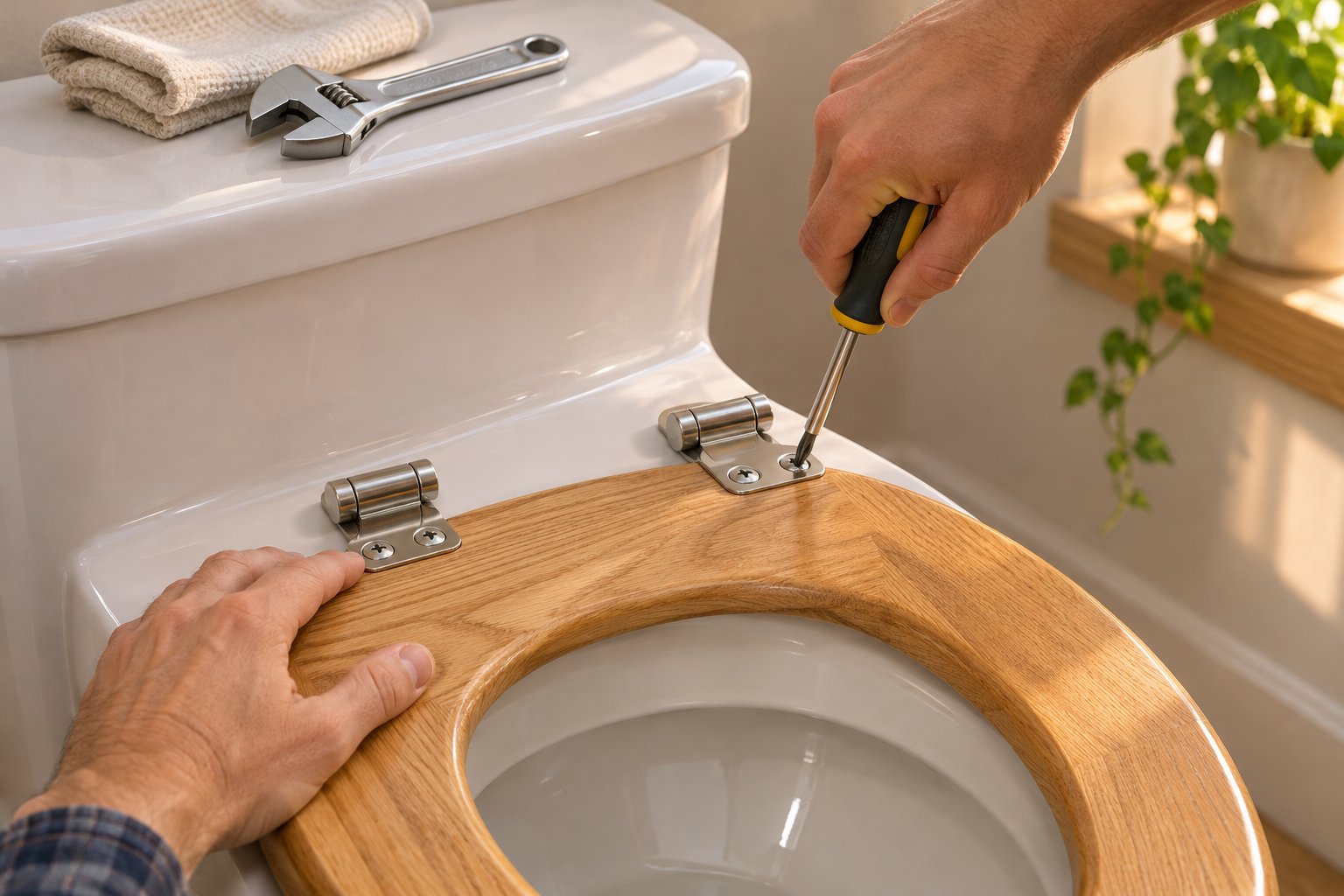
Installing and Replacing a Wood Seat Step by Step
Does a seat swap sound like a job for a plumber? Usually it isn't. With a few basic tools and some patience, you can do it yourself. The steps are much the same whether you're removing a cracked plastic Tuffy toilet seat or a tired wood grain toilet seat. Often the hardest part is getting the old one off.
Removing an Old Wooden Seat Toilet Assembly
Most seats attach with a bolt through each hinge and a nut under the back of the bowl. Some older seats use a bolt built into the hinge itself, and that bolt can spin uselessly once the nut corrodes. For stuck hardware, Natural Handyman suggests drilling off a plastic nut. For a rusty steel bolt, drill into the bolt head from above. Start with a small pilot bit and step up gradually. A sharp bit needs less force, which helps protect the porcelain.
Fitting Hinges on a Soft Close Toilet Seat Wooden Model
Many soft close designs bolt mounting posts to the bowl first, and then the seat slides or clicks onto them. Some models add quick-release hinges and a locking system to keep the seat from shifting. Since hinge designs vary, keep the manufacturer's instructions open as you work.
- Gather tools: a screwdriver, an adjustable wrench or pliers, rubbing alcohol, and a clean rag.
- Open the bolt caps: pry up the hinge covers gently with a flat screwdriver.
- Loosen the nuts: hold each nut under the rim while you turn the bolt. If it won't budge, drill it off carefully.
- Clean the mounting area: wipe around the bolt holes and under the rim with alcohol. You won't get easier access to this spot.
- Position the hinge posts: insert the new bolts as directed. If the kit includes adhesive pads, apply them to the seat first so they center properly. They add friction that keeps the seat from loosening.
- Center the seat: lower it and line it up with the rim.
- Tighten evenly: alternate between sides until the seat is snug, then stop.
- Test the closing action: raise the lid fully and let it fall on its own.
Tightening and Aligning the Wood Toilet Lid
Before the final turn, look at the seat from the front. The edges should sit evenly over the rim on both sides. Next, close the lid. It should land squarely on the ring, with both dampers engaging at the same time. If one corner touches first, loosen the nuts, nudge the seat, and retighten. A heavy solid wood toilet seat shows misalignment quickly, because the extra weight loads the lower damper harder.
Stop at snug: overtightened bolts can crack the seat, the hinges, or the vitreous china bowl itself.
A careful install gives your soft close wooden toilet seat a strong start. Still, hinges change with use. A lid that glided perfectly in the first month may start dropping faster, creaking, or drifting to one side, and each symptom points to a different cause.
Troubleshooting Slamming, Wobbling and Weak Damping
You lift the lid, let go, and instead of a slow glide you hear a thud. Sound familiar? Most soft close problems trace back to the causes covered in the hinge section: a worn damper, loose mounting, misalignment, or a lid too heavy for its hinge. Matching the symptom to the cause keeps you from replacing parts that still work.
When a Soft Close Seat Slams or Drops Fast
A lid that suddenly drops fast usually means the damper has lost resistance. It isn't always worn out, though. A plumbing expert on JustAnswer lists dirt, hard water mineral buildup, and lost lubrication as common culprits too. Remove the seat, clean the hinge joints, and apply a silicone-based lubricant that is safe for plastic. Skip household oil and thick grease. Many hinges have no speed dial at all, so cleaning may be your only DIY adjustment.
Fixing Uneven Closing and Seat Wobble
Wobble almost always starts at the mounting. Check the bolts first, then re-center the seat just as you did during installation. If one side closes faster, the two dampers may be wearing unevenly. Some dampers carry slow and fast markings that let you rotate them for more tension, as iFixit's hinge guide shows. If yours have only one set of notches, they can't be adjusted.
| Symptom | Likely Cause | Fix to Try | When to Replace |
|---|---|---|---|
| Slamming or dropping fast | Worn damper, grime, or a lid too heavy for the hinge | Clean and apply silicone lubricant | Damping stays weak after cleaning |
| One side closes faster | One damper weakening, or seat misalignment | Realign the seat; rotate adjustable dampers | A damper is cracked or leaking |
| Wobbling | Loose bolts or worn hinge posts | Retighten evenly to snug | Posts or hinge body are cracked |
| Creaking | Dry or dirty joints, worn friction surfaces | Clean and lubricate the hinge | Noise continues with visible play |
| Lid not staying open | Tank clearance or hinge position | Slide the seat forward within its mounting slots | Hinge geometry doesn't suit your tank |
| No damping | Fluid leakage or failed seals | Inspect for oily residue and cracks | Damper is empty or broken |
What to Do When the Hinge Stops Damping
Never push a slow lid down to speed it up. Forcing it overrides the damper and strains the seals that hold its fluid. Look for an oily film around the hinge, which shows up quickly on white wooden toilet seats, or dampers that feel loose and floppy.
Repair options depend on the maker. Some sell hinge and damper assemblies as separate parts, while others expect you to replace the whole seat. The same JustAnswer expert ballparks replacement hardware at roughly $10 to $25, well below the cost of a new wood seat. A molded wood toilet seat is heavier than plastic, so any replacement damper must match that weight. Check the manufacturer's guidance and warranty terms before you order parts or open a hinge.
Let the lid close on its own every time, because a forced close is the fastest way to ruin a healthy damper.
Hinges are only half the story, though. A molded toilet seat can have flawless dampers and still fail early if its finish starts to crack and let moisture in.
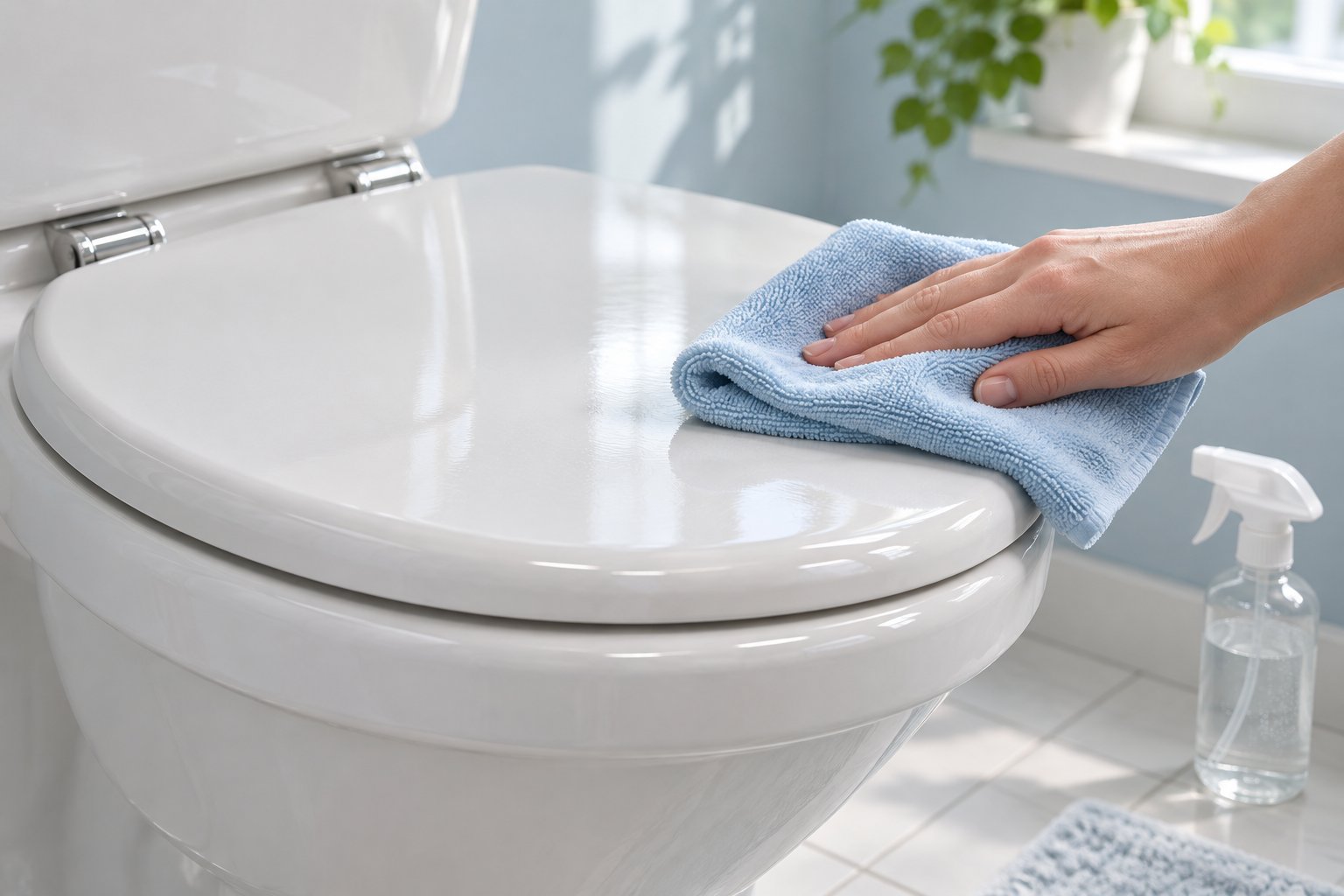
Finish Care and Hygiene for Lasting Wood Seats
When you wipe down a wood seat, what are you really cleaning? Mostly the finish. That thin coating keeps water, urine, and germs away from the wood underneath. Caring for it means caring for the whole seat.
Sealed and Enameled Finishes vs Stained Solid Wood
Enameled and sealed surfaces form a continuous hard skin. Moisture sits on top, and a quick wipe sanitizes them. Stained or oiled solid wood offers natural grain and warmth, but its protective layer is thinner. It needs gentler cleaning and some finish upkeep over time.
Either way, the finish is the line of defense. Experts quoted by Family Handyman warn that cracks, chips, and worn finishes create pathways for bacteria and moisture that cleaning products can't reach. They recommend replacing the seat rather than patching it with sealant. The same source notes wood seats are usually good for only two or three years of daily use, which is shorter than plastic.
Cleaning Solid Wood Toilet Seats Without Damage
Wood is less water-resistant than plastic, so B&Q suggests diluted dish soap on a damp cloth, followed by drying the seat right away. The same routine applies whether you own a round toilet seat wood model or an elongated one.
Do:
- Use mild soap or a gentle bathroom cleaner on a soft cloth
- Spray cleaner onto the cloth, not the seat
- Rinse toilet bowl cleaner splashes off immediately
- Dry the seat and the underside of the wooden toilet cover after every clean
- Check edges and hinge areas for finish cracks
Don't:
- Use scouring pads or abrasive creams
- Apply bleach, degreasers, or other harsh chemicals that strip the finish
- Leave the cloth dripping wet
On a wood toilet seat, slow close hinges collect grime and moisture too. Wipe around them with a soft cloth, then rinse and dry. A quick-release design makes this much easier. Whether you bought a Target soft close wood toilet seat or a specialty brand, lower the lid gently while cleaning and never force it shut.
Caring for Vintage and Antique Wooden Toilet Seat Styles
Vintage-style seats often use stained or varnished wood that shows wear quickly. Clean them with plain soap and water only, and dry them right away. Inspect the varnish regularly, especially near the hinges. If you spot a fresh chip, B&Q advises sealing it quickly to stop water from soaking in and warping the wood. Once the finish cracks or flakes widely, it's time to replace the seat.
For a high-moisture bathroom, choose a fully sealed or enameled finish that covers the edges and underside, because an intact coating matters more than the wood itself.
A finish that holds up for years is rarely luck. It reflects choices made long before the seat reached a shelf, from how the coating was applied to which hinge was paired with the lid.
What Makes a Well Built Wood Seat Last
Why do two seats with the same glossy finish age so differently? One still closes in silence years later, while the other wobbles and thuds within months. The gap usually comes down to engineering you can't see in a product photo.
Signs of a Well Engineered Soft Close Wooden Toilet Seat
- Matched damping: Hinge torque suits the lid's real weight, so it neither slams nor stalls.
- Sturdy hinge material: Metal or reinforced posts carry the extra load of wood.
- Secure mounting: Fixings hold alignment without needing to be overtightened.
- Sealed finish: The coating covers edges, the underside, and hinge areas.
- Accurate shape fit: The seat follows the bowl's round or elongated profile.
These signals apply whether you want a crisp white wooden toilet seat or a vintage wood toilet seat with a warm stain. Even a retro bathroom styled after the old enamel potty look relies on the same basics underneath.
Why Hinge and Seat Compatibility Matters
A hinge is not a universal part. Its torque, length, and mounting points must suit the seat it carries. Put a damper built for light plastic on a molded wood lid and you get the fast drop described earlier. Compatibility should be verified, never assumed.
Hardware Options for Seat Manufacturers and Private Label Brands
For brands designing wood or MDF seats, hinge sourcing shapes the finished product as much as the core material. Useful resources include:
- Tianyun MDF and metal damper collection: Soft-close hinges for MDF, wooden, resin, and metal seats, with custom length, damping torque, and mounting designs. Tianyun cites SUS304 and POM components and 100,000-cycle testing. It supplies hinge components, not finished seats, so round, oval, or elongated fit depends on your seat design and verified hinge compatibility.
- Prototype cycle testing: Test open-close performance on the exact seat and lid weight before production.
- Finish and mold partners: Confirm hinge mounting points won't break the sealed coating.
For shoppers, every stage builds on the one before:
- Choose the material and finish for your room.
- Measure the bowl, not the old seat.
- Install evenly and stop at snug.
- Maintain the finish with gentle cleaning.
- Troubleshoot by matching symptoms to causes.
- Replace hinges or the seat when the damper or finish fails.
Get each stage right, and a well-matched wood seat will keep closing quietly long after the novelty wears off.
Soft Close Wooden Toilet Seat FAQs
1. Is a soft close wooden toilet seat worth it?
For most homes, yes, as long as the hinge suits the lid. Wood is heavier than plastic, so a free-falling wood lid hits the bowl harder. That makes it louder, and the impact can chip the finish or crack the seat. A damped hinge cuts the noise and the impact, protects small fingers, and spares the coating that keeps moisture out of the wood. The benefit holds only when the damper torque fits the lid's real weight. A mismatched hinge can still drop fast or stall halfway, so check the hinge details and reviews that mention long-term closing before you buy.
2. Why does my soft close wooden toilet seat slam shut?
A wood lid that suddenly drops fast usually has a hinge problem. The most common causes are a damper leaking its internal fluid, grime or mineral buildup in the hinge joints, or a damper that was too weak for a heavy lid from the start. Start by removing the seat, cleaning the hinges, and applying a silicone lubricant that is safe for plastic. If both dampers are fine but one side lands first, re-center the seat and retighten the bolts evenly. Oily residue around the hinge or a floppy, resistance-free lid means the damper has failed and needs replacing. Never push the lid down to speed it up, because forcing it strains the seals.
3. How do I know if I need a round or elongated wooden toilet seat?
Measure the bowl itself, not your old seat. Lift the seat and run a tape from the midpoint between the two bolt holes to the front edge of the rim. A reading near 16.5 inches points to a round bowl, while one near 18.5 inches points to an elongated bowl. Also measure the widest part of the bowl and the distance between bolt hole centers, which is usually 5.5 inches in the US. Wood seats need one more check. Make sure the tank and wall leave enough room for a thick, heavy lid to rest fully open without tipping forward.
4. How do you clean a wooden toilet seat without damaging the finish?
Treat the finish gently, because it is what keeps water and germs away from the wood. Use mild soap or a non-abrasive bathroom cleaner on a soft cloth, and spray the cloth rather than soaking the seat. Rinse off any toilet bowl cleaner splashes right away, then dry the top, the underside, and the hinge areas. Avoid scouring pads, bleach, and degreasers, which can dull or strip the coating. Check the edges and hinge zones for chips now and then. A small chip on a vintage varnished seat can be sealed quickly, but widespread cracking means it is time for a new seat.
5. Can I replace just the soft close hinges on a wooden toilet seat?
Sometimes. Some seat brands sell hinge and damper assemblies as spare parts, while others expect you to replace the whole seat, so check the manufacturer's guidance and warranty first. Any replacement must suit the weight of a wood lid, because a hinge built for light plastic will let a heavy lid drop fast. On the production side, seat makers and private-label brands often source hinges from specialist suppliers. Tianyun's MDF and metal damper collection, for example, offers soft-close hinges for MDF, wooden, resin, and metal seats with custom length, damping torque, and mounting designs. It supplies components to manufacturers rather than finished retail seats, and round, oval, or elongated fit depends on the finished seat design and verified hinge compatibility.
Apply This Insight to Your Project
Tell us what you are building and how the topic “Soft Close Wooden Toilet Seat: Stop Slams, Wobbles and Bad Fits” relates to your application. Our engineering team can help evaluate the next step.