What Are Soft Close Door Dampers and How Do They Work
Imagine pushing a cabinet door shut and hearing... nothing. No bang, no rattle, just a smooth glide into place. That quiet magic is the work of soft close door dampers — compact devices engineered to decelerate a door, drawer, or lid during the final degrees of its closing arc. They absorb kinetic energy so the panel settles gently against the frame instead of slamming into it.
A soft close door damper is a small hydraulic, pneumatic, or rotary device that catches a door in its last 10 to 20 degrees of travel, converting forward momentum into controlled resistance so the door closes silently and without impact.
What Exactly Is a Soft Close Door Damper
So what is a soft close mechanism, really? Think of it as that thing on door that slows it down right before contact. A door damper does not pull a door shut the way a traditional door closer does. Standard closers use a spring to actively drive the panel toward the frame and engage the latch. A door soft closer, by contrast, is a purely passive device. It sits idle until the door enters that final stretch of travel, then it activates — forcing fluid or air through a tiny internal orifice to create smooth, progressive resistance.
These dampers come in several form factors. Some are embedded inside a hinge cup. Others are surface-mounted with adhesive pads or small screws directly onto cabinet doors, furniture lids, and full-size interior doors. You'll even find them built into drawer slide systems and appliance covers. Regardless of the style, the core principle stays the same: absorb energy, eliminate impact.
Why Soft Close Technology Is Gaining Popularity
A few years ago, softclose hardware was a premium feature found mostly in high-end kitchens. That has changed quickly. Mid-range cabinetry brands now include soft close door damper technology as a standard offering, and homeowners renovating older kitchens increasingly expect it.
Several forces are driving the shift:
- Quieter-home expectations — Open-plan living means kitchen noise travels everywhere. Eliminating door slams makes a noticeable difference in daily comfort.
- Child and elder safety — A soft close hinge or damper reduces the risk of pinched fingers by decelerating the door in the exact zone where small hands are most vulnerable.
- Perceived quality — A door that glides shut signals craftsmanship. Builders and remodelers use soft close features to elevate the feel of an entire room without a major cost increase.
Despite the growing demand, most online results for soft close doors lead to product-listing pages with little explanation of how the technology works, which type fits which application, or how to install and maintain it. The sections ahead fill that gap — covering damper types, sizing differences between full-size doors and cabinets, installation walkthroughs, troubleshooting, and cost guidance — so you can make a confident, informed decision.
Types of Soft Close Dampers Explained
Every soft close damper slows a door down before it hits the frame, but the way each type generates that resistance varies significantly. Choosing the wrong mechanism for your application can mean a door that still slams, closes too slowly, or wears out far sooner than expected. Understanding how each damper type works — and where it performs best — puts you in a much stronger position before you buy.
Hydraulic Dampers and How Fluid Resistance Controls Speed
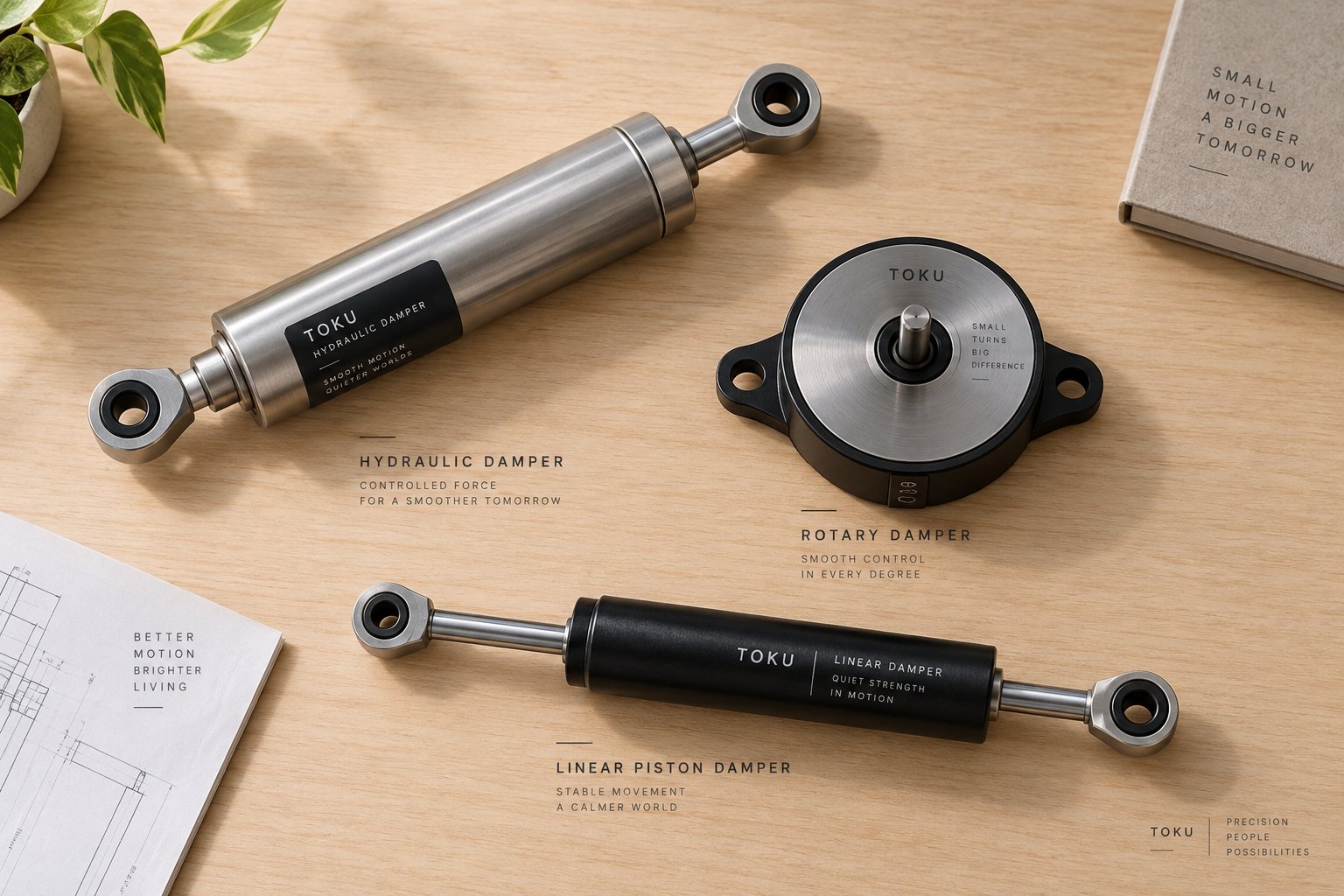
Hydraulic soft close dampers are the most widely used type in both residential and commercial settings, and for good reason. Inside a sealed cylinder, a piston moves through viscous fluid — typically silicone oil. As the door nears its closed position, the fluid is forced through a small orifice or valve, creating resistance that increases proportionally with speed. Push the door harder, and the damper pushes back harder. That self-regulating behavior is what makes hydraulic dampers so reliable across a wide range of users and closing forces.
Here is a practical detail you won't find on most product pages: temperature directly affects hydraulic damper performance. The silicone oil inside the cylinder changes viscosity as conditions shift. In high heat — think a cabinet above the stove or an outdoor kitchen in summer — the fluid thins, reducing resistance so the door may close faster than expected. In cold environments like an unheated garage, the fluid thickens and the door can feel sluggish or fail to latch completely. Industry testing protocols typically validate damper performance at -20°C and +60°C, with acceptable torque variation set at 30% or less from baseline. Premium units use high-viscosity-index silicone PDMS fluids rated from -30°C to +250°C, which helps maintain consistent closing speed across seasonal temperature swings.
Designers tune the damping curve by adjusting the orifice size and fluid viscosity grade. Viscosity grades for rotary damper applications typically range from 50 to 100,000 cSt, giving engineers broad flexibility to match a specific door weight and desired closing feel. For homeowners, the key takeaway is simple: a quality hydraulic soft close damper handles everyday use beautifully, but extreme temperatures are worth considering if your cabinets sit in non-climate-controlled spaces.
Pneumatic and Rotary Damper Alternatives
Not every situation calls for hydraulic fluid. Pneumatic and rotary dampers each bring distinct advantages depending on the application, the mounting space available, and the environmental conditions involved.
Pneumatic dampers work on a door closer piston principle, but instead of oil, they use air compressed inside a cylinder. As the piston moves, air is forced through a small internal passage, creating controlled resistance. Because there is no fluid involved, pneumatic door dampers are immune to the viscosity shifts that affect hydraulic units in extreme heat or cold. They also eliminate any risk of oil leaks — a real advantage in visible installations where a stain on a cabinet face would be unacceptable. The trade-off? Pneumatic units generally offer less precise speed control and a narrower range of adjustability compared to their hydraulic counterparts.
Rotary dampers take a completely different physical form. Instead of a linear piston cylinder, a rotary damper is a compact disc-shaped or barrel-shaped device that generates resistance through rotational motion. Many rotary models snap directly into a hinge barrel or mount beside the hinge cup, making them nearly invisible once installed. Inside, a rotor turns through viscous fluid or uses friction elements to slow movement. Rotary damper hinges are popular in cabinet doors, appliance lids, and industrial enclosures because they integrate tightly with existing hinge hardware without requiring additional surface area on the door or frame. Some models offer adjustable torque via a small screw, allowing fine-tuning of the closing speed on site.
Linear dampers deserve a mention as well, especially for sliding applications. These use a door closer piston arrangement oriented along a straight track rather than a rotational arc. You'll encounter linear dampers most often in sliding cabinet doors, pocket door systems, and drawer slides where the motion path is horizontal rather than hinged. They mount at the end of the track and engage as the sliding panel reaches its final position, cushioning the stop.
Matching Damper Type to Application
With several damper technologies on the market, matching the right type to your specific door or lid is the single most important step. The table below compares the four main categories across the factors that matter most when shopping:
| Damper Type | Mechanism | Best For | Adjustability | Typical Lifespan Range |
|---|---|---|---|---|
| Hydraulic | Piston forces silicone oil through a restricted orifice | Cabinet doors, interior doors, appliance lids — general-purpose use | High — orifice size and fluid viscosity can be tuned; some models have external adjustment screws | Varies by manufacturer; refer to rated cycle-life figures on product datasheets (commonly 50,000 to 200,000+ cycles for quality units) |
| Pneumatic | Piston compresses air through an internal passage | Environments with temperature extremes or where oil leaks are unacceptable | Moderate — air passage size is typically fixed at manufacture | Refer to manufacturer datasheets; generally comparable to hydraulic units under moderate use |
| Rotary | Rotor turns through viscous fluid or friction elements inside a compact housing | Hinge-integrated cabinet doors, appliance lids, furniture, industrial enclosures | Moderate to high — many models include a torque-adjustment screw | Refer to manufacturer datasheets; high-quality units are rated for tens of thousands of cycles or more |
| Linear | Piston and cylinder arranged along a straight track | Sliding cabinet doors, pocket doors, drawer slides | Low to moderate — typically preset for a specific weight range | Refer to manufacturer datasheets; lifespan depends heavily on load and frequency of use |
A few tips to keep in mind when comparing options:
- Door weight is the starting point. Every soft close damper is rated for a specific weight range. A door dampener sized for a lightweight cabinet panel will be overwhelmed by a heavy interior door — and vice versa.
- Mounting space matters. Rotary dampers fit where linear or piston-style units physically cannot. Check clearances before committing to a type.
- Environmental conditions tip the scale. If your installation faces temperature swings — a garage workshop, outdoor kitchen, or near an oven — a pneumatic or temperature-rated hydraulic unit with premium silicone fluid is the safer bet.
- Adjustability saves headaches. A door shock absorber with no speed adjustment forces you to rely on a perfect factory setting. Adjustable models let you dial in the exact closing feel after installation.
The mechanism inside the damper determines how it feels, how long it lasts, and where it belongs. But there is another layer of distinction that trips up even experienced shoppers: the difference between dampers designed for full-size interior doors and those built for cabinets. The two categories look similar on screen yet differ in size, weight rating, and mounting hardware in ways that matter enormously at installation time.
Full-Size Door Dampers vs Cabinet Door Dampers
Search for "soft close door dampers" online and you will see full-size interior door products and tiny cabinet accessories jumbled together in the same results. They share a name and a general purpose, but treating them as interchangeable is one of the most common — and most frustrating — purchasing mistakes homeowners make. The two categories differ in virtually every practical dimension: physical size, weight capacity, mounting method, and price point.
Full-Size Interior Door Dampers and Mounting Methods
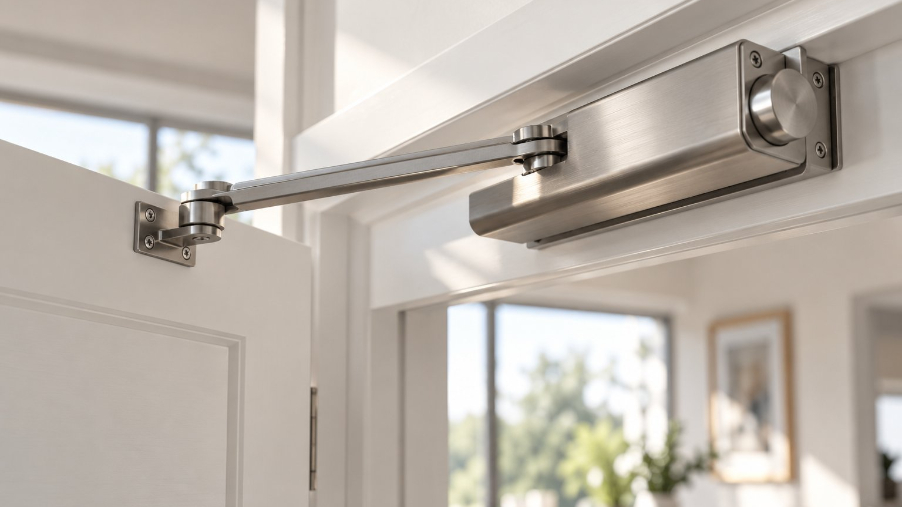
Full-size interior door dampers are designed for room doors that typically weigh anywhere from 15 kg to 100 kg. Unlike a traditional overhead door closer that controls the entire opening and closing arc, these dampers only engage in the last 5 to 15 degrees of travel. That means the door swings freely with no added resistance until it reaches the very end, where the damper catches it and guides it softly into the frame.
What does that look like in practice? You push a bedroom or bathroom door shut, and it moves normally until the final moment — then it decelerates on its own, settling against the jamb without a sound. Because the damper does not fight the door throughout its swing, you avoid the heavy, sluggish feel associated with commercial closers.
Mounting options for full-size doors generally fall into two categories:
- Surface-mount units — These attach visibly to the top of the door frame. They tend to be compact, with some models as small as 200 mm in height, but they are still noticeable.
- Concealed units — Mortised directly into the door frame, these dampers are completely hidden when the door is closed. Concealed models are the preferred choice in residential interiors and high-end hospitality settings where aesthetics matter. Some concealed cabinet door dampers designed for heavier wardrobe and cupboard doors combine a damper with a built-in catch, holding the door shut on a latch while also controlling the closing speed.
Because full-size doors carry significant mass, these dampers are built with heavier-duty internal components — larger pistons, stronger springs, and more viscous fluid. Weight rating is non-negotiable: installing a damper rated for a 25 kg door on a solid-core 40 kg panel will either fail to slow the door meaningfully or burn out the mechanism within months.
Cabinet and Furniture Door Dampers
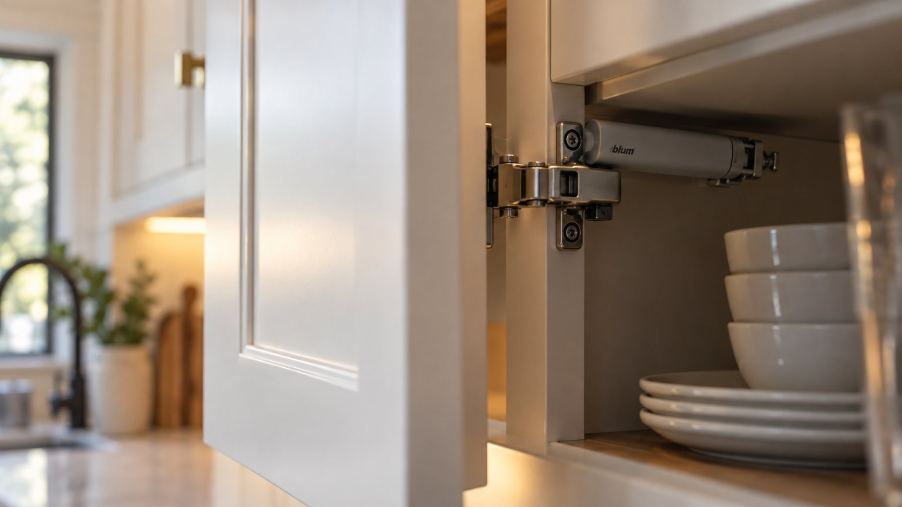
On the opposite end of the scale, a soft close damper for cabinet doors is a remarkably small device. Many are no larger than a pencil eraser. These soft close cabinet dampers mount with adhesive pads, small screws, or clip directly into the hinge cup — the circular recess bored into the back of a cabinet door panel.
Three common form factors dominate the cabinet market:
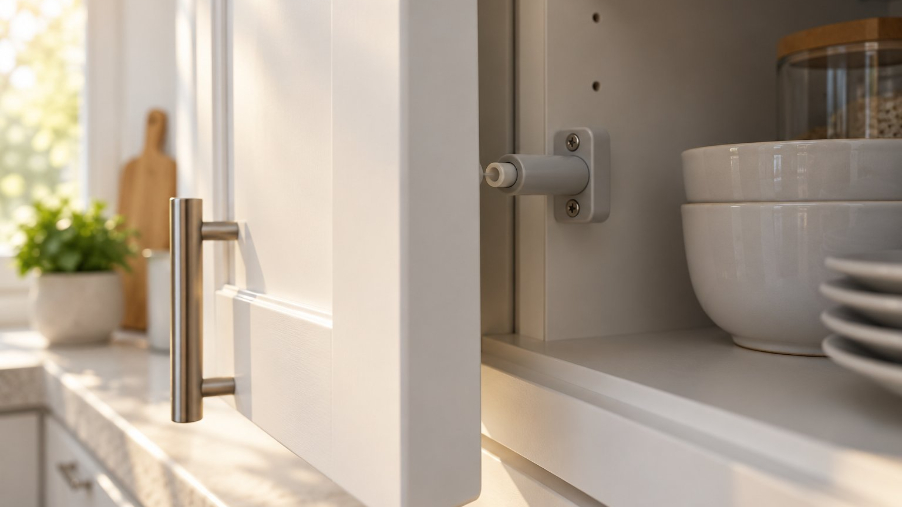
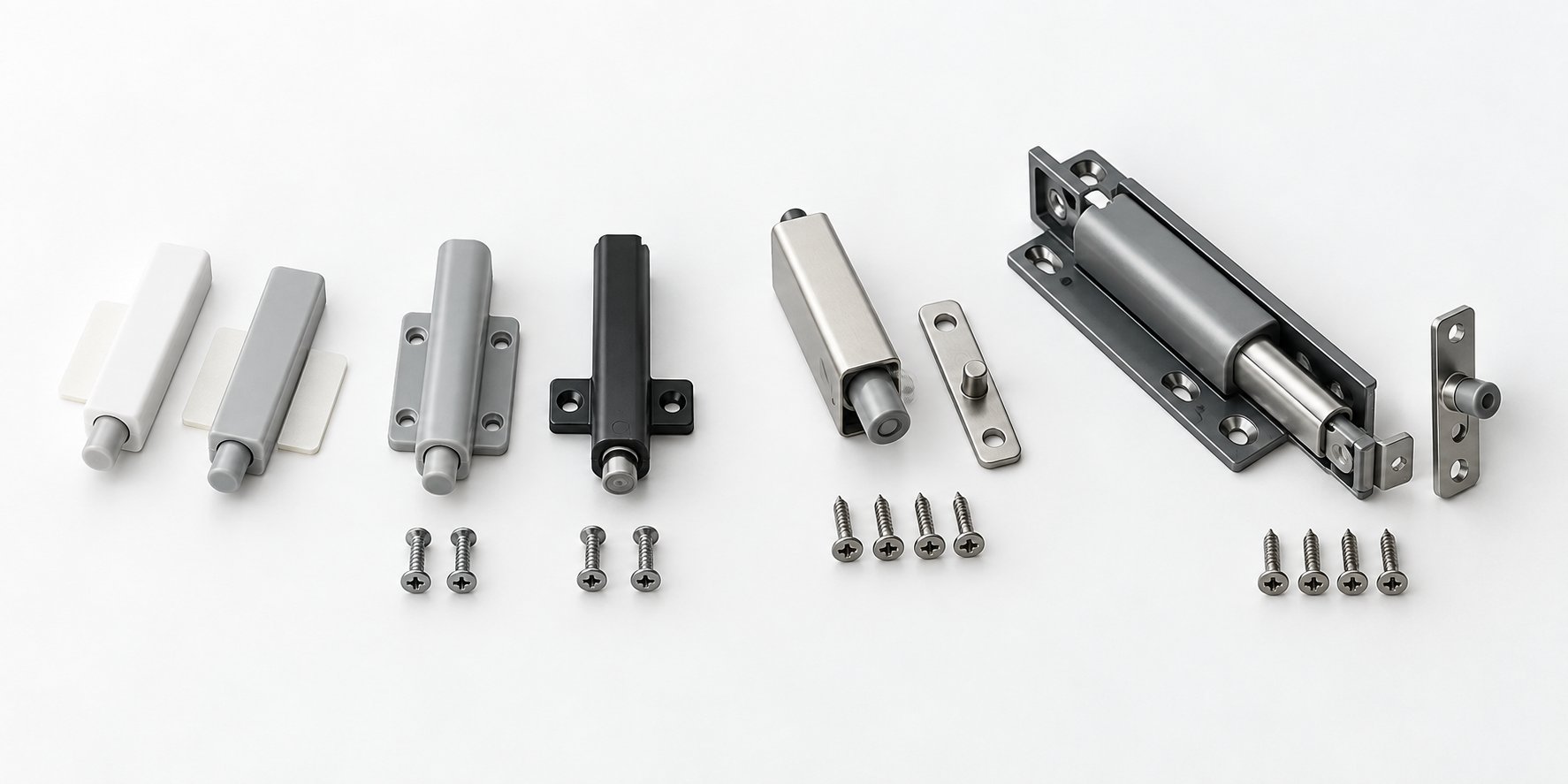
- Adhesive-mount bumper dampers — Peel-and-stick units that attach to the inside of the cabinet frame. They cushion the door at the point of contact. Installation takes seconds, and they require no tools or drilling.
- Hinge-cup integrated dampers — Built into or clipped onto the hinge itself. Soft close cabinet door closers in this style catch the door roughly two inches from closed and guide it the rest of the way, combining damping with the hinge mechanism in a single unit.
- Screw-on dampers — Small cylinders that mount to the interior of the cabinet box with one or two screws. They sit in the path of the closing door and absorb impact energy. These are popular for retrofitting older cabinets that did not originally include soft close features.
Sizing, weight ratings, and hardware are fundamentally different from full-size door products. A typical soft close cabinet door damper handles panels weighing roughly 1 kg to 8 kg — a fraction of what a room door weighs. Attempting to use a cabinet damper on an interior door would be like putting bicycle brakes on a car.
The table below lays out the key differences so you can quickly identify which category matches your project:
| Dimension | Full-Size Interior Door Dampers | Cabinet and Furniture Door Dampers |
|---|---|---|
| Typical Unit Size | 100 mm to 300 mm or larger | 10 mm to 50 mm (often smaller than a thumb) |
| Weight Rating | 15 kg to 100 kg+ | 1 kg to 8 kg (varies by model) |
| Mounting Style | Surface-mount on frame, concealed mortise, or jamb-mounted | Adhesive pad, hinge-cup clip, or small screws inside cabinet box |
| Typical Cost Range | Moderate to high — reflects heavier-duty construction and concealment engineering | Low to moderate — basic adhesive units are very affordable; hinge-integrated models cost more |
| Primary Setting | Bedroom, bathroom, office, and closet doors; wardrobe doors | Kitchen cabinets, bathroom vanities, furniture lids, media consoles |
A quick self-check before you shop: if the door you want to quiet down swings on full-size hinges screwed into a wall frame, you need an interior door damper. If it is attached to a cabinet box, a piece of furniture, or an appliance, you need a cabinet-scale product. Getting this distinction right at the start saves both money and the headache of returning the wrong part.
Even within the correct category, though, there is one more distinction that catches shoppers off guard — the difference between soft close and self close. These two terms sound nearly identical, yet they describe separate functions that, when confused, lead to hardware that does not perform the way you expect.
Soft Close vs Self Close and Why It Matters
You are standing in a hardware aisle — or scrolling through an online listing — and you see two products that sound almost identical: "soft close" and "self close." They must do the same thing, right? Not quite. Confusing these two terms is the single most common reason people end up with hardware that disappoints them. Each describes a distinct mechanical function, and grabbing the wrong one means your soft close door will either still slam or refuse to shut on its own.
How Soft Close Differs from Self Close
A self-close mechanism uses an internal spring that actively pulls a door shut once you release it from a partially open position. Picture a cabinet door that swings closed on its own when you let go — that is self close at work. The spring engages automatically, typically within the last 35 degrees or so of the arc, driving the door toward the frame. It is convenient, hands-free, and ensures doors stay shut. The catch? A self-close hinge does nothing to control the speed of that final contact. The door still arrives at the frame with whatever momentum the spring delivers — and that often means a noticeable thump or outright slam.
A soft close mechanism does the opposite job. It does not pull the door shut at all. Instead, it decelerates the door during the last portion of travel, absorbing energy so the panel eases into the frame silently. If the door is not already swinging toward the frame on its own — through gravity, a spring, or a push — a soft door closer will not make it move. It only manages how fast the door arrives.
Here is where the confusion deepens: many modern hinges and dampers combine both functions into a single unit. These products pull the door shut and cushion its landing. Manufacturers sometimes label them simply as "soft close," which makes shoppers assume that every product marked "soft close" will also close automatically. It will not — unless the listing specifically states combined operation.
Why the Distinction Matters When Shopping
Buying the wrong type leads to one of two frustrating outcomes:
- Soft close without self close — The damper decelerates the door beautifully, but only if someone pushes it shut first. Leave the door slightly ajar and it stays that way. In a busy kitchen, you will find soft close doors hanging open all day.
- Self close without soft close — The spring snaps the door shut automatically, but there is no cushion at the end. You get the convenience of hands-free closing paired with the annoyance of a loud snap every single time.
The table below breaks down the three options side by side so you can match the right hardware to what you actually need:
| Feature | Soft Close | Self Close | Combined Soft + Self Close |
|---|---|---|---|
| Closes door automatically | No — requires a manual push or gravity | Yes — spring drives door shut | Yes — spring drives door shut |
| Prevents slamming | Yes — decelerates door in final arc | No — door arrives at frame with spring force | Yes — damper cushions the spring-driven close |
| Noise level at close | Near silent (when door is pushed shut) | Audible thump or slam | Near silent |
| Best for | Doors already pushed or swung shut by the user; retrofitting existing cabinets | Hands-free convenience where noise is acceptable | Hands-free and quiet — ideal for kitchens, bathrooms, and households with children |
| Typical cost | Low to moderate | Low to moderate | Moderate to higher — reflects dual mechanism |
Soft close controls how the door arrives. Self close controls whether the door arrives. If you want both silence and automatic closing, look specifically for hardware labeled "soft close and self close" or "combined" — do not assume one term covers both functions.
With that distinction clear, you can shop with confidence — knowing exactly which soft door closers match the behavior you want. The payoff goes beyond just picking the right product, though. Whichever route you choose, the safety and noise-reduction benefits of a properly functioning damper reach further than most people expect.

Safety Benefits and Noise Reduction Explained
Knowing which damper to buy is one thing. Understanding why it matters is what turns a minor hardware upgrade into a genuine quality-of-life improvement. The safety and noise-reduction advantages of a door soft close system run far deeper than the brief bullet points you see on packaging — and for certain households, they border on essential.
How Soft Close Dampers Prevent Finger-Pinch Injuries
A cabinet door does not seem dangerous — until you think about the physics. Even a lightweight kitchen cabinet panel weighing a few kilograms can develop surprising force when swinging freely across its arc. The energy concentrates at two critical zones: the closing edge where the door meets the frame and the hinge-side gap that narrows like a scissor as the door shuts. Small fingers placed in either zone at the wrong moment face a real risk of bruising, fractures, or worse.
How serious is the problem? NEISS data analyzed in Clinical Pediatrics found that U.S. emergency departments treated a child for a door-related injury roughly every four minutes over the decade from 1999 to 2008. Pinching accounted for 54.8% of those cases — the leading injury mechanism — and approximately four out of ten pediatric door-injury visits involved children age four or younger. When injuries were severe enough to require hospitalization, amputation was the most common diagnosis.
Toddlers are especially vulnerable because their reaction times are slow and their curiosity outpaces their caution. Elderly individuals face a parallel risk: reduced grip strength and slower reflexes make it harder to pull a hand clear of a closing door in time. A soft door close mechanism directly addresses both groups by decelerating the door in the critical last portion of travel — the exact zone where fingers are most exposed. Instead of arriving at the frame with full momentum, the door eases in slowly enough for a hand to be withdrawn. It does not make the door childproof on its own, but it dramatically reduces the force of contact if a finger is caught.
As Titus Group's applications engineering team notes, dampers regulate uncontrolled movements so that even when a lid or door is closed forcefully by hand, the mechanism always provides controlled motion. That consistent deceleration is what separates a damper from a simple bumper pad — the protection works every time, regardless of how hard someone pushes.
Noise Reduction and Its Practical Impact
Safety may be the most important benefit, but noise reduction is the reason most people actually buy soft close door dampers. Imagine reaching into the kitchen cabinet for a glass at midnight — and having the door slam shut loudly enough to wake everyone down the hall. In an open-plan home, that sound carries with nothing to absorb it.
A smooth close eliminates the impact that generates noise in the first place. When two solid materials — wood, metal, or plastic — collide without cushioning, they produce a sharp, percussive sound. Dampers prevent that collision entirely by bleeding off momentum before contact occurs. The door meets the frame at near-zero velocity, and the result is silence or, at most, a barely perceptible whisper of contact.
Consumer research backs up how strongly buyers feel about this. A multi-country study conducted across the UK, Germany, and Slovenia found that quiet operation was the single most cited factor when consumers evaluated cabinet door quality. Specifically, 41.4% of respondents mentioned the desire for quiet as the overriding reason they valued soft closing and a no-slam experience. Closing noise was not just an annoyance — participants described loud sounds as physically unpleasant.
The practical contexts where a quiet door closer makes the biggest difference extend well beyond the home kitchen:
- Nighttime access — Parents making a bottle, shift workers preparing a meal after hours, or anyone reaching for medication in a bathroom vanity can do so without disturbing sleeping household members.
- Open-plan and small-space living — In apartments and studio layouts, cabinet and door noise has nowhere to dissipate. Dampers remove the most jarring everyday sound source in the room.
- Healthcare and hospitality settings — Hospitals, clinics, and hotels treat quiet operation as a facility requirement, not a luxury. Dampers are used on treatment-room cabinets, patient-area doors, and hotel bathroom vanities to maintain calm environments around the clock.
- Shared workspaces and offices — Break-room cabinets and storage closets that slam repeatedly throughout the day create background noise that compounds stress and reduces focus over time.
Taken together, the combined safety and noise-reduction benefits make a compelling case:
- Reduced risk of finger-pinch injuries for children and elderly household members
- Controlled closing force regardless of how hard the door is pushed
- Near-silent operation that eliminates percussive impact noise
- Extended lifespan for cabinets, doors, and frames by preventing repeated high-force collisions
- Improved perceived quality — a door that glides shut signals craftsmanship to guests, clients, and potential homebuyers
The advantages are clear in the abstract, but they play out differently depending on where the damper is installed. A kitchen cabinet faces dozens of daily cycles in a humid, heat-variable environment. An interior bedroom door handles heavier loads but far fewer openings. A washing machine lid needs a compact mechanism that survives years of vibration. Each setting demands its own approach to damper selection — and the right choice starts with understanding what each room actually requires.
Best Applications for Soft Close Dampers by Room and Setting
A damper that works perfectly on a lightweight bathroom vanity door may fail within months on a heavy kitchen cabinet that gets opened forty times a day. The room itself — its temperature swings, moisture levels, and how aggressively the hardware gets used — shapes which damper type, weight rating, and mounting method will actually hold up over time. Here is a room-by-room breakdown to help you match the right soft close damper to the right environment.
Kitchen Cabinets and Bathroom Vanities
Kitchens are the highest-demand environment for soft close drawers and cabinets. Think about your own routine: you open the spice cabinet, the dish cabinet, the pantry, and the silverware drawer dozens of times between breakfast and bedtime. That daily cycle count adds up fast. Research on residential appliance use shows that Americans open their refrigerator alone roughly 33 times per day — and kitchen cabinet doors easily match or exceed that frequency for the most-used stations.
What does that mean for damper selection? Durability is the top priority. You want soft close dampers for cabinets that are rated for high cycle counts — quality hydraulic or rotary units typically carry ratings of 50,000 cycles and well above, though exact figures vary by manufacturer. Look for rated cycle-life data on the product datasheet rather than relying on vague marketing language. A cheap adhesive bumper might quiet a guest-room dresser drawer for years, but in a busy kitchen it can wear out in months.
Adjustability matters here, too. Kitchen cabinets vary widely in weight — a narrow spice door weighs almost nothing, while a large pantry panel with a heavy overlay face can weigh several kilograms. Dampers with a torque-adjustment screw let you dial in the closing speed per door, so the lightweight door does not feel sluggish and the heavy one does not overpower the mechanism.
Bathrooms introduce a different challenge: humidity. Steam from showers saturates the air daily, and moisture can corrode low-grade metal components or degrade adhesive mounts over time. For bathroom vanity installations, prioritize dampers with corrosion-resistant housings — stainless steel or high-quality polymer bodies — and avoid bare zinc die-cast units, which are a documented failure point in high-humidity environments. If you are using adhesive-mount dampers, confirm the adhesive is rated for damp conditions; standard peel-and-stick pads can lose grip in a steamy bathroom surprisingly quickly.
- Kitchen damper checklist:
- High cycle-life rating (check manufacturer datasheets for specific numbers)
- Adjustable closing speed to accommodate varying door weights
- Mounting style compatible with your cabinet type — hinge-cup, screw-on, or adhesive
- Temperature tolerance if cabinets sit near heat sources like ovens or dishwashers
- Bathroom damper checklist:
- Corrosion-resistant housing material (polymer or stainless steel preferred)
- Moisture-rated adhesive if using peel-and-stick mounting
- Compact size to fit shallow vanity frames
- Sealed construction to prevent moisture intrusion into hydraulic fluid chamber
Interior Room Doors and Sliding Door Applications
Moving from soft close cabinets to full-size room doors shifts the engineering requirements dramatically. A standard interior door weighs 15 kg to 40 kg or more for solid-core models, which means the damper must handle significantly higher kinetic energy during each closing cycle. Under-sizing here is not just ineffective — it can physically destroy the damper mechanism or tear the mounting hardware from the frame.
When selecting a damper for interior hinged doors, start with the door's actual weight, including any added mass from mirrors, hooks, or decorative panels. Match that weight to a damper rated at or above the real installed load — not the bare-door weight listed by the door manufacturer. Concealed overhead or jamb-mounted dampers are the most popular choice for bedrooms, bathrooms, and home offices because they disappear into the frame, preserving a clean aesthetic. Surface-mount options are simpler to install and easier to adjust but remain visible on the door frame.
Sliding doors present a unique scenario. A soft close sliding door — whether a pocket door recessing into the wall or a barn-style door gliding along an exposed track — uses linear dampers rather than rotary or piston-style units. The damper mounts at the end of the track and engages when the door panel reaches its final few inches of travel, cushioning the stop so the door does not slam against the end stop or bounce back open.
Soft close sliding door hardware is increasingly available as a complete kit that includes the track, rollers, and integrated linear dampers. If you are retrofitting an existing sliding door, standalone add-on dampers that attach to the track end can deliver a similar result, though compatibility with your specific track profile needs to be confirmed before purchasing. Barn-door hardware has especially benefited from sliding door soft close technology — these heavy doors rolling on exposed rails produce a loud, jarring collision without damping, and the visual prominence of the track makes a smooth, silent stop feel essential.
- Interior and sliding door checklist:
- Confirm the exact installed weight of the door (including mirrors, hooks, and panels)
- Choose a damper rated at or above the actual door weight
- Decide between concealed or surface-mount based on aesthetic preference
- For sliding doors, verify that the linear damper is compatible with your track profile and door weight
- For pocket doors, check clearance inside the wall cavity — some damper housings require more depth than the pocket provides
Appliance Lids and Compact Mechanisms
Beyond traditional doors and cabinets, soft close technology has found its way into dozens of everyday household products — and in many cases, the damper mechanism is so small you may not even realize it is there. Washing machine lids, trash can covers, toilet seats, bread boxes, and small furniture compartments all benefit from controlled closing motion.
Appliance lids face unique stresses. A washing machine lid, for instance, endures constant vibration during spin cycles, exposure to moisture, and thousands of open-close repetitions over the machine's service life. Rotary dampers designed for washing machine lids typically use silicone oil for stable viscosity and are built with polymer housings like polybutylene terephthalate (PBT) that resist moisture and chemical exposure. These units are rated for 50,000 or more life cycles — critical for an appliance that may be used multiple times daily over a decade or longer.
Toilet seat dampers follow a similar principle but face an even tighter space envelope. The damper must fit entirely within or alongside the seat hinge barrel, producing enough torque to slow the lid's fall without making the seat difficult to lift. Kitchen drawer slow closers in trash pull-outs and recycling bins use compact linear or rotary dampers matched to the weight of the loaded bin — a heavier load than an empty drawer, so weight rating needs to account for contents, not just the hardware.
Manufacturers like Tianyun engineer compact dampers specifically for appliance, furniture, and household-product manufacturers, providing controlled soft-close motion for lids, doors, and compact mechanisms that need quieter, safer operation. These purpose-built components are designed from the ground up to fit the tight dimensional and performance requirements of products where a standard cabinet damper simply would not work — the torque curve, housing geometry, and material selection are all tailored to the specific application.
- Appliance and compact mechanism checklist:
- Verify the damper is engineered for the specific product type (washing machine, toilet seat, trash can, etc.)
- Check torque rating against the lid or cover weight
- Confirm material compatibility with the operating environment (moisture, vibration, cleaning chemicals)
- Look for silicone-oil-based units for temperature stability
- Review rated cycle life against expected daily usage over the product's service life
Environmental Factors That Affect Every Setting
Regardless of which room or product you are equipping, one variable cuts across every application: temperature. Hydraulic dampers rely on fluid viscosity to generate resistance, and that viscosity shifts with heat and cold. In a climate-controlled kitchen or bathroom, the effect is negligible. But install that same damper in a garage workshop, an outdoor kitchen, or a cabinet directly above a commercial oven, and performance can change noticeably with the seasons.
In high heat, the silicone oil thins and the door may close faster than intended — a phenomenon engineers informally call "summer slam." In freezing conditions, the fluid thickens and the door can feel stiff or fail to latch. Industry validation protocols test dampers at -20°C and +60°C with a pass threshold of no more than 30% torque variation from baseline. If your installation site experiences temperature extremes, seek out dampers using high-viscosity-index silicone PDMS fluids — or consider pneumatic alternatives that sidestep the viscosity issue entirely.
Armed with the right damper for the right setting, the next question most people face is practical: how do you actually install one — especially if you are retrofitting existing cabinets or doors that were never designed for soft close hardware in the first place?
How to Install and Retrofit Soft Close Dampers
Retrofitting soft close hardware onto existing cabinets and doors is one of the most satisfying weekend projects a homeowner can tackle — the tools are basic, the time investment is modest, and the before-and-after difference is immediate. Yet the process has real pitfalls that can leave you with dampers that underperform or doors that refuse to latch. A little preparation upfront prevents nearly every one of them.
Tools and Preparation for a Successful Install
Before you open a single damper package, gather these tools and materials:
- Cordless drill with a selection of small-diameter bits (typically 2 mm to 3 mm for pilot holes)
- Phillips or Pozidriv screwdriver — match the head type to the screws included with your damper
- Pencil or bradawl for marking screw positions
- Small level to verify alignment on longer runs of cabinetry
- Kitchen scale or bathroom scale for weighing doors if the weight is not documented
- Measuring tape for checking clearances between the door, frame, and hinge
With tools ready, tackle the three preparation steps that matter most:
- Measure the door weight. Every soft close drawer adapter and door damper is rated for a specific weight range. A lightweight 1 kg spice-rack door and a 6 kg full-overlay pantry panel require different damper strengths. Weigh the door if you are unsure — remove it from the hinges and set it on a scale. Incorrect weight-rating is the single most common installation mistake and the hardest to diagnose after the fact, because the damper will appear to work at first and then gradually fail.
- Check clearances. Open and close each door slowly, watching the gap between the door edge, the cabinet frame, and adjacent doors. Some damper styles — particularly screw-on cylinders and soft close adapter clips — protrude slightly into the cabinet opening. If two doors share a center stile, confirm there is enough room for the damper body without interfering with the neighboring panel.
- Confirm your hinge type. This step is critical for cabinet retrofits. Soft close hinge adapter clips are designed to work with self-closing hinges. If your existing hinges are free-swing — meaning the door stays wherever you leave it rather than springing shut on its own — a clip-on soft close adapter will not function correctly, because there is no spring force to drive the door into the damper zone. In that case, you would need either a combined soft-close and self-close hinge replacement or a screw-on damper paired with a separate self-closing hinge upgrade.
Retrofitting Soft Close to Existing Cabinets and Doors
The most popular retrofit scenario is adding dampers to existing cabinet doors and drawers without replacing the hinges entirely. Two main approaches cover the vast majority of situations: clip-on hinge adapters and screw-on or adhesive-mount standalone dampers.
Approach A — Soft close hinge adapter clips (for self-closing hinges):
- Open the cabinet door fully to expose the hinge arm and mounting plate inside the cabinet box.
- Position the soft close adapter bracket just below the existing hinge arm so that it bridges the mounting-plate fixing screw. A small lip on the bracket should sit flush against the front edge of the cabinet frame. Mark the screw holes with a bradawl or sharp pencil.
- Using the screws provided with the adapter, fix the bracket into the pilot holes. Drive the screws firmly but do not overtighten — cracking the bracket or stripping the pilot hole is a common error with small hardware.
- Slide the soft close adapter unit onto the bracket until it clicks securely into place.
- Close the door gently and observe the action. The door should swing freely through most of its arc, then decelerate smoothly in the last two inches before making contact with the frame.
- If the closing speed feels too fast or too slow, many adapters include a small adjustable plunger. Twist the plunger to increase or decrease resistance until the feel is right. For large or heavy cabinet doors, you can add a second adapter below another hinge on the same door.
Approach B — Screw-on or adhesive-mount standalone dampers:
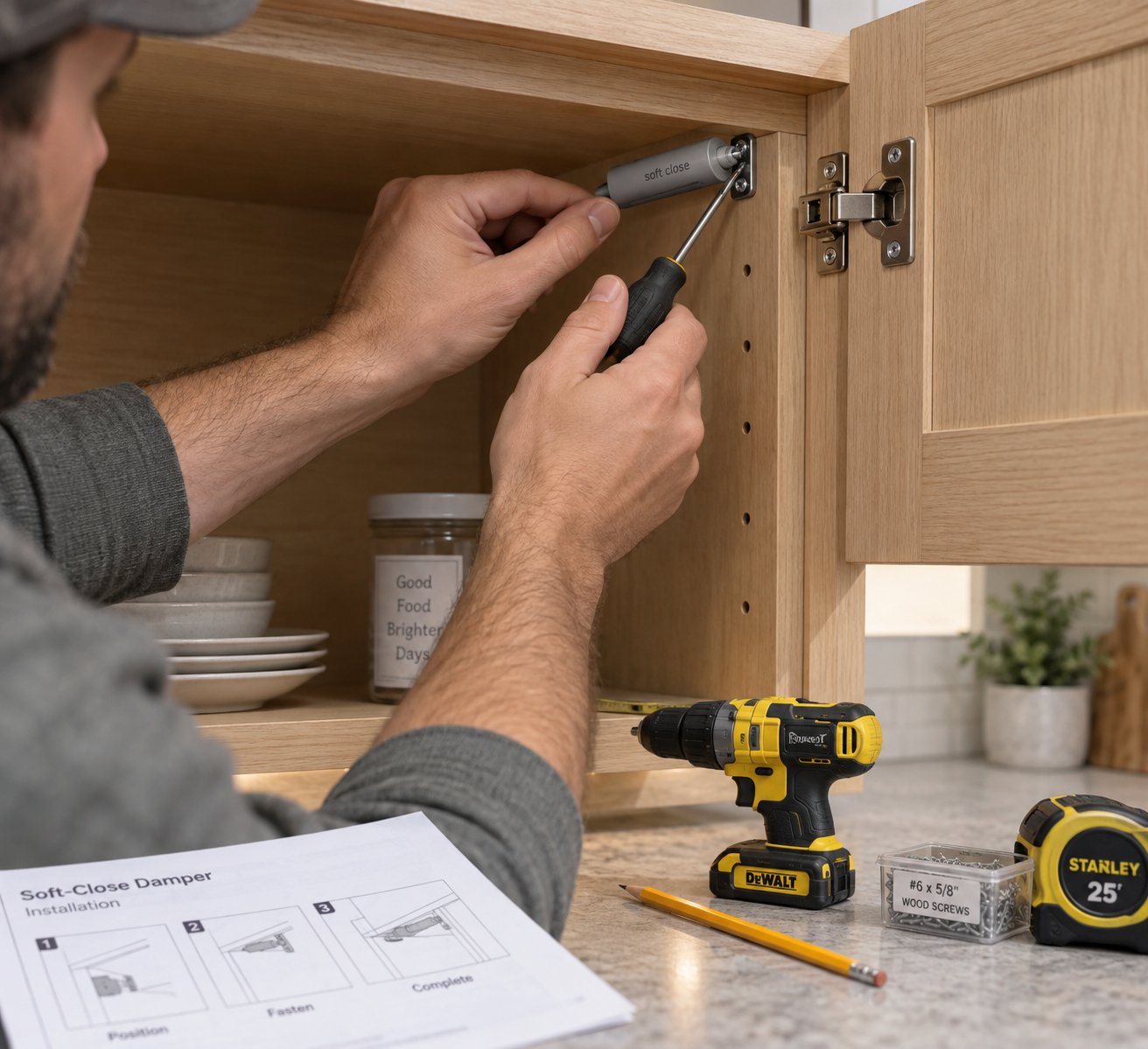
- Identify the optimal mounting position inside the cabinet box. For hinged doors, the damper typically mounts on the interior side of the cabinet frame, close to the top or bottom corner opposite the hinge side. This placement maximizes the lever arm, giving the damper the best mechanical advantage to slow the door.
- Hold the damper in position and mark the screw holes with a pencil. If using an adhesive-mount unit, clean the mounting surface thoroughly with rubbing alcohol, let it dry completely, and then press the damper firmly in place.
- For screw-mount units, drill pilot holes slightly smaller than the screw diameter. Drive the screws snugly — firm enough to prevent movement, gentle enough to avoid cracking the damper housing or splitting thin cabinet panels.
- Close the door and test the action. The door should contact the damper plunger a few inches before fully closing, then decelerate into the frame without bouncing back.
- Adjust damper placement if the door does not engage the plunger at the correct point in the closing arc. Even a few millimeters of repositioning can make the difference between a smooth glide and a door that misses the damper entirely.
For drawers, the process is similar in principle but uses linear dampers or drawer-slide-integrated mechanisms. A soft close drawer conversion typically involves either replacing the existing slides with soft close drawer slides or adding small clip-on damper units to the rear of the existing slide track. Clip-on drawer dampers catch the drawer box in the last inch of travel and cushion the close — a straightforward retrofit that avoids the labor of swapping out full-length slides.
Common Installation Mistakes to Avoid
Even experienced DIYers trip over these errors. Recognizing them before you start saves time, hardware, and frustration:
- Using a damper rated for the wrong weight. A soft close adapter for cabinet doors rated at 3 kg will be overwhelmed by a 7 kg panel. The door may appear to slow down initially, but the damper wears out rapidly — or the door simply overpowers it from day one, slamming despite the hardware being in place. Always match the rated weight to the actual door weight.
- Mounting at the wrong position on the door or frame. Placing the damper too close to the hinge side reduces its leverage, requiring more damping force than the unit can provide. Placing it too far from the closing edge may mean the door never contacts the plunger at all. Follow the manufacturer's positioning guidelines exactly.
- Over-tightening screws. Small damper housings are typically made from plastic or lightweight alloy. Excessive torque cracks the housing, strips the screw hole in the cabinet panel, or distorts the damper body enough to misalign internal components. Snug is sufficient — the damper does not bear structural load.
- Failing to account for door overlay or inset configurations. A full-overlay door sits differently against the frame than a half-overlay or inset door. The damper contact point shifts accordingly. If your soft close cabinet door adapter was designed for full overlay but your doors are inset, the geometry will not match and the damper either engages too early — making the door feel heavy — or too late, providing little cushioning before impact.
- Skipping pilot holes. Driving screws directly into cabinet panels without a pilot hole invites splitting, especially in particleboard or MDF. A two-second pilot hole prevents a repair job that takes far longer.
- Ignoring hinge compatibility. As noted above, clip-on soft close adapters require self-closing hinges. Attaching one to a free-swing hinge produces a door that decelerates if pushed shut manually but never closes on its own — defeating the purpose for most users.
A properly installed damper should feel effortless: the door swings naturally, slows itself in the final stretch, and settles against the frame without a sound. If that is not happening, the issue is almost always traceable to one of the mistakes above — not a defective damper. Revisit your weight rating, mounting position, and hinge compatibility before assuming the hardware is at fault.
Of course, even a perfectly installed damper is not maintenance-free forever. Over thousands of cycles, seals age, fluid properties shift, and mounting hardware loosens. Knowing how to spot early warning signs — and what to do about them — is what keeps a soft close system performing years after installation day.
Troubleshooting and Maintenance for Long-Lasting Performance
A well-installed soft close door mechanism should feel invisible — the door glides, the room stays quiet, and you forget the hardware is even there. But months or years down the line, you might notice a subtle change. The door does not quite reach the frame. The closing speed feels different in January than it did in July. Or a faint oil stain appears on the cabinet face. These are not signs of a bad product — they are normal wear signals that, when caught early, take minutes to address and years off your replacement timeline.
Diagnosing Common Soft Close Damper Problems
Most damper issues fall into four categories. Understanding the likely cause behind each one points you directly toward the fix.
The door does not close fully. You push it shut, the damper engages, the door decelerates — and then it stalls an inch or two from the frame, hanging slightly ajar. This is the most reported complaint, and the cause is almost always a mismatch between damper resistance and the force available to drive the door home. If the damper's braking force is too high relative to the door's weight or the hinge spring's strength, the door simply runs out of momentum before it reaches the latch. The fix? First, check whether the hinges themselves are creating friction — sticky or dirty hinges can rob enough energy to stall the close. Clean and lightly lubricate the hinge pins. If the hinges are fine, reduce the damper's resistance using the adjustment screw (on models that have one), or switch to a lighter-rated damper that better matches the door weight.
The damper loses effectiveness over time. A door slow closer that used to glide now barely slows the door at all. This gradual decline usually points to hydraulic fluid degradation or internal seal wear. Over tens of thousands of cycles, the O-rings inside a hydraulic damper can harden and shrink, allowing fluid to bypass the piston rather than being forced through the orifice. The result is reduced resistance — the door slow close mechanism no longer generates enough braking force to decelerate the panel. Once internal seals have failed, the damper typically cannot be rebuilt cost-effectively at home. Replacement is the practical path.
Inconsistent closing speed. The door shuts perfectly in the morning but slams by afternoon, or feels sluggish in winter and too fast in summer. If you are using a hydraulic unit, temperature-related viscosity changes are the most likely explanation. As discussed in earlier sections, silicone oil thins in heat and thickens in cold — a slow close door closer mounted near an oven or in an unheated garage will behave differently across seasons. For mild variation, no action is needed. For extreme swings, switching to a damper with high-viscosity-index fluid or opting for a pneumatic alternative eliminates the issue at the source.
Visible oil leaks. Dark streaks on the damper body, door surface, or cabinet interior are a clear sign that hydraulic seals have failed. Leaking hydraulic fluid means the damper is losing the very medium that creates its braking effect — and the problem only accelerates from here. Continuing to use a leaking unit risks staining finishes and, if fluid reaches the floor, creates a slip hazard. Wipe the area clean, remove the failed damper, and install a replacement. Topping up the fluid without replacing the worn seals is a temporary fix at best and can be hazardous without proper tools.
Maintenance Habits That Extend Damper Lifespan
Quality soft close door dampers are designed for long service — manufacturer-rated cycle lives commonly range from 50,000 to well over 100,000 cycles for premium units, though exact figures vary by brand and model. Checking the product datasheet for your specific damper gives you a realistic baseline expectation. Reaching or exceeding that rated life, however, depends on how you treat the hardware between installation day and replacement day.
Several habits reliably shorten damper life:
- Slamming doors open past the damper's designed range of motion — Swinging a door or lid open with excessive force stresses internal components and mounting hardware, even though the damper only engages during closing.
- Exposing hydraulic units to sustained extreme heat — Persistent high temperatures degrade seals faster and thin the damping fluid beyond its designed operating range.
- Ignoring early signs of wear — A slow closing door closer that has started to feel slightly inconsistent is telling you something. Catching seal wear or mounting looseness early often means a quick adjustment rather than a full replacement.
A simple maintenance routine, repeated every six to twelve months, keeps dampers performing at their best:
- Inspect for leaks — Look at the damper body and surrounding surfaces for any sign of fluid seepage. Even a faint sheen can indicate the beginning of seal failure.
- Test closing speed — Push the door shut with normal force and observe. Is the deceleration smooth and consistent? Does the door reach the frame and latch reliably? Any change from the original behavior warrants investigation.
- Clean mounting points — Dust, grease, and kitchen grime accumulate on adhesive pads and screw heads. A damp cloth wipe keeps mounting surfaces stable and prevents adhesive-mount dampers from loosening.
- Check screw tightness — Loose hinge and damper screws allow the door to shift position, which throws off alignment and prevents the soft close mechanism from engaging at the correct point. Snug each screw — firm, not forced.
- Lubricate hinges (not the damper) — The damper itself is a sealed unit and should not be oiled externally. But the hinges the door rides on benefit from periodic lubrication with a light machine oil or silicone spray. Smooth hinges reduce the workload on the damper.
When is replacement more practical than repair? For small cabinet dampers — especially adhesive-mount or clip-on models — the answer is almost always. These units are inexpensive, and their compact, sealed construction makes field repair impractical. For larger door-mounted dampers, replacement also tends to win out once leaks appear, because sourcing replacement seals and refilling hydraulic fluid requires specialized tools that most homeowners do not have on hand.
Keeping dampers in good working order is ultimately about protecting a small investment to preserve a large one — the quiet, controlled feel of every door in your home. That sense of value naturally raises a practical question: what does the right damper actually cost, and how do you choose wisely among the options on the market?
Cost Factors and How to Choose the Right Soft Close Door Hardware
You have identified the damper type you need, confirmed the weight rating, and verified the mounting method. The final variable is price — and soft close hardware spans a surprisingly wide range. A basic adhesive-mount cabinet bumper might cost less than a cup of coffee, while a concealed full-size door system can run into significantly higher territory. Understanding what drives that spread helps you spend wisely rather than simply spending more.
What Influences Soft Close Damper Pricing
Five factors account for nearly all of the price variation you will encounter when shopping for soft close door hardware:
Damper mechanism. Hydraulic dampers tend to sit in the mid-to-upper price range because their sealed fluid chambers, precision orifices, and O-ring seals require tighter manufacturing tolerances. Pneumatic units — which use air rather than oil — are sometimes less expensive to produce but may offer narrower adjustability. Rotary dampers vary widely depending on whether they are simple friction-based designs or precision silicone-oil units engineered for specific torque curves.
Material quality. A cabinet door soft close damper with a polymer housing and basic zinc internals costs less than one built with reinforced engineering plastics and stainless-steel components. The difference matters most in demanding environments: kitchens near heat sources, bathrooms with daily steam exposure, and outdoor or semi-outdoor installations. Cheaper materials can degrade faster, which means a low upfront price sometimes translates into a higher long-term cost when you factor in earlier replacement.
Adjustability features. Fixed-resistance dampers are the most affordable option — they are set at the factory and cannot be fine-tuned after installation. Models with external torque-adjustment screws cost more, but they let you dial in the exact closing speed per door. For a kitchen where cabinet doors range from a lightweight spice panel to a heavy pantry door, adjustability eliminates the need to buy multiple damper models.
Brand reputation and engineering support. Established manufacturers invest in rigorous cycle-life testing, consistent quality control, and published datasheets. That transparency carries a price premium over unbranded imports, but it also reduces the risk of buying a unit that fails prematurely or performs inconsistently out of the box. When you are outfitting an entire kitchen — potentially 20 to 40 mounting points — reliability across every single unit matters more than saving a small amount per piece.
Rated cycle life. This is perhaps the most underappreciated cost factor. A damper rated for 50,000 cycles at a slightly higher price point will almost certainly outlast a bargain unit rated for 20,000 cycles, especially in high-traffic areas. Industry data on soft close cabinet hinges reinforces this: quality hinges rated to 50,000 or more cycles maintain their soft close feel for 10 to 15 years of normal use, while cheaper alternatives can lose effectiveness within three to five years. The same principle applies directly to standalone dampers — cycle rating is your best predictor of real-world longevity.
In general terms, soft close hardware for cabinets falls into three pricing tiers:
- Entry tier — Basic adhesive-mount or simple screw-on bumper dampers. Lowest upfront cost, limited adjustability, best suited for light-duty doors and furniture.
- Mid tier — Hinge-cup integrated dampers, clip-on soft close adapters, and standalone hydraulic or rotary units with moderate cycle ratings. The sweet spot for most residential kitchen and bathroom retrofits.
- Upper tier — Concealed full-size door dampers, low profile door closer units designed to disappear into the frame, and precision-engineered dampers for appliance and industrial applications. Higher upfront cost, but justified by heavier-duty construction, longer rated life, and superior aesthetics.
For a typical kitchen retrofit using mid-tier soft close cabinet door hardware — say, 20 cabinet doors plus a handful of drawers — the total material cost generally remains a fraction of the broader renovation budget. As one comparison illustrates, upgrading a full kitchen from standard to soft close hinges adds roughly $200 to $280 in material cost across 40 hinges. Standalone dampers added to existing hinges can land even lower, depending on the model selected. Spread over a decade of daily use, the per-year cost is negligible — and the daily noise reduction, safety improvement, and extended cabinet life easily justify the investment.
Selecting the Right Damper for Your Needs
With pricing context in hand, the final step is matching your specific requirements to the right product. The table below organizes the key decision factors into a single reference you can consult before purchasing:
| Factor | What to Look For | Why It Matters |
|---|---|---|
| Door or lid type | Identify whether you are equipping a full-size room door, cabinet door, drawer, appliance lid, or furniture compartment | Determines the entire product category — full-size door dampers and cabinet dampers are not interchangeable |
| Weight rating | Weigh the door or lid and select a damper rated at or above that weight | Under-rated dampers fail prematurely or cannot slow the door effectively; over-rated units make the door feel sluggish |
| Soft close mechanism | Choose between hydraulic, pneumatic, rotary, or linear based on your application and environment | Each mechanism handles temperature, humidity, and space constraints differently — the wrong type compromises performance |
| Mounting compatibility | Confirm the damper fits your existing hinge type, cabinet configuration (overlay vs. inset), and available clearance | Mismatched mounting leads to poor engagement, interference with adjacent doors, or cosmetic damage to the cabinet |
| Adjustability | Prefer models with external torque or speed adjustment when equipping doors of varying weights | Fine-tuning on site means one damper model can serve multiple doors — reducing inventory and ensuring consistent feel across the kitchen |
| Rated cycle life | Check the manufacturer's datasheet for tested cycle count — aim for 50,000+ for kitchen and high-traffic use | Higher cycle ratings correlate directly with longer service life, fewer replacements, and lower total cost of ownership |
| Material and environment | Stainless steel or high-grade polymer for bathrooms, outdoor kitchens, and humid environments; standard materials for climate-controlled interiors | Corrosion and seal degradation are the primary failure modes in harsh environments — material selection is your first line of defense |
For manufacturers and product designers sourcing dampers for appliances, furniture, or household goods, the selection criteria shift further toward precision engineering and integration. Tianyun's Home and Appliance Soft Close Dampers are a strong option in this space — their range is engineered specifically for appliance, furniture, and household-product applications, covering controlled soft-close motion for lids, doors, and compact mechanisms requiring quieter, safer operation. When a washing machine lid, trash can cover, or small furniture compartment needs a damper that fits within a tight dimensional envelope and delivers a consistent torque curve across thousands of cycles, purpose-built components like these outperform generic hardware repurposed from cabinet applications.
Whether you are a homeowner retrofitting a kitchen or a product engineer specifying a soft close mechanism for a new appliance design, the decision process follows the same logic. Use this final checklist to confirm you have covered every base before placing an order:
- Identify your door or lid type — full-size room door, cabinet door, drawer, appliance lid, or furniture panel.
- Confirm the weight rating — weigh the actual door or lid, including any added mass from mirrors, panels, or contents.
- Choose the damper mechanism — hydraulic for general use, pneumatic for temperature extremes, rotary for hinge-integrated compactness, linear for sliding applications.
- Verify mounting compatibility — check hinge type, overlay configuration, and available clearance before committing.
- Consider rated lifespan — match the cycle-life rating to your expected usage frequency. High-traffic kitchen cabinets demand higher-rated units than a guest-room dresser.
- Factor in the environment — humidity, heat, cold, and vibration all influence which materials and fluid types will perform reliably over time.
Investing in the right soft close hardware pays dividends you experience every single day — in the quiet that greets you when the cabinet shuts, in the peace of mind that small fingers are safer, and in the long-term durability of doors and frames that no longer absorb repeated impact. A low profile door closer hidden in the frame or a tiny damper clipped inside a hinge cup may be invisible once installed, but the difference it makes is anything but. Choose deliberately, install carefully, and you will enjoy a home where every door closes exactly the way it should — smoothly, silently, and without a slam.
Frequently Asked Questions About Soft Close Door Dampers
1. What is the difference between a soft close damper and a regular door closer?
A regular door closer uses a spring to actively drive a door shut across its full swing arc and engage the latch. A soft close damper, by contrast, is a passive device that only activates during the last 10 to 20 degrees of travel. It absorbs kinetic energy through hydraulic fluid, air compression, or rotary resistance so the door decelerates gently into the frame rather than slamming. Dampers do not pull a door closed — they simply control the speed of arrival. Manufacturers like Tianyun engineer compact dampers specifically for appliances, furniture, and household products that need this kind of controlled, quiet closing motion.
2. Can I add soft close dampers to my existing cabinets without replacing the hinges?
Yes, retrofitting soft close to existing cabinets is straightforward and does not always require new hinges. You can attach adhesive-mount bumper dampers to the inside of the cabinet frame, install screw-on cylinder dampers near the top or bottom corner opposite the hinge, or clip a soft close hinge adapter onto compatible self-closing hinges. The key requirement is confirming your current hinge type: clip-on adapters only work with self-closing hinges. If your hinges are free-swing, you will need either a standalone screw-on damper paired with a self-closing hinge upgrade or a full hinge replacement with a combined soft-close and self-close unit.
3. Why does my soft close damper work differently in summer versus winter?
Hydraulic soft close dampers use silicone oil to create resistance, and that oil changes viscosity with temperature. In warmer conditions the fluid thins, reducing resistance so the door may close faster than intended. In cold environments the fluid thickens, making the door feel sluggish or preventing it from latching fully. Industry testing validates damper performance between -20°C and +60°C with acceptable torque variation of 30% or less. If your installation faces significant temperature swings — such as a garage or outdoor kitchen — choose a damper with high-viscosity-index silicone fluid or consider a pneumatic damper, which uses air instead of oil and is immune to viscosity shifts.
4. How long do soft close door dampers typically last?
Lifespan depends on the damper quality, usage frequency, and operating environment. Premium hydraulic and rotary dampers commonly carry manufacturer-rated cycle lives of 50,000 to over 100,000 cycles. In a busy kitchen where a cabinet door opens 30 to 40 times a day, a 50,000-cycle damper can last several years. Factors that shorten lifespan include slamming doors open with excessive force, sustained exposure to extreme heat, and ignoring early signs of seal wear or oil leaks. A simple biannual maintenance check — inspecting for leaks, testing closing speed, and tightening mounting screws — helps dampers reach or exceed their rated life.
5. Are soft close dampers safe for homes with young children?
Soft close dampers significantly reduce the risk of finger-pinch injuries, which are a leading cause of door-related emergency visits among young children. Research based on NEISS data found that U.S. emergency departments treated a child for a door-related injury roughly every four minutes over a full decade, with pinching accounting for nearly 55% of cases. Soft close dampers decelerate the door in the exact zone where small fingers are most vulnerable, lowering the closing force enough to allow time for withdrawal. While no single product makes a door completely childproof, a quality damper — whether installed on cabinet doors, room doors, or appliance lids — adds a meaningful layer of passive protection.
Apply This Insight to Your Project
Tell us what you are building and how the topic “Stop the Slam: How Soft Close Door Dampers Transform Any Room” relates to your application. Our engineering team can help evaluate the next step.