What WC Seat Size Means and Why It Varies
WC seat size is the match between four things: the pan (bowl) shape, the seat length, the seat width and the spacing of the fixing holes (mounting holes). A seat fits when all four line up with your pan. The hinge adjustment range then decides how much leeway you have on hole position.
Say you order a replacement seat and it arrives too short, overhangs at the sides or has hinges that miss the holes. In almost every case, one of those four figures was wrong. This guide uses three terms throughout: WC (toilet), pan (bowl) and fixing holes (mounting holes). If you know the topic as commode seat size, the same rules apply.
What WC Seat Size Actually Measures
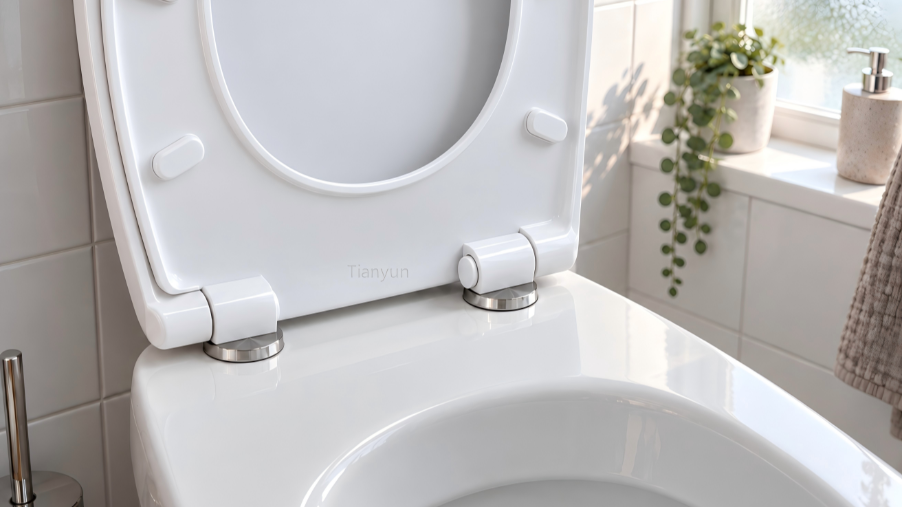
Seat size covers two things: the outline and the fixings. The outline is the shape of the rim plus its length and width. The fixings are the two holes at the back of the pan and the hinges that attach to them. A seat can match your pan's shape and still fail if its hinges can't reach your holes.
All measurements here are given in millimetres first, with inches in brackets, because most people searching for WC seat size work in metric.
Are Toilet Seats Universal or Shape-Specific
No, toilet seats are not universal. Pans come in round, elongated, D-shaped, square and compact outlines, and lengths differ even within one shape. Victorian Plumbing puts pan length and width anywhere from about 350 to 500 mm (13.8 to 19.7 in). The US seat maker Bemis says plainly that a round seat won't fit an elongated bowl, and that an elongated seat won't fit a round one. A seat sold as universal is built around a compromise outline that sits between common shapes. It fits well on pans close to that outline and poorly on the rest.
To take the guesswork out, this article works through the choice in the same order a fitter would:
- Identify the pan shape.
- Match the seat shape to it.
- Check which fixing type your pan needs.
- Take the measurements.
- Confirm against the specification before you buy.
Since shape comes first, it helps to know the typical size range for each shape before you pick up a tape measure.
Toilet Seat Size Chart in Millimetres and Inches
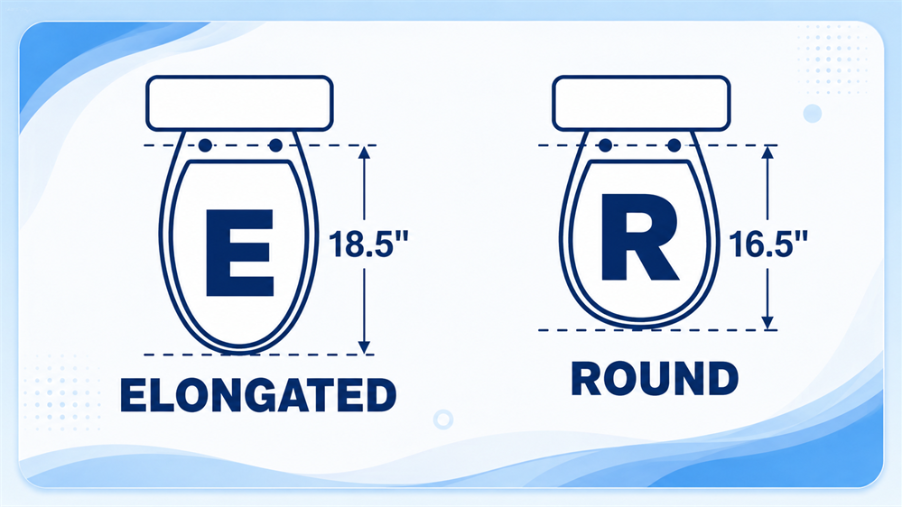
Most pans fall into a small number of size bands. The chart below gives the typical range for each shape, so you have a rough idea of what your tape measure should show before you start.
Standard Toilet Seat Dimensions in mm and Inches
| Shape | Typical length mm (in) | Typical width mm (in) | Best for |
|---|---|---|---|
| Round | 419 to 445 (16.5 to 17.5) | 356 (14) | Smaller bathrooms where floor space is tight |
| Elongated | 470 to 495 (18.5 to 19.5) | 356 (14) | Users who want a longer seating area and more thigh support |
| Oval | Varies by model, check the manufacturer specification | Varies by model, check the manufacturer specification | Markets where "oval" is the usual name for a longer, elongated-style pan |
| D-shaped | Varies by model, check the manufacturer specification | Varies by model, check the manufacturer specification | Pans with a straight back edge and squared shoulders near the hinges |
| Square | Varies by model, check the manufacturer specification | Varies by model, check the manufacturer specification | Modern pans with squared front corners |
| Compact | Varies by model, check the manufacturer specification | Varies by model, check the manufacturer specification | Short pans in cloakrooms and other tight spaces |
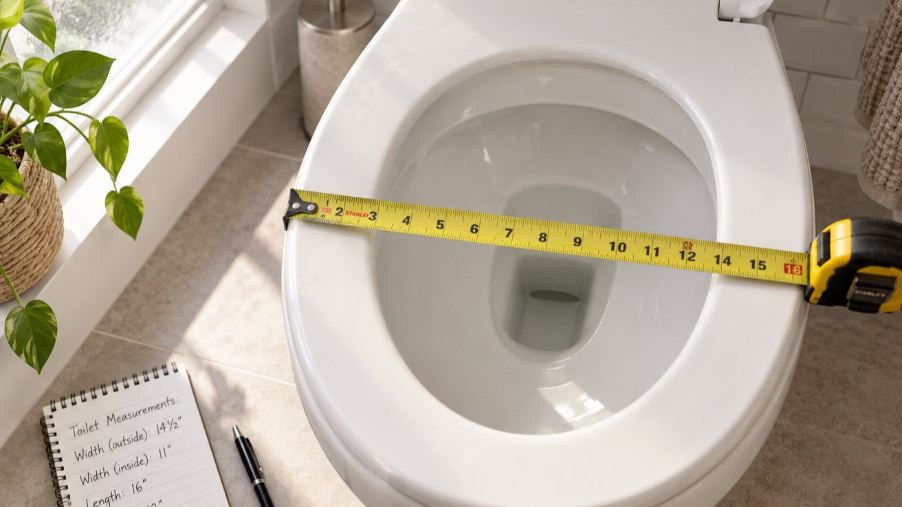
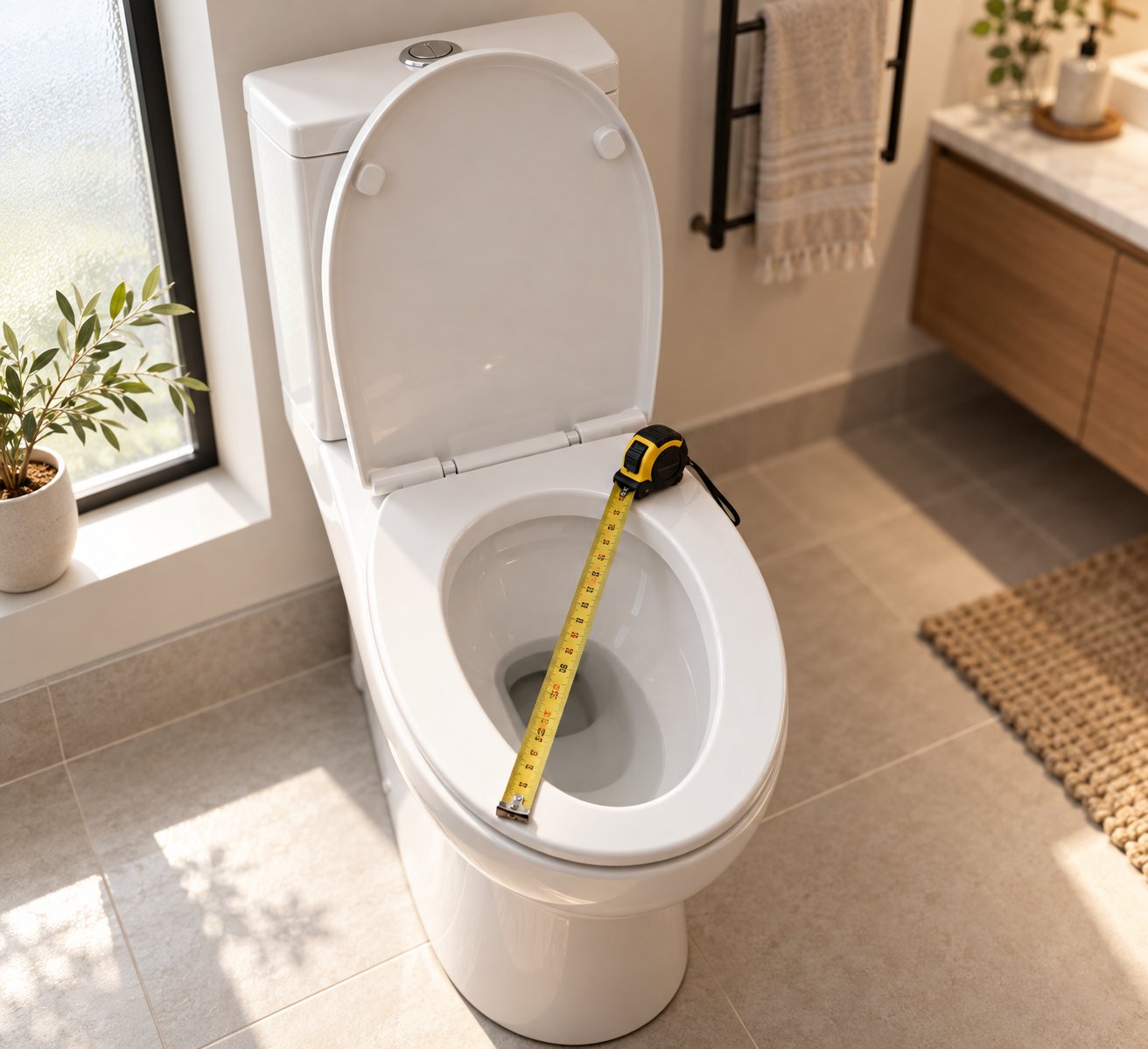
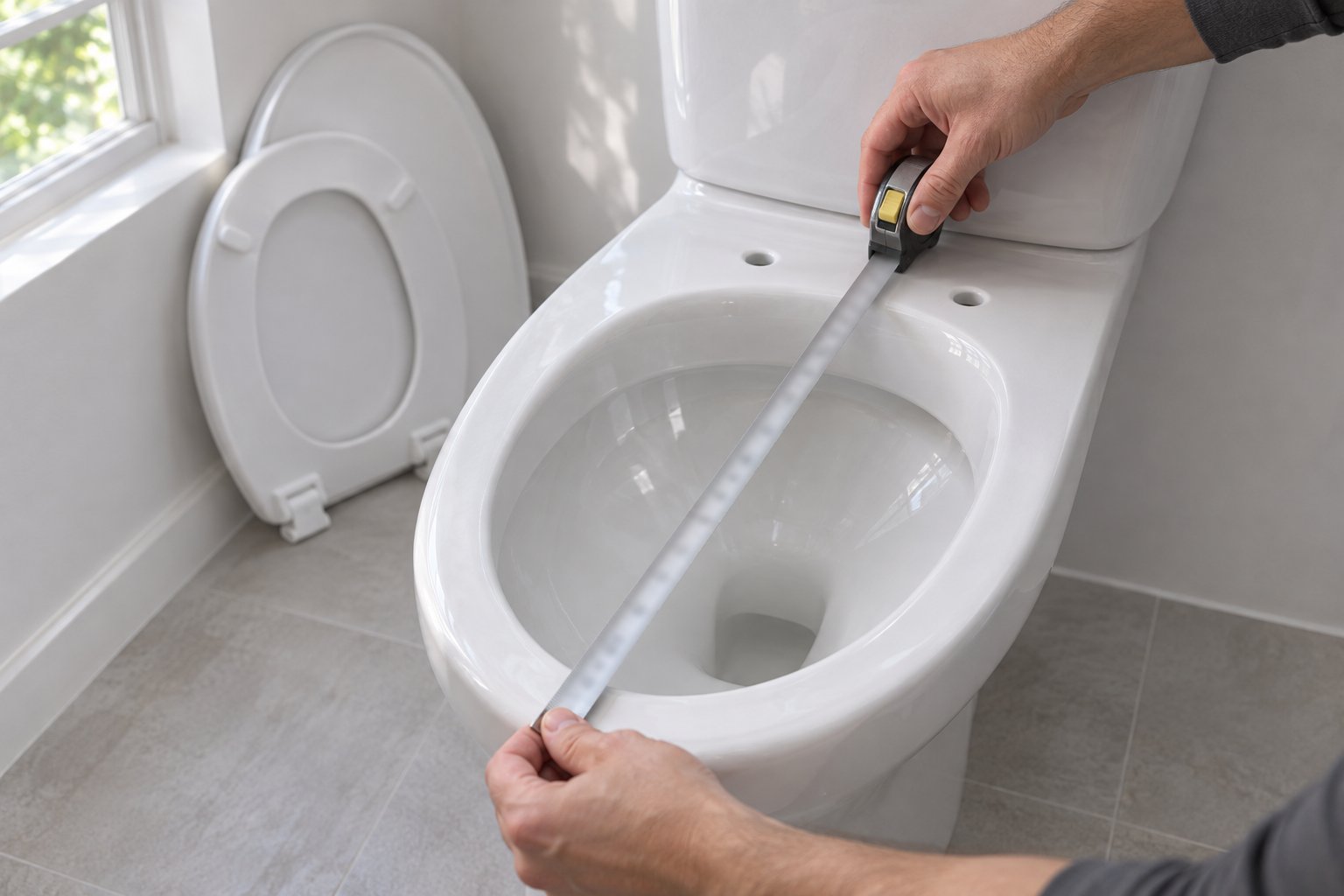
Every figure in this toilet seat size chart depends on two measurements. Length runs from the line between the centres of the two fixing holes straight to the outer front edge of the rim. Width runs across the widest point of the outer rim, from one outer edge to the other. Lowe's uses the same method and puts typical width at 14 to 14.5 in (356 to 368 mm).
Round and Elongated Toilet Seat Sizes Compared
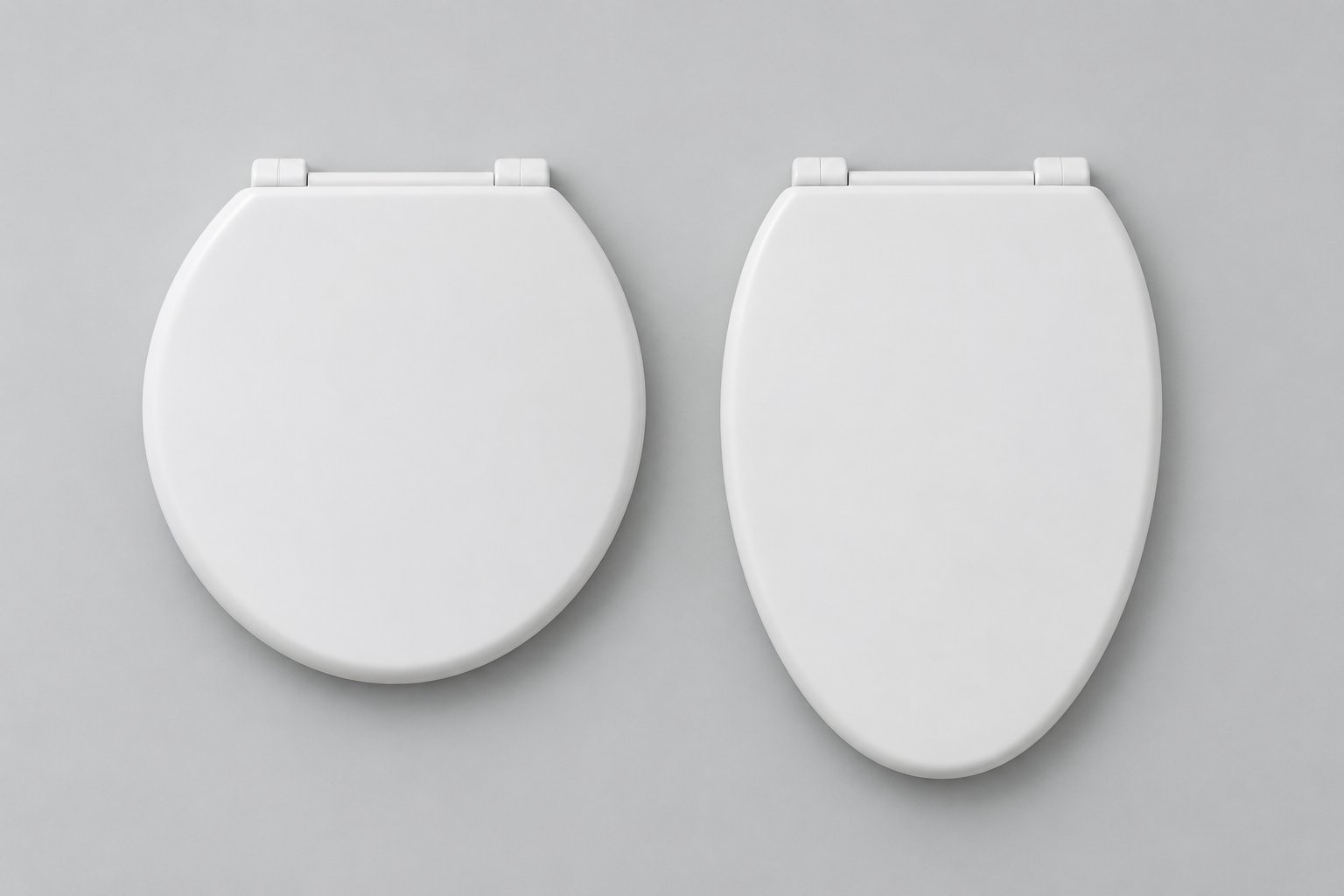
The two main shapes have the same width, so length is what separates them. Round seats start at 419 mm (16.5 in). Elongated toilet seat measurements start at 470 mm (18.5 in), which Bio Bidet gives as the minimum length for a pan to count as elongated. The difference is about 50 mm (2 in). If you fit an elongated seat on a round pan, that 50 mm hangs off the front, and Bio Bidet warns that the overhang can make the seat bend or crack over time.
Treat these standard toilet seat dimensions as a starting point. They come from US-market data, and European, UK, Indian and Australian pans can fall outside them. For example, the UK retailer Royal Bathrooms gives about 400 mm (16 in) for a round seat and about 450 mm (18 in) for an oval one. The round figure is shorter than the US round range, and the oval figure falls in the gap between round and elongated. Measure your own pan and use the chart to check your figures. Don't order from the chart alone.
How Toilet Lid Sizes Relate to the Seat
The lid usually follows the seat outline. A round seat has a round lid, and an elongated seat has an elongated lid. Seat and lid normally share one hinge assembly, so when you get the seat size right, the lid size comes with it. Size the pair from your pan's measurements and don't measure the old lid.
The chart only helps if you know which row your pan belongs in. At a glance, a D-shaped or compact pan can easily be mistaken for a round one.
Toilet Seat Shapes and How to Identify Your Pan
Lift the seat and look straight down at the pan. What do you see? Three features are enough to identify most toilet seat shapes without a picture. The first is the back edge near the fixing holes, which is either straight or curved. The second is the front, which can be a circular curve, a tapered oval or squared corners. The third is the overall proportions: near-circular, long and narrow, or short.
Round, Elongated and Oval Toilet Seat Shapes
US readers search the toilet seat round vs elongated comparison more than any other. From above, Premier Bidets notes, a round bowl looks close to a circle, while an elongated bowl stretches into a longer oval toward the front. Both shapes have a curved back edge, so length is what tells them apart. Round seats start at about 419 mm (16.5 in) and elongated seats at about 470 mm (18.5 in), both measured from the fixing-hole centres.
The word oval is used less consistently. Some sellers use it for elongated-style pans. The UK retailer Aqualona uses it for traditional rounded pans and calls it the most common shape. Treat oval as a label and confirm the shape with a length measurement.
D-Shaped, Square and Compact Pans
Here is how each outline reads, from the back edge to the front:
- Round: curved back, circular front, near-circular proportions. Best for small bathrooms. Family Handyman suggests round toilet seats for children's bathrooms, apartments and half-baths.
- Elongated: the back curves inward and the front tapers into an oval, giving a long, narrow outline. Best for bathrooms with room for the extra 50 mm (2 in) and for adults who want more seat under the thighs.
- Oval: curved back and oval front. Proportions depend on the market. Best for pans sold under that name, once you've checked the length.
- D-shaped: straight back edge, squared shoulders near the hinges and a gently rounded front. Best for modern pans with a flat back.
- Square: straight back, straight sides and squared front corners. Best for minimalist or designer bathrooms.
- Compact: looks round but is short overall. Best for cloakrooms and other tight spaces.
- Universal: a seat outline, not a pan shape. It is a compromise between round and oval. Best for standard rounded pans close to that outline. It suits D-shaped, square or compact pans poorly.
Telling Similar Toilet Seat Shapes Apart
Different size toilet seats can look almost identical in a product photo. These rules settle the most common mix-ups:
D-shaped versus elongated: a D-shaped pan has a straight back edge with squared shoulders near the hinges. An elongated pan curves inward toward the back. If a straight ruler laid across the back of the rim touches it along its full width, the pan is D-shaped.
Compact versus round: a compact pan looks round but measures shorter than the 419 mm (16.5 in) start of the round range. Check the length before ordering. In the US, some makers also sell compact elongated bowls that fall between the round and elongated lengths. Premier Bidets notes that these usually take an elongated seat, so check the manufacturer's spec sheet for these too.
Round versus elongated: a reading between the two ranges usually means you should measure again from the exact centre of the fixing holes.
Shape tells you which row of the chart your pan belongs in. Choosing a seat within that row depends on a few careful measurements, starting with exactly where you place the end of the tape.
How to Measure a Toilet Seat for Replacement
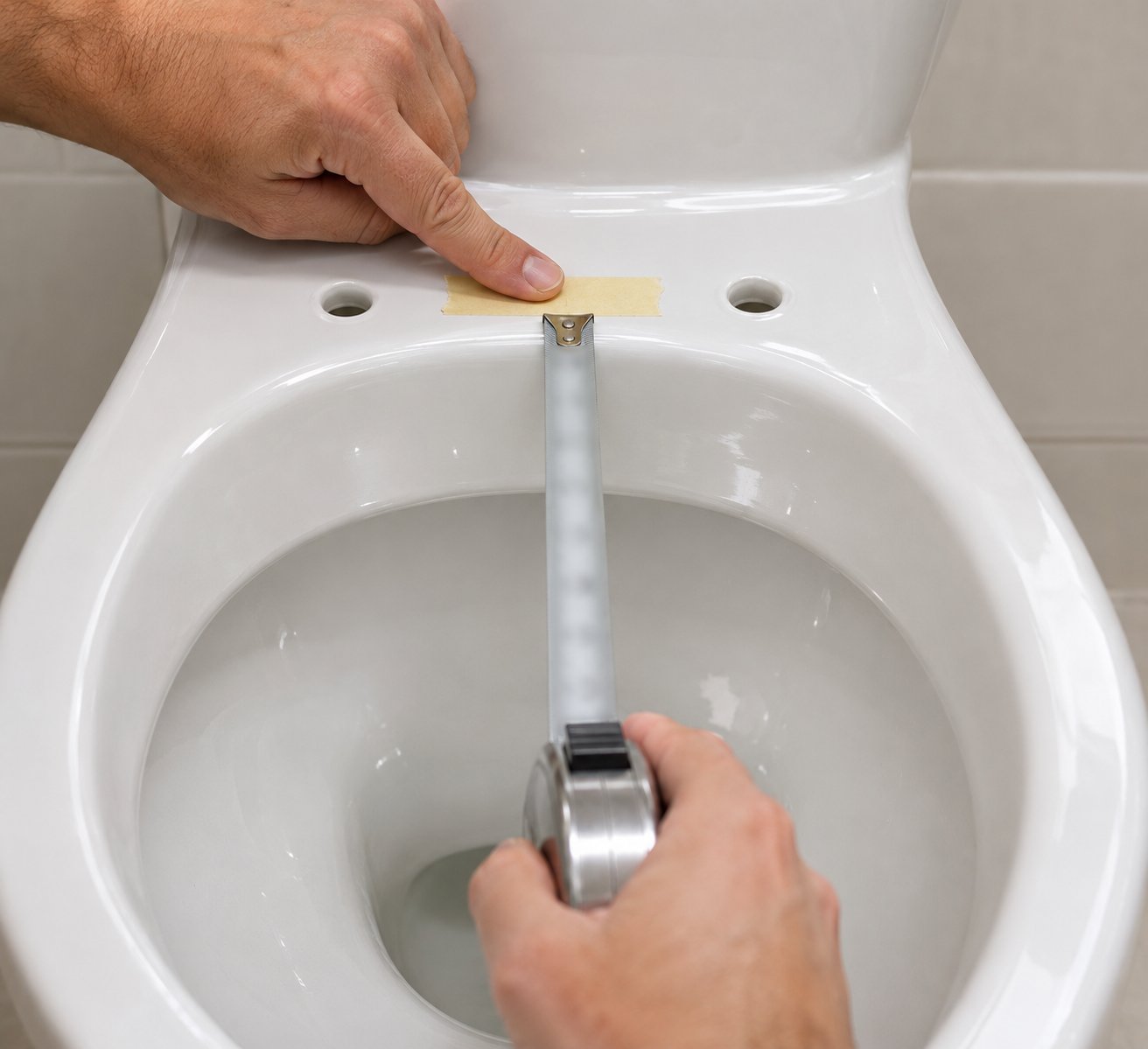
How do you measure a toilet seat so the new one fits the first time? You measure the pan, not the seat. The measuring guide from B&Q makes the same point. Your old seat may have been the wrong size all along, and if you copy it, you copy the mistake. Measuring toilet seat size takes about five minutes. You need three core figures and two quick checks.
Tools and Preparation for Measuring a Toilet
You need a steel tape measure, a strip of masking tape or a pencil, and something to write on. A torch helps when you check under the pan. Wipe the rim first so the tape lies flat and doesn't slip.
Step-by-Step Toilet Seat Measurements
- Clear the rim. Take the old seat off, or lift it upright, so you measure the pan rim itself. If you have to measure the old seat instead, first check that it fitted with no overhang at the sides or front.
- Measure the hole spacing. Find both fixing holes at the back of the pan. Measure from the centre of one hole to the centre of the other. Retailers often call this the hinge fitting width.
- Measure the length. Put a piece of masking tape on the midpoint between the two hole centres. Start the tape measure at that mark and run it straight to the outer front edge of the rim. This figure is the seat length.
- Measure the width. Find the widest point of the outer rim, which is usually around the middle. Measure from one outer edge to the other.
- Note the back edge. Write down whether the back edge is straight or curved. This tells you which row of the shape chart applies.
- Check underneath. Can you reach the underside of the fixing holes? Your answer decides the fixing type. Open access allows bottom fixing. An enclosed pan normally needs top fixing.
- Record every figure. Write each measurement in mm with inches in brackets, for example a length of 432 mm (17 in).
Why You Measure From the Centre of Each Fixing Hole
Fixing holes vary. Some are slotted, and hole diameters differ from pan to pan. If you measure from the edge of a hole, part of the hole's width ends up in your figure, and two people measuring the same pan can get different results. The hinges are positioned from the hole centres, so the centre is the only reference point that matches how the seat is built.
Hinge adjustment gives you some leeway. If a product lists a range for hole spacing instead of a single number, the seat has adjustable hinges. B&Q says the seat should fit as long as your measurement falls within that range. Ranges vary a lot between products. Bemis gives 140 mm (5.5 in) as the North American standard spacing. One Australian seat with adjustable hinges covers 115 to 170 mm (4.5 to 6.7 in). Don't assume your pan has a standard spacing. Check your own figure against the range in the product specification.
Your notes now describe one specific pan, and you can use them to test a claim that appears on many product pages: that a single seat fits every toilet.
Are All Toilet Seats the Same Size
Pick up two seats in a store that are both labeled round, and you might expect them to be identical. Often they aren't. Are all toilet seats the same size? No. Do all toilet seats fit all toilets? Also no, and that includes seats sold as universal.
Why Not All Toilet Seats Fit All Toilets
Sizes vary even within one shape. Round seats run from 419 to 445 mm (16.5 to 17.5 in) in length, a spread of about 25 mm (1 in). So are all round toilet seats the same size? No. If you put a seat from the short end of that range on a pan from the long end, you'll see bare rim at the front.
Hole spacing varies too. Bemis gives 140 mm (5.5 in) as the North American standard. The UK retailer Wholesale Domestic says many UK toilets use 155 mm (6.1 in). A seat with hinges set for one spacing won't line up with the other unless the hinges can move far enough. Wholesale Domestic also warns that a seat designed for a round pan, fitted to a D-shaped toilet, leaves exposed rim edges and unstable fittings.
Where Universal Seats Fit Poorly
Imagine the universal outline as a stencil laid over your pan. Wherever your rim strays from it, you get one of the problems below. Each one is paired with the pan type that usually causes it:
- Overhang at the sides or front: a universal seat on a compact pan. The seat is larger than the rim, so it sticks out past the edge.
- Exposed rim at the back corners: D-shaped and square pans. The curved universal outline can't follow the straight back edge, so the squared shoulders near the hinges stay uncovered.
- Exposed rim at the front: a seat sized for a round pan on an elongated pan. The seat stops about 50 mm (2 in) short of the front edge.
- Hinges that miss the holes: any pan whose hole spacing falls outside the hinge adjustment range. The outline may match, but the seat can't be fixed securely.
Fit affects more than looks. Wholesale Domestic notes that a seat has to follow the rim underneath it to spread weight evenly across the buffers, the small pads under the seat that rest on the rim. A seat that overhangs or leaves gaps is carrying your weight on fewer contact points than it was designed for.
A universal seat is a compromise outline, and it fits well only when your pan is close to that outline.
The last problem on that list differs from the other three. You can't spot it by looking at the rim, because it depends on what sits below the rim: how the seat is fixed to the pan and how far its hinges can move.
Fixing Types and Hinge Adjustment Explained
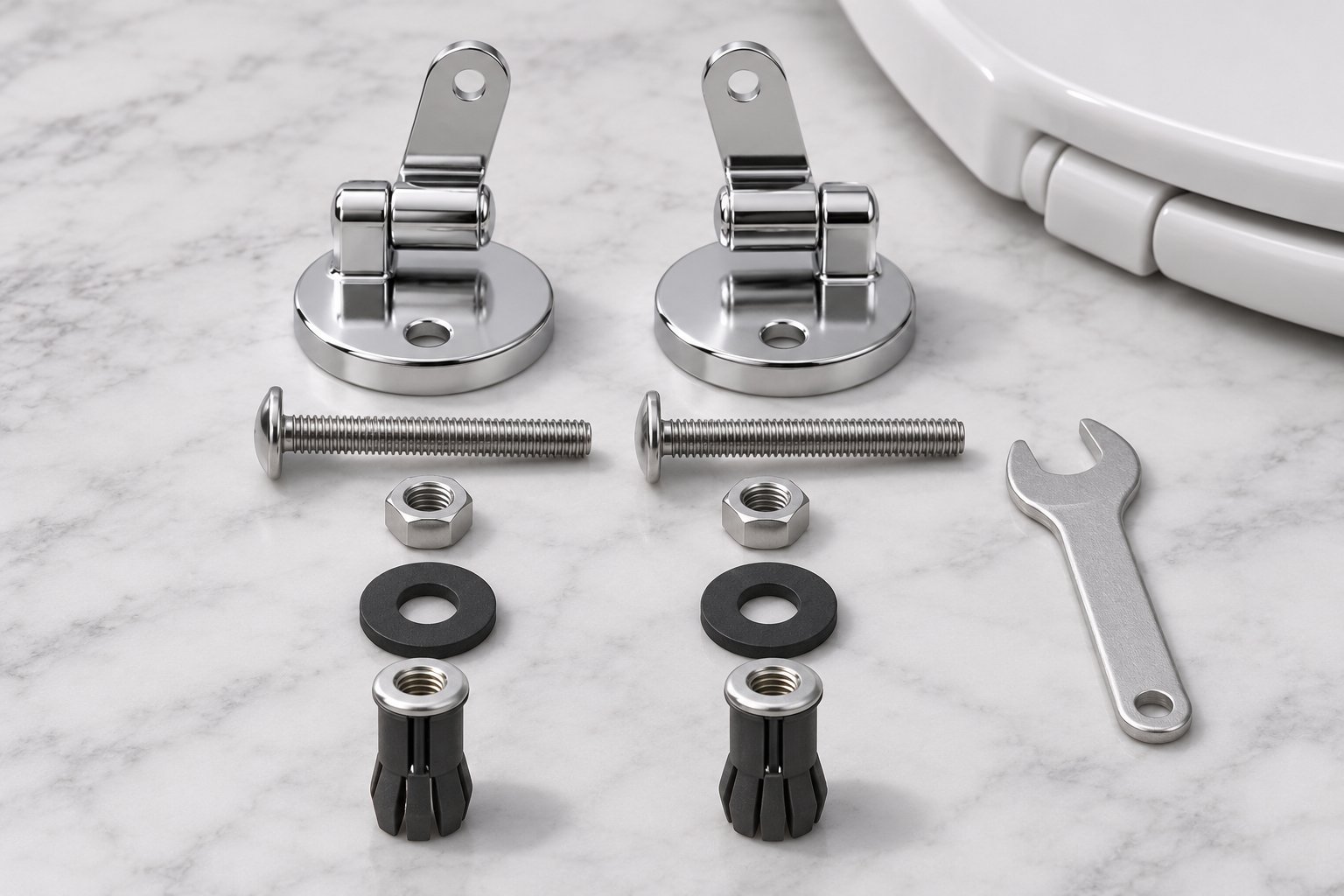
When you reached under the pan during measuring, what did your hand find? It may have been a bolt and nut, an open hollow or a smooth, closed surface. That answer matters more than any product name. Most toilet seat types are sold on looks, but the fixing decides whether the seat will attach at all. The Drench buying guide says that if you get the fixing wrong, there's no way around it.
Bottom Fixing, Top Fixing and Blind-Hole Fixing
Start from your pan's situation, then read across the table to see what to buy and what to check.
| Fixing type | Pan situation | How it tightens | What to check |
|---|---|---|---|
| Bottom fixing | Clear access under the fixing holes, as on classic open-back pans | Bolts drop through the holes from above, and nuts (often wing nuts) are tightened from below | That you can reach both nuts by hand or with a spanner |
| Top fixing | No access underneath, as on most back-to-wall and wall-hung pans | Expanding anchors or similar fixings sit in the holes and are tightened from above | That the anchors suit your hole diameter, as listed in the manufacturer specification |
| Blind-hole fixing | Holes that don't pass all the way through the pan | Expanding fixings grip the sides of the closed hole and are tightened from above | Hole depth and diameter, and that the kit is made for blind holes |
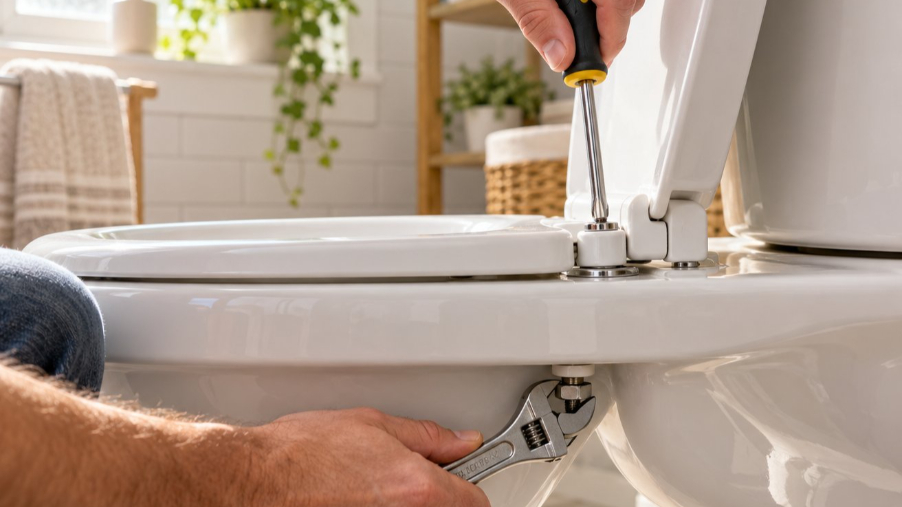
Not sure which one you have? Reach under the pan near the hinge holes. If you feel a bolt and nut, the pan is bottom-fix. If you feel nothing, it needs top fixing. Drench also notes that top-fix seats work on bottom-fix toilets, so a top-fix seat is the more flexible choice if you're unsure.
Hinge Adjustment and Soft-Close Hinges
Hinge adjustment is how far the hinges can slide or swivel to meet your holes. Toilet seat specifications usually list it as a range of hole spacings. Your centre-to-centre figure has to fall inside that range. When you compare replacement toilet seat sizes, check this range alongside length and width.
Quick-release hinges let you unclip the seat and lid from the fixings for cleaning, so you can reach the area around the hinges without tools. You'll notice this matters most on pans where dirt collects behind the hinges.
Soft-close hinges use dampers to lower the seat and lid slowly so they don't slam. Hinges take wear every time the lid opens and closes, so the damper has to suit the seat it carries. A damper tuned for a heavy seat may not let a light one close fully. One tuned for a light seat can let a heavy one drop too fast. Seat weight depends on material, which is covered later in this guide.
This guide doesn't give hole diameters, torque values or load ratings because they differ between products. Take them from the manufacturer specification.
Top fixing is the default for one group of pans, and on those pans the space behind the hinges matters as much as the holes.
Seats for Back-to-Wall and Wall-Hung WCs
Back-to-wall and wall-hung WCs hide their plumbing behind a panel or inside the wall. The look is clean, but it changes what you measure and what you can fit. Crouch beside one of these pans and you'll usually find smooth ceramic or a boxed-in panel where the nuts would normally be.
Why Access Under the Pan Decides the Fixing
On most back-to-wall and wall-hung pans, the underside of the fixing holes is enclosed. You can't reach a nut from below, so a bottom-fix seat has nothing to tighten against. The B&Q measuring guide names these two pan types as the usual case for top-fix fittings. Some pans in this group still leave a gap at the back, though. Check both holes by hand before you order.
Clearance Behind the Seat and Lid
A seat can match the rim and the holes and still fail at the back. When you lift the lid, it has to tilt far enough back to stay upright. If the wall, panel or cistern sits too close behind the hinges, the lid hits it too early and drops forward. American Standard lists tight wall clearance, a sloped or uneven tank and compact pan designs among the common reasons a seat won't stay up.
To check your toilet seat space, measure from the fixing-hole centre line straight back to the nearest obstruction. Then compare that figure with the hinge depth and clearance in the product specification. Clearance needs differ from seat to seat, and soft-close or quick-release hinge housings can take up more room than plain hinges.
Measuring Back-to-Wall and Wall-Hung Pans
You measure a toilet bowl in this group the same way as any other: length from the hole-centre line, width at the widest point, and hole spacing from centre to centre. Shape is where people go wrong. These pans are often D-shaped or compact, so use the shape rules from earlier instead of assuming round or elongated. Is the back edge straight? Is the length shorter than 419 mm (16.5 in)?
Take these measurements as well as length, width and hole spacing:
- Rear clearance: from the hole-centre line back to the wall, panel or cistern.
- Lean-back surface: the height and angle of whatever the raised lid will rest against, such as the cistern top, a panel shelf or the flush plate.
- Underside access: checked by hand at both holes, to confirm that top fixing is needed.
- Hole depth: whether the holes pass all the way through or stop short, which means you need a blind-hole kit.
Clearance also depends on the seat itself. A thicker, heavier seat and lid need more room to tilt back and put more load on the hinges, and weight and thickness both come down to the material.
Seat Materials, Price and Sourcing Options
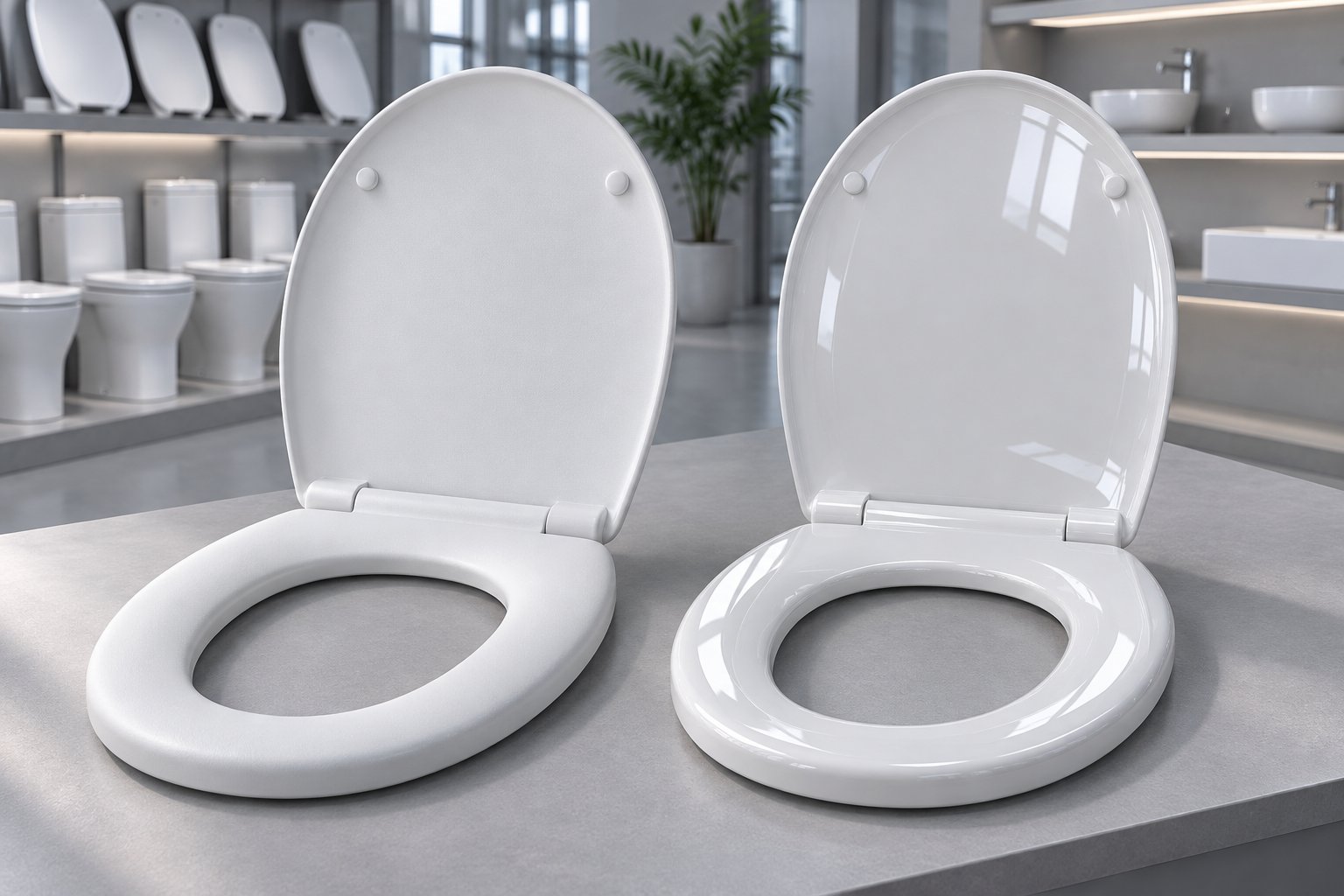
Two seats can have the same size and the same hinges and still feel very different. The material usually explains it. Most rigid plastic seats are made from polypropylene (PP) or urea-formaldehyde (UF). Your choice affects how heavy the seat is, how the surface feels and which soft-close hinge suits it.
PP vs UF Toilet Seat Materials
PP is a thermoplastic that is injection molded. UF, also sold as Duroplast, is a thermoset. It is compressed and cured under heat and pressure, which gives it a hard surface that looks like ceramic. The seat maker BFORIGIN describes both processes.
| Property | Polypropylene (PP) | Urea-formaldehyde (UF) |
|---|---|---|
| Weight | Light, easy to handle and ship | Heavier, feels more solid |
| Surface feel | Plastic finish, often matte or satin | Smooth, glossy, close to ceramic |
| Scratch resistance | Moderate, shows wear sooner | Very high |
| Flexibility | Flexible, resists cracking under impact | Rigid, with less give under a sharp knock |
| Soft-close suitability | Works with soft-close hinges if the damper is matched to a lighter seat | Works with soft-close hinges if the damper is rated for a heavier seat and lid |
A private-label guide from Main Focus Bath makes the same trade-off. PP takes impact better. UF keeps its surface and resists yellowing longer.
Toilet Seat Price Versus Installation Cost
Think of toilet seat price as the product cost only. A basic toilet seat in PP with plain hinges is usually the cheapest option, because PP costs less as a material and is cheaper to mold. UF, soft-close dampers and quick-release hinges all add to the product cost.
Installation is a separate cost. The Homewyse estimate splits a job into three lines: the seat, the labor, and job supplies such as connectors and mounting hardware. It also applies a minimum labor charge. If you hire a fitter, ask for the seat and the labor as separate lines on the quote. Wondering how to know what toilet seat to buy? Fit comes first. A seat that is cheap to buy costs you more overall if it doesn't fit and you have to buy another.
Sourcing Seats for OEM and Private-Label Ranges
Trade buyers usually have three sourcing routes:
- Tianyun: the Tianyun PP and UF seat collection is aimed at sanitary ware manufacturers and private-label buyers. It is a starting point for choosing a material, matching a soft-close hinge and developing an OEM seat. The collection does not list individual models, dimensions, colors, load ratings or prices. You confirm shape, dimensions, color and load requirements through an inquiry.
- The pan manufacturer's matching seat range: these seats are made for that maker's own pan outlines and hole positions. They are a sensible route when you supply seats for specific pan models.
- Other seat makers and OEM suppliers: compare their material options, hinge choices, color matching and branding. A custom shape usually needs a new mold, which is a one-off tooling cost.
Before any of these suppliers can confirm a seat, they will ask for the same information: the pan shape, the measurements, the fixing type and the hinge requirements. It helps to have all of it written down in one place.
Before You Buy
Before you click the order button, one page of notes can save you from returning a seat that doesn't fit. Every part of this toilet seat size guide leads to the checks below. If you work through them in order, you end up with a complete record of how to size a toilet seat for your own pan. It also works as a quick reminder of how to measure for a new toilet seat the next time you replace one.
Before-You-Buy Toilet Seat Size Checklist
- Pan shape: identified from the back edge (straight or curved), the front (circular curve, tapered oval or squared corners) and the overall proportions.
- Seat length: in mm (in), measured from the line between the fixing-hole centres to the outer front edge of the rim.
- Width: measured across the widest point of the outer rim.
- Hole spacing: measured from the centre of one fixing hole to the centre of the other.
- Access underneath: open or enclosed, and the fixing type that follows from it: bottom, top or blind-hole.
- Hinge adjustment range: confirmed to include your hole spacing.
- Rear clearance: measured from the hole-centre line back to the wall, panel or cistern. You need this on back-to-wall and wall-hung pans.
- Material and hinges: PP or UF, and whether you want soft-close or quick-release hinges.
Do you only have the old seat to go on? You can measure it, but first check that it fitted without overhang at the sides or front and without exposed rim at the back corners. Blue Leaf Bathware points out that the fitted seat may already be a replacement, so treat it as a reference and not as proof of the right size. If it didn't sit flush with the rim, measure the pan instead.
Confirming Fit With the Manufacturer or Supplier
If you're buying for your own bathroom, compare the checklist with the manufacturer specification sheet before you order. Make sure both sets of figures are measured between the same points. Blue Leaf notes that the overall seat length on a product drawing can include material behind the hinge centreline, so that figure is not the same as your length from the hole-centre line. If the sheet leaves out a figure you need, ask the seller before you pay.
Trade and private-label buyers should send the same checklist with every supplier inquiry. The seat maker Beewill advises adding a technical drawing, a reference model or a physical sample, because photos alone may not show the dimensions a supplier needs. For example, an OEM buyer could send the completed list to Tianyun and ask the company to confirm the shape, dimensions, material and hinge requirements for a PP or UF seat.
Your measurements show what the pan needs, and a confirmed specification shows that the seat meets those needs, so check both before you order.
WC Seat Size FAQs
1. Are toilet seats a universal size?
No. Pan outlines and lengths differ by shape, by brand and by market. A seat labelled universal follows a middle-ground outline between round and oval. It sits well on standard rounded pans and badly on D-shaped, square and compact ones. Shape alone doesn't settle the size either. US round seats span roughly 419 to 445 mm (16.5 to 17.5 in), and UK round pans can be shorter still. A round seat on an elongated pan leaves about 50 mm (2 in) of bare rim at the front. An elongated seat on a round pan overhangs by the same amount and can flex or crack over time. Measure your own pan before you trust any universal label.
2. How do I measure my toilet to find the right seat size?
Measure the pan with the old seat removed, because the old seat may never have fitted properly. You need three figures. The first is the hole spacing, from the centre of one fixing hole to the centre of the other. The second is the length, from the midpoint between the hole centres to the outer front edge of the rim. The third is the width, across the widest part of the outer rim. Also note whether the back edge is straight or curved, and whether you can reach under the holes, since that decides between bottom and top fixing. Record everything in mm with inches in brackets. Then compare your figures with the product specification sheet, and check that it measures length from the same hinge-centre line you used.
3. What is the standard spacing between toilet seat fixing holes?
No single figure applies everywhere. Bemis gives 140 mm (5.5 in) as the usual North American spacing. UK retailer Wholesale Domestic reports that many UK pans use about 155 mm (6.1 in). Many seats have adjustable hinges that cover a range, and one Australian example spans 115 to 170 mm (4.5 to 6.7 in). Measure centre to centre, not edge to edge, because slotted or wider holes add error if you measure from an edge. A seat fits only if your figure falls inside the hinge adjustment range in its specification.
4. What type of toilet seat do I need for a back-to-wall or wall-hung WC?
Most of these pans hide the underside of the fixing holes, so you'll normally need a top-fix seat that tightens from above. If the holes stop partway into the ceramic, you need a blind-hole fixing kit. Reach under both holes by hand to confirm before you order. Top-fix seats also work on pans with open access, so they are the safer choice if you're unsure. Also measure from the hole-centre line back to the wall, panel or cistern. If that gap is too small, the lid can't tilt far enough to stay upright. Compare the gap with the hinge clearance in the specification. These pans are often D-shaped or compact, so check the back edge and the length instead of assuming round or elongated.
5. Should I choose a PP or UF toilet seat?
Polypropylene (PP) is light and flexible, handles knocks without cracking and usually costs less. Urea-formaldehyde (UF, also sold as Duroplast) is heavier, with a hard, glossy, near-ceramic finish that resists scratches and yellowing for longer. Whichever you pick, the soft-close damper has to match the weight of the seat and lid, or the seat may close too fast or not fully. Trade and private-label buyers can use Tianyun's PP and UF seat collection as a starting point for choosing a material and matching a soft-close hinge for OEM development. The collection doesn't publish models, dimensions, colours, load ratings or prices. Send your pan shape, measurements, fixing type and hinge requirements with an inquiry so the supplier can confirm them.
Apply This Insight to Your Project
Tell us what you are building and how the topic “WC Seat Size Chart: Measure Once, Order the Right Seat First Time” relates to your application. Our engineering team can help evaluate the next step.