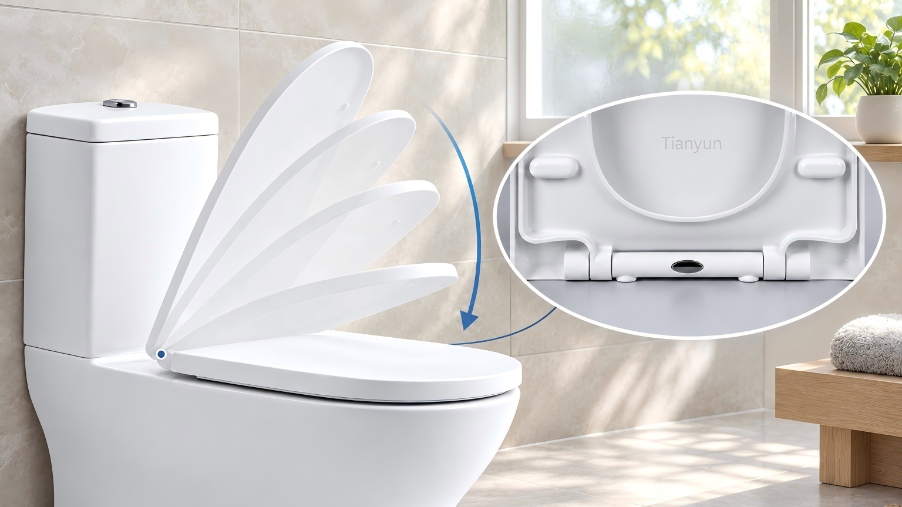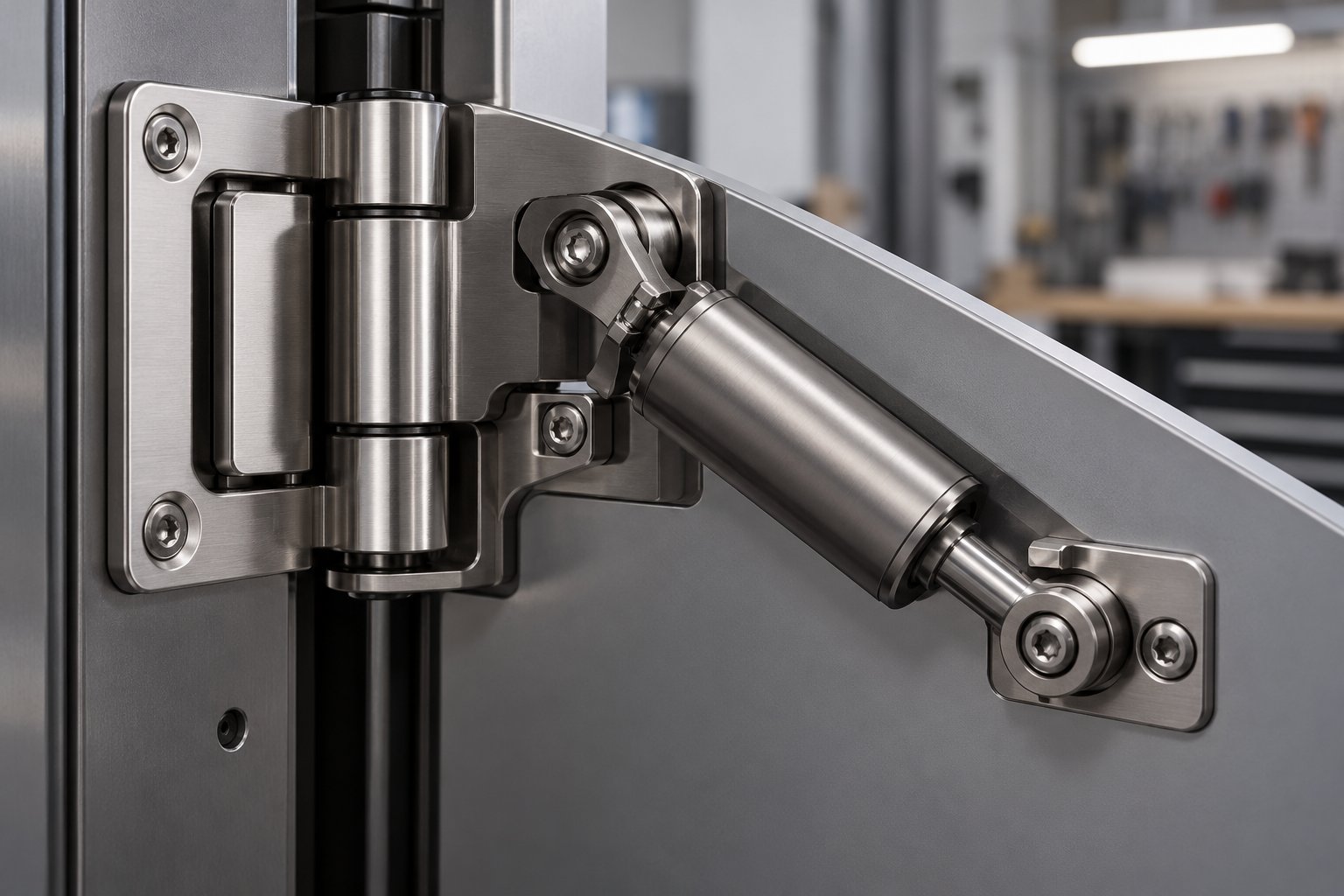
What Damping Hinges Are and Why Engineers Specify Them
Imagine a heavy equipment lid swinging shut and slamming into a steel frame dozens of times per shift. The noise alone is a problem. The wear on mounting hardware, the safety risk to operators, and the impression it leaves on anyone nearby? Even worse. That scenario is exactly what damping hinges are engineered to prevent.
What Is a Damping Hinge
A damping hinge is a rotational mechanism designed to absorb kinetic energy and convert it into controlled, decelerated motion. Unlike a standard free-swinging hinge or a simple spring-loaded closer that snaps a door shut with unregulated force, a damping hinge uses deliberate resistance to govern how fast and how forcefully a panel, lid, or door moves through its arc. That resistance typically comes from one of three sources: hydraulic fluid (often silicone oil) forced through calibrated internal channels, friction between engineered contact surfaces, or magnetic force opposing rotation.
The distinction matters. A self-closing hinge uses spring force to pull a door shut on its own, but it offers no control over how fast that final movement happens. A soft-close damping hinge adds a critical layer: it slows the motion so the door settles into place rather than snapping shut. One gets the door closed. The other defines how it gets there.
These are purpose-built components integrated during product design, not aftermarket accessories bolted on as an afterthought. When you see cupboard self closing hinges with a smooth, quiet finish or quick release hinges on industrial enclosures that prevent slamming, a damping mechanism is doing the work behind the scenes.
Why Damping Hinges Matter in Product Design
The functional benefits extend well beyond a softer close. In practical terms, damping hinges deliver four measurable advantages across nearly every application where they appear:
- Noise reduction: Eliminating the impact at the end of each closing cycle removes a significant source of repetitive noise, which is critical in medical equipment, research labs, and residential products like toilet seats.
- Component longevity: A controlled closing motion means less force transferred into mounting points, fasteners, and surrounding structures. Over thousands of cycles, that reduced impact directly slows hardware fatigue and frame wear.
- User safety: Heavy lids and panels carry real momentum. As Southco notes, the last thing users want is a heavy lid slamming into their fingers at the end of a long day. Damped motion makes panels easy to move but nearly impossible to slam shut.
- Perceived product quality: The tactile feel of a smooth, controlled close signals premium engineering to end users, whether they are opening a laptop lid, an automotive glove compartment, or an industrial machinery access panel.
A damping hinge doesn't just slow a lid - it defines the tactile experience of the entire product.
You will find these components wherever controlled motion intersects with user interaction: toilet seat assemblies, laptop displays, automotive storage compartments, heavy-duty industrial enclosures, and medical device panels. Each application demands a different balance of torque, speed control, and durability, but the core principle remains the same - managing energy so the closing motion feels intentional rather than accidental.
This article is built for product engineers and design teams who need more than a basic overview but less than a raw product catalog. The approach is mechanism-first: understanding how each damping type generates resistance before comparing them, specifying them, and designing around their real-world limitations.
How Damping Mechanisms Create Controlled Motion
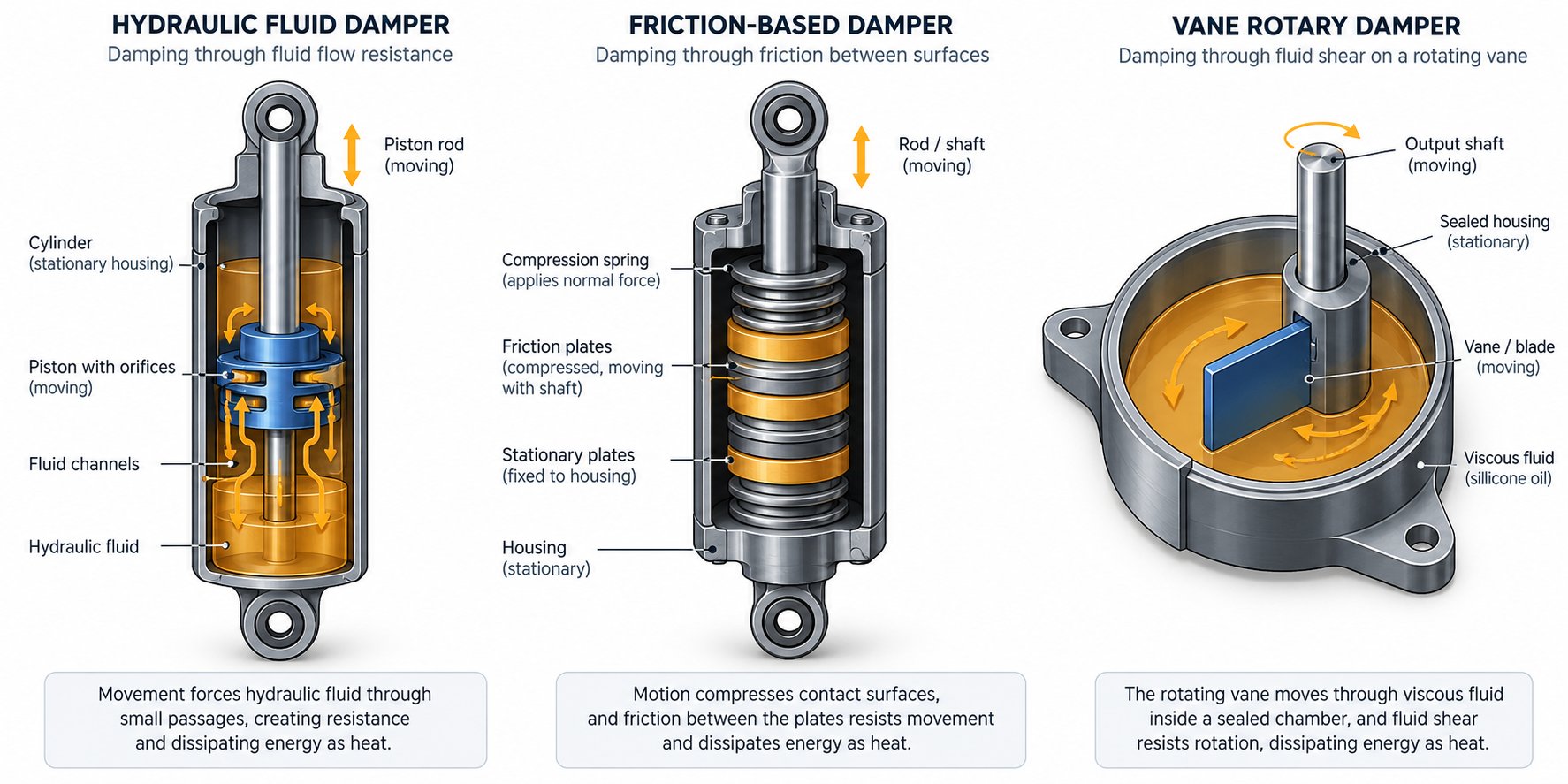
Every damping hinge solves the same basic problem: it takes uncontrolled kinetic energy and converts it into slow, predictable motion. But the way each mechanism accomplishes that conversion differs significantly, and those differences determine everything from torque consistency to long-term durability. If you're selecting a damper for a product design, understanding the physics behind each approach is the fastest path to choosing the right one.
Three core mechanisms dominate the damping hinge landscape. Each generates resistance through a fundamentally different physical process, which means each behaves differently under real-world operating conditions.
Hydraulic and Fluid-Based Damping
Fluid-based damping is the most widely used mechanism in soft close dampers, and the physics behind it is surprisingly intuitive. Imagine pushing honey through a narrow straw - the thicker the honey and the narrower the straw, the harder you have to push. That's essentially what happens inside a hydraulic damping hinge.
As the hinge rotates, an internal component forces viscous fluid - typically silicone oil sealed inside the housing - through calibrated orifices or narrow channels. The fluid resists being displaced, and that resistance translates directly into opposing torque that slows the rotation. Two variables control how much resistance the mechanism produces:
- Orifice geometry: A narrower throttle gap restricts fluid flow more aggressively, generating higher damping torque. A wider gap lets fluid pass more freely, producing a softer, lighter feel. Manufacturers tune these internal dimensions to target specific torque ranges for different applications.
- Fluid viscosity: Higher-viscosity silicone oil resists flow more and produces greater torque. Lower-viscosity oil allows easier flow and produces less resistance. Selecting the right viscosity grade is one of the primary ways engineers calibrate a damper's behavior.
Here's the critical consideration that often gets overlooked in product design: fluid viscosity is not constant. It changes with temperature. As temperature rises, silicone oil thins out and torque decreases. In colder conditions, the oil thickens and torque increases. A damper that produces a perfectly smooth close at room temperature may feel sluggish in a cold warehouse or noticeably faster in a sun-heated bathroom. This temperature sensitivity is a defining characteristic of every fluid-based damper, and ignoring it during specification is one of the most common engineering mistakes in the field.
Rotation speed also plays a role. Fluid-based dampers inherently resist fast movements more strongly than slow ones, which is why a lid that closes gently under a light push will resist much harder if someone tries to slam it. That speed-dependent response is often a desirable feature in applications like soft close concealed cabinet hinges, where the goal is to prevent sudden impacts regardless of how much force a user applies.
Friction and Mechanical Damping
Friction-based damping takes a completely different approach. Instead of forcing fluid through channels, it relies on direct physical contact between internal surfaces to resist rotation. Picture two surfaces pressed firmly together - when you try to slide one past the other, the friction between them resists the movement. That's the core operating principle.
In a typical friction damping hinge or suspension hinge, engineered polymer washers or metal plates are held under compression against a rotating element. As the hinge turns, these contact surfaces generate a drag force that opposes the motion. The resulting resistance tends to be relatively constant across the full angular range, meaning you'll feel roughly the same amount of drag whether the hinge is at 10 degrees or 90 degrees.
This consistency is both an advantage and a limitation. On the positive side, friction dampers are far less sensitive to temperature changes than their fluid-based counterparts. They contain no liquid that can thin or thicken with heat and cold, so they deliver stable performance across a wide environmental range. They're also structurally simpler - no seals to leak, no fluid to degrade - which makes them inherently low-maintenance.
The trade-off? Wear. Every rotation generates microscopic surface abrasion between the contact materials, and over thousands of cycles, that cumulative wear gradually reduces the damping torque. A friction hinge that felt perfectly tuned at installation may feel noticeably lighter after extended use. The rate of wear depends on the materials, the applied load, and the duty cycle, but it's an unavoidable characteristic of any friction-based system.
Vane Rotary Damping Mechanisms
Vane-type rotary dampers combine the precision of fluid-based damping with a distinct structural advantage. Inside the damper body, a rotating shaft drives an internal blade - the vane - through sealed, fluid-filled chambers. As the vane sweeps through the chamber, it forces silicone oil through the gap between the blade edge and the housing wall, generating controlled resistance.
What makes this mechanism stand out is how it separates the damping behavior from the hinge body itself. Because the gap between the vane and the housing can be engineered independently from the rest of the structure, manufacturers can tune vane dampers to distinctly different torque profiles without redesigning the entire unit. This configurability is especially valuable for product engineers who need to iterate on damping feel during prototyping - you can adjust the torque characteristics without switching to a completely different damper family.
Like all fluid-based systems, vane dampers are still subject to temperature-dependent viscosity changes and speed-proportional resistance. But the independent tunability of the vane-to-housing clearance gives designers a level of control that disk or barrel dampers simply don't offer in the same package.
To keep these three mechanisms straight, here's a concise comparison:
- Hydraulic / Fluid-Based: Forces viscous oil through calibrated orifices to resist rotation. Torque is speed-dependent and temperature-sensitive. Primary trade-off: performance varies with environmental temperature.
- Friction / Mechanical: Uses controlled surface contact between compressed materials to generate drag. Torque is relatively constant across the angular range. Primary trade-off: gradual wear reduces damping force over the product lifecycle.
- Vane Rotary: Drives an internal blade through fluid-filled chambers for precise, configurable resistance. Torque profiles can be adjusted without changing the damper body. Primary trade-off: still temperature-sensitive like all fluid-based systems, but offers superior tunability.
Each mechanism has a clear performance envelope, and none is universally superior. The right choice depends entirely on the application's specific demands - which raises an obvious question: how do these mechanisms actually compare when you line them up against the engineering parameters that matter most?
Comparing Damping Hinge Types Side by Side
Knowing how each damping mechanism works is one thing. Knowing which one to specify for a particular product is something else entirely. Engineers rarely have the luxury of choosing in the abstract - they're working within real constraints like operating temperature ranges, noise limits, budget ceilings, and durability targets that can shift from one project to the next.
The challenge? Most technical resources describe each damping hinge type in isolation, leaving the comparison work to the reader. That gap between understanding a mechanism and selecting one is where costly specification errors tend to happen. The table and decision framework below are designed to close it.
Hydraulic vs. Friction vs. Magnetic vs. Spring-Loaded Damping
Four primary damping approaches appear across the motion control landscape. Some rely on fluid dynamics, others on material contact, electromagnetic resistance, or stored mechanical energy. Each carries distinct strengths and limitations that become apparent only when you compare them against the same set of engineering parameters.
| Parameter | Hydraulic (Fluid-Based) | Friction (Mechanical) | Magnetic (Eddy Current) | Spring-Loaded |
|---|---|---|---|---|
| Damping Mechanism | Viscous fluid (silicone oil) forced through calibrated orifices or vane channels | Controlled surface contact between compressed polymer washers or metal plates | Electromagnetic resistance generated by magnets interacting with conductive elements | Mechanical spring tension stores energy on opening; releases it to drive closure |
| Torque Consistency | High - smooth, repeatable torque curve when temperature is stable | Medium - consistent across the angular range initially, but degrades with wear | High - very consistent and repeatable with minimal degradation | Low - force peaks near full closure; acceleration is largely uncontrolled |
| Temperature Sensitivity | High - fluid viscosity changes significantly with temperature, directly affecting torque output | Low - no fluid means minimal thermal impact on resistance | Low - magnetic properties are stable across typical operating ranges | Low to Medium - spring tension shifts slightly in extreme cold or heat |
| Typical Cycle Life Range | 50,000+ cycles under rated conditions (per industry standard testing at 20°C) | Moderate - surface wear reduces torque progressively; lifecycle depends heavily on load and materials | Very High - no contact-based wear; primarily limited by housing integrity | Moderate - metal fatigue reduces spring tension over time, leading to inconsistent closing |
| Relative Cost | Medium to High | Low to Medium | High | Low |
| Noise Level | Very Low - fluid absorption produces near-silent operation | Low to Medium - some audible contact noise possible as surfaces wear | Very Low - non-contact mechanism generates virtually no sound | High - impact at end of travel produces noticeable slam |
| Best-Fit Applications | Toilet seats, self closing cabinet door hinges, automotive compartments, laptop lids | Adjustable equipment panels, lightweight access doors, positioning applications with infrequent cycling | High-precision instruments, medical equipment, applications requiring maintenance-free longevity | Budget screen doors, basic cabinet closers, secondary gates with low user-experience requirements |
A few things jump out immediately. Hydraulic and magnetic mechanisms lead in torque consistency and quiet operation, but they sit at different price points and respond differently to environmental stress. Friction-based designs offer simplicity and thermal stability at the cost of long-term torque degradation. Spring-loaded systems are the most affordable option, yet they provide the least control over closing behavior - a limitation that directly impacts noise, safety, and hardware longevity.
Notice, too, that the 50,000-cycle benchmark for hydraulic dampers comes with an important caveat: that figure is typically validated at 20°C under rated torque conditions, with each test cycle running through a 110° to 0° range. Real-world duty cycles involving heavier loads, faster speeds, or temperature extremes will shift that number - sometimes dramatically.
Choosing a Mechanism Based on Application Requirements
Tables are useful for side-by-side comparisons, but the actual selection process works more like a decision tree. Each design constraint narrows the field until one mechanism - or at most two - emerges as the clear fit. Walk through these questions in order, and you'll arrive at a well-grounded recommendation before you ever open a supplier catalog.
- Does your application require consistent torque across the full angular range?
- Yes, torque must remain smooth and predictable throughout the entire rotation. Hydraulic or magnetic mechanisms are your strongest options. Hydraulic dampers deliver excellent torque curves when temperature is controlled. Magnetic dampers provide equally consistent resistance without any fluid-related variability.
- If budget is a primary constraint, lean toward hydraulic. If long-term maintenance-free operation justifies the premium, magnetic damping is the more durable path.
- No, some torque variation is acceptable. Friction-based and spring-loaded options remain in play. Move to the next question.
- Yes, torque must remain smooth and predictable throughout the entire rotation. Hydraulic or magnetic mechanisms are your strongest options. Hydraulic dampers deliver excellent torque curves when temperature is controlled. Magnetic dampers provide equally consistent resistance without any fluid-related variability.
- Will the operating temperature vary significantly across the product's use environment?
- Yes, the product will encounter wide temperature swings (outdoor equipment, vehicles, warehouses, bathrooms with radiant heating). Avoid purely fluid-based mechanisms unless the damper is specifically rated for your temperature range. Friction-based and magnetic mechanisms handle thermal variation with far less impact on torque output.
- No, the product operates in a controlled or narrow temperature range. Fluid-based hydraulic dampers and vane rotary dampers become strong candidates - their temperature sensitivity is manageable when the environment is stable. This is a common scenario for indoor consumer products and self closing cabinet door hinges.
- Does the component need to be sealed and maintenance-free, or is periodic adjustment acceptable?
- Sealed and maintenance-free is required. Hydraulic and magnetic dampers are typically sealed units designed for install-and-forget service. Friction hinges can also be sealed, but keep in mind that wear-based torque loss is not correctable in a sealed assembly.
- Periodic adjustment or replacement is feasible. An adjustable damping hinge with friction-based resistance may be ideal here. Some designs allow torque to be recalibrated by changing compression on internal washers, extending the usable service life. This is especially relevant for equipment panels that technicians access regularly.
- Is noise a critical design constraint?
- Yes, the product demands near-silent operation (medical devices, premium consumer electronics, residential furniture). Hydraulic and magnetic mechanisms produce virtually no operational noise. Eliminate spring-loaded designs entirely, as their uncontrolled impact at end-of-travel generates the very slam sound you're trying to avoid.
- No, moderate operational sound is acceptable. Friction-based designs can work well here, offering a cost-effective solution with stable thermal performance and straightforward integration.
One principle runs through every branch of this decision tree: the mechanism choice must come before component selection. It's tempting to browse supplier catalogs and pick a damping hinge that fits the physical envelope, only to discover later that its torque behavior, thermal response, or cycle life doesn't match the application. That sequence - pick a hinge, then hope the mechanism suits the need - is backward, and it's responsible for a significant share of damping performance complaints in production.
Define the mechanism first. Confirm that its physics align with your operating environment, durability targets, and user-experience goals. Then select the specific component that delivers those characteristics within your dimensional and budgetary constraints.
Of course, even the right mechanism type won't help if the underlying motion control need has been misidentified. A damping hinge controls speed - but what if the application actually needs position holding, or force assistance, or something else entirely? That distinction between adjacent technologies is surprisingly easy to overlook, and getting it wrong means solving the wrong problem from the start.
Damping Hinges vs. Adjacent Motion Control Technologies
Here's a scenario that plays out more often than most engineers would admit: a design team specifies a damping hinge, integrates it into their product, and discovers during validation testing that the real problem was never about controlling closing speed. The lid needed to stay open at 60 degrees. Or the panel was too heavy and needed lifting assistance, not resistance. The damping hinge worked perfectly - it just solved the wrong problem.
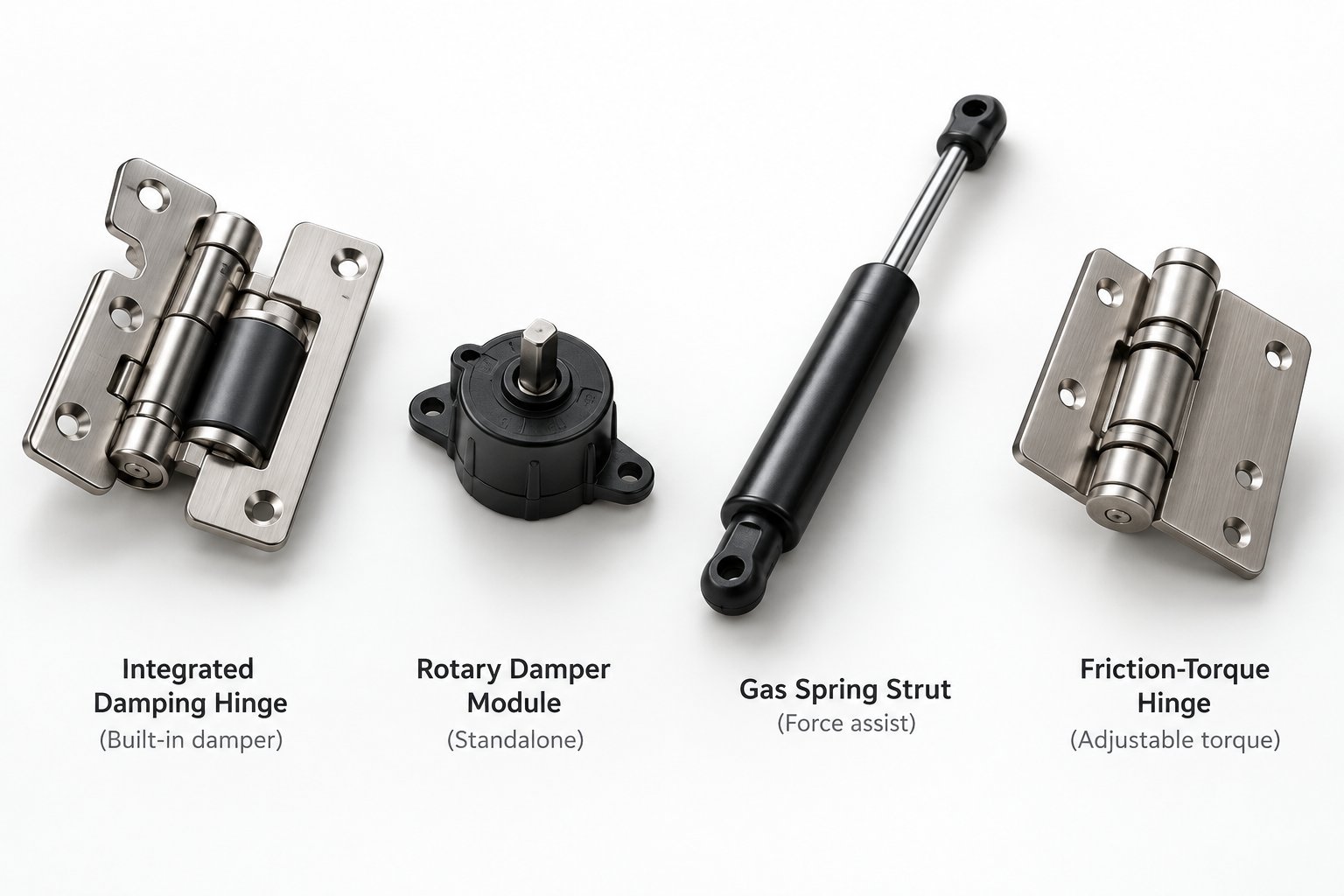
Damping hinges occupy a specific niche within a broader family of motion control technologies. Several of those technologies overlap in appearance, mounting location, and even marketing language, which makes it dangerously easy to confuse what each one actually does. Before committing to any door damper hinge solution, it pays to understand exactly where these boundaries fall.
Damping Hinges vs. Gas Springs and Struts
Gas springs and damping hinges both appear in lid, panel, and door applications, and they're sometimes even mounted side by side on the same assembly. But they perform fundamentally different mechanical functions.
A gas spring generates force. It uses compressed nitrogen inside a sealed cylinder to push a piston outward, which translates into a lifting or holding force that counteracts gravity. When you open a car trunk and the lid stays up on its own, that's a gas spring at work. It's providing assistance - actively supporting the weight of the moving element so it doesn't fall.
A damping hinge generates resistance. It opposes the motion that's already happening, slowing a door or lid as it moves through its arc. It doesn't lift anything, hold anything open, or push in any direction. It simply absorbs energy and decelerates movement.
Think of it this way: a gas spring holds a laptop screen open at whatever angle you set it. A damping hinge controls how fast that screen settles closed when you let go. One fights gravity on behalf of the user. The other manages what gravity does when it wins.
The confusion typically arises because both components appear in the same product categories - soft closing hinges for doors, storage compartment lids, industrial access panels - and both contribute to a "premium" feel. But specifying a damping hinge when the application actually needs a gas spring means the lid will close at a controlled speed and then land on someone's hand, because nothing was holding it up in the first place. Conversely, a gas spring alone won't prevent a heavy panel from slamming shut if the spring force is overcome. Many well-designed assemblies use both: a gas spring to support weight across the travel arc, and a damper to manage the final closing motion.
Damping Hinges vs. Friction Hinges and Constant-Torque Hinges
This is where the terminology gets particularly slippery. Friction hinges and constant-torque hinges look similar to damping hinges, mount in similar locations, and are frequently marketed alongside them. Some suppliers even use the same product pages to describe both. But the functional difference is significant.
A friction hinge or constant-torque hinge is designed to hold position. It creates enough drag that the moving element - a laptop screen, an equipment panel, an adjustable display arm - stays wherever the user places it. Push the lid to 45 degrees and let go; it stays at 45 degrees. Push it to 90 degrees; it stays there too. The resistance exists to prevent unwanted movement, not to control the speed of intentional movement.
Damping hinges do the opposite. They allow free movement through the arc but control the rate of that movement. A toilet seat with a damping hinge won't hold at 45 degrees - it will descend smoothly from any open position all the way to closed, just more slowly than gravity alone would allow.
The practical trap? Some products labeled "soft close" are actually friction hinges with intentional drag, not true fluid-based or vane-type dampers. You'll notice this distinction when testing: a genuine soft-close damper lets the lid move freely at low speed and ramps up resistance as velocity increases. A mislabeled friction hinge simply feels stiff at every speed and every angle. If a product resists being opened just as much as it resists closing, you're likely dealing with friction-based position holding rather than true damped motion control.
For applications like fitting gate hinges on outdoor enclosures or adjustable monitor arms, friction hinges may actually be the right choice - the design goal is angular stability, not closing speed management. Recognizing which behavior your product needs before browsing supplier catalogs saves significant time during prototyping.
Damping Hinges vs. Standalone Soft-Close Damper Modules
Even within the damping category itself, there's an important architectural distinction that affects design complexity, cost, and serviceability. An integrated damping hinge combines the pivot function and the damping mechanism into a single assembly - you mount one component, and it both pivots and decelerates. A standalone soft-close damper module is a separate device, typically a small rotary vane damper, that mounts alongside a standard hinge and provides the damping function independently.
Integrated designs simplify assembly and reduce the total part count, which appeals to high-volume manufacturing. For appliance OEMs, an integrated soft-close hinge is often the preferred approach because it delivers consistent performance across production runs within a smaller mounting footprint.
Standalone modules, on the other hand, offer flexibility. If a product line uses the same standard hinge across multiple models but only some SKUs require soft-close behavior, adding a discrete damper module lets the team upgrade specific models without redesigning the entire hinge system. This modular approach also simplifies replacement - if the damper wears out, you swap the module without touching the hinge itself.
The trade-off is integration complexity. Two separate components mean two sets of mounting hardware, two alignment tolerances, and a higher risk that field assembly errors compromise damping performance. In contrast, a single integrated unit eliminates alignment variables but locks the damping characteristics to the hinge body - you can't change one without changing the other.
The table below maps these four motion control approaches against the parameters that matter most during early design decisions:
| Parameter | Integrated Damping Hinge | Standalone Rotary Damper + Standard Hinge | Gas Spring | Friction Hinge |
|---|---|---|---|---|
| Motion Control Type | Speed control - decelerates closing or opening motion through the arc | Speed control - damper module provides resistance independently of the hinge pivot | Force assistance - generates lifting or holding force to counteract gravity | Position holding - maintains the element at any set angle through frictional drag |
| Position Holding | No - the element moves freely through the range; damping only controls the rate of travel | No - same behavior as integrated; the element will not hold at a set angle | Yes - gas pressure holds the element open at or near the extended position | Yes - the element stays at whatever angle the user places it |
| Typical Applications | Toilet seats, cabinet doors, appliance doors, automotive glove boxes | Industrial enclosures, equipment lids, products requiring modular damping upgrades | Car trunks, heavy oven lids, storage benches, overhead access panels | Laptop screens, adjustable display arms, equipment panel positioning |
| Design Complexity | Low - single component handles pivot and damping; minimal alignment variables | Medium - two components require coordinated mounting and alignment | Medium to High - cylinder length, force rating, and mounting geometry must be carefully calculated | Low - single component; torque is typically set by preload adjustment |
The pattern is clear: each technology answers a different question. Gas springs answer "How do I hold this open?" Friction hinges answer "How do I keep this in place?" Damping hinges - whether integrated or modular - answer "How do I control how fast this closes?"
Getting this foundational question right is the prerequisite for everything that follows. Once you've confirmed that controlled closing speed is genuinely the design requirement, the next challenge shifts from what to specify to how to specify it - translating application needs into the precise engineering parameters that suppliers need to deliver a matching component.
How to Specify Damping Requirements for Manufacturers
Knowing that your application needs a damping hinge is only half the problem. The other half - the half that actually determines whether the component performs correctly in production - is translating that need into a set of parameters precise enough for a supplier to act on. Vague requirements produce vague results. And vague results, in motion control, usually mean prototypes that feel wrong, closing times that miss the target, and revision cycles that burn through schedule and budget.
Most engineers have a general sense of what they want: "something that closes smoothly" or "a soft-close feel like our competitor's product." But suppliers don't work from feelings. They work from numbers, tolerances, and environmental constraints. The specification framework below covers exactly what those numbers are, why each one matters, and what happens when any of them gets left off the request.
Critical Parameters for Damping Hinge Specification
Think of this as a checklist you walk through before contacting any supplier. Each parameter builds on the last, and skipping one often means rework later. Whether you're sourcing cabinet door soft closers for a kitchen line or heavy-duty industrial dampers for equipment enclosures, the same core variables apply.
- Required torque range (Newton-meters). This is the single most important number in any damping specification. Torque defines how much resistance the damper applies to rotation. Under-specify it, and the lid closes too fast - users hear a thud instead of a gentle settle. Over-specify it, and the lid stalls partway through its arc, creating the impression that the mechanism is broken. For most cabinet door self closing hinges and toilet seat applications, the required torque falls within a relatively narrow band, but that band shifts significantly with the weight and geometry of the moving element.
- Angular operating range (degrees). Not every damper needs to provide resistance across a full 180-degree sweep. Some applications only require damping during the final 20 degrees of closure - the "soft close" zone. Others need controlled motion from fully open to fully shut. Define the active damping arc explicitly; otherwise, the supplier may deliver a unit that damps across a range your product doesn't use, wasting torque capacity where it isn't needed.
- Mounting style and physical envelope constraints (diameter, length). A damper that delivers perfect torque is useless if it doesn't physically fit the assembly. Specify the maximum allowable diameter, overall length, and mounting interface type (axial, flange, clip-in, or shaft-driven). For soft closing cupboard door hinges integrated into compact cabinetry, envelope constraints are often the tightest design bottleneck - and the one most likely to force a mechanism change late in development if not addressed early.
- Operating temperature range. As discussed in earlier sections, fluid-based dampers are directly affected by temperature swings. A damper rated at 0.4 Nm at 25°C may deliver noticeably different torque at 5°C or 40°C. Specify the full range of temperatures the product will encounter during storage, shipping, and use. Industry testing protocols typically validate performance at extremes like -20°C and 60°C with 65% humidity for 72 hours, then check for torque variation and oil leakage after returning to ambient conditions. If your application falls outside these common bounds, call it out explicitly.
- Required cycle life. How many open-close cycles must the damper survive before torque degrades beyond acceptable limits? A residential toilet seat might need 50,000 cycles. A commercial restroom fixture might need 200,000 or more. Standard endurance testing often runs 30,000 test cycles from a 70-80 degree opening angle and checks that drop time remains above 2 seconds with torque variation no greater than 30%. But these are test conditions, not your conditions. Specifying cycle life without defining the test load, speed, and temperature makes the number functionally meaningless.
- Material and environmental compatibility. Will the damper be exposed to moisture, cleaning chemicals, UV radiation, or salt air? Corrosion resistance matters for outdoor applications and bathroom fixtures. Chemical resistance matters for products that get scrubbed with detergents. Some testing programs include dedicated detergent resistance and salt spray testing to validate surface and seal integrity under harsh exposure. If your product lives in a demanding environment, specify the exposure conditions so the supplier can recommend appropriate housing materials and seal compounds.
- Configurable vs. fixed torque requirements. Does the product line include multiple models with different lid weights or geometries? If so, a damper platform with selectable torque settings eliminates the need to source entirely different components for each variant. This is particularly valuable during prototyping, when teams need to iterate quickly on closing feel without waiting for new custom damper tooling.
How to Communicate Requirements to a Damper Supplier
Even a complete parameter list can fall short if it lacks application context. Suppliers who specialize in damping components don't just match torque numbers to catalog entries - the experienced ones reverse-engineer the requirement from the physical system. That means the most productive conversations start with real-world details, not isolated specifications.
When you reach out to a supplier, provide:
- Mass and dimensions of the moving element - the lid, door, or panel that the damper must control. A 2 kg toilet seat lid behaves very differently from a 6 kg industrial enclosure panel, even if the desired closing time is identical.
- Desired closing time in seconds - how long the element should take to travel from open to closed. This is what end users actually perceive, and it's the most intuitive way to communicate the target behavior.
- Installation geometry - specifically the distance from the hinge axis to the center of gravity of the moving element. This distance determines the effective gravitational torque the damper must overcome, and it changes the required damping torque even when the mass stays the same.
- Environmental constraints - temperature range, chemical exposure, moisture levels, and any regulatory or material compliance requirements (RoHS, REACH, etc.).
Suppliers offering configurable torque and diameter options are especially well-suited to this kind of application-based conversation. Tianyun's vane rotary dampers, for example, are designed specifically for toilet seat manufacturers and product engineers who need to match damping performance to specific seat geometries and weights. Their product line provides selectable torque and diameter configurations, allowing engineering teams to fine-tune the closing feel for each seat design without commissioning custom tooling for every variant. For teams iterating through multiple prototypes with different lid weights or hinge placements, that configurability compresses development timelines significantly.
Specifying the application context - not just the torque number - leads to better supplier recommendations and fewer prototype revision cycles.
Engineers evaluating configurable vane damper options can explore Tianyun's vane damper product page as a practical starting point for understanding what selectable parameters are available and how they map to common soft-close applications.
A well-prepared specification gets you to the right damper faster. But even a perfectly specified component can be undermined by misreading its own datasheet - a surprisingly common problem when torque values, temperature ratings, and cycle-life claims aren't presented with the context needed to interpret them correctly.
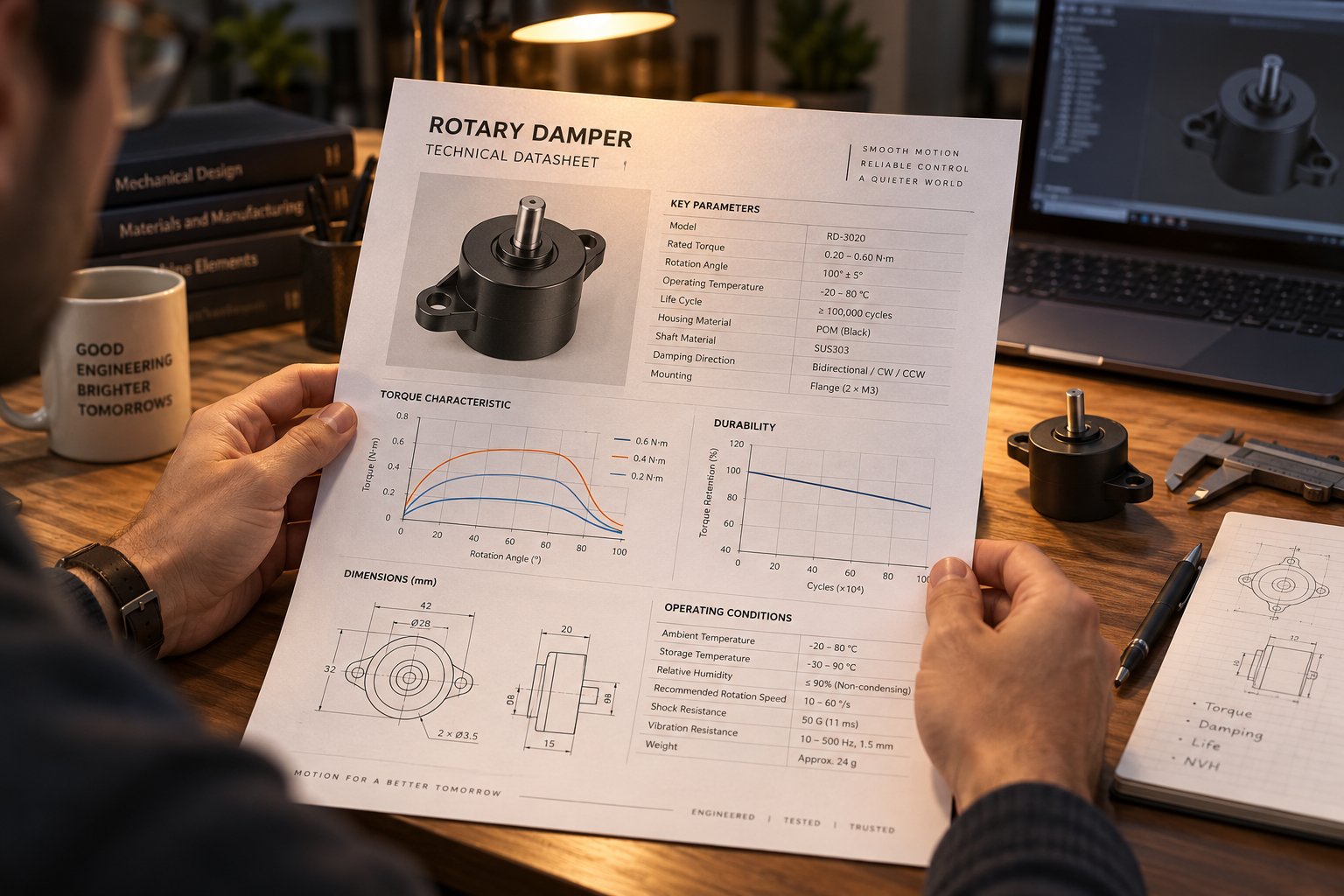
Reading and Interpreting a Damping Hinge Datasheet
A solid specification gets you to the right supplier conversation. But the document that comes back - the datasheet - is where many engineers quietly lose their footing. A damping hinge datasheet can look authoritative at first glance: a product image, a handful of values, a torque number in bold. The question is whether those values actually tell you what the damper will do in your specific application, or whether they're leaving out the context that makes the numbers meaningful.
Datasheets vary widely in quality and completeness. Some are rigorous engineering documents backed by validated test data. Others are little more than catalog summaries dressed up with a few dimensions. Knowing what to look for - and what's conspicuously absent - is the difference between a confident sourcing decision and an expensive assumption.
Key Datasheet Fields and What They Mean
Every damping hinge datasheet should include a core set of parameters. When any of these fields are missing or presented without supporting context, treat it as a gap that needs clarification before you approve a sample or place an order. Here's what to look for and where the red flags hide:
- Rated Torque: This is the nominal resistance value the damper provides, expressed in Newton-meters (N·m) or Newton-centimeters (N·cm). It's the headline specification most buyers focus on. But here's the catch - rated torque is measured at a specific, standardized speed (commonly 20 RPM) and a standard room temperature (typically 23°C). If your application operates at 5 RPM or 40 RPM, the actual torque will differ from the catalog value. A datasheet that lists a torque number without stating the test speed and temperature isn't giving you a specification - it's giving you a ballpark guess. Always confirm the measurement conditions behind the number.
- Torque Curve: This describes how resistance changes across the angular range - whether it stays flat, increases progressively, or decreases regressively. A single torque number is a snapshot; the torque curve is the full picture. Some datasheets present this as a graph; others describe it qualitatively. Either way, you need to know the shape. We'll dig into how to read these graphs in the next section.
- Operating Temperature Range: This defines the thermal bounds within which the rated torque specification holds. Outside that range, fluid viscosity shifts, seals behave differently, and the torque you measured in the lab may not resemble the torque users experience in the field. For cabinet door hinges self closing in a kitchen near an oven, or dampers in outdoor equipment, this parameter is non-negotiable. A datasheet that omits operating temperature limits is essentially telling you the damper works - somewhere, under some conditions, probably.
- Cycle Life: This is the tested durability of the damper, expressed as the number of open-close cycles the unit can sustain before torque degrades beyond an acceptable threshold. The critical detail is the test conditions behind that number: what load, what speed, what temperature, and what percentage of torque retention qualifies as "passing." A damper rated for 50,000 cycles at light load and room temperature may tell you very little about performance under heavier real-world duty cycles. As one engineering review framework puts it, a cycle-life number without its test conditions is preliminary catalog information, not an engineering approval basis.
- Mounting Dimensions: These are the physical measurements critical for integration - overall diameter, body length, shaft diameter, mounting hole patterns, and any flange or clip features. Dimensional accuracy matters here more than you might expect. A damper that's 1 mm too long or 0.5 mm too wide in the barrel may not seat properly in a tight hinge pocket, especially in compact assemblies. Confirm whether stated dimensions apply to the bare component or the fully assembled state, and whether tolerances account for any surface coatings or finishes that add to the envelope.
A useful rule of thumb: if a datasheet presents a performance value without the conditions under which it was measured, it's a marketing number, not an engineering number. Torque without temperature. Cycle life without load. A load rating without test geometry. Each of these gaps introduces ambiguity that can surface as a prototype failure or a production complaint weeks or months later.
Interpreting Torque Curves and Performance Graphs
Not every datasheet includes a torque curve graph, but when one is provided, it's the single most informative element on the page. A torque curve visualizes the damper's behavior in a way that a single rated-torque number simply cannot.
For fluid-based damping hinges, you'll typically encounter two types of curves. A torque-vs-speed graph plots damping torque on the vertical axis against rotational speed (RPM) on the horizontal axis. Because viscous dampers generate resistance by forcing fluid through internal channels, the faster the rotation, the higher the resistance. You'll see an upward-sloping line: low torque at slow speeds on the left, increasing torque at higher speeds on the right. This speed-dependent behavior is exactly why a damped toilet seat lid descends gently under its own weight but resists strongly if someone tries to slam it.
A torque-vs-temperature graph typically slopes in the opposite direction - downward. As temperature rises, fluid viscosity drops, and the damper produces less resistance. In cold environments, the oil thickens, and torque climbs. This curve tells you whether your damper will still deliver acceptable closing behavior during a winter morning in an unheated warehouse or a summer afternoon in a sun-baked vehicle cabin.
Beyond those two standard plots, pay attention to the shape of any torque-vs-angle curve if one is available:
- Flat curve: Resistance stays consistent throughout the entire angular range. The lid or door decelerates at roughly the same rate from start to finish. This is the most common profile for general-purpose soft-close applications and delivers a predictable, uniform feel.
- Progressive curve: Resistance increases as the hinge approaches the closed position. The lid moves relatively freely at the start of its arc and slows dramatically in the final degrees before contact. This profile is often preferred for heavy lids where you want the last portion of travel to feel particularly cushioned - think of a premium appliance door that almost floats into its latch.
- Regressive curve: Resistance is highest at the start and decreases as the hinge moves toward closure. This is less common in consumer soft-close applications but appears in industrial contexts where initial motion control matters more than final-stage deceleration.
Why does the shape matter? Because it directly determines the user experience. Two dampers with identical rated torque values can feel completely different in practice if one has a flat curve and the other has a progressive profile. The rated number tells you how much resistance exists at one test point. The curve tells you how that resistance is distributed across the entire motion - and distribution is what users actually feel when they interact with the product.
One more credibility signal worth noting: suppliers who provide downloadable CAD models alongside their datasheets are signaling engineering-grade seriousness. A CAD model means the supplier expects their component to be integrated into formal assembly designs, not just eyeballed from a PDF. It also allows you to verify physical fit in your own 3D environment before committing to a sample order - a step that catches envelope conflicts far earlier than physical prototyping alone. If a supplier can't provide a CAD file, it doesn't automatically disqualify them, but it does suggest their documentation may lean more toward catalog-level information than validated engineering data.
A torque value without a stated temperature and speed is not a specification - it is a guess.
Datasheets and torque curves give you the information needed to evaluate a damper on paper. But even a carefully read datasheet can't protect against the specification mistakes that happen before the datasheet is ever opened - errors in how the requirement itself was defined, conditions that were assumed rather than stated, and failure modes that no one considered until production units started coming back from the field.
Common Specification Mistakes That Undermine Performance
Every field complaint about a "defective" damping hinge tells a story - and more often than you'd expect, the real story isn't about a faulty component. It's about a specification gap that was invisible on the drawing but painfully obvious in the field. The damper did exactly what it was designed to do. It just wasn't designed for what actually happened.
These mistakes aren't rookie errors, either. They appear in products designed by experienced teams, because the variables that trip up damping performance are easy to overlook when they aren't causing problems on the test bench. A lab at 23°C and controlled humidity is a forgiving environment. A shipping container crossing the Pacific in January, or a bathroom with south-facing windows in August, is not.
Ignoring Temperature Effects on Fluid-Based Dampers
This is the single most common - and most consequential - specification mistake in the entire damping hinge category. If your damper uses silicone oil internally (and most hydraulic and vane rotary dampers do), its performance is inherently temperature-dependent. That's not a defect. It's physics.
Silicone fluid viscosity drops as temperature rises and climbs as temperature falls. A damper tuned to deliver a perfect 4-second close at room temperature might produce a sluggish 7-second close in a cold warehouse at 5°C, because the thickened oil resists flow more aggressively. That same unit, installed in a sun-heated bathroom where surface temperatures reach 45°C, might let the lid descend in barely 2 seconds - fast enough to feel uncontrolled. The torque number on the datasheet didn't change. The environment did.
The mistake isn't choosing a fluid-based damper for an application with temperature variation. The mistake is specifying torque at a single temperature and assuming it holds everywhere. Engineers should define the full operating temperature range during specification and request torque data at both the high and low extremes, not just the comfortable midpoint. For applications like soft closing kitchen cupboard hinges near stovetops or cabinet hinges self closing in unheated garages, this step is non-negotiable.
If no viscosity-temperature data is available for the specific damper, ask for the viscosity-temperature curve of the silicone fluid grade used inside. That curve reveals how much the oil's resistance will shift across your operating range and whether the resulting torque variation falls within acceptable limits for the user experience you're targeting.
Under-Specifying Cycle Life and Load Conditions
A damper rated for 50,000 cycles sounds durable. But 50,000 cycles under what conditions? At what load? At what speed? At what temperature? Without those qualifiers, the number is marketing, not engineering.
Imagine a damper tested at 50,000 cycles using a lightweight 1 kg test lid at room temperature with gentle, gravity-driven closing. That same damper, installed under a 4 kg cast-resin toilet seat lid that users routinely push closed with moderate force, is operating under dramatically heavier real-world loads. It might reach only 10,000 to 15,000 cycles before torque degrades noticeably. The damper didn't "fail early." It was never rated for that duty cycle in the first place.
As one industrial damper specialist puts it, premature failure is a specification problem more often than a product problem. The fix is straightforward: when reviewing cycle-life claims, demand the test protocol - the applied load, rotational speed, angular range, ambient temperature, and the pass/fail criteria for torque retention. Then compare those conditions against the actual operating profile of your product. If there's a gap, either derate the expected life accordingly or request testing under conditions that mirror your real-world application.
Mounting orientation introduces another frequently missed variable. A damper tested in a horizontal orientation, where gravity acts perpendicular to the rotation axis, experiences different effective loading than the same unit installed vertically, where the weight of the lid acts directly along the closing arc. Vertical installations typically impose higher gravitational torque on the damper, which accelerates wear and can change the perceived closing speed. If your product mounts the hinge vertically but the supplier tested horizontally, the performance mismatch will show up in the field - guaranteed.
Confusing Loose Hardware with Damper Failure
Here's a scenario that wastes more engineering time and supplier goodwill than almost any other: a product returns from the field with a complaint that the "soft-close hinge stopped working." The engineering team pulls the damper unit, inspects it, and finds it tests within spec on the bench. The problem? The hinge screws had loosened over time, allowing the door to shift position and the damper to lose its mechanical engagement with the moving element.
This isn't a rare edge case. Loose mounting hardware - screws, brackets, hinge pins, and clip fasteners - is one of the most common root causes of perceived damper failure in consumer and commercial products alike. Vibration, thermal cycling, repeated impact loads, and even humidity-driven wood swelling and contraction all work to loosen threaded fasteners over hundreds or thousands of cycles. When the mounting loses clamping force, the damper may spin freely without engaging the load, the hinge may develop visible gaps or misalignment, or the closing motion may become erratic and noisy.
The engineering response should happen at the design stage, not the service desk. Specify thread-locking compounds or nylon-insert lock nuts for critical mounting fasteners. Use mounting geometries that resist loosening under cyclic loading. For quick release cabinet hinges and clip-mounted systems, verify that the retention mechanism maintains adequate preload after thousands of insertion cycles, not just the first ten.
Equally important: product documentation and service guides should instruct end users to check hardware tightness before concluding the damper itself has failed. Sealed rotary dampers and sealed damping hinges are not designed to be field-serviced, disassembled, or refilled. When someone opens a sealed damper unit to "fix" it, they void whatever performance the component had left. If the screws are tight and the damper still underperforms, replacement of the sealed unit is the correct response.
To keep these pitfalls visible during your next specification cycle, here's a scannable checklist of the five most damaging mistakes:
- Specifying torque at a single temperature only - failing to account for silicone oil viscosity changes across the actual operating temperature range.
- Accepting cycle-life ratings without test conditions - treating a cycle-life number as absolute when it was validated under lighter loads, slower speeds, or narrower temperature bands than the real application demands.
- Ignoring mounting orientation effects - assuming horizontal and vertical installations produce equivalent damper behavior, when gravity loading differs significantly between the two.
- Under-designing the mounting system for long-term clamping force - using standard fasteners without thread-locking or retention features, leading to hardware loosening that mimics damper failure.
- Skipping environmental exposure analysis - overlooking moisture, cleaning chemicals, UV exposure, or particulate contamination that degrade seals, housings, or internal fluid over the product lifecycle.
Each of these mistakes is preventable at the specification stage. None of them is visible on a standard datasheet. And every one of them produces field symptoms that look like a damper defect but trace back to a gap in how the requirement was defined - a gap that grows wider as the product accumulates real-world cycles, temperature swings, and the inevitable loosening of hardware that wasn't designed to stay tight forever.
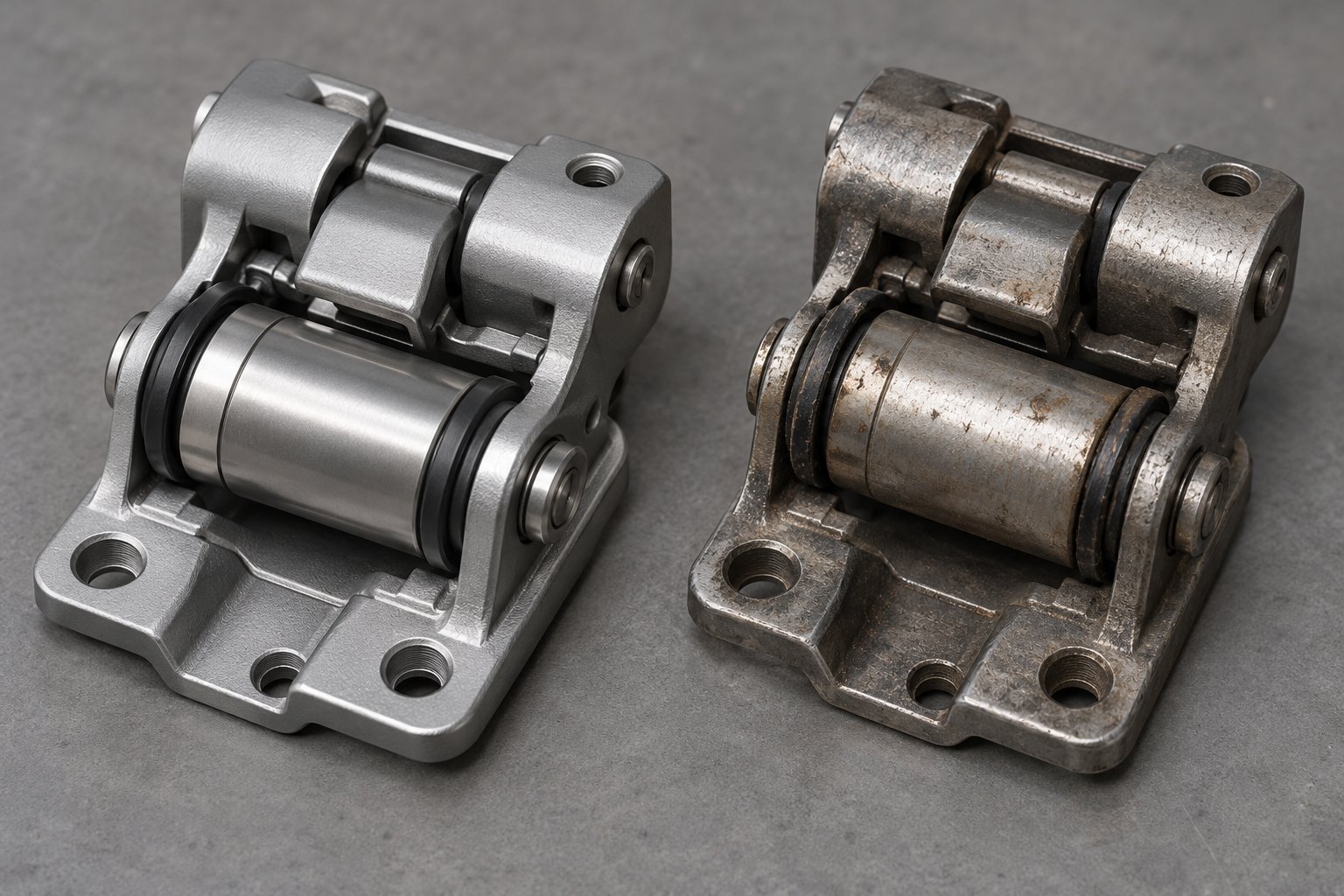
Lifecycle Expectations and Failure Mode Analysis
Specification mistakes cause problems at launch. But even a perfectly specified damping hinge doesn't perform identically on day one and day one thousand. Every mechanical system degrades over time, and dampers are no exception. The difference between a well-managed product lifecycle and a flood of warranty claims often comes down to whether the engineering team understood what "normal aging" looks like for their chosen mechanism - and designed the product around it.
This is the part of the conversation that rarely makes it into product catalogs. Suppliers understandably emphasize peak performance and rated specifications. But engineers need the full picture: how does damping behavior change over tens of thousands of cycles, what does failure actually look like when it arrives, and what's the correct response when a sealed unit stops performing?
Expected Service Life and Performance Degradation
All damping hinges experience gradual performance changes over their operational life. This isn't a quality issue - it's an engineering reality baked into the physics of every mechanism type. The key is understanding which degradation pattern applies to your chosen technology and planning accordingly.
Fluid-based dampers (hydraulic and vane rotary types) degrade primarily through seal wear and microscopic fluid loss. Over thousands of cycles, the elastomeric seals that contain the silicone oil experience compression set and surface abrasion. Even tiny amounts of fluid migration past worn seals reduce the volume of oil available to generate resistance, which gradually lowers the effective damping torque. You'll notice the closing speed of soft closed hinges creeping slightly faster as the product ages - a toilet seat that originally took 5 seconds to close might settle at 3.5 seconds after years of daily use. That shift is normal, but if the original specification didn't account for end-of-life torque reduction, the product may feel "broken" to users long before the damper has actually failed.
Friction-based dampers follow a different degradation curve. Instead of fluid loss, they experience surface wear between the contact materials - polymer washers, metal plates, or composite friction elements. Each rotation removes microscopic material from the contact interface, progressively reducing the clamping force and, with it, the damping resistance. The rate of wear depends heavily on applied load, rotational speed, and the material pairing. Lighter-duty applications like adjustable display arms may retain usable torque for hundreds of thousands of cycles. Heavier applications with frequent cycling will see measurable torque loss much sooner.
Actual service life numbers depend on a matrix of variables: load weight, closing speed, operating temperature, duty cycle frequency, and environmental exposure. Residential appliances like refrigerators can accumulate over 180,000 cycles across a 15-year lifespan, while commercial equipment in high-traffic environments may approach 365,000 cycles in a decade. A damper rated for 50,000 cycles under standard test conditions may or may not survive those real-world demands - which is exactly why understanding the test protocol behind any rated cycle life is so critical.
The practical takeaway? Build your closing-time specification with a degradation margin. If the acceptable closing time ranges from 3 to 6 seconds, specify a damper that starts at the slower end of that window so it remains within range as torque naturally decreases over the product's life.
Failure Modes and Their Root Causes
Degradation is gradual. Failure is the point where performance drops below the threshold of acceptable function - and it doesn't always look the same. The table below maps the most common damping hinge failure symptoms to their likely root causes, giving engineering and service teams a diagnostic starting point when field complaints arrive.
| Failure Mode | Likely Root Cause | Mechanism Most Affected |
|---|---|---|
| Torque Loss - lid or door closes noticeably faster than original performance | Seal degradation or fluid leakage in hydraulic units; surface wear in friction-based units. Excessive gaps between sealing rings and shaft core components are a known contributor in rotary dampers. | Hydraulic, Vane Rotary, Friction |
| Inconsistent Torque - closing speed varies unpredictably from one cycle to the next | Temperature fluctuation causing viscosity shifts in silicone oil; internal contamination from debris ingress; or inadequate damping oil quantity from manufacturing variation | Hydraulic, Vane Rotary |
| Noise During Operation - clicking, grinding, or scraping sounds during rotation | Worn internal components creating metal-to-metal contact; improper mounting allowing the hinge body to shift under load; or debris trapped between moving surfaces | Friction, Hydraulic (when seals fail) |
| Seized Movement - hinge resists or completely blocks rotation | Corrosion of internal metal components; debris ingress past damaged seals; or fluid thickening in extreme cold beyond the damper's rated temperature range | All types (corrosion); Hydraulic and Vane Rotary (cold seizure) |
| Oil Leakage - visible fluid on exterior surfaces | Misalignment of upper cover and shaft core components; seal failure from chemical exposure or thermal cycling beyond rated limits | Hydraulic, Vane Rotary |
A few patterns stand out. Fluid-based mechanisms dominate the failure mode landscape because they have more internal components that can degrade - seals, oil, precision-machined chambers. Friction-based systems have fewer failure modes overall but offer no way to recover lost torque once wear occurs. And corrosion-driven seizure can strike any mechanism type if the housing material and seal specification didn't account for the actual operating environment.
It's also worth noting that not every field complaint represents true damper failure. As the previous section emphasized, loose mounting hardware remains one of the most frequent root causes of perceived malfunction. A damper that tests within spec on the bench but underperforms in the product is often dealing with a mounting system that has lost clamping force - not an internal mechanism that has degraded. The principle applies equally whether you're troubleshooting soft close cabinet hinges in a kitchen renovation or diagnosing a commercial enclosure panel that's suddenly slamming shut.
When Replacement Is the Only Option
Here's the reality that product designers need to internalize early: most sealed rotary dampers and sealed damping hinges are not designed to be field-serviced, disassembled, or refilled. The seal that keeps silicone oil inside the housing is a permanent assembly feature, not a maintenance access point. Once that seal is breached - whether by age, damage, or a well-intentioned technician with a screwdriver - the damper's performance is permanently compromised.
This is fundamentally different from how many other motion control components work. A gas spring can sometimes be recharged. A friction hinge can occasionally be retensioned. But a sealed fluid damper that has lost oil or developed internal wear? Replacement is the correct engineering response. Attempting to "repair" a sealed unit by opening it, adding fluid, or replacing seals typically introduces contamination and misalignment that makes performance worse, not better.
The practical implication is that replacement accessibility should be a first-class design consideration - not an afterthought. If your product uses sealed dampers (and most soft closed hinges in consumer products do), the mounting system should allow the damper unit to be swapped without disassembling the entire hinge assembly or the surrounding product structure. A damper replacement that takes a technician five minutes and a screwdriver is a minor service event. One that requires removing the entire door, drilling out rivets, or accessing hidden fasteners behind panels becomes a warranty cost that scales with every unit in the field.
Think about it from the end user's perspective too. Someone searching for soft close cabinet hinges amazon is often looking to replace a damper that has reached end of life in an existing installation. If the original product was designed with a standard mounting interface and an easily removable damper cartridge, that replacement is a straightforward swap. If the damper is permanently bonded or buried inside a proprietary housing, the entire hinge assembly becomes disposable - increasing waste, cost, and customer frustration.
The same principle scales up to industrial and commercial applications. Equipment designers who anticipate damper replacement during the initial product development phase can standardize on common damper form factors, maintain spare parts inventory efficiently, and document the replacement procedure in service manuals. Those who treat the damper as a permanent, non-serviceable element of the assembly end up fielding calls when the inevitable performance degradation arrives - and discovering that the "simple fix" requires a redesign.
Even in specialized contexts far removed from everyday hinge applications - earthquake damping systems in structural engineering, for instance - the same lifecycle philosophy applies. Components designed to absorb and dissipate energy will eventually degrade under repeated loading. The sophistication isn't in preventing degradation; it's in planning for it.
The lifecycle lesson is clear: specify with degradation in mind, monitor the failure modes your mechanism is most susceptible to, and design your mounting system so that replacing a worn damper is a planned maintenance task rather than an emergency engineering project. That mindset - treating the damper as a consumable component with a defined service life rather than a permanent fixture - is what separates products that age gracefully from products that generate warranty claims.
Selecting the Right Damping Solution for Your Next Design
Mechanisms, comparison tables, specification parameters, datasheet interpretation, failure modes, lifecycle planning - that's a lot of ground to cover before a single component ever ships. But here's the thing: every one of those steps exists to prevent the same outcome. A damper that looks right on the catalog page but feels wrong in the finished product. The engineering teams that consistently avoid that outcome aren't the ones with the biggest budgets or the most exotic components. They're the ones who follow a disciplined selection sequence, every time.
Matching Damping Technology to Application Requirements
Whether you're sourcing a soft closing cabinet hinge for a kitchen line or specifying heavy-duty dampers for industrial enclosures, the decision framework compresses into five steps. Follow them in order, and you'll arrive at your supplier conversation with everything needed to get a matched component on the first round - not the third.
- Define the motion control need. Is the goal speed control during closing, position holding at a set angle, or energy absorption to protect downstream components? This single question determines whether you need a damping hinge, a friction hinge, a gas spring, or something else entirely. Getting it wrong here means solving the wrong problem from the start.
- Select the appropriate damping mechanism. Match the mechanism to your torque consistency requirements, expected temperature range, and cycle life targets. Hydraulic and vane rotary dampers deliver smooth, repeatable torque curves in thermally stable environments. Friction-based designs handle wide temperature swings with less variability. Magnetic options offer maintenance-free longevity at a premium. Spring-loaded systems cover budget applications where precise motion control is secondary.
- Specify all critical parameters before approaching suppliers. Torque range, angular operating range, physical envelope, operating temperature, cycle life under realistic loads, material compatibility, and configurable vs. fixed torque. Every parameter left undefined becomes a variable the supplier must guess at - and guesses don't survive production.
- Validate datasheet claims against your actual operating conditions. A rated torque at 23°C and 20 RPM may not reflect what happens at 5°C or 45°C in your product's real environment. Request performance data at the extremes of your operating range. If torque curves and temperature-dependent data aren't available, that gap should factor into your supplier evaluation. Slow close hinges for kitchen cabinets near ovens and soft close hidden hinges in outdoor enclosures face very different thermal realities than lab conditions suggest.
- Design for eventual replacement of sealed damper units. Sealed dampers degrade. That's not a defect - it's a physical certainty. Products designed with accessible, swappable damper mounting points turn end-of-life replacement into a five-minute service task instead of an engineering emergency. Teams searching for amazon soft close hinges as replacements already know this frustration firsthand - the easier you make the swap, the longer your product stays in service and out of the waste stream.
Engineering Resources for Configurable Vane Dampers
For engineering teams working on soft-close applications - particularly toilet seat designs - where configurable torque and compact diameter are priorities, Tianyun's vane rotary dampers offer a practical starting point. Their product line is built specifically for manufacturers and product engineers, providing controlled soft-close motion with selectable torque and diameter options that allow teams to match damping performance to their specific seat geometry and weight.
This configurability is especially relevant during prototyping. Imagine iterating through three different seat lid weights across a product family. With a fixed-torque damper, each variant potentially requires a different component, a different supplier conversation, and a different lead time. With a configurable vane damper platform, the team adjusts torque settings within the same damper family - compressing development timelines without sacrificing the precision of the final closing feel. That flexibility extends into production, where a single damper platform serving multiple SKUs simplifies inventory, procurement, and quality control.
Engineers evaluating their options can explore Tianyun's vane damper product page for detailed specifications, configurable parameter ranges, and application guidance tailored to soft-close integration.
The best damping hinge is the one specified correctly before production begins - not the one adjusted after complaints arrive.
Frequently Asked Questions About Damping Hinges
1. What is the difference between a damping hinge and a soft-close hinge?
A damping hinge is the broader engineering term for any hinge that uses controlled resistance - hydraulic fluid, friction, or magnetic force - to decelerate rotational movement. A soft-close hinge is a specific application of damping technology focused on the final closing stage, slowing the last degrees of travel so a door or lid settles gently instead of slamming. Some products marketed as soft-close actually use friction-based drag rather than true fluid damping, so checking the mechanism type is important when performance consistency and longevity matter.
2. How does temperature affect damping hinge performance?
Temperature directly impacts fluid-based damping hinges because silicone oil viscosity changes with heat and cold. As temperatures rise, the oil thins and produces less resistance, causing faster closing speeds. In cold conditions, the oil thickens and closing slows noticeably. A damper tuned for a perfect close at 23°C may feel sluggish at 5°C or too fast at 45°C. Engineers should always specify the full operating temperature range and request torque data at both extremes. Friction-based and magnetic damping mechanisms are far less sensitive to temperature variation, making them better suited for environments with wide thermal swings.
3. How long do damping hinges last before they need replacement?
Service life varies significantly depending on the mechanism type, applied load, closing speed, temperature, and duty cycle. Fluid-based dampers commonly achieve 50,000 or more cycles under standard test conditions at 20°C, while residential appliances can accumulate over 180,000 cycles across a 15-year lifespan. Friction-based dampers degrade through surface wear, with lighter-duty applications lasting hundreds of thousands of cycles. Always verify the test protocol behind any rated cycle life - the load, speed, temperature, and pass/fail torque retention criteria - and compare those conditions against your real-world application before relying on the number.
4. Can a sealed damping hinge be repaired or adjusted in the field?
In most cases, no. Sealed rotary dampers and sealed damping hinges are designed as install-and-forget units. The internal seals that contain silicone oil are permanent assembly features, not maintenance access points. Opening a sealed damper introduces contamination and misalignment that worsens performance. When a sealed unit reaches end of life, replacement is the correct engineering response. Many perceived damper failures are actually caused by loose mounting hardware - screws, brackets, or hinge pins that have worked free over time - so checking fastener tightness should always be the first troubleshooting step before replacing the damper itself.
5. What specifications should I provide when ordering damping hinges from a supplier?
Start with the required torque range in Newton-meters, the angular operating range in degrees, and the physical envelope constraints including diameter and length. Then define the operating temperature range, required cycle life under realistic load conditions, and any material or environmental compatibility needs such as moisture, UV, or chemical exposure. Beyond raw numbers, provide application context: the mass and dimensions of the moving element, desired closing time in seconds, and installation geometry. Suppliers like Tianyun, who offer configurable vane rotary dampers at tianyuntech.com/vane-damper, use this application-level detail to recommend torque and diameter configurations matched to specific product designs - especially useful for toilet seat manufacturers iterating across multiple seat weights.
Apply This Insight to Your Project
Tell us what you are building and how the topic “Damping Hinges Decoded: From Spec Sheet to Flawless Motion Control” relates to your application. Our engineering team can help evaluate the next step.